Introduction
Stable cell lines are widely used for recombinant protein and antibody production, drug screening, gene function
studies, and other applications. They can grow continuously for long periods of time and stably carry genetic
modifications or express transgenes without significant changes in expression levels. There are two main ways to
prepare recombinant proteins in industry: transient transfection and stable transfection. Transient transfection is
often used to prepare small amounts of protein (up to the gram scale) for protein activity or animal testing early
in drug development. Unlike transient transfection, stable cell lines are constructed for the industrial production
of therapeutic proteins. Stable cell lines require the ability to produce the same quality product at different
times, at different sites, and between batches. However, after several passages of cell lines, genetic instability
may occur. Therefore, it is of great significance to verify whether the N-terminal methionine and signal peptide of
the protein products are correctly processed during the establishment and fermentation of cell lines.
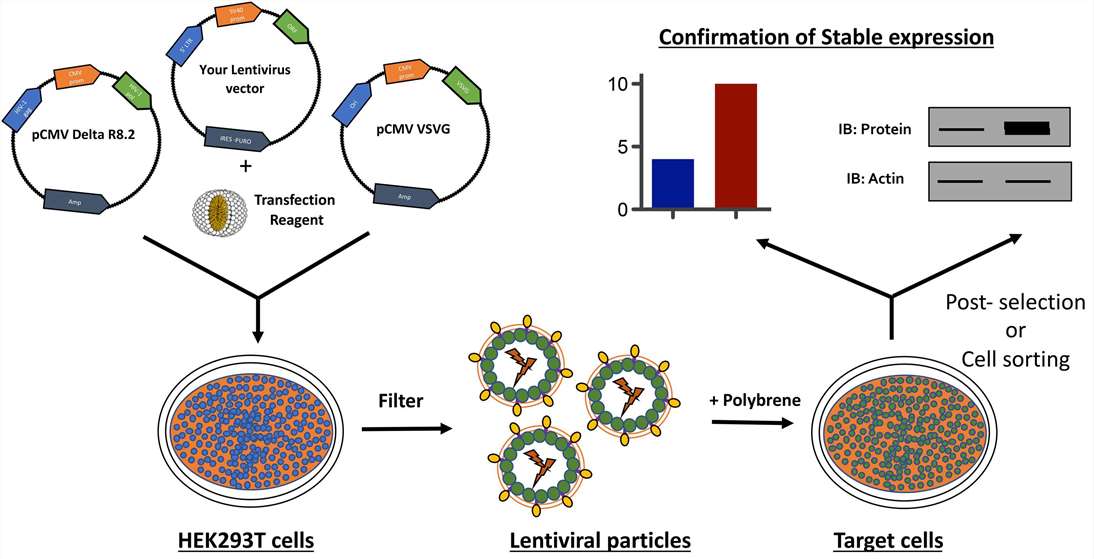 Fig. 1. Schematic
representation of generation of stable cell lines using lentivirus. (Tandon N, et al., 2018)
Fig. 1. Schematic
representation of generation of stable cell lines using lentivirus. (Tandon N, et al., 2018)
Our Services
Creative Proteomics has been devoted to the research of recombinant protein expression and
preparation for many years. The analysis process of the purified product of recombinant protein expression (cell
line construction and fermentation) requires confirmation of the N-terminal sequence of the protein. Relying on the
company's existing Edman sequencing system, Creative Proteomics' experienced technicians
can provide high-quality protein N-terminal sequencing services for researchers and scientific research customers.
Edman degradation method that we provided can accurately determine protein N-terminal up to 60-70 amino acids
Sequence, this method can label and cleave peptides from the N-terminus without breaking the peptide bonds between
other amino acid residues, and accurately identify the N-terminal methionine and signal of protein products during
cell line establishment and fermentation Whether the peptide is processed correctly.
Advantages of Our Services
- High sensitivity in detecting PTH-AA at low picomole level.
- Analyze N-Terminal 60-70 amino acids.
- Accurately discriminate amino acids of high similarity, i.e. I/L, and Q/K.
Sample Requirements
Purified proteins (dissolved in or lyophilized from low-salt buffers) or SDS-PAGE bands blotted onto PVDF are
suitable. A minimum of 25 pmol of protein (five steps) is required, more is strongly recommended for improved signal
quality.
Creative Proteomic provides global customers with professional validation of cell line expression
products services, which could be used to verify whether the N-terminal methionine and signal peptides of protein
products are correctly processed during cell line establishment and fermentation. At Creative
Proteomics, our highly qualified team works with our customers stand together on the front lines to
help you solve tough research challenges. If you are interested in our services, please contact us immediately.
References
- Geraghty R J, Davis A C, Davis J M, et al. (2014) Guidelines for the use of cell lines in biomedical
research. Br J Cancer. 111(6):1021-46.
- Dumont J, Euwart D, Mei B, et al. (2016) Human cell lines for biopharmaceutical manufacturing: history,
status, and future perspectives. Crit Rev Biotechnol. 36(6):1110-1122.