
Stability Studies Service
Creative Proteomics provides stability study services for nucleic acid drugs to evaluate how drug substances and formulated products respond to storage, handling, biological, and stress-related conditions. These studies are designed to assess stability risks that may affect molecular integrity, degradation profiles, formulation consistency, and key quality-related attributes during nucleic acid therapeutic development. Our services cover multiple stability assessment scenarios, including thermal stability, serum stability, freeze-thaw stability, and forced degradation studies. By combining well-defined sample treatment conditions with appropriate chromatographic, electrophoretic, mass spectrometry, particle characterization, and formulation-related assays, we help generate stability-relevant analytical data tailored to different nucleic acid formats and development stages.
Request a Custom Phosphorylation Analysis PlanIn line with ICH Q6B Guidance for biologic characterization
Jump to Section
- Why Stability Matters
- Analytical Capabilities
- Development Scenarios
- Service Advantages
- Instrument Platform
- Analysis Workflow
- Case Study
- FAQs
- References
Why Stability Matters
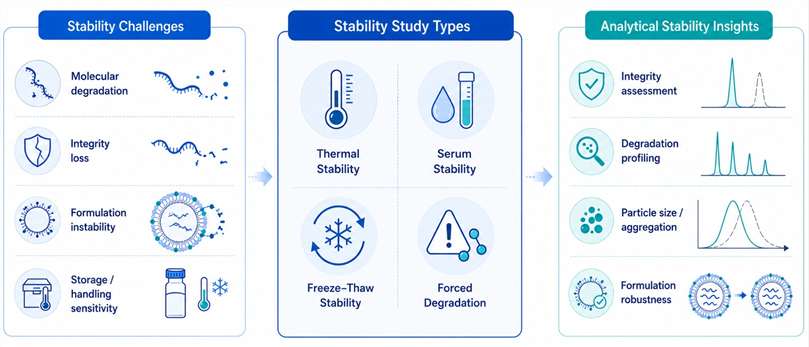
Stability studies are controlled analytical evaluations used to determine how nucleic acid drug substances and formulated drug products change after exposure to predefined conditions. Rather than relying on a single endpoint, these studies examine whether key molecular, structural, and formulation-related attributes remain consistent or show measurable changes during a defined study period. For RNA, oligonucleotides, and nucleic acid-based formulations, stability assessment is especially important because product quality may be affected at multiple levels. Full-length product retention, degradation-related species, impurity profile shifts, particle size changes, aggregation, and formulation integrity may each provide different information about product behavior under storage, handling, biological, or stress-related conditions.
Together, these considerations make stability studies essential for understanding how nucleic acid drug products respond to real-world and stress-related conditions during development.
- Nucleic acid drugs are highly sensitive to stability-related changes
RNA, oligonucleotides, and formulated nucleic acid products may undergo molecular or formulation-level changes during development, storage, transport, or handling. Stability studies help determine whether these changes occur under controlled and relevant study conditions. - Different study conditions can reveal different stability risks
A product that appears stable under one condition may show measurable changes under another. Evaluating stability under defined thermal, biological, freeze-thaw, or stress-related conditions provides a broader understanding of product behavior. - Molecular integrity and formulation performance may not change in parallel
For formulated nucleic acid drug products, the nucleic acid molecule and the delivery system can respond differently to the same condition. Assessing both levels helps avoid relying on only one part of the product profile. - A single analytical readout may not capture all relevant changes
Stability-related changes may appear in different forms, such as altered integrity profiles, new degradation-related signals, or formulation-related shifts. Using appropriate and complementary readouts helps provide a more reliable stability assessment. - Early stability evaluation reduces development uncertainty
Detecting potential stability liabilities early can help guide analytical planning and reduce the risk of unexpected quality issues during later development stages.
Stability Studies at Creative Proteomics
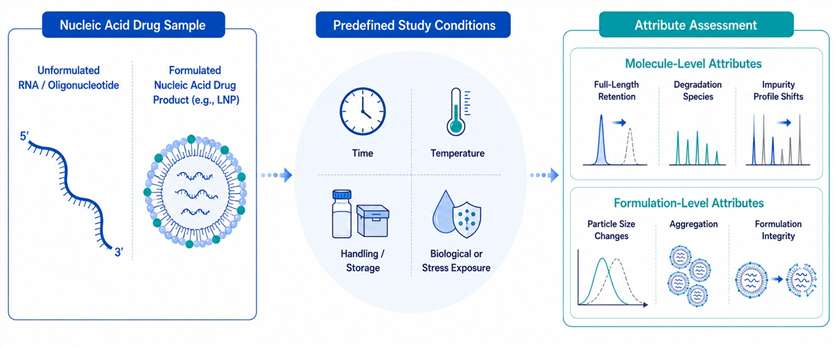
Creative Proteomics provides integrated stability study services for nucleic acid drug substances and formulated drug products, covering study design, controlled sample treatment, analytical method selection, and stability-related data interpretation.
| Stability Study Focus | Analytical Strategy | Key Information Delivered |
| Thermal Stability | Evaluation of nucleic acid drug substances or formulated products under defined temperature exposure conditions, with chromatographic, electrophoretic, mass spectrometry, particle characterization, or formulation-related assays selected as appropriate | Temperature-related changes in molecular integrity, full-length product retention, degradation-related species, impurity profile shifts, particle size, aggregation tendency, or formulation consistency when applicable |
| Serum Stability | Incubation of nucleic acid samples in serum or other agreed biologically relevant matrices, followed by fit-for-purpose analysis of intact product retention, degradation behavior, and matrix-associated stability changes. | Stability behavior in biological matrices, nuclease- or matrix-associated degradation trends, intact product retention, and time-dependent molecular stability information. |
| Freeze-Thaw Stability | Assessment of nucleic acid drugs or formulated products after controlled freeze-thaw cycles, with analytical readouts selected according to molecule-level and formulation-level stability concerns | Effects of repeated freezing and thawing on molecular integrity, particle size distribution, aggregation tendency, encapsulation- or formulation-related changes, and handling-related product robustness when applicable |
| Forced Degradation Studies | Exposure of nucleic acid drug candidates or formulated products to selected chemical, physical, or environmental stress conditions to evaluate degradation behavior and support stability-related analytical planning | Degradation behavior under defined stress conditions, potential degradation-related species, impurity profile changes, stress-condition sensitivity patterns, and information to support stability-indicating method selection or development |
Applications of Stability Studies Service
Stability studies can be applied across nucleic acid drug development to support formulation evaluation, condition selection, analytical method planning, and quality-related comparison.
- Formulation screening and comparison
Compare stability profiles across candidate formulations to support the selection of more robust nucleic acid drug product designs. - Storage, transport, and handling condition evaluation
Assess product behavior under defined storage, transport, thawing, or handling conditions to support practical development and product management decisions. - Biological stability assessment
Evaluate nucleic acid stability in serum, plasma, or other biologically relevant matrices to understand matrix-associated degradation behavior. - Stability-indicating analytical method support
Generate condition-related analytical profiles that can help guide the selection or optimization of methods used to monitor stability-related changes. - Comparability and quality-related evaluation
Support comparison of different batches, formulations, storage conditions, or process conditions based on molecular and formulation-level stability readouts.
Advantages of Our Stability Studies Service
- Integrated molecule- and formulation-level assessment: Our stability study design can combine nucleic acid integrity analysis with formulation-related characterization, helping capture changes at both the molecular and drug product levels when applicable.
- Flexible study design for different nucleic acid formats: Study conditions, time points, stress settings, and analytical readouts can be adjusted for RNA, oligonucleotides, chemically modified nucleic acids, and formulated nucleic acid drug products.
- Orthogonal analytical strategy: We integrate complementary chromatographic, electrophoretic, mass spectrometry, particle characterization, and formulation-related assays to support more reliable stability evaluation.
- Condition-specific analytical planning: Analytical methods are selected according to the intended stability scenario, such as temperature exposure, biological matrix incubation, freeze-thaw handling, or accelerated stress conditions.
- Development-stage appropriate reporting: Data interpretation can be tailored to early screening, formulation comparison, method development, or quality-related assessment, supporting clear decision-making without overextending beyond the project scope.
- Experienced scientific support: Our scientific team provides support for study planning, analytical method selection, data review, and interpretation of stability-related results based on the sample type and project objective.
Stability Studies Platforms
Creative Proteomics supports nucleic acid drug stability studies using fit-for-purpose chromatographic, electrophoretic, mass spectrometry, particle characterization, and fluorescence- or formulation-related analytical platforms, with platform selection tailored to the sample type, stability condition, and target readouts.
- Thermo Scientific Q Exactive Plus Hybrid Quadrupole-Orbitrap Mass Spectrometer
High-resolution accurate mass analysis for molecular integrity assessment, degradation-related species investigation, and MS/MS-supported characterization of selected nucleic acid changes when applicable. - Agilent 1260 Infinity II HPLC System
HPLC-based separation for stability-related profiling, intact product assessment, impurity monitoring, and chromatographic comparison of treated and reference samples. - Waters ACQUITY UPLC H-Class System
High-efficiency UPLC separation for stability-related impurity profiling, degradation product monitoring, and improved resolution of closely related nucleic acid species. - SCIEX PA 800 Plus Pharmaceutical Analysis System
Capillary electrophoresis platform for orthogonal integrity assessment, size- or charge-related profiling, and electrophoretic comparison of nucleic acid samples under defined stability conditions. - Thermo Scientific Varioskan LUX Multimode Microplate Reader
Multimode plate reader for fluorescence-, absorbance-, or plate-based assays used to support selected nucleic acid retention, matrix stability, or formulation-related readouts. - Zetasizer Nano ZS90
DLS and zeta potential analysis platform for particle size, PDI, aggregation tendency, and surface charge assessment of formulated nucleic acid drug products such as LNP-based systems.

Workflow of Stability Studies
- 1
Study Design
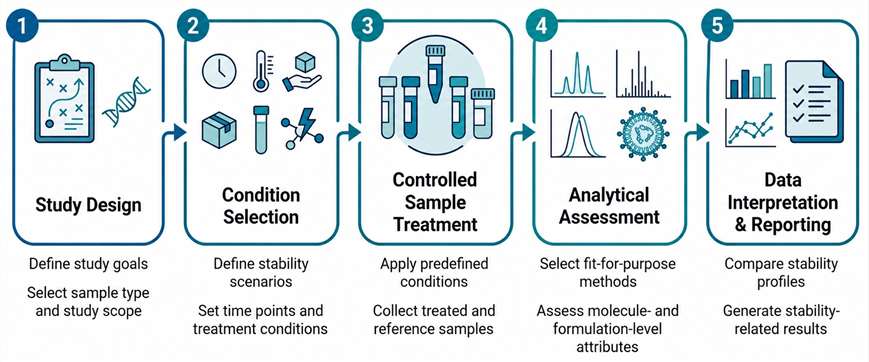
We begin by reviewing the nucleic acid type, formulation format, available sample information, intended stability question, and development-stage objective. This step helps define whether the study should focus on molecular integrity, degradation behavior, formulation stability, storage or handling sensitivity, biological stability, or stress-related degradation.
- 2
Condition Selection
Based on the project objective, we select appropriate stability scenarios and define the study conditions. These may include temperature exposure, serum or biological matrix incubation, repeated freeze-thaw cycles, or selected forced degradation conditions. Time points, control groups, reference samples, and treatment settings are planned according to the study scope and available material.
- 3
Controlled Sample Treatment
Samples are prepared and treated under predefined conditions using controlled and traceable procedures. Treated samples and corresponding reference or control samples are collected at designated time points to support meaningful comparison across stability conditions.
- 4
Analytical Assessment
Fit-for-purpose analytical methods are selected according to the nucleic acid format, formulation type, and target readouts. Depending on the study design, assessment may include chromatographic profiling, electrophoretic analysis, mass spectrometry-based characterization, particle size analysis, aggregation assessment, fluorescence-based assays, or other formulation-related readouts.
- 5
Data Interpretation and Reporting
Results from different analytical readouts are integrated to evaluate stability-related changes in molecular integrity, degradation profiles, impurity patterns, particle behavior, formulation consistency, or other project-specific quality attributes. The final report summarizes study conditions, methods, representative data, key observations, and stability-related interpretation based on the agreed project scope.
Case Study: Stability Assessment of mRNA-LNPs under Storage and Handling Stress
mRNA-LNP formulations require stability evaluation at both the nucleic acid payload and nanoparticle formulation levels. In a 2022 study published in Pharmaceutics, Kamiya et al. used an MC3-based mRNA-LNP model system to investigate how practical storage and handling conditions affect particle properties, retained mRNA, and expression-related performance.
Key findings:
- Storage at −80 °C without cryoprotectant markedly increased particle size and PDI, indicating formulation-level instability under this frozen-storage condition.
- mRNA retention decreased after −80 °C storage without cryoprotectant, showing that storage conditions can affect both nanoparticle properties and mRNA-associated readouts.
- Addition of sucrose under −80 °C frozen-storage conditions improved particle properties and mRNA retention compared with frozen storage without sucrose.
- The original study further linked physicochemical instability with reduced luciferase expression, suggesting that formulation-level changes may translate into altered expression performance.
- Agarose gel analysis of selected samples showed comparable mRNA migration positions after no exposure, light exposure, and −80 °C storage, highlighting the need to combine molecular integrity assays with formulation-level characterization.
These findings demonstrate the importance of multi-readout stability assessment for formulated nucleic acid drug products. For mRNA-LNPs, storage and handling conditions may affect particle behavior, retained mRNA, and expression-related performance in different ways, making complementary analytical evaluation essential for stability study design.
Source
Kamiya M.; et al. Stability Study of mRNA-Lipid Nanoparticles Exposed to Various Conditions Based on the Evaluation between Physicochemical Properties and Their Relation with Protein Expression Ability. Pharmaceutics. 2022, 14(11):2357. doi: 10.3390/pharmaceutics14112357
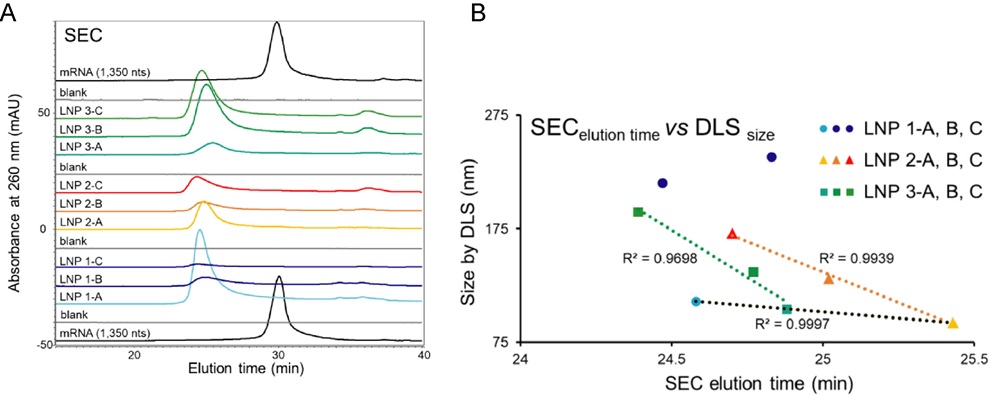
Figure adapted from Table 2 of Kamiya et al. (2022) showing storage temperature-dependent changes in mRNA-LNP particle size, PDI, and mRNA retention after 7 days of storage (CC BY 4.0).
FAQs of Stability Studies
What types of nucleic acid drugs can be evaluated in stability studies?
Stability studies can be designed for unformulated nucleic acid drug substances and formulated drug products, including RNA-based molecules such as mRNA, siRNA, and guide RNA; synthetic oligonucleotides such as antisense oligonucleotides and chemically modified oligonucleotides; and formulated nucleic acid products such as LNP-based systems. The study design and analytical readouts are selected according to the nucleic acid type, formulation format, and development objective.
How do I choose the appropriate stability study type?
The choice depends on the stability question being addressed. Thermal stability studies are useful for evaluating temperature-related changes, serum stability studies assess behavior in biological matrices, freeze-thaw studies examine handling-related robustness, and forced degradation studies are commonly used to explore degradation behavior under accelerated stress conditions. For complex projects, multiple study types may be combined.
Can both molecular stability and formulation stability be assessed?
Yes. For unformulated nucleic acid samples, the study may focus mainly on molecular integrity, intact product retention, degradation-related species, and impurity profile changes. For formulated products, additional readouts such as particle size distribution, aggregation, encapsulation- or formulation-related changes, and product consistency can be included when applicable.
What analytical methods are used for nucleic acid drug stability studies?
The analytical platform depends on the sample and study objective. Commonly used methods include HPLC/UPLC, LC-MS or LC-MS/MS, capillary electrophoresis, gel-based assays, fluorescence-based assays, DLS, NTA, and other formulation-related characterization methods. Orthogonal methods may be recommended when a single assay cannot fully capture relevant stability changes.
Can stability study conditions be customized?
Yes. Study conditions such as temperature, incubation time, freeze-thaw cycle number, biological matrix, stress condition, sampling time points, and analytical endpoints can be adjusted based on the product format and project goal. Customized study design is especially useful for early formulation comparison, method development, and project-specific quality evaluation.
How much sample is required for a stability study?
Sample requirements depend on the nucleic acid type, formulation format, number of study conditions, time points, replicates, and analytical platforms involved. As a general starting point, focused molecular-level stability profiling may require approximately 20–100 µg of purified nucleic acid per sample set when available. Multi-condition or multi-time-point studies, formulated product characterization, particle analysis, or orthogonal method combinations may require higher sample amounts, often from several hundred micrograms to milligram-level total material depending on the study design. Specific sample requirements should be confirmed based on the experimental objective and final analytical plan. Please contact us for project-specific sample recommendations.
What is the typical turnaround time?
Turnaround time depends on study complexity. Focused single-condition or short-term studies may typically require about 1–2 weeks after sample receipt and method confirmation. Multi-condition studies, longer incubation designs, forced degradation studies, formulation-level characterization, or projects requiring multiple orthogonal methods may require several weeks. Project-specific timelines can be provided after reviewing the sample type and study scope.
Can the results support quality evaluation or method development?
Yes. Stability study results can support quality-related assessment, formulation comparison, storage and handling evaluation, and stability-indicating analytical method development. However, the regulatory use of the data depends on the assay design, validation status, product stage, and intended application. For formal QC or release testing, method validation may be required.
References
- Kamiya M, et al. Stability Study of mRNA-Lipid Nanoparticles Exposed to Various Conditions Based on the Evaluation between Physicochemical Properties and Their Relation with Protein Expression Ability. Pharmaceutics. 2022, 14(11):2357.
- Schoenmaker L, et al. mRNA-lipid nanoparticle COVID-19 vaccines: Structure and stability. Int J Pharm. 2021, 601:120586.
For Research Use Only. Not for diagnostic procedures.