
Comparative Analysis Service
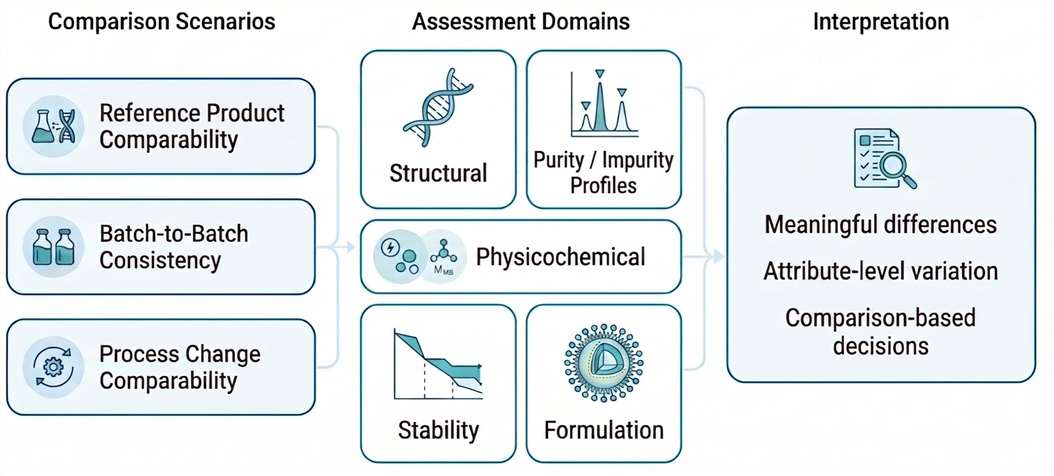
Creative Proteomics provides comparative analysis services for nucleic acid therapeutics and related formulations to support side-by-side evaluation of quality attributes across product development and manufacturing. These services help place analytical results into a comparative context, allowing clients to identify meaningful product differences, assess quality consistency, and understand how formulation or process variables may affect product attributes. Our comparative analysis services cover three major comparison scenarios: reference product comparability, batch-to-batch consistency assessment, and process change comparability. By selecting fit-for-purpose analytical readouts according to the comparison objective and development stage, Creative Proteomics helps support formulation screening, process optimization, manufacturing control, and QC-related evaluation.
Request a Custom Phosphorylation Analysis PlanIn line with ICH Q6B Guidance for biologic characterization
Jump to Section
- Why Comparative Analysis Matters
- Analytical Capabilities
- Development Scenarios
- Service Advantages
- Instrument Platform
- Analysis Workflow
- Case Study
- FAQs
- References
Why Comparative Analysis Matters
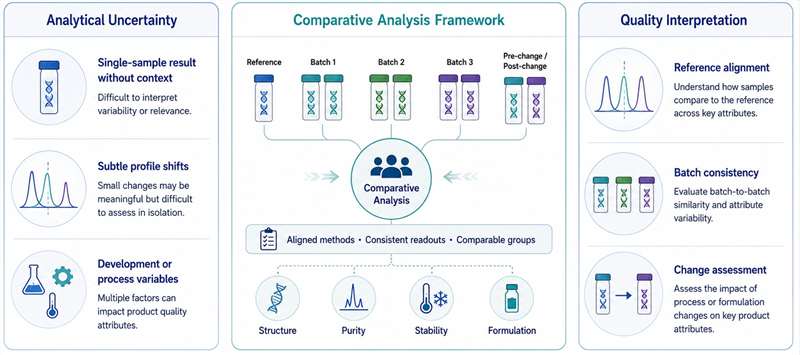
Comparative analysis provides a structured way to evaluate nucleic acid therapeutic samples under aligned analytical conditions. Instead of interpreting a single dataset in isolation, it compares analytical profiles, quantitative readouts, and attribute-specific patterns across defined sample groups, such as reference and test samples, multiple batches, or pre-change and post-change materials. For nucleic acid therapeutics and related formulations, this approach helps place structural, purity-related, physicochemical, stability-related, and formulation-associated attributes into a clear comparative context.
This comparative context is especially important when analytical differences are subtle, multi-dimensional, or dependent on the intended development and quality evaluation objective.
- Single-sample data may lack sufficient context
An individual analytical result can describe a product at one point in development, but it may not show whether the observed profile is expected, shifted, or meaningfully different from a relevant comparator or historical baseline. - Small analytical differences require careful interpretation
Minor changes in chromatographic profiles, impurity patterns, particle behavior, or stability-indicating signals may reflect normal variability, method-related fluctuation, or product-related changes. Comparative analysis helps clarify whether these differences are relevant to the intended evaluation. - Product quality often depends on multiple connected attributes
For nucleic acid drugs and formulated products, changes in structure, purity, degradation, particle properties, encapsulation-related features, or stability may not occur in parallel. A comparative framework supports more objective interpretation across multiple quality-related readouts. - Defined comparison logic supports development and quality decisions
Using consistent sample grouping, matched analytical methods, standardized data processing, and clear comparison metrics helps development, analytical, CMC, and quality teams review results using the same evidence structure.
Comparative Analysis at Creative Proteomics
Creative Proteomics offers customizable comparative analysis services for nucleic acid therapeutics and related formulations, covering study design, analytical testing, data comparison, and result interpretation according to the selected comparison objective.
| Comparative Focus | Analytical Strategy | Key Information Delivered |
| Reference Product Comparability | Side-by-side comparison of test samples and reference products or benchmark materials using fit-for-purpose analytical readouts to assess alignment across relevant quality attributes | Comparative evidence for product similarity, including differences in structural features, purity-related profiles, physicochemical properties, stability-indicating attributes, and formulation-associated characteristics |
| Batch-to-Batch Consistency | Multi-attribute comparison of development or manufacturing batches using matched analytical methods to evaluate whether product profiles remain consistent across lots | Batch-related consistency information, including variation in key product attributes, identification of out-of-trend analytical signals, and data support for batch quality evaluation |
| Process Change Comparability | Comparative assessment of pre-change and post-change samples after process, formulation, raw material, or scale-related modifications to determine whether product attributes remain comparable | Analytical evidence showing whether process-related changes are associated with shifts in critical product characteristics, supporting internal evaluation of process impact and comparability |
Applications of Comparative Analysis Services
Comparative analysis is widely used in nucleic acid therapeutic development and manufacturing to evaluate product quality across candidate designs, preparation conditions, handling environments, and manufacturing-related changes.
- Candidate and formulation screening
Comparing different sequence designs, chemical modification patterns, buffer systems, delivery formulations, or LNP-based formulation options to support candidate selection. - Development condition comparison
Evaluating samples prepared under different synthesis, purification, concentration, buffer exchange, or preparation conditions to compare whether product profiles remain consistent or show condition-related changes. - Storage, handling, and shipping condition comparability
Comparing samples exposed to different temperature, freeze-thaw, light, agitation, or transport-related conditions to assess whether product quality remains comparable across handling environments. - Scale transition comparison
Comparing small-scale, pilot-scale, or manufacturing-scale materials to assess whether scale transition is associated with changes in product quality profiles. - Out-of-trend or atypical sample investigation
Comparing an atypical sample with representative control or historical materials to help determine whether altered impurity patterns, degradation signals, particle behavior, or profile shifts are sample-specific or condition-related. - Development-stage CMC documentation support
Organizing comparative analytical evidence to support formulation discussions, process evaluation, internal quality review, and development-stage CMC preparation.
Advantages of Our Comparative Analysis Services
- Flexible Study Configuration: Comparative studies can be adjusted according to sample type, comparator selection, project stage, and the level of analytical depth required.
- Integrated Analytical Capability: Multiple analytical platforms can be combined when needed to generate complementary evidence for nucleic acid drug substance and formulated product evaluation.
- Broad Coverage of Nucleic Acid Modalities: The service is suitable for oligonucleotides, siRNA, ASO, mRNA, modified RNA, nucleic acid conjugates, and LNP-formulated nucleic acid products.
- Stage-Appropriate Analytical Strategy: Analytical plans can be adapted for early formulation screening, process development, manufacturing optimization, or QC-related assessment without overcomplicating the study design.
- Clear and Practical Result Presentation: Results are organized in a format that supports efficient review by development, analytical, CMC, and quality teams.
- Experienced Scientific Support: Our scientific team provides technical guidance on comparator selection, analytical strategy, result interpretation, and follow-up study planning based on the specific project requirements.
Comparative Analysis Platforms
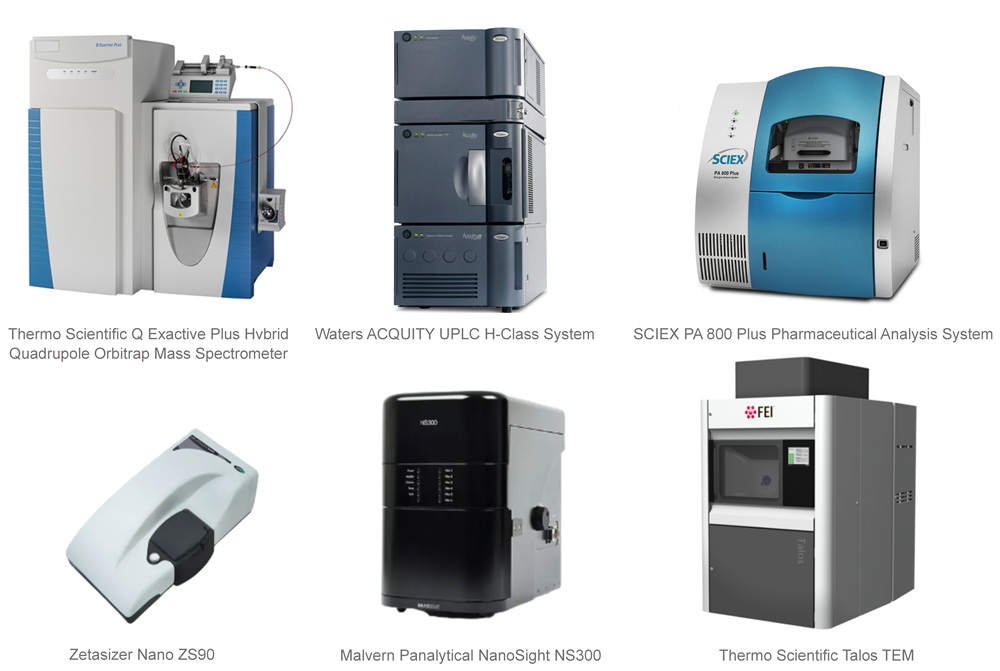
Creative Proteomics integrates molecular, separation-based, electrophoretic, and formulation-related analytical platforms to support comparative analysis of nucleic acid therapeutics and related formulations.
- Thermo Scientific Q Exactive Plus Hybrid Quadrupole-Orbitrap Mass Spectrometer
High-resolution accurate mass analysis for molecular integrity assessment, degradation-related species investigation, and MS/MS-supported characterization of selected nucleic acid modifications or sequence-related changes when applicable. - Waters ACQUITY UPLC H-Class System
High-efficiency UPLC separation for purity and impurity profiling, degradation product monitoring, and improved resolution of closely related nucleic acid species across comparison groups. - SCIEX PA 800 Plus Pharmaceutical Analysis System
Capillary electrophoresis platform for orthogonal integrity assessment, size- or charge-related profiling, and electrophoretic comparison of nucleic acid samples under matched analytical conditions. - Zetasizer Nano ZS90
DLS and zeta potential analysis platform for particle size, PDI, aggregation tendency, and surface charge assessment of formulated nucleic acid drug products such as LNP-based systems. - Malvern Panalytical NanoSight NS300
Nanoparticle tracking analysis platform for particle size distribution and particle concentration assessment of LNP-formulated or other particle-based nucleic acid products, supporting batch, formulation, and condition-related comparison. - Thermo Scientific Talos TEM
Transmission electron microscopy platform for visual assessment of particle morphology, size heterogeneity, aggregation, and formulation-associated structural features when morphological comparison is required.
Workflow of Comparative Analysis
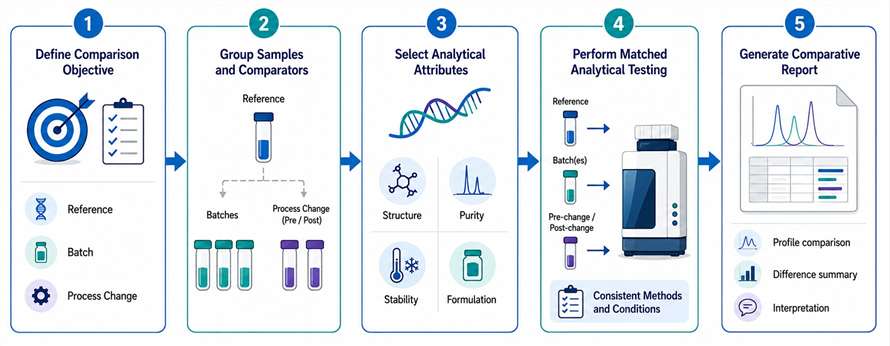
- 1
Define the Comparison Objective
The study begins by clarifying the intended comparison scenario, such as reference product comparability, batch-to-batch consistency, or process change comparability. This step helps determine the sample groups, analytical depth, and reporting focus.
- 2
Group Samples and Comparators
Test samples, reference materials, batch groups, or pre-change and post-change samples are organized according to the comparison objective. Clear sample grouping helps ensure that analytical results can be interpreted in the correct comparative context.
- 3
Select Relevant Analytical Attributes
Fit-for-purpose attributes are selected based on the nucleic acid modality, formulation type, and project stage. These may include structural features, purity and impurity profiles, physicochemical properties, stability-indicating changes, and formulation-associated attributes.
- 4
Perform Matched Analytical Testing
Samples are analyzed using consistent analytical methods, matched testing conditions, and standardized data acquisition procedures. When needed, multiple platforms can be combined to generate complementary evidence across molecular, separation-based, electrophoretic, and formulation-related readouts.
- 5
Generate Comparative Report
Results are organized into side-by-side profiles, attribute comparison tables, difference summaries, and scientific interpretation. The final report helps clients understand whether observed differences are expected, sample-specific, batch-related, or associated with formulation or process changes.
Case Study: Multi-Attribute Comparative Assessment of LNP-RNA Batch Variability
LNP-RNA therapeutics are complex formulated products whose quality can be influenced by lipid composition, RNA loading, particle properties, structural features, and functional activity. In this study, Parot et al. evaluated two LNP-mRNA formulations and three batches of the same SM-102-based LNP formulation using orthogonal analytical techniques. The study provides a practical example of how comparative analysis can be used to assess batch-related variability across multiple quality-related readouts.
Key findings:
- Composition analysis showed that the three LNP2 batches differed in RNA loading and lipid/RNA ratio, with LNP2–2 and LNP2–3 showing reduced RNA content relative to lipid content.
- Multi-method particle size analysis using DLS, MADLS, NTA, and AUC revealed batch-related differences in particle distribution, including broader particle profiles and a larger particle population in LNP2–3.
- Orthogonal physical characterization helped distinguish batch-level differences that were not fully captured by a single particle sizing method.
- Functional luciferase expression analysis showed that LNP2-1 produced the highest expression, while LNP2-2 showed reduced expression and LNP2-3 showed nearly negligible expression.
- The combined results indicated that composition, particle-related properties, and functional activity should be interpreted together when evaluating LNP-RNA batch consistency.
This study highlights the importance of multi-attribute comparative analysis for evaluating batch-to-batch variability in LNP-RNA formulations. By combining composition analysis, orthogonal particle characterization, and functional activity testing, batch-related differences can be assessed more clearly than by relying on a single analytical readout.
Source
Parot J.; et al. Quality assessment of LNP-RNA therapeutics with orthogonal analytical techniques. Journal of Controlled Release. 2024, 367:385-401. doi: 10.1016/j.jconrel.2024.01.037
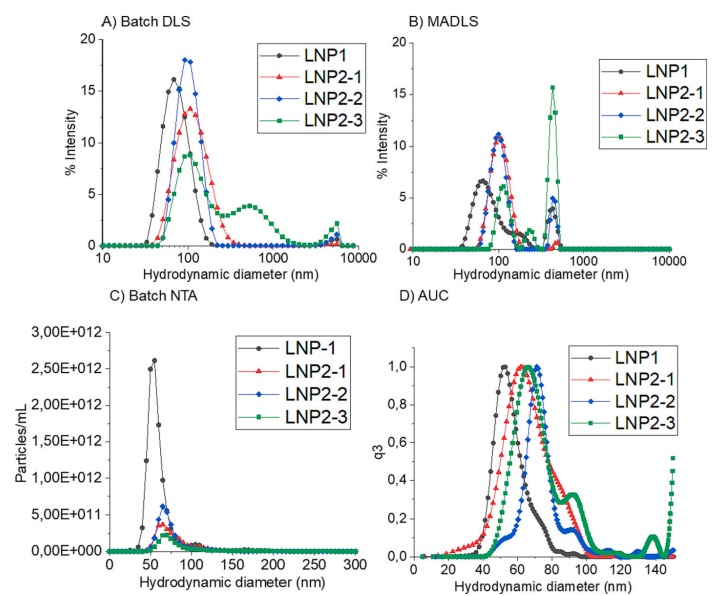
Figure from Parot et al. (2024) showing multi-method particle size distribution analysis of LNP-RNA formulations and LNP2 batches using DLS, MADLS, NTA, and AUC (CC BY 4.0).
FAQs of Comparative Analysis
What types of nucleic acid therapeutic samples can be evaluated by comparative analysis?
Comparative analysis can be applied to different nucleic acid drug substances and related formulations, such as synthetic oligonucleotides, ASO/siRNA, mRNA or modified RNA, nucleic acid conjugates, and LNP-formulated RNA products. The specific analytical strategy depends on the molecule type, formulation format, sample condition, and comparison objective.
Do I need to provide a reference product or comparator sample?
A comparator or comparison baseline is generally recommended. This may be a reference product, benchmark material, internal reference standard, previous batch, pre-change sample, control formulation, or representative historical sample. Providing clear comparator information helps ensure that the study design and reporting format are aligned with the intended comparison objective.
How should samples be grouped for a comparative analysis study?
Sample grouping depends on the intended comparison. Common designs include test sample versus comparator, multiple batches from the same process, pre-change versus post-change samples, different formulation candidates, or samples exposed to different handling or storage conditions. Clear grouping information helps ensure that the results are interpreted in the correct context.
Can comparative analysis confirm that two samples are comparable?
Comparative analysis can provide analytical evidence showing whether selected product attributes are similar, different, or changed under the agreed testing conditions. However, it should not be interpreted as a standalone proof of regulatory equivalence, therapeutic equivalence, or interchangeability. Final conclusions depend on the intended use, predefined criteria, method suitability, and the broader development or regulatory context.
What analytical attributes are commonly compared?
Depending on the product and project goal, comparison may include molecular identity, structural integrity, full-length product content, purity and impurity profiles, degradation-related changes, charge-related variants, molecular weight-related differences, aggregation, particle size distribution, encapsulation-related properties, and stability-indicating profiles.
How much sample is required?
Sample requirements depend on the nucleic acid modality, formulation format, concentration, number of comparison groups, and selected analytical methods. The following ranges can be used as general planning guidance:
| Sample / Study Type | Recommended Starting Amount | Notes |
| Nucleic acid drug substance | 10–50 µg per sample | Suitable for routine comparison of purified oligonucleotides, ASO/siRNA, mRNA, or related nucleic acid drug substances using selected analytical readouts. |
| LNP-formulated or particle-based products | 50–200 µg RNA-equivalent material, or sufficient formulation volume | Additional volume may be required for particle size, PDI, zeta potential, NTA, TEM, encapsulation-related analysis, or other formulation-specific assays. |
| Multi-attribute comparative studies | 200 µg or more per sample may be recommended | Larger amounts may be needed when multiple platforms, replicate testing, stability-related comparison, or both molecular and formulation-level assays are included. |
Final sample requirements will be confirmed after reviewing the sample format, concentration, number of comparison groups, comparison objective, and requested analytical scope.
What is the typical turnaround time?
Turnaround time depends on the number of samples, analytical platforms, method readiness, and reporting depth. For routine comparative analysis using established methods, testing and reporting may typically require about 10–15 business days after scope confirmation and testing initiation with accepted samples. Complex multi-attribute studies, formulated product comparisons, projects requiring method optimization, or studies involving multiple comparison groups may require a longer timeline. The final turnaround time will be confirmed in the quotation based on sample number, selected assays, method readiness, and reporting requirements.
What results will be included in the final report?
The final report can include side-by-side analytical profiles, quantitative comparison tables, chromatogram or electropherogram overlays, attribute-level summaries, observed difference descriptions, and scientific interpretation based on the agreed comparison objective. The reporting format can be adjusted according to development, internal review, or QC-related needs.
References
- Parot J, et al. Quality assessment of LNP-RNA therapeutics with orthogonal analytical techniques. Journal of Controlled Release. 2024, 367:385-401.
- Ma Y, VanKeulen-Miller R, Fenton OS. mRNA lipid nanoparticle formulation, characterization and evaluation. Nat Protoc. 2025, 20(9):2618-2651.
For Research Use Only. Not for diagnostic procedures.