Physicochemical Characterization Service
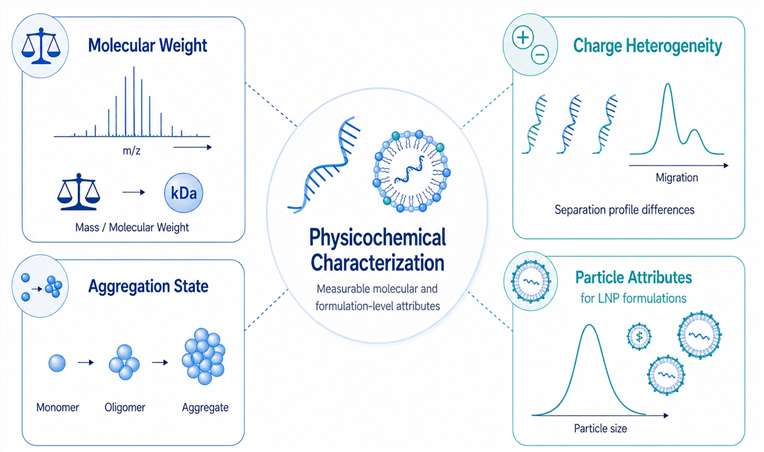
Creative Proteomics provides physicochemical characterization services for nucleic acid drugs to evaluate key molecular and formulation-level attributes that influence product identity, consistency, and development-stage quality assessment. Our services focus on major physicochemical properties, including molecular weight, charge heterogeneity, aggregation behavior, and particle size attributes for LNP-based or nanoparticle-formulated products. By integrating mass spectrometry, chromatographic separation, electrophoretic analysis, and particle characterization platforms, we support the assessment of synthetic oligonucleotides, RNA therapeutics, and formulated nucleic acid drug products where applicable. These services help researchers understand product-specific physicochemical profiles, compare batches or formulations, and develop fit-for-purpose analytical strategies from early development through quality-related evaluation.
Request a Custom Phosphorylation Analysis PlanIn line with ICH Q6B Guidance for biologic characterization
Jump to Section
- Why Physicochemical Characterization Matters
- Analytical Capabilities
- Development Scenarios
- Service Advantages
- Instrument Platform
- Workflow
- Case Study
- FAQs
- References
Why Physicochemical Characterization Matters?
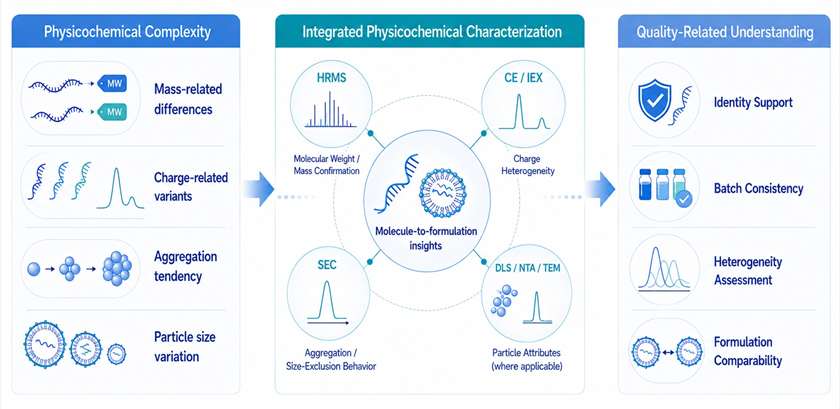
Physicochemical characterization of nucleic acid drugs refers to the analytical evaluation of measurable physical and chemical attributes that describe the quality profile of a nucleic acid drug substance or formulated drug product. Rather than focusing on sequence-level confirmation or impurity-specific identification, this type of characterization assesses how the product behaves as a molecule, complex, or formulation under defined analytical conditions. These readouts provide important information for understanding product identity, molecular heterogeneity, aggregation tendency, formulation quality, and batch-to-batch consistency during nucleic acid therapeutic development. For formulated systems, physicochemical characterization may also include particle-level attributes that are relevant to formulation performance and comparability. In some cases, charge heterogeneity profiling by CE- or IEX-based methods may also support purity or impurity-related assessment, depending on the analytical objective and how the observed variants are interpreted.
This makes physicochemical characterization valuable for nucleic acid drug development for several reasons:
- Reveal quality-relevant differences beyond sequence information
Products with the same intended sequence may still differ in mass profile, charge-related behavior, aggregation tendency, or particle-level properties, which can affect downstream development decisions. - Understand molecular and formulation behavior more comprehensively
Nucleic acid drug substances and formulated products may behave differently depending on chemical modification, length, formulation composition, or manufacturing conditions. Physicochemical testing helps capture these differences from multiple analytical perspectives. - Reduce uncertainty during development and comparability assessment
When batches, process conditions, or formulations show unexpected differences, physicochemical data can help clarify whether these changes are associated with mass, separation profile, aggregation state, or particle attributes. - Provide a basis for quality-related method development
Physicochemical characterization generates information that can support the selection and optimization of analytical methods for development-stage product evaluation and future quality-control planning.
Physicochemical Characterization at Creative Proteomics
Creative Proteomics provides integrated physicochemical characterization services for nucleic acid drugs, with fit-for-purpose analytical modules selected according to product format, formulation type, and development needs.
| Characterization Focus | Analytical Strategy | Key Information Delivered |
| Molecular Weight and Mass Confirmation | HRMS-based intact mass analysis to evaluate molecular weight, mass consistency, and mass-shift information for nucleic acid drug substances. | Evidence supporting expected molecular weight, mass-related identity, and potential mass differences associated with sequence length, modification, conjugation, or degradation-related changes |
| Charge Heterogeneity Profiling | CE- and IEX-based separation methods to assess charge-related profiles, including main species, shoulder peaks, additional peaks, and profile differences between samples. | Charge-related heterogeneity information, separation-profile comparison, and support for evaluating product consistency, process-related changes, or batch-to-batch differences |
| Aggregation and Size-Exclusion Analysis | SEC-HPLC/UPLC, SEC-MALS, or other orthogonal approaches to assess main product distribution, high-molecular-weight species, low-molecular-weight species, and aggregate-related behavior | Information on aggregation state, size-exclusion behavior, main product distribution, and aggregate- or fragment-related species that may affect product comparability and development decisions |
| Particle Attribute Analysis for Formulated Products | DLS, NTA, TEM, or cryo-TEM analysis to evaluate particle size distribution, polydispersity, particle concentration, and morphology for LNP-based or nanoparticle-formulated nucleic acid products | Particle-level information supporting assessment of formulation quality, particle size variation, morphology, polydispersity, and comparability of formulated nucleic acid drug products. |
Applications of Physicochemical Characterization Service
Physicochemical characterization can be applied across nucleic acid therapeutic development to compare product profiles, evaluate formulation-related properties, and investigate changes that may affect product consistency or quality-related performance.
- Candidate and construct comparison
Compare physicochemical profiles of different oligonucleotide or RNA designs during early-stage candidate evaluation. - Process development and optimization
Assess how synthesis, purification, processing, or scale-up conditions may influence mass profiles, charge-related separation behavior, aggregation state, or particle-level properties. - Batch-to-batch comparability assessment
Evaluate whether different production batches show comparable molecular weight, separation profiles, aggregation behavior, or formulation-related particle attributes. - Formulation screening and optimization
Compare LNP-based or nanoparticle-formulated products based on aggregation tendency, particle size distribution, polydispersity, morphology, or formulation-associated variation. - Investigation of unexpected analytical profile changes
Support troubleshooting when unexpected peak shifts, additional peaks, broadened profiles, aggregate-related features, or particle size changes are observed during development.
Advantages of Our Physicochemical Characterization Service
- Integrated multi-platform characterization: We combine mass spectrometry, chromatographic separation, electrophoretic analysis, and particle characterization platforms to evaluate nucleic acid drug products from complementary analytical perspectives.
- Coverage from drug substance to formulated products: Our services support physicochemical assessment of synthetic oligonucleotides, RNA therapeutics, and LNP-based or nanoparticle-formulated nucleic acid drug products where applicable.
- Efficient attribute-driven testing: Analytical methods are selected based on the physicochemical attributes most relevant to the product format and development question, helping avoid unnecessary testing while allowing deeper characterization when needed.
- Orthogonal data interpretation: Results from different analytical platforms can be interpreted together to help evaluate whether observed changes are associated with mass-related, charge-related, aggregation-related, or particle-level attributes.
- Development-stage flexibility: The service can support early candidate screening, formulation comparison, process development, batch comparison, and quality-related method optimization without being limited to a single assay format.
- Experienced scientific support: Our team provides scientific input on assay selection, sample preparation considerations, data interpretation, and follow-up testing options based on the analytical objective and product format.
Physicochemical Characterization Platforms
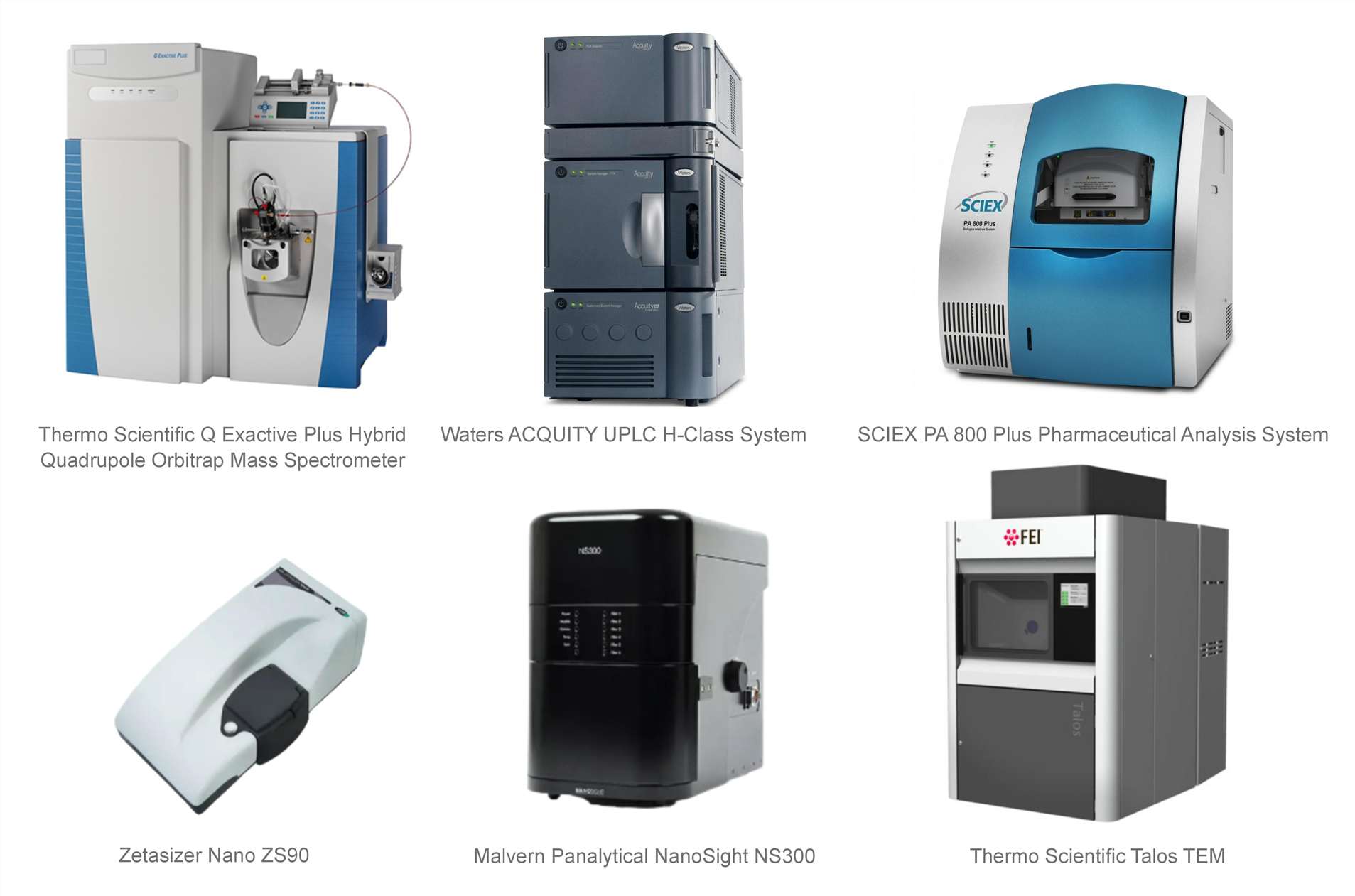
Creative Proteomics supports physicochemical characterization of nucleic acid drugs using fit-for-purpose mass spectrometry, chromatographic, electrophoretic, and particle analysis platforms selected according to sample type and analytical objectives.
- Thermo Scientific Q Exactive Plus Hybrid Quadrupole-Orbitrap Mass Spectrometer
High-resolution accurate mass analysis for intact oligonucleotide mass confirmation, LC-HRMS-based impurity investigation, and MS/MS-supported sequence or modification assignment. - Waters ACQUITY UPLC H-Class System
- High-efficiency chromatographic separation for nucleic acid drug substances, supporting purity profiling, related-substance analysis, size-exclusion analysis, and separation of closely related variants, depending on column chemistry and method configuration
- SCIEX PA 800 Plus Pharmaceutical Analysis System
Capillary electrophoresis platform for oligonucleotide purity assessment, charge-related separation, electrophoretic profiling, and selected variant analysis applications. - Zetasizer Nano ZS90
Dynamic light scattering platform for particle size distribution and polydispersity analysis of LNP-based or nanoparticle-formulated nucleic acid drug products. - Malvern Panalytical NanoSight NS300
Nanoparticle tracking analysis platform for particle size distribution and particle concentration assessment of LNPs, nanoparticles, and other nucleic acid formulation systems. - Thermo Scientific Talos TEM
Transmission electron microscopy platform for visualizing particle morphology, size-related features, and structural appearance of LNP-based or nanoparticle-formulated nucleic acid products.
Workflow of Physicochemical Characterization
Our physicochemical characterization workflow is designed to align sample type, analytical objectives, method selection, multi-platform testing, and integrated data interpretation within a clear service process.
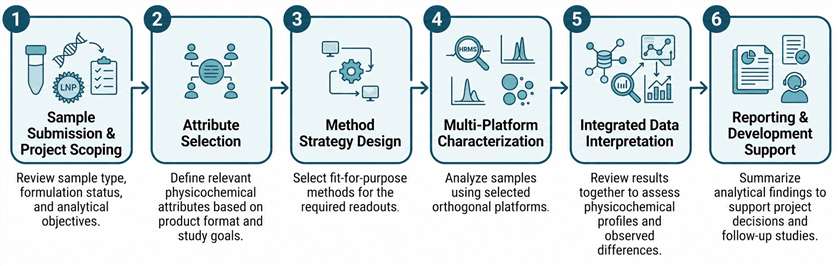
- 1
Sample Submission & Project Scoping
We begin by reviewing the nucleic acid sample type, formulation status, available material amount, concentration, storage condition, and main analytical objectives. This step helps define whether the project focuses on molecular weight confirmation, charge-related profiling, aggregation assessment, particle characterization, or comparability evaluation.
- 2
Attribute Selection
Based on the product format and study purpose, relevant physicochemical attributes are selected for evaluation. These may include mass-related properties, separation-profile heterogeneity, size-exclusion behavior, aggregate-related features, or particle-level attributes for LNP-based and nanoparticle-formulated products.
- 3
Method Strategy Design
A fit-for-purpose analytical strategy is developed according to the selected attributes, sample complexity, formulation type, and project stage. Appropriate mass spectrometry, chromatographic, electrophoretic, and particle analysis platforms are considered to generate complementary physicochemical readouts.
- 4
Multi-Platform Characterization
Samples are analyzed using selected orthogonal platforms under suitable experimental conditions. Depending on the study design, this step may include HRMS-based mass analysis, CE/IEX profiling, SEC-based size-exclusion analysis, DLS or NTA particle sizing, and TEM-based morphology evaluation where applicable.
- 5
Integrated Data Interpretation
Analytical results are reviewed together to assess physicochemical profiles and observed differences between samples. Integrated interpretation helps evaluate whether changes are related to molecular weight, charge-associated behavior, aggregation state, particle size distribution, or formulation-level variation.
- 6
Reporting & Development Support
The final report summarizes analytical methods, representative profiles, key readouts, comparative findings, and interpretation of relevant physicochemical attributes. When appropriate, follow-up testing options or additional orthogonal analyses may be suggested based on the sample type and project objective.
Case Study: SEC-Based Physicochemical Characterization of mRNA-LNP Formulations and Aggregates
mRNA-LNP drug products present analytical challenges because the RNA cargo, lipid nanoparticle carrier, and aggregate-related species may differ substantially in size and physicochemical behavior. In this study, researchers evaluated ultrawide pore size-exclusion chromatography (SEC) as a separation-based approach for profiling mRNA-LNP formulations. DLS and SEC-MALS-dRI were also used as complementary tools to support size-related and aggregate-related interpretation.
Key findings:
- Ultrawide pore SEC-UV separated the free Cre mRNA standard from intact mRNA-LNP formulations, with the free mRNA eluting later than the LNP main peaks.
- SEC elution times of LNP main peaks showed strong correlation with DLS-measured particle sizes for selected LNP formulation series, supporting size-related interpretation of chromatographic behavior.
- Formulation-dependent differences were observed among LNP groups with different PEG-lipid compositions and Fab-conjugation states, indicating that SEC profiling can support formulation comparability assessment.
- Earlier-eluting species observed in Fab-conjugated LNP samples were further interpreted by SEC-MALS-dRI, supporting their assignment as aggregate-related LNP populations.
This study highlights how SEC-based physicochemical profiling, combined with orthogonal particle and light-scattering analysis, can support evaluation of mRNA-LNP formulation heterogeneity, size-related behavior, and aggregate-related species during nucleic acid drug development..
Source:
Goyon A.; et al. Separation of Plasmid DNA Topological Forms, Messenger RNA, and Lipid Nanoparticle Aggregates Using an Ultrawide Pore Size Exclusion Chromatography Column. Analytical Chemistry. 2023, 95(40):15017-15024. doi: 10.1021/acs.analchem.3c02944
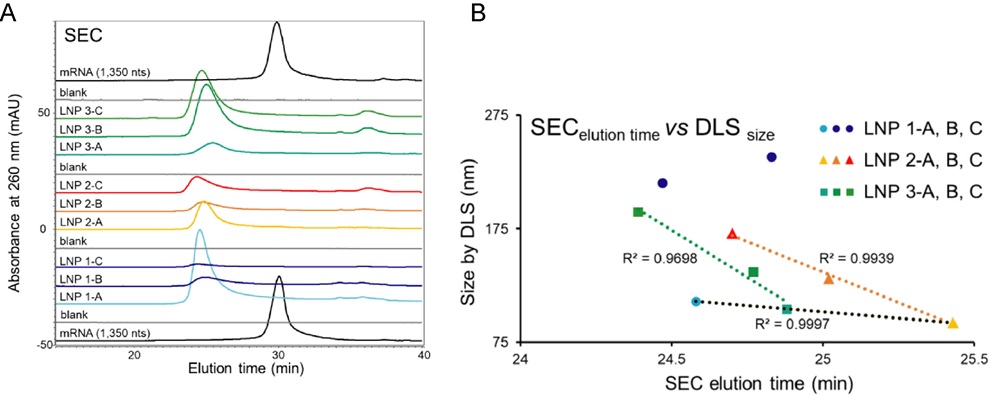
Figure from Goyon et al. (2023) showing SEC-UV profiling of mRNA-LNP formulations and correlation between SEC elution time and DLS-measured particle size (CC BY 4.0).
FAQs of Physicochemical Characterization
Which physicochemical attributes should be evaluated for nucleic acid drugs?
The required attributes depend on the product format and analytical objective. Common assessments include molecular weight or mass consistency, charge-related heterogeneity, aggregation or size-exclusion behavior, and particle attributes for LNP-based or nanoparticle-formulated products.
Is particle size analysis required for all nucleic acid therapeutics?
No. Particle size analysis is most directly relevant for LNP-based, nanoparticle-formulated, or complexed nucleic acid drug products. For purified oligonucleotides or unformulated RNA drug substances, DLS or NTA may still be considered when large aggregates, particulate species, or higher-order assemblies are suspected. However, for soluble size variants, low- or high-molecular-weight species, and size-exclusion profiles, SEC-based methods are generally more standard and are often used together with orthogonal particle-based methods when needed.
Can one analytical method cover all physicochemical characterization needs?
Usually not. HRMS, CE/IEX, SEC, DLS, NTA, and TEM provide different types of information. A fit-for-purpose combination of methods is often needed to evaluate mass-related properties, separation behavior, aggregation state, and particle-level attributes.
How should assays be selected for different nucleic acid sample types?
For purified oligonucleotides or RNA drug substances, HRMS, CE/IEX, and SEC-based methods are commonly considered for mass, charge-related, and aggregation-related assessment. For LNP-based or nanoparticle-formulated products, particle characterization methods such as DLS, NTA, and TEM may also be included where relevant.
How much sample is typically required?
Sample requirements depend on sample type, concentration, analytical platform, testing objective, replicate design, and whether method development or orthogonal confirmation is needed. Different assays may require different input amounts, and some workflows, such as intact mass analysis of larger RNA molecules or multi-platform physicochemical characterization, may require additional material. For LNP or nanoparticle-formulated samples, both sample volume and concentration should be considered, since low-concentration formulations may not be suitable for reliable DLS, NTA, or related particle analyses even when the submitted volume is sufficient. Please contact us with your sample type, concentration, formulation status, and intended testing scope so that we can provide project-specific sample recommendations.
What is the typical turnaround time?
The typical turnaround time for routine physicochemical characterization is approximately 2 weeks after sample receipt. Projects involving multiple analytical platforms, method optimization, complex formulations, comparability studies, or additional confirmatory testing may require a longer timeline depending on project scope. Please contact us to confirm the expected turnaround time for your specific sample type and testing plan.
References
- Goyon A, et al. Separation of Plasmid DNA Topological Forms, Messenger RNA, and Lipid Nanoparticle Aggregates Using an Ultrawide Pore Size Exclusion Chromatography Column. Analytical Chemistry. 2023; 95(40):15017-15024.
- Graewert MA, et al. Quantitative size-resolved characterization of mRNA nanoparticles by in-line coupling of asymmetrical-flow field-flow fractionation with small angle X-ray scattering. Sci Rep. 2023; 13(1):15764.
For Research Use Only. Not for diagnostic procedures.