
Antisense Oligonucleotide Characterization Service
Creative Proteomics provides comprehensive antisense oligonucleotide (ASO) characterization services to support the development and quality assessment of antisense oligonucleotide drug candidates. ASOs often contain multiple chemical modifications, such as phosphorothioate backbones, 2′-modified sugars, and locked nucleic acid structures, which require accurate analytical confirmation during sequence design, synthesis optimization, and product development. Our ASO characterization platform integrates mass spectrometry, chromatographic separation, and stability-related analytical approaches to evaluate molecular identity, modification patterns, product-related impurities, and degradation behavior. These services can support early candidate screening, process development, batch comparison, impurity investigation, and stability assessment for chemically modified oligonucleotides.
Request a Custom Phosphorylation Analysis PlanIn line with ICH Q6B Guidance for biologic characterization
Jump to Section
- Why ASO Characterization Matters
- Analytical Capabilities
- Development Scenarios
- Service Advantages
- Instrument Platform
- Analysis Workflow
- Case Study
- FAQs
- References
Why ASO Characterization Matters
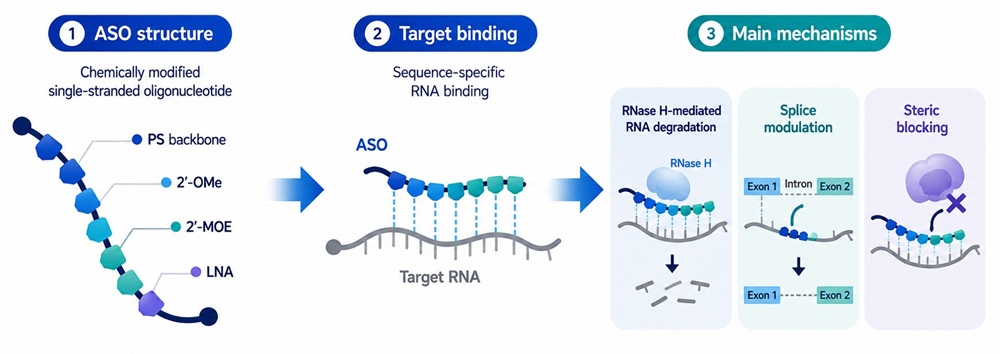
Antisense oligonucleotides (ASOs) are synthetic, single-stranded oligonucleotides designed to bind complementary RNA sequences and regulate gene expression through mechanisms such as RNase H-mediated degradation, splice modulation, or steric blocking. To improve nuclease resistance, binding affinity, and pharmacological properties, ASOs are often engineered with chemical modifications such as phosphorothioate (PS) backbones, 2′-OMe, 2′-MOE, locked nucleic acid (LNA), and other modified nucleotide chemistries. Because ASOs are sequence-defined and modification-dependent molecules, their final analytical profile may differ from the intended design due to synthesis, deprotection, purification, formulation, storage, or handling-related changes. ASO characterization helps connect the intended molecular design with analytical evidence, supporting evaluation of sequence-related features, modification consistency, full-length product profile, impurity composition, and degradation behavior.
In practice, ASO characterization is valuable because it helps clarify whether observed differences are associated with molecular identity, chemical modification patterns, product-related variants, or stability-related changes. The following points summarize how ASO-focused characterization supports a deeper understanding of antisense oligonucleotide quality.
- Confirm that the synthesized ASO matches the intended molecular design
ASOs are sequence-defined molecules, and even small differences in sequence, length, or modification pattern may be associated with changes in biological activity, stability, or development suitability. - Evaluate the impact of chemical modifications on ASO quality
Common ASO modifications, such as PS backbones, 2′-OMe, 2′-MOE, and LNA, are introduced to improve stability, affinity, or pharmacological properties, but they also increase analytical complexity. - Identify product-related variants that may affect performance
Truncated sequences, deletion products, oxidation products, desulfurized species, and other ASO-related impurities may influence target binding, potency, stability, or safety-related evaluation. - Understand degradation behavior under relevant conditions
ASOs may undergo chemical or enzymatic degradation during storage, handling, formulation, or biological exposure. Characterization helps reveal potential degradation pathways and vulnerable structural features. - Reduce uncertainty before downstream functional or preclinical studies
Verifying ASO identity, impurity profile, and stability at an early stage helps ensure that observed biological results are based on a well-characterized oligonucleotide molecule.
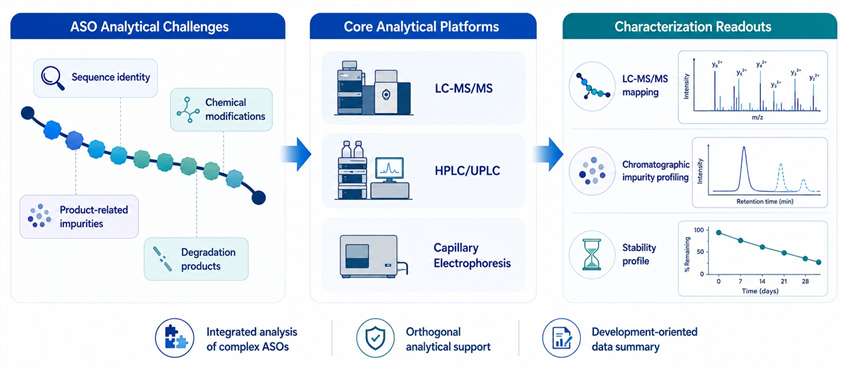
Antisense Oligonucleotide Characterization at Creative Proteomics
Creative Proteomics offers ASO characterization services covering modification mapping, purity and impurity profiling, and stability-related degradation assessment for chemically modified antisense oligonucleotides.
| ASO Characterization Focus | Analytical Strategy | Key Information Delivered |
| ASO Identity and Modification Mapping | Intact mass confirmation and LC-MS/MS-supported sequence or modification mapping for chemically modified ASOs, including PS backbone, 2′-OMe, 2′-MOE, LNA, and other modification chemistries when analytically feasible | Molecular identity information; expected sequence-related features; modification pattern confirmation; support for verifying chemically modified ASO designs |
| ASO Purity and Impurity Profiling | Chromatographic and mass spectrometry-based profiling of full-length ASO or main product proportion and product-related impurity species | Full-length ASO / main product proportion; truncated sequences; deletion or addition products; oxidation-related species; backbone-related variants; synthesis- or degradation-associated impurities |
| ASO Stability and Degradation Assessment | Stability-related analytical assessment under selected storage, stress, enzymatic, serum, or project-specific conditions using chromatography and MS-supported approaches where applicable | Degradation behavior; major degradation products; stability comparison across ASO designs, batches, or conditions; information supporting formulation and development studies |
Applications of Antisense Oligonucleotide Characterization Services
ASO characterization services can be applied throughout antisense oligonucleotide discovery, development, and quality evaluation to support data-driven decision-making.
- ASO candidate screening
Compare different ASO sequences or modification designs before selecting candidates for further functional evaluation. - Synthesis and process optimization
Evaluate whether synthesis, deprotection, purification, or processing conditions affect ASO identity, impurity profile, or product consistency. - Batch-to-batch comparison
Assess consistency among research, pilot, or process-development batches of chemically modified ASOs. - Impurity investigation
Support the identification and interpretation of ASO-related variants observed during synthesis, purification, storage, or stress testing. - Stability study support
Evaluate ASO stability under selected storage, handling, enzymatic, or stress conditions to support formulation and development studies.
Advantages of Our Antisense Oligonucleotide Characterization Services
- Integrated orthogonal analysis: Multiple analytical approaches, such as mass spectrometry, chromatographic separation, and stability-related assays, can be combined to improve confidence in ASO characterization results.
- Support for diverse chemical modifications: We support the evaluation of commonly used ASO modifications, including PS backbone, 2′-OMe, 2′-MOE, LNA, and other modified nucleotide chemistries, depending on project scope and analytical feasibility.
- Impurity-oriented data interpretation: In addition to main product assessment, our workflow emphasizes the interpretation of ASO-related impurity profiles, including synthesis-related variants and degradation-associated species.
- Flexible method selection for different development stages: Analytical strategies can be adjusted for early candidate screening, synthesis optimization, batch comparison, impurity investigation, or stability assessment.
- Clear and development-relevant reporting: Reports can include method information, chromatographic or mass spectrometric data, identity assessment, impurity interpretation, and stability-related findings to support downstream decision-making.
- Experience with nucleic acid and oligonucleotide analytical workflows: Our team supports a broad range of nucleic acid and oligonucleotide characterization projects, enabling method adaptation for chemically modified ASOs with different sequences, modification patterns, and development objectives.
Antisense Oligonucleotide Characterization Platforms
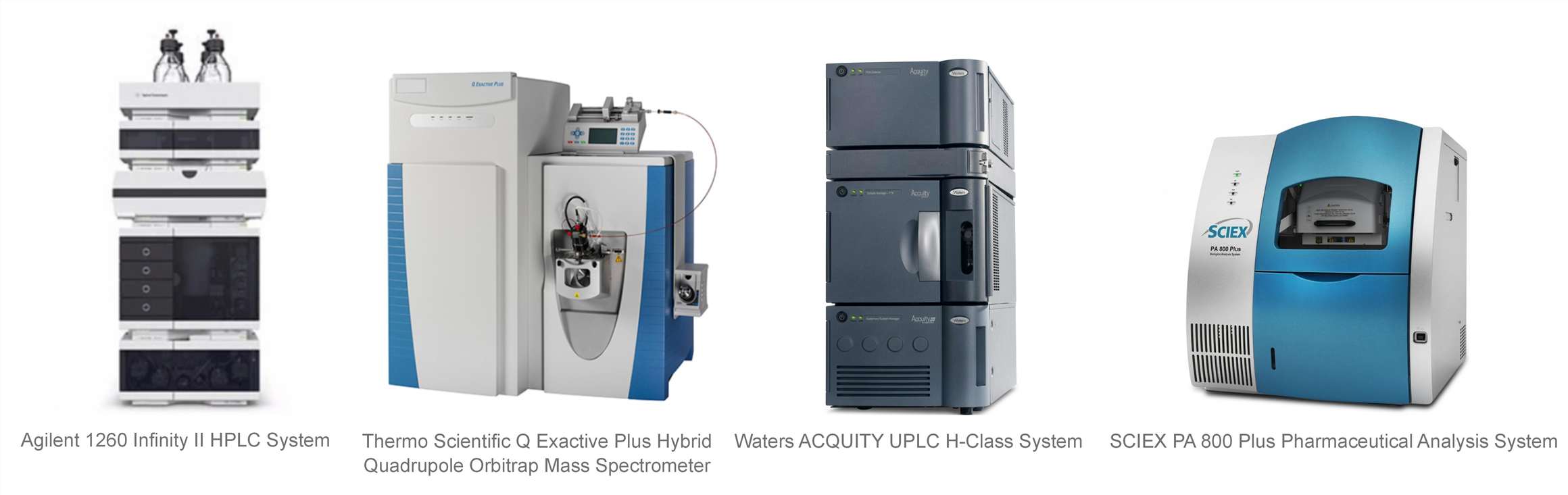
Creative Proteomics integrates HPLC/UPLC separation, high-resolution mass spectrometry, and capillary electrophoresis platforms to support ASO identity confirmation, modification analysis, impurity profiling, and stability-related characterization.
- Agilent 1260 Infinity II HPLC System
HPLC-based separation platform for ASO chromatographic profiling, full-length ASO or main product proportion assessment, impurity comparison, and degradation-related profile evaluation. - Thermo Scientific Q Exactive Plus Hybrid Quadrupole-Orbitrap Mass Spectrometer
High-resolution accurate mass and MS/MS platform for intact ASO mass confirmation, sequence-related assessment, modification mapping, and mass-based identification of product-related impurities or degradation products where applicable. - SCIEX PA 800 Plus Pharmaceutical Analysis System
Capillary electrophoresis platform for orthogonal ASO assessment, including size-, length-, charge-, or purity-related profiling of selected oligonucleotide samples when applicable. - Waters ACQUITY UPLC H-Class System
High-efficiency UPLC platform for improved separation of closely related ASO species, supporting impurity profiling, chromatographic method optimization, batch comparison, and stability-related analytical workflows.
Workflow of Antisense Oligonucleotide Characterization
Our workflow combines project-specific strategy selection, ASO sample preparation, analytical testing, data interpretation, and report delivery to support reliable characterization of chemically modified antisense oligonucleotides.
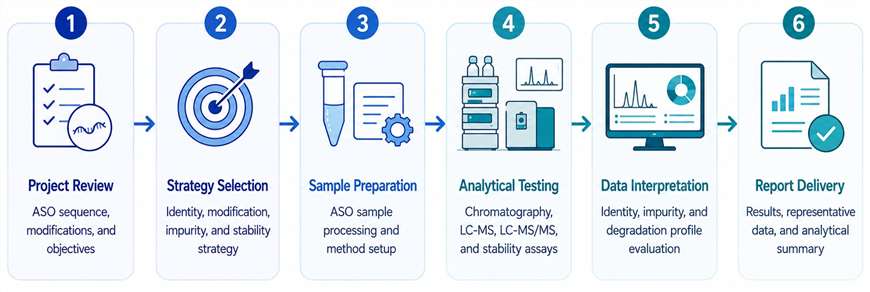
- 1
Project Review
We begin by reviewing the ASO sequence, expected molecular weight, modification design, sample information, and project objectives. This step helps clarify whether the project should focus on identity confirmation, modification mapping, purity/impurity profiling, stability assessment, or a combined characterization strategy.
- 2
Strategy Selection
Based on the ASO design and analytical goal, we select suitable methods for identity, modification, impurity, or stability-related analysis. The strategy may include chromatographic separation, high-resolution mass spectrometry, LC-MS/MS-based mapping, capillary electrophoresis, or stability-related analytical workflows where applicable.
- 3
Sample Preparation
Submitted ASO samples are reviewed for amount, concentration, buffer composition, formulation status, and compatibility with the planned analysis. When needed, sample dilution, desalting, or other preparation steps may be considered to support reliable chromatographic, mass spectrometric, or electrophoretic analysis.
- 4
Analytical Testing
Selected analyses are performed according to the project-specific characterization plan. Depending on the scope, testing may include intact mass confirmation, modification-related assessment, chromatographic impurity profiling, full-length ASO or main product proportion evaluation, and stability/degradation analysis under defined conditions.
- 5
Data Interpretation
Analytical results are integrated to evaluate key ASO quality attributes, including molecular identity, modification consistency, impurity profile, and degradation behavior. Findings may be compared with expected sequence information, reference data, batch information, or stability conditions to support project-specific interpretation.
- 6
Report Delivery
A structured report is provided with analytical methods, representative chromatograms or mass spectra, key results, data interpretation, and project-specific observations. When appropriate, the report may also include recommendations for follow-up characterization, method refinement, or additional comparative analysis.
Case Study: UHPLC-HRMS-Based Characterization and Impurity Profiling of Therapeutic ASOs
Therapeutic antisense oligonucleotides (ASOs) are chemically modified single-stranded nucleic acid molecules whose quality assessment requires evaluation of sequence integrity, modification-related features, and product-related impurities. During solid-phase synthesis and subsequent handling, ASOs may generate structurally similar impurity species, including shortmers, full-length modified variants, sulfur-loss products, oxidation-related species, and degradation-associated products. In this study, fomivirsen and tofersen were used as representative therapeutic ASOs to develop an IP-RP-UHPLC-HRMS method for impurity profiling and structural characterization. The workflow combined chromatographic separation, Orbitrap-based high-resolution MS detection, and DoE-assisted method optimization to balance separation performance and MS sensitivity.
Key findings:
- IP-RP-UHPLC-HRMS enabled impurity profiling of therapeutic ASOs by combining chromatographic separation with accurate mass-based structural assignment.
- The optimized workflow supported detection and relative quantitation of product-related impurities down to approximately the 0.1% level.
- For fomivirsen, all four detected impurities were identified, including n−1 deletion products, an n−2 deletion product, and a phosphorothioate-to-phosphate conversion product.
- For tofersen, 15 impurities above 0.1% were detected, and 13 were successfully identified, reflecting the greater impurity complexity of this chemically modified gapmer ASO.
- Several impurity signals eluted close to the full-length ASO peak, highlighting the value of HRMS-based mass selectivity when complete chromatographic separation is difficult.
This study highlights the value of UHPLC-HRMS-based workflows for ASO impurity profiling, structural characterization, and development-stage quality assessment of chemically modified oligonucleotides.
Source:
A.Triolo.; et al. Characterisation of Antisense Oligonucleotides by Ion-PairReversed-Phase UHPLC-HRMS: Method development using Design of Experiments. Journal of Mass Spectrometry. 2026, 4: e70049. https://doi.org/10.1002/jms.70049
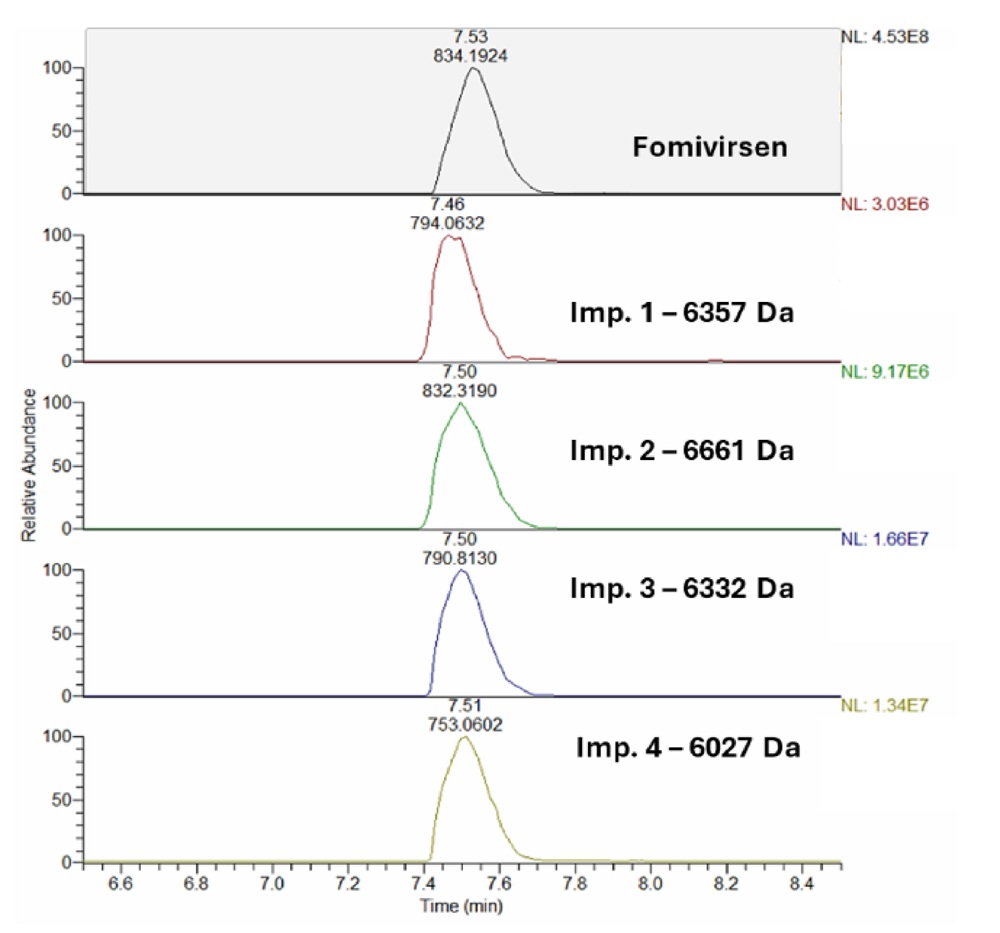
Figure from Triolo et al. (2026) showing UHPLC-HRMS extracted mass chromatograms of fomivirsen and four detected impurity species, including deletion-related products and phosphorothioate-to-phosphate conversion (CC BY 4.0).
FAQs of Antisense Oligonucleotide Characterization Analysis
What types of ASO designs can be characterized?
We can support characterization of different chemically modified single-stranded ASO designs, including gapmers, mixmers, splice-modulating ASOs, steric-blocking ASOs, and other antisense oligonucleotides. Analytical feasibility depends on ASO length, sequence, modification pattern, sample quality, and the specific characterization objective.
Which ASO modifications can be evaluated?
Commonly evaluated modifications include phosphorothioate (PS) backbones, 2′-OMe, 2′-MOE, LNA, and other modified nucleotide chemistries. The exact analytical strategy depends on the ASO sequence, modification pattern, sample quality, and project objective.
Can you confirm both ASO identity and modification pattern?
Yes. ASO identity can be assessed by intact mass analysis and sequence-related mass spectrometry approaches. Modification pattern evaluation may be performed through digestion-based mapping, LC-MS/MS analysis, or other suitable methods, depending on ASO design and achievable analytical coverage.
Can ASO purity and impurities be analyzed in the same project?
Yes. We can assess the full-length ASO or main product proportion while profiling product-related impurities. These may include truncated sequences, deletion or addition products, oxidation-related species, backbone-related variants, and degradation-associated impurities.
Can you identify ASO degradation products?
Yes. Major degradation products can be investigated using chromatographic and mass spectrometry-based methods. Degradation analysis may be performed after storage, stress treatment, nuclease exposure, serum incubation, or other project-specific conditions.
Is this service suitable for comparing different ASO designs or batches?
Yes. ASO characterization can support comparison of different sequences, chemical modification designs, synthesis batches, purification conditions, or stability study samples. This is useful for candidate selection, process optimization, and batch consistency evaluation.
What information should be provided before starting an ASO characterization project?
Recommended information includes ASO sequence, expected molecular weight, modification type and position, sample amount, concentration, buffer composition, and the main purpose of analysis. If available, previous chromatograms, mass spectra, or purity data can also help method selection.
How much sample is required?
For routine ASO identity confirmation or purity profiling, approximately 10–50 μg per sample may be sufficient in many cases. For comprehensive modification mapping, impurity identification, or stability/degradation studies, 50–200 μg or more may be recommended depending on ASO length, modification complexity, analytical methods, and the number of test conditions. Specific sample requirements will be confirmed after reviewing the project scope.
What is the typical turnaround time?
For routine ASO identity confirmation or purity profiling, the typical turnaround time is approximately 1–2 weeks after sample receipt. Projects involving detailed modification mapping, impurity identification, or stability/degradation analysis may require 2–4 weeks or longer, depending on sample number, analytical complexity, and whether method optimization is needed.
References
- A.Triolo.; et al. Characterisation of Antisense Oligonucleotides by Ion-PairReversed-Phase UHPLC-HRMS: Method development using Design of Experiments. Journal of Mass Spectrometry. 2026, 4: e70049. https://doi.org/10.1002/jms.70049
- Rentel C.; et al. Assay, Purity, and Impurity Profile of Phosphorothioate Oligonucleotide Therapeutics by Ion Pair-HPLC-MS. Nucleic Acid Ther. 2022, 32(3):206-220. doi: 10.1089/nat.2021.0056
For Research Use Only. Not for diagnostic procedures.