
siRNA and miRNA Characterization Service
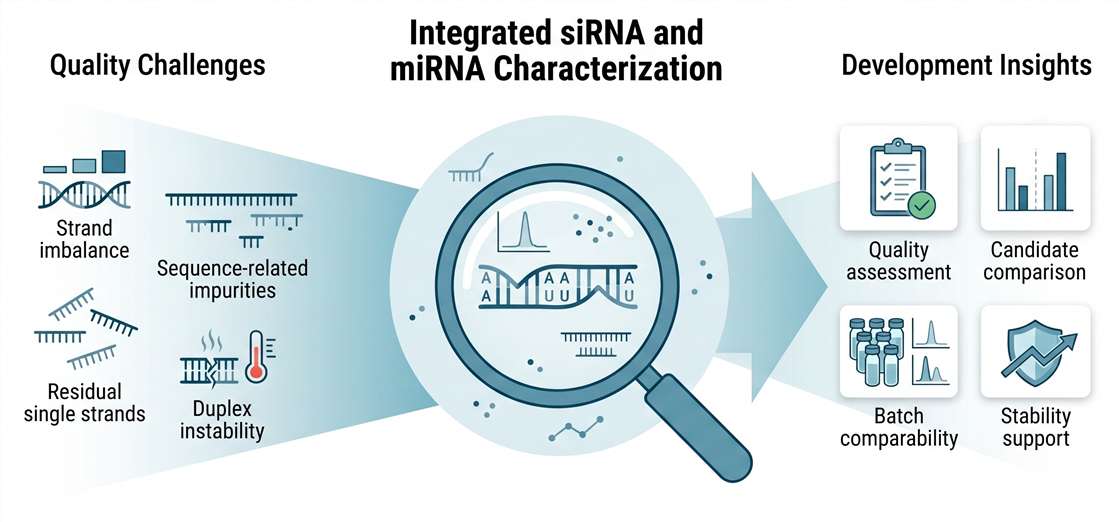
Creative Proteomics provides siRNA and miRNA characterization services to support the quality assessment of short RNA duplex therapeutics, including duplex-format siRNA and miRNA products, throughout development and manufacturing. For siRNA and miRNA products, therapeutic performance depends not only on the intended RNA sequence, but also on accurate strand composition, controlled impurity profiles, and stable duplex formation. Variations in guide/passenger strand ratio, residual single strands, truncated or sequence-variant oligonucleotides, modification-related species, and duplex instability may affect RNAi activity, target specificity, product consistency, and stability. Our integrated analytical platforms convert these quality concerns into measurable readouts for molecular identity, strand composition, impurity distribution, duplex assembly, and stability-related changes. These results help clients compare product quality across synthesis, purification, formulation, storage, and batch-to-batch development stages.
Request a Custom Phosphorylation Analysis PlanIn line with ICH Q6B Guidance for biologic characterization
Jump to Section
- Why siRNA and miRNA Characterization Matters
- Analytical Capabilities
- Development Scenarios
- Service Advantages
- Instrument Platform
- Analysis Workflow
- Case Study
- FAQs
- References
Why siRNA and miRNA Characterization Matters
siRNA and miRNA therapeutics are highly design-dependent short RNA products, but the final analytical profile may differ from the intended design because of synthesis-related variants, incomplete annealing, residual single strands, chemical modification heterogeneity, purification effects, or storage-related changes. For duplex-format siRNA and miRNA mimic products, characterization must evaluate both individual RNA strands and the assembled duplex structure, rather than relying only on theoretical sequence information.
This analysis provides strand-level and duplex-level evidence to determine whether key quality attributes remain consistent with the intended product design. It helps clarify whether observed differences between samples are associated with strand composition, duplex formation, sequence-related species, or stability-related behavior. For development and quality-related evaluation, this information supports a more reliable understanding of siRNA and miRNA materials before formulation studies, biological evaluation, batch comparison, or downstream development.
In practice, siRNA and miRNA characterization is valuable because it connects molecular design, analytical evidence, and development-stage decision-making. The following points summarize how strand- and duplex-focused analysis supports short RNA therapeutic quality assessment.
- Confirm product consistency beyond sequence design
siRNA and miRNA candidates may share the intended design sequence but still differ in strand balance, annealing quality, residual single-strand content, related oligonucleotide species, or stability behavior. - Identify sample-related factors that may influence downstream readouts
Low-abundance variants, incomplete duplex assembly, excess unpaired strands, or synthesis-derived side products may be associated with altered RNAi-related readouts or reduced reproducibility in functional studies. - Provide a clearer understanding of sample composition
Analytical characterization helps reveal duplex integrity, strand distribution, and related oligonucleotide species that may not be evident from sequence information or overall purity results alone. - Reduce uncertainty before functional or in vivo studies
Establishing molecular and duplex-related quality before biological testing helps distinguish sample-quality-related variability from true biological differences. - Enable comparability across development stages
Consistent characterization supports comparison of research batches, process-development lots, formulation candidates, purification conditions, and stability samples.
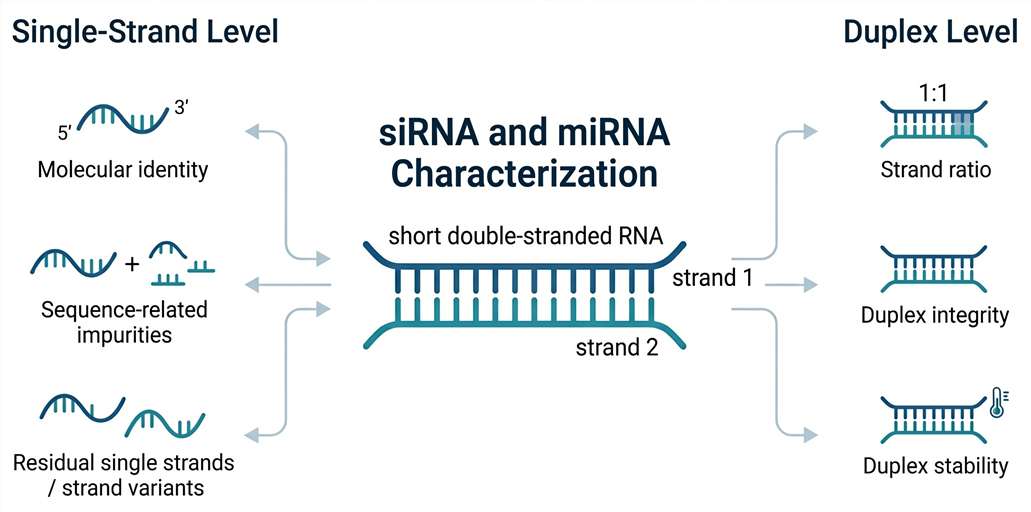
siRNA and miRNA Characterization at Creative Proteomics
Creative Proteomics provides integrated siRNA and miRNA characterization solutions covering strand ratio analysis, sequence-related impurity profiling, and duplex stability evaluation to support short RNA therapeutic development and quality assessment.
| Characterization Focus | Analytical Strategy | Key Information Delivered |
| Strand Ratio Analysis | Quantitative assessment of guide/passenger strand balance or paired miRNA duplex component ratios using strand-resolving chromatographic, electrophoretic, and mass-supported analytical strategies where applicable. | Strand ratio results; relative abundance of individual RNA strands; detection of excess strand components; chromatographic or electrophoretic profiles; analytical report supporting annealing efficiency, batch consistency, and duplex preparation assessment. |
| Sequence-Related Impurity Profiling | Characterization of truncated strands, sequence variants, mismatch-related species, non-target oligonucleotide components, and selected synthesis- or modification-related variants where analytically feasible, such as PS-related heterogeneity, incomplete 2′-OMe/2′-F modification, or terminal modification variants. | Impurity profile summary; information on truncated, variant, non-target, or modification-related species; LC/UPLC chromatograms, CE profiles, or LC-MS/MS spectra where applicable; interpretation of impurity distribution associated with synthesis, purification, handling, or batch-to-batch differences. |
| Duplex Stability Evaluation | Evaluation of duplex formation, duplex integrity, and stability-related behavior using fit-for-purpose nondenaturing, electrophoretic, chromatographic, and UV-based thermal denaturation approaches under selected buffer, temperature, storage, dilution, or stress-related conditions. | Duplex-associated profiles; assessment of unpaired or partially dissociated species; thermal denaturation curves or Tm information where applicable; stability comparison summary supporting formulation, storage, freeze-thaw, stress-condition, or batch comparability studies. |
Applications of siRNA and miRNA Characterization Services
siRNA and miRNA characterization can be applied across RNA therapeutic development to evaluate product quality, support decision-making, and monitor changes in short RNA duplex products under different preparation and development conditions.
- Candidate screening and design comparison
Compare siRNA or miRNA candidates with different sequences, strand designs, modification patterns, or duplex formats. - Synthesis and annealing process evaluation
Assess whether RNA synthesis, strand annealing, or duplex preparation generates the expected product composition. - Purification strategy assessment
Evaluate how purification conditions affect residual single strands, related oligonucleotide species, and overall duplex quality. - Batch-to-batch comparability
Compare analytical profiles across research batches, process-development lots, or scale-up materials. - Formulation development support
Characterize siRNA or miRNA materials before or after formulation to understand whether formulation conditions affect duplex-related quality attributes. - Stability sample analysis
Monitor changes in siRNA or miRNA samples under selected storage, temperature, buffer, or stress-related conditions.
Advantages of Our siRNA and miRNA Characterization Services
- Integrated and Flexible Analytical Strategy: Combines complementary analytical approaches and adjusts characterization plans according to RNA length, duplex format, chemical modification status, sample type, and project objective.
- Fit-for-Purpose Method Selection: Analytical methods are selected based on the specific quality attributes to be evaluated, such as strand composition, impurity profile, duplex assembly, or stability-related behavior.
- Compatibility with Different Development Stages: Services can support early candidate screening, process development, purification optimization, formulation comparison, and stability-related evaluation.
- Comparative Data Interpretation: Provides clear comparison of analytical profiles across batches, preparation conditions, storage time points, or formulation candidates.
- Clear Quality-Focused Reporting: Delivers organized analytical summaries to help clients understand key molecular and duplex-related quality differences in siRNA and miRNA samples.
- Experienced Scientific Support: Our scientific team provides technical guidance on method selection, data interpretation, and study design for siRNA and miRNA characterization projects.
siRNA and miRNA Characterization Platforms
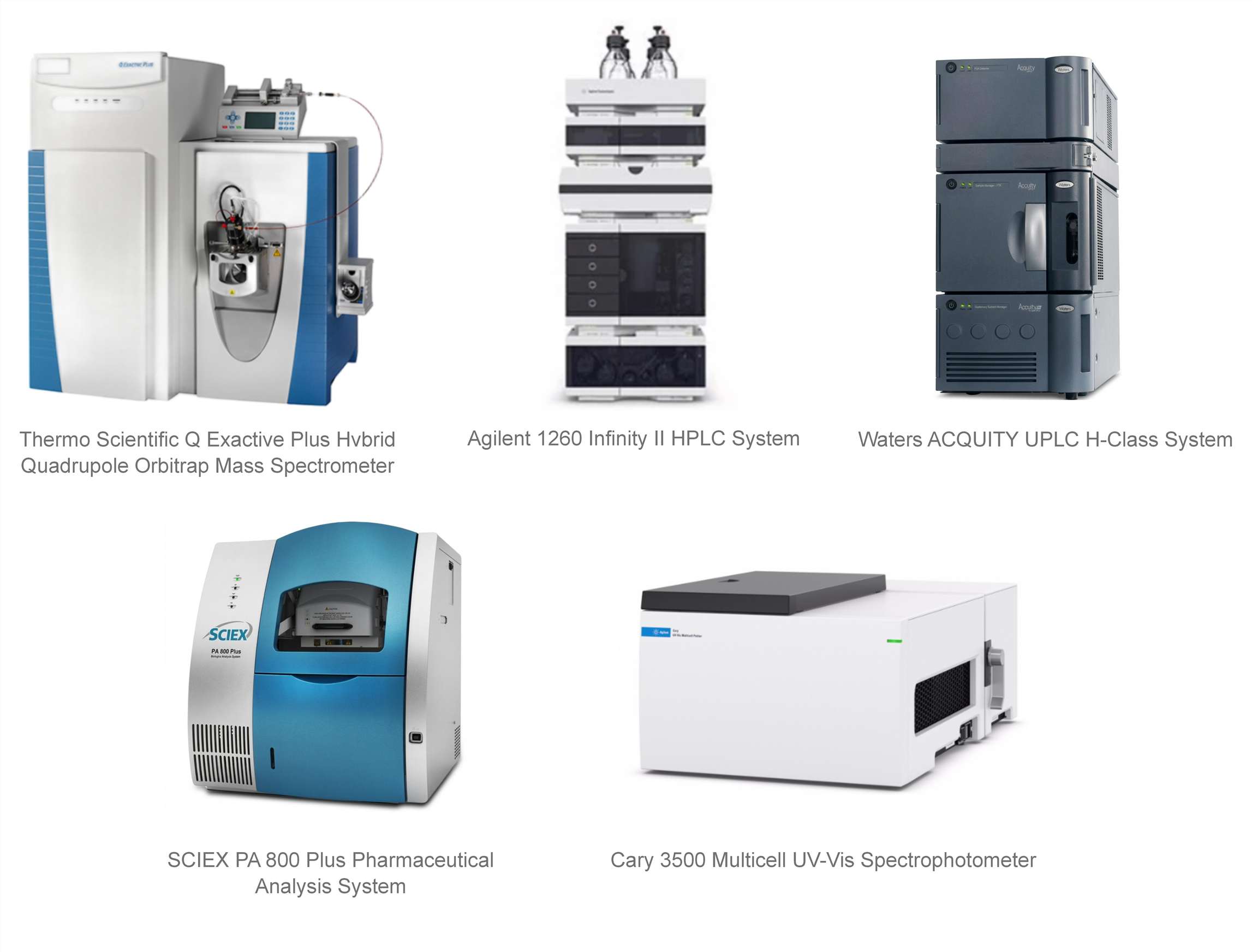
Creative Proteomics integrates high-resolution mass spectrometry, HPLC/UPLC separation, CE-based electrophoretic profiling, and UV-based thermal denaturation analysis to support strand-level, impurity-related, and duplex-associated characterization of siRNA and miRNA therapeutics.
- Thermo Scientific Q Exactive Plus Hybrid Quadrupole-Orbitrap Mass Spectrometer
High-resolution accurate-mass and MS/MS platform for mass-based characterization of siRNA and miRNA strands, supporting molecular weight confirmation, strand identity assessment, and selected sequence- or modification-related impurity analysis where applicable. - Agilent 1260 Infinity II HPLC System
HPLC-based separation platform for strand-level profiling, strand ratio assessment, purity-related analysis, and chromatographic comparison of siRNA or miRNA samples under selected analytical conditions. - Waters ACQUITY UPLC H-Class System
High-efficiency UPLC platform for improved chromatographic resolution of closely related short RNA species, supporting strand-associated separation, impurity profile comparison, and duplex- or single-strand-associated analytical readouts where applicable. - SCIEX PA 800 Plus Pharmaceutical Analysis System
Capillary electrophoresis platform for orthogonal assessment of short RNA samples, including size-, charge-, or mobility-based profiling of RNA strands, duplex-associated species, residual single strands, and related heterogeneity. - Agilent Cary 3500 Multicell UV-Vis Spectrophotometer
UV-based thermal denaturation platform for duplex stability evaluation, melting curve acquisition, and melting temperature (Tm) assessment of siRNA or miRNA duplexes under selected buffer, temperature, storage, or stress-related conditions.
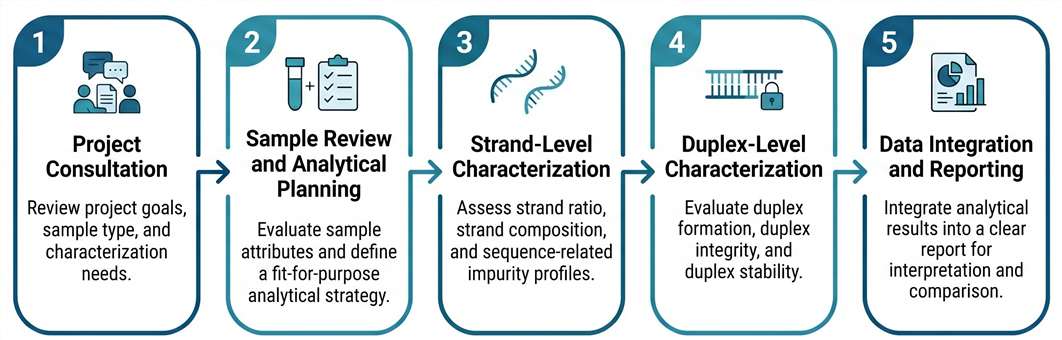
Workflow of siRNA and miRNA Characterization
- 1
Project Consultation
We begin by reviewing the project background, RNA format, molecular design, development stage, sample type, and key characterization questions. This step helps clarify whether the project should focus on strand ratio, sequence-related impurity profiling, residual single strands, duplex integrity, duplex stability, batch comparison, or a combined analytical scope.
- 2
Sample Review and Analytical Planning
Submitted sample information is evaluated, including RNA length, guide/passenger or duplex component design, chemical modification status, concentration, buffer composition, formulation matrix, storage condition, and available sample amount. Based on these factors, a fit-for-purpose analytical strategy is designed using appropriate chromatographic, electrophoretic, mass-based, or thermal stability approaches.
- 3
Strand-Level Characterization
Strand-focused analysis is performed to evaluate individual RNA strands and related oligonucleotide species. Depending on the project scope, this step may assess strand ratio, strand-level composition, residual single strands, truncated species, sequence-related variants, non-target oligonucleotide components, and selected synthesis- or modification-related variants where analytically feasible.
- 4
Duplex-Level Characterization
Duplex-focused analysis is conducted to determine whether the intended RNA strands form the expected duplex-associated product. This step may include evaluation of duplex formation, duplex integrity, unpaired or partially dissociated species, and stability-related behavior under selected buffer, temperature, storage, dilution, freeze-thaw, or stress-related conditions.
- 5
Data Integration and Reporting
Analytical results are integrated into a clear report for interpretation and comparison. The final report may include strand ratio results, chromatographic or electrophoretic profiles, LC-MS/MS information where applicable, impurity profile summaries, duplex stability assessment, and comparative interpretation across batches, preparation conditions, formulations, or stability samples.
Case Study: Nondenaturing LC-Based Analysis of siRNA Duplex Integrity and Strand-Associated Profiles
Short interfering RNA (siRNA) therapeutics are double-stranded oligonucleotides composed of complementary sense and antisense strands. Because siRNA product quality depends on both individual strand composition and intact duplex formation, analytical methods must distinguish duplex-associated profiles from excess or dissociated single-strand components. Conventional IP-RPLC is widely used for oligonucleotide analysis, but typical conditions may promote siRNA duplex denaturation, making nondenaturing intact-duplex characterization challenging. In this study, Enmark et al. evaluated whether salt-mediated IP-RPLC conditions could better preserve siRNA duplexes during chromatographic analysis.
Key findings:
- Melting-temperature experiments showed that IP-RPLC diluent conditions strongly influenced siRNA duplex stability, while PBS addition reduced the destabilizing effect on siRNA#1.
- Under IP-RPLC conditions without PBS, siRNA#1 was largely converted into sense and antisense single strands, even at low column temperature, indicating substantial duplex disruption.
- With 0.25X PBS-containing mobile phases, the siRNA#1 duplex was preserved at 30 °C, and excess antisense strand could still be distinguished from the intact duplex profile.
- Increasing column temperature under PBS-containing conditions led to progressive duplex denaturation, demonstrating the importance of matching chromatographic conditions with duplex thermal behavior.
- Ammonium acetate was further used as an MS-compatible salt additive, enabling nondenaturing LC-MS analysis of the intact siRNA duplex and strand-associated profiles.
This case study demonstrates that salt-mediated IP-RPLC can improve nondenaturing analysis of siRNA duplexes by reducing chromatographic duplex disruption. The results highlight the importance of condition-sensitive analytical design for distinguishing intact duplexes, excess single strands, and stability-related profile changes during siRNA characterization.
Source
Enmark M.; et al. Expanding the Analytical Toolbox for the Nondenaturing Analysis of siRNAs with Salt-Mediated Ion-Pair Reversed-Phase Liquid Chromatography. Analytical Chemistry. 2024, 96(47):18590-18595. doi: 10.1021/acs.analchem.4c05248
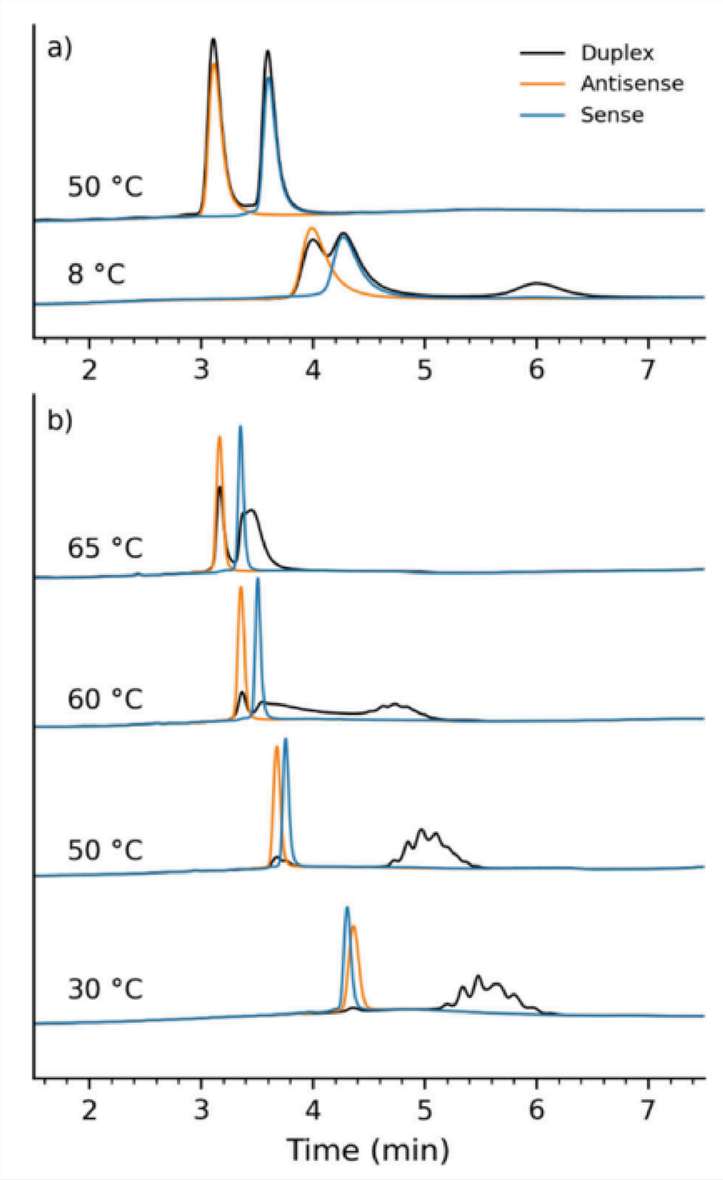
Figure from Enmark et al. (2024) showing UV-based nondenaturing LC analysis of siRNA#1 duplex, sense strand, and antisense strand under IP-RPLC conditions with and without PBS (CC BY 4.0).
FAQs of siRNA and miRNA Characterization
What types of siRNA and miRNA samples can be analyzed?
We support characterization of synthetic siRNA duplexes, miRNA mimics, miRNA inhibitors, and chemically modified short RNA duplexes. Purified RNA samples are generally preferred, while formulation-related samples can be evaluated depending on matrix compatibility, sample concentration, and project objective.
What quality attributes can be evaluated in siRNA and miRNA characterization?
Typical readouts may include strand ratio, strand-level composition, residual single strands, sequence-related impurity profiles, duplex formation, duplex integrity, and duplex stability. For chemically modified siRNA or miRNA products, modification-related assessment can be included where applicable and analytically feasible.
Does off-target impurity profiling mean biological off-target effect testing?
Not exactly. In this analytical context, off-target-associated impurity profiling refers to the detection of non-target or sequence-related oligonucleotide species that may affect product specificity, RNAi activity, or sample consistency. Direct biological off-target effect evaluation usually requires additional bioinformatics, transcriptomic, or cell-based functional studies.
How is duplex stability evaluated?
Duplex stability can be evaluated from both thermodynamic and condition-dependent perspectives. Common assessments may include thermal denaturation profiles, melting temperature (Tm), and comparison of duplex- and strand-associated analytical profiles before and after defined buffer, temperature, storage, freeze-thaw, dilution, or limited stress conditions. The specific study design depends on the sample format, available material, and development question.
How much sample is generally required?
Sample requirements vary by assay type and project scope. For routine siRNA or miRNA characterization, we generally recommend providing approximately 10-100 µg per sample when available. More sample may be needed for method development, repeat analysis, complex impurity profiling, or multi-condition stability studies. Please contact us for sample-specific recommendations.
What is the typical turnaround time?
Routine characterization projects typically require about 7-15 business days after sample receipt and project confirmation. More complex studies involving multiple batches, stability conditions, formulation comparisons, or customized method development may require a longer timeline, often around 2-4 weeks. Please contact us to discuss the expected timeline for your specific project.
How should I choose the appropriate characterization approach?
The most suitable approach depends on the key question, such as strand ratio and composition, impurity profiling, duplex formation, stability behavior, or batch comparability. Please provide sequence information, modification details, sample format, concentration, and project goals so that our team can recommend an appropriate analytical plan.
References
- Enmark M.; et al. Expanding the Analytical Toolbox for the Nondenaturing Analysis of siRNAs with Salt-Mediated Ion-Pair Reversed-Phase Liquid Chromatography. Analytical Chemistry. 2024, 96(47):18590-18595. doi: 10.1021/acs.analchem.4c05248
- Studzińska S.; et al. Cholesterol Stationary Phase in the Separation and Identification of siRNA Impurities by Two-Dimensional Liquid Chromatography-Mass Spectrometry. Int J Mol Sci. 2022, 23(23):14960. doi: 10.3390/ijms232314960.
For Research Use Only. Not for diagnostic procedures.