Free Cysteine Analysis Service
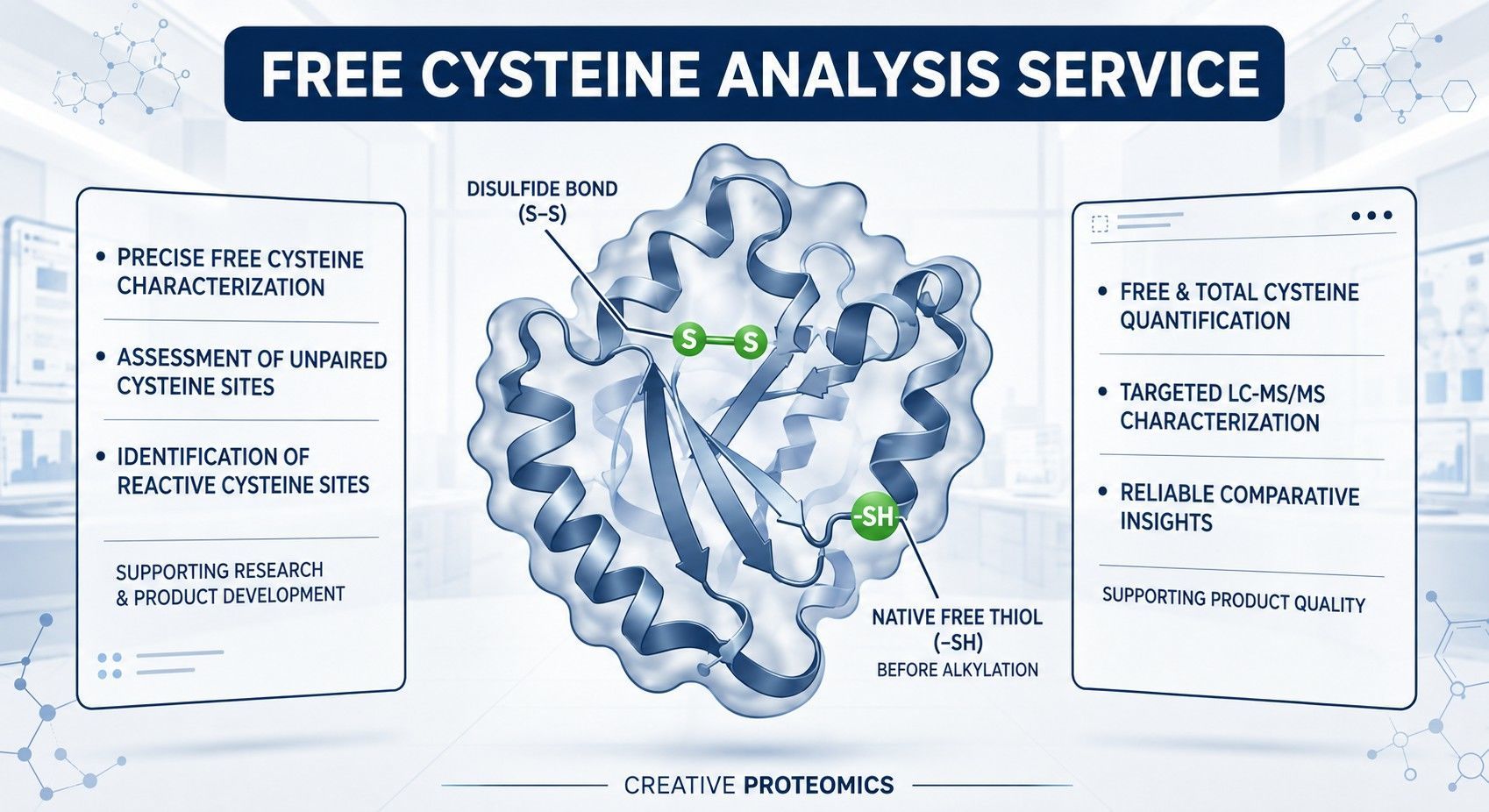
At Creative Proteomics, we understand that precise cysteine characterization is critical to the success of your research and product development. Whether you need routine free-thiol quantification, comparison of free and total/reducible cysteine, or targeted characterization of unpaired cysteine sites by LC-MS/MS, our service can be tailored to the sample matrix and study objective.
Our comprehensive analysis empowers you to:
- Understand protein folding dynamics, redox states, and structural changes
- Evaluate treatment efficacy in drug development or protein engineering
- Ensure product quality in pharmaceuticals, supplements, or biologics
To fully support your analytical journey, our suite of advanced bioinformatics tools provides high-accuracy insights to complement our laboratory testing. These tools are designed to serve both academic and commercial applications, ensuring that the data you receive from our testing services is translated into clear, reliable, and actionable structural knowledge.
Discuss Your ProjectIn line with ICH Q6B Guidance for biologic characterization
Jump to Section
- Why Free Cysteine Analysis Matters
- Service Capabilities
- Biologic Modalities
- Analytical Approaches
- Service Advantages
- Instrument Platform
- Workflow
- Report Deliverables
- FAQs
- Sample preparation
Why Free Cysteine Analysis Matters in Protein Characterization
Cysteine thiols are highly reactive and can participate in disulfide bonding, redox regulation, catalytic activity, covalent ligand binding, and post-translational modification. Measuring free cysteine supports assessment of protein folding and redox state, evaluation of structural changes, and research-stage product-quality characterization.
Critical pre-analytical requirement. Free cysteines must be stabilized immediately after sample collection or lysis to lock their redox state and prevent artifactual oxidation. Please contact us for recommended stabilization buffers compatible with downstream analysis.
Free Cysteine Analysis Service Capabilities
Our Free Cysteine Analysis service includes the following capabilities:
Free Cysteine Quantification
Measure native free-thiol content in samples stabilized at collection without an initial reduction step.
Total Cysteine Measurement
Analyze a separate aliquot after reduction and secondary capping to measure total cysteine content.
Oxidized Cystine Estimation
Estimate the oxidized cysteine fraction from the difference between total and free cysteine measurements when the study design, reporting basis, and stabilization support the comparison. Reporting as cystine molecules requires the appropriate 2:1 cysteine-to-cystine stoichiometric conversion.
Cysteine Variant and PTM Characterization
Use high-specificity LC-MS/MS strategies when trace-level detection, cysteine-peptide differentiation, or identification of specific modifications is required.
Routine Product and Formulation Testing
Support quantification, purity checks, and quality-control studies for purified proteins, peptides, pharmaceutical formulations, and nutritional products.
Free Cysteine Analysis Across Biologic Modalities
We support free cysteine analysis across a range of biologic and formulation sample types:
- Purified Proteins and Peptides
Routine free or total cysteine quantification, purity checks, and assessment of disulfide-related structural changes in relatively clean samples. - Antibodies and Other Biologics
Characterization of unpaired or reactive cysteines relevant to folding, structural stability, protein engineering, and biologic product quality. - Cell Lysates, Tissues, and Complex Biological Matrices
High-sensitivity LC-MS/MS analysis for trace-level cysteine measurements or cysteine-containing species in crowded matrices. - Food, Beverage, Supplement, and Pharmaceutical Formulations
Method selection based on expected concentration, matrix complexity, and the need for routine quantification versus higher-specificity characterization.
Analytical Approaches for Free Cysteine Characterization
Selecting the right analytical method is crucial for obtaining accurate, actionable data. We offer two complementary analytical options.
| Approach | Best suited for | Service scope |
| HPLC-UV/Fluorescence | Routine quantification, purity checks, and standard formulations | Established derivatization adds a fluorescent or UV-absorbing tag to cysteine for reliable, cost-effective quantification in relatively simple and clean sample matrices. |
| LC-MS/MS | Complex biological matrices, trace-level detection, and structural characterization | Targeted chemical modification locks reactive free thiols, while mass-to-charge analysis provides high sensitivity and specificity for cysteine variants, specific PTMs, or cysteine-containing peptides. |
Service Advantages
Our service combines flexible method selection, pre-analytical guidance, quantitative insight, and clear data interpretation.
- Complementary Method Options
Choose routine HPLC-UV/Fluorescence quantification or high-sensitivity LC-MS/MS according to matrix complexity and the required analytical depth. - Pre-Analytical Stabilization Guidance
Project-specific guidance helps protect the native thiol state and reduce oxidation artifacts before samples reach the laboratory. - Quantitative and Structural Insight
The workflow can support free and total cysteine measurements, oxidized-fraction calculation, and—when required—specific cysteine variant or PTM characterization. - Comprehensive Data Interpretation
Advanced informatics and report-level quality metrics help translate raw analytical results into clear and actionable conclusions.
Instrument Platform for Free Cysteine Analysis
Creative Proteomics provides two complementary analytical platforms: HPLC with UV or fluorescence detection for derivatization-based routine quantification, and high-sensitivity LC-MS/MS for trace-level analysis in complex matrices and more specific structural characterization. The final platform and sample-preparation strategy are selected according to sample type, expected concentration, and study goal.
Free Cysteine Analysis workflow
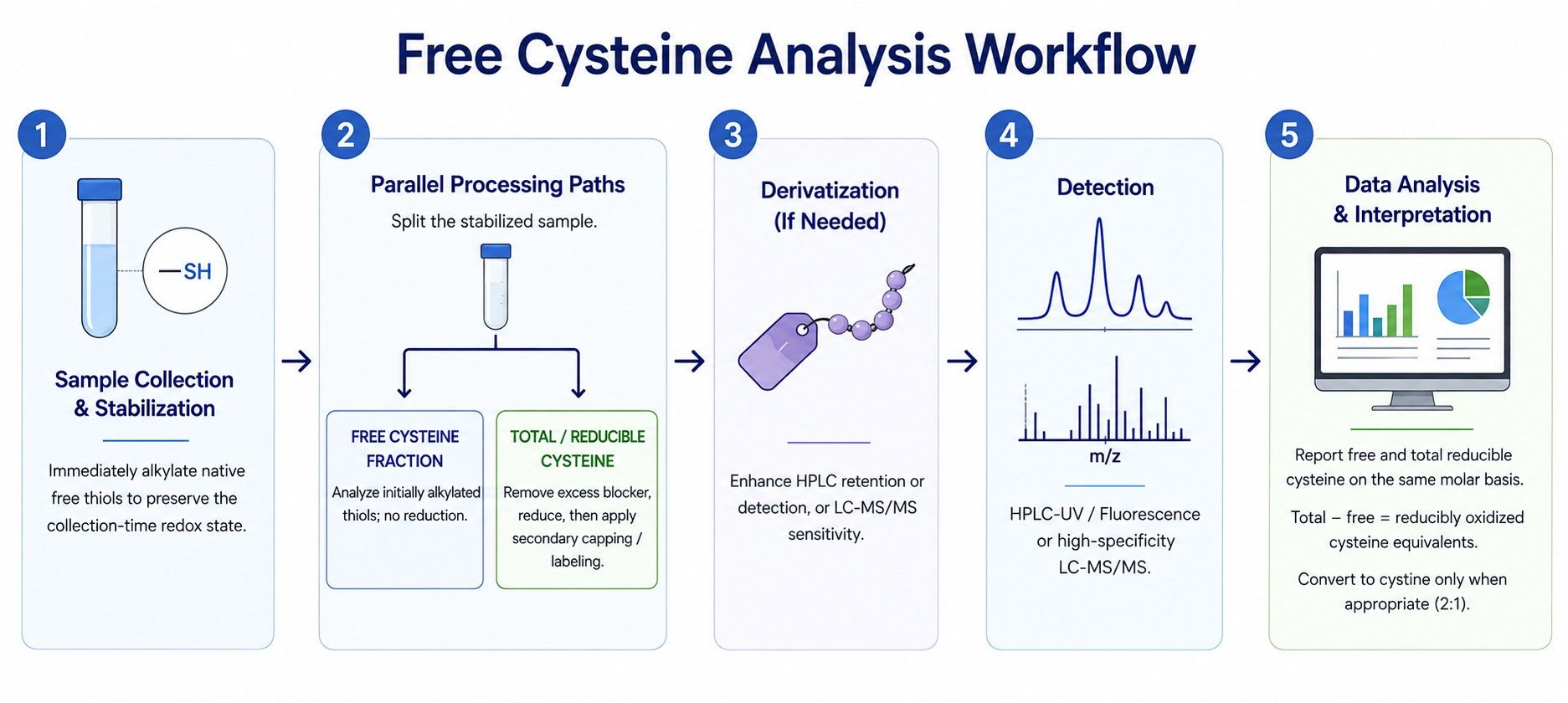
Our five-stage workflow supports accurate quantification of free and total cysteine in proteins, peptides, and complex samples:
- 1
Sample Collection & Stabilization
Free cysteines must be immediately stabilized via alkylation at the collection site to lock their redox state and prevent artifactual oxidation. Please contact us for our recommended stabilization buffers to ensure complete compatible with the selected downstream analytical workflow.
- 2
Parallel Processing Paths
- For Free Cysteine: The stabilized sample bypasses reduction and goes directly to downstream analysis to measure the native free thiol content.
- For Total Cysteine: A separate aliquot undergoes Reduction to break oxidized cystines and mixed disulfides, followed by a secondary capping step to measure total cysteine content.
- 3
Derivatization (If Needed)
Cysteines may be tagged to enhance detection for HPLC or LC-MS/MS analysis, especially in complex or trace-level samples.
- 4
Detection
Samples are analyzed using HPLC-UV/Fluorescence (for high-concentration, purified samples) or LC-MS/MS (for high sensitivity and complex biological matrices).
- 5
Data Analysis & Bioinformatics
Quantification is performed using appropriate data-analysis tools. When both free and total measurements are available, the oxidized cysteine contribution can be estimated by difference; reporting as cystine molecules requires the appropriate stoichiometric conversion.
Note: Depending on the selected platform and project scope, the final report may include chromatograms or mass spectra, calibration data, replicate-precision metrics, processed results, and scientific interpretation.
Report Deliverables
The comprehensive final report can include:
- Free cysteine results and, when included in the project scope, total cysteine results and the estimated oxidized cysteine fraction with its documented calculation basis.
- Method, sample-preparation, stabilization, and analytical-condition details.
- Calibration curves with verified linearity (R² values) and data reproducibility metrics.
- Raw mass spectra for LC-MS/MS projects and other relevant analytical outputs, where applicable.
- Processed results, conclusions, and interpretation aligned with the study objective.
Frequently Asked Questions About Free Cysteine Analysis
What is the typical turnaround time for results?
Our standard turnaround time is 3 to 4 weeks from the date we receive your samples. Larger batches or highly complex LC-MS/MS requests may require additional processing time, which will be communicated upon sample receipt.
Can you distinguish between free cysteine and oxidized cystine?
If the sample's free cysteines are stabilized at the time of collection, we can quantify free cysteine. A separate aliquot can then be reduced to measure total cysteine, allowing the oxidized cysteine contribution to be estimated by difference. When reported as cystine molecules, the calculation includes the appropriate stoichiometric conversion. Please contact us for stabilization-buffer guidance.
Which method should I choose?
For a clean, purified sample used to verify concentration, HPLC-UV/Fluorescence is generally appropriate. For trace amounts in complex matrices or identification of specific modifications, LC-MS/MS is generally preferred.
What happens to my samples after the analysis is complete?
We are unable to return leftover samples once testing is complete. Please send only the amount needed for the agreed analysis and quality-control plan.
Sample Requirements for Free Cysteine Analysis
Please provide sufficient material for replicate runs and quality control. General submission guidelines are summarized below.
| Parameter | General guideline |
| Accepted sample types | Purified proteins and peptides; complex biological matrices; food, beverage, and nutritional supplements; pharmaceutical and industrial formulations |
| Liquid samples | Minimum 100 µL per sample for plasma, lysates, extracts, and other liquids |
| Solid samples | Minimum 1 mg per sample for tissue, purified protein, powder, and other solids |
| Concentration | For purified protein or peptide solutions, a concentration of ≥1 mg/mL is preferred. Lower-concentration samples and complex biological matrices may be accepted following project-specific review. |
| Interfering substances | Clearly report reducing agents such as DTT or BME, detergents such as SDS or Triton X-100, and elevated EDTA or salt. Pre-cleaning, dialysis, FASP, or MS-compatible alternatives may be recommended. |
| Shipping | Ship biological matrices such as plasma, lysates, and tissue on dry ice. Purified lyophilized proteins or stabilized extracts may be shipped on cold packs or at ambient temperature when their stability supports it. |
Stability Warning: Cysteine is highly susceptible to artifactual oxidation. Apply the recommended stabilization buffer at the collection site. Shipping an unstabilized sample on dry ice does not necessarily preserve the original biological redox state.
References
- Cheng Y, Chen MT, Patterson LC, et al. Domain-specific free thiol variant characterization of an IgG1 by reversed-phase high-performance liquid chromatography mass spectrometry. Analytical Biochemistry. 2017;519:8–14. doi:10.1016/j.ab.2016.12.003.
- Sethuraman M, McComb ME, Huang H, et al. Isotope-coded affinity tag (ICAT) approach to redox proteomics: identification and quantitation of oxidant-sensitive cysteine thiols in complex protein mixtures. Journal of Proteome Research. 2004;3:1228–1233. doi:10.1021/pr049887e.
- Furuki K, Toyo'oka T. Determination of thiol-to-protein ratio and drug-to-antibody ratio by in-line size exclusion chromatography with post-column reaction. Analytical Biochemistry. 2017;527:33–44. doi:10.1016/j.ab.2017.04.008.