CRISPR Constructs Analysis Service
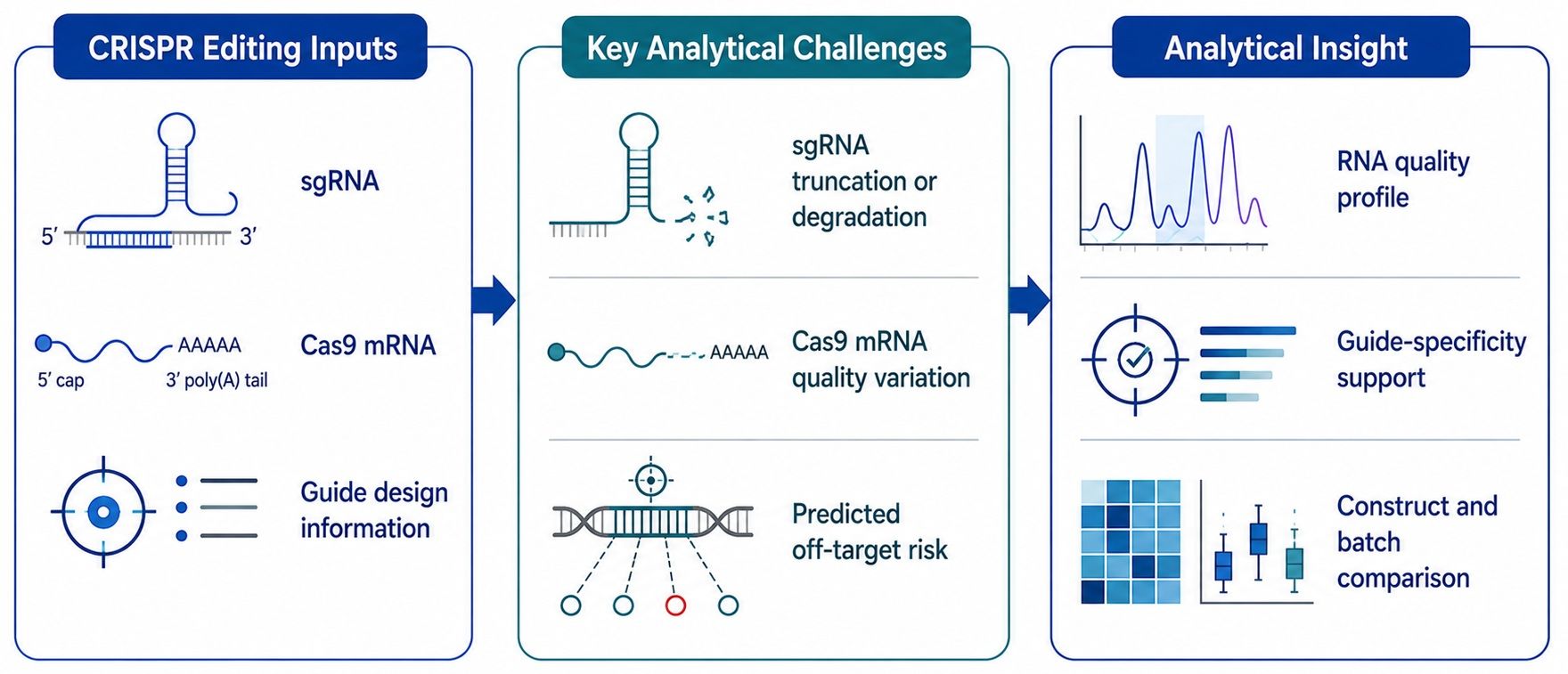
Creative Proteomics provides CRISPR constructs analysis services to support the development, optimization, and quality assessment of genome editing components. In CRISPR-based workflows, the performance of editing systems can be influenced by guide RNA integrity, nuclease mRNA quality, and the potential specificity risks associated with guide design. Reliable characterization of these components helps researchers identify construct-related quality issues before downstream cell-based or functional studies. Degraded sgRNA, poor Cas9 mRNA integrity, sequence-related impurities, or insufficient off-target risk assessment may affect editing efficiency, reproducibility, and data interpretation. Our CRISPR constructs analysis services integrate sgRNA integrity assessment, Cas9 mRNA quality assessment, and off-target evaluation support. These services help researchers compare candidate constructs, optimize CRISPR editing workflows, and generate analytical data to support genome editing research and development.
Discuss Your ProjectIn line with ICH Q6B Guidance for biologic characterization
Jump to Section
- Why CRISPR Constructs Analysis Matters
- Service Capabilities
- Development Scenarios
- Service Advantages
- Instrument Platform
- Analysis Workflow
- Case study
- FAQs
Why CRISPR Constructs Analysis Matters
CRISPR-based editing systems are highly design-dependent, but editing performance is not determined by guide design alone. The molecular condition of sgRNA, the quality profile of Cas9 mRNA, and the specificity-related features of guide-target recognition can all influence experimental reproducibility, data interpretation, and downstream decision-making. CRISPR constructs analysis provides construct-level evidence to help determine whether key editing components and guide-related attributes remain consistent with the intended experimental design.
In practice, CRISPR constructs analysis is valuable because it connects guide design, molecular quality, and specificity-related evaluation. The following points summarize how construct-focused analysis supports a deeper understanding of CRISPR editing materials.
- Reduce uncertainty before downstream editing studies
The molecular condition of CRISPR editing components can influence experimental performance and data interpretation. Early construct-level analysis helps identify potential material- or design-related concerns before cell-based or functional studies. - Improve consistency in CRISPR workflows
Differences in RNA condition, construct preparation, or guide-related properties may contribute to variable editing results. Analytical assessment helps researchers better understand possible sources of inconsistency. - Support rational construct selection
When multiple guide RNAs or CRISPR formats are being compared, construct-level information can help support more informed candidate selection and reduce reliance on trial-and-error screening. - Strengthen comparability across batches or designs
For CRISPR workflows involving different lots, designs, or preparation conditions, construct analysis provides useful information for comparing material consistency and tracking changes during optimization.
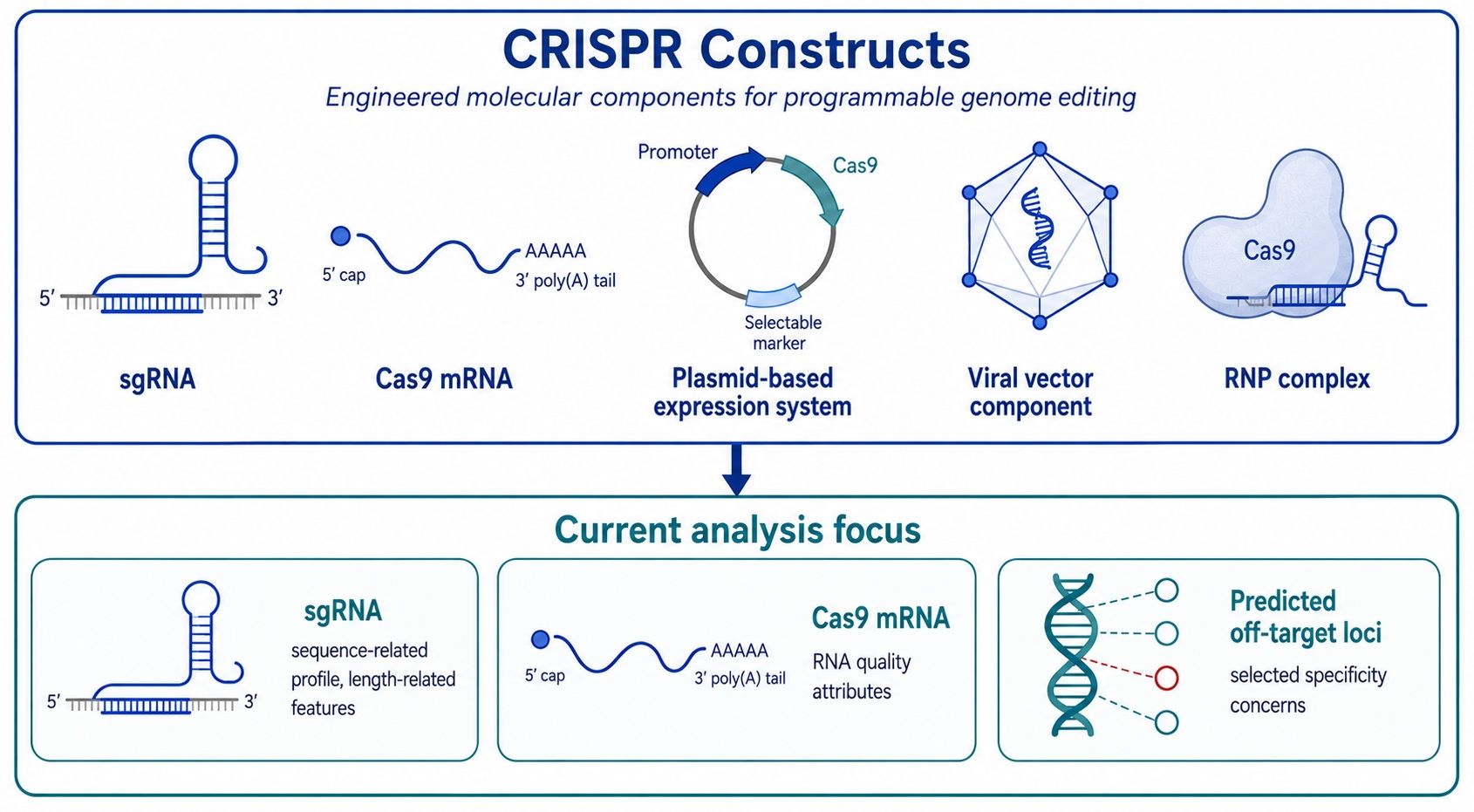
CRISPR Constructs Analysis at Creative Proteomics
Creative Proteomics provides focused analytical support for CRISPR constructs, covering guide RNA integrity, nuclease mRNA quality attributes, and guide-specificity evaluation to support CRISPR editing workflow development and construct comparison.
| CRISPR Construct Analysis Focus | Analytical Strategy | Key Information Delivered |
| sgRNA Integrity Analysis | Evaluation of sgRNA integrity and sequence-related quality attributes using suitable analytical approaches, such as LC-MS, LC-MS/MS, HPLC/UPLC, capillary electrophoresis, or fragment analysis, selected according to guide RNA length, modification status, and project goals. | Information on expected guide RNA species, length-related variants, truncation products, degradation-related signals, and sequence-related impurity profiles to support sgRNA material assessment and construct comparison. |
| Off-Target Evaluation Support | In silico prediction, candidate off-target site prioritization, and targeted amplicon sequencing-based evaluation for selected loci, designed according to guide sequence, target species, genome context, and edited sample availability. | Prioritized off-target candidate information, selected-locus modification frequency, indel-related readouts, and guide-specificity-related evidence to support guide selection and off-target risk follow-up. |
| Cas9 mRNA Quality Assessment | Assessment of Cas9 mRNA quality using RNA-focused analytical methods, such as fragment analysis, electrophoretic analysis, chromatographic profiling, and other fit-for-purpose RNA quality evaluation strategies. | Information on RNA integrity, size-related distribution, degradation pattern, purity-related profile, and transcript quality attributes relevant to downstream CRISPR editing workflows. |
Applications of CRISPR Constructs Analysis Services
CRISPR constructs analysis can be applied across early genome editing research, construct optimization, and analytical comparison workflows where reliable information on CRISPR-related materials is needed.
- Guide RNA candidate screening
Support comparison of candidate sgRNAs during early CRISPR system design and guide selection. - CRISPR construct and workflow development
Provide analytical support during editing component preparation, construct format selection, and pre-experiment assessment before downstream transfection, formulation, or cell-based editing studies. - Early-stage genome editing research
Support research projects that require construct-level characterization and guide-specificity evaluation before further biological testing. - Batch-to-batch and design comparability studies
Support comparison of different sgRNA lots, Cas9 mRNA preparations, construct designs, or preparation conditions. - Off-target risk follow-up studies
Support evaluation of predicted or selected off-target loci during guide optimization and editing specificity assessment.
Advantages of Our CRISPR Constructs Analysis Services
- Integrated analytical strategy: We combine RNA-focused analytical methods, sequencing-based approaches, and bioinformatic evaluation to support CRISPR construct assessment from multiple perspectives.
- Project-specific method selection: Analytical workflows can be adjusted based on construct type, sample format, target species, guide design, and downstream study objectives.
- Support for both molecular quality and specificity-related evaluation: Our service framework covers construct-level quality attributes as well as guide-specificity considerations, helping researchers evaluate CRISPR materials more comprehensively.
- Flexible support for early-stage and development-stage projects: Whether the project involves initial guide screening, construct comparison, batch assessment, or preparation for downstream studies, the analysis plan can be tailored to the project stage.
- Clear and interpretable analytical reports: Results can be organized with method descriptions, key analytical findings, sequence- or site-related observations, and project-specific interpretation to support decision-making.
- Experience with nucleic acid and RNA-based analytical workflows: Our team supports a broad range of nucleic acid characterization projects, enabling method adaptation for CRISPR-related RNA components and editing-support studies.
CRISPR Constructs Analysis Platforms
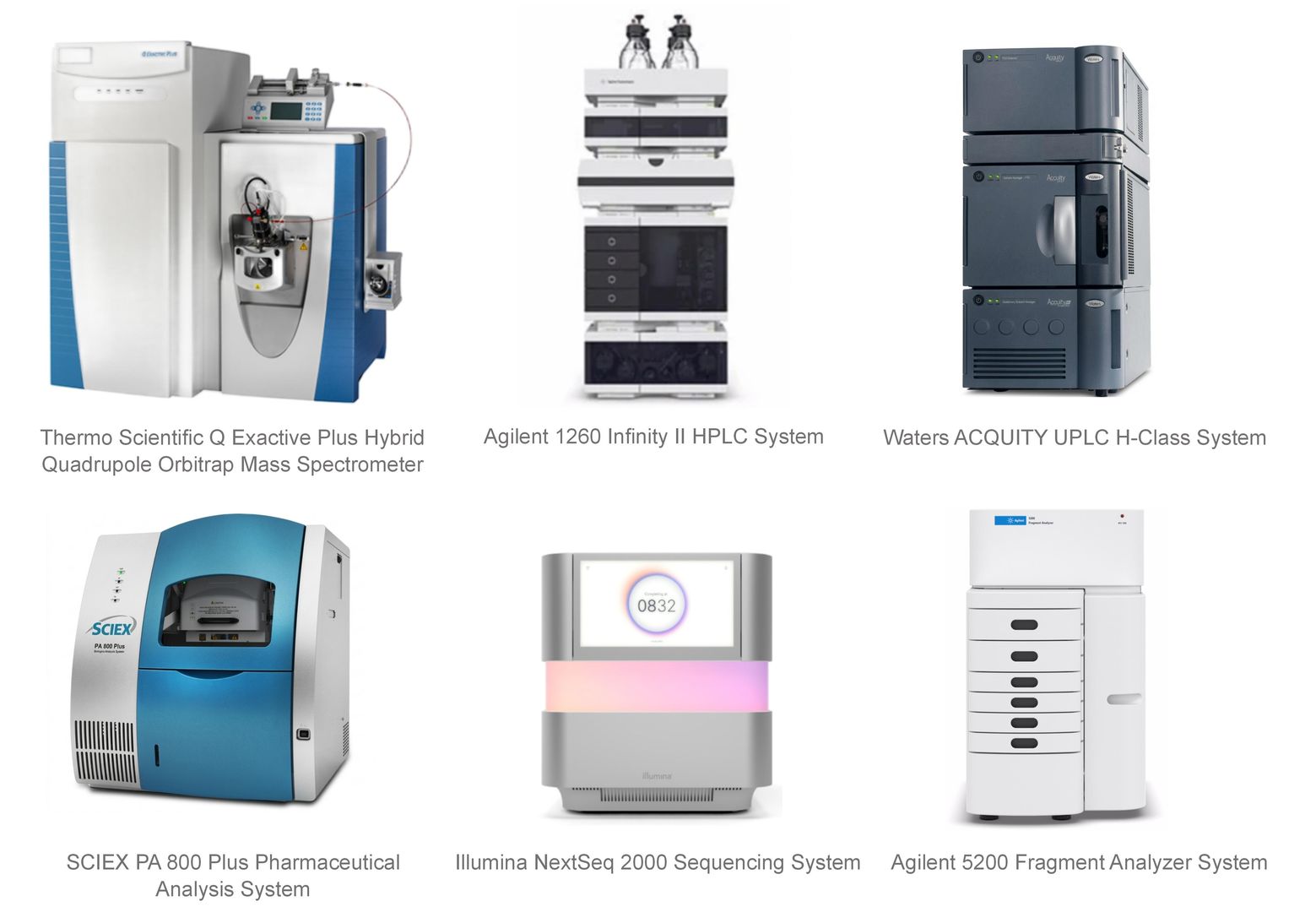
Creative Proteomics is equipped with advanced analytical and sequencing platforms to support CRISPR constructs analysis, including RNA integrity assessment, chromatographic profiling, mass spectrometry-based characterization, capillary electrophoresis analysis, and targeted amplicon sequencing.
- Thermo Scientific Q Exactive Plus Hybrid Quadrupole Orbitrap Mass Spectrometer
High-resolution accurate-mass and MS/MS platform for RNA- and oligonucleotide-related characterization, supporting sgRNA mass confirmation, sequence-related impurity assessment, modification-related analysis, and fragment-level characterization where suitable. - Agilent 1260 Infinity II HPLC System
HPLC-based separation platform for chromatographic profiling of CRISPR-related RNA components, including purity-related assessment, degradation profile evaluation, and comparison of sgRNA or RNA preparation conditions. - Waters ACQUITY UPLC H-Class System
High-efficiency UPLC platform for improved chromatographic resolution of closely related RNA species, supporting separation of length-related variants, truncated products, degradation-related species, and product-related heterogeneity where applicable. - SCIEX PA 800 Plus Pharmaceutical Analysis System
Capillary electrophoresis platform for orthogonal nucleic acid assessment, supporting size- or charge-related profiling, electrophoretic comparison, and purity-related evaluation of sgRNA, RNA fragments, or other CRISPR-related nucleic acid materials. - Illumina NextSeq 2000 Sequencing System
NGS platform for targeted amplicon sequencing of selected genomic loci, supporting off-target evaluation by quantifying indel-related readouts or modification frequencies at selected on-target and predicted or prioritized off-target sites. - Agilent 5200 Fragment Analyzer System
Automated fragment analysis platform for RNA size distribution, integrity assessment, and length-related profiling. It is particularly useful for evaluating Cas9 mRNA quality attributes, RNA degradation patterns, and size-related consistency across samples.
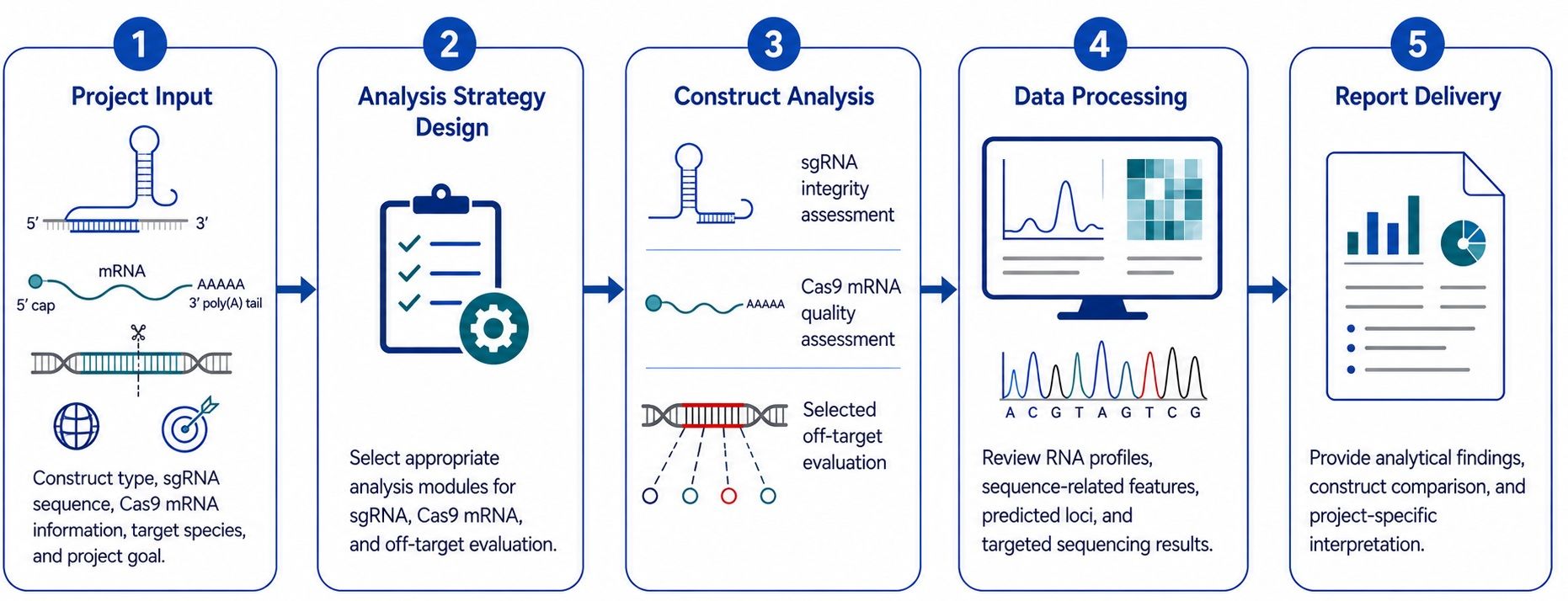
Workflow of CRISPR Constructs Analysis
- 1
Project Input
We begin by reviewing the construct type, sgRNA sequence, Cas9 mRNA information, target species, available sample details, and project objectives. This step helps clarify whether the project should focus on sgRNA integrity, Cas9 mRNA quality attributes, selected off-target loci, or a combination of these analysis modules.
- 2
Analysis Strategy Design
Based on the project goal and construct format, we design a fit-for-purpose analytical strategy. The analysis plan may include sgRNA integrity assessment, Cas9 mRNA quality assessment, off-target prediction, candidate off-target site prioritization, or targeted amplicon sequencing for selected loci.
- 3
Construct Analysis
Construct-level analysis is performed according to the selected strategy. Depending on the scope, this step may evaluate sgRNA integrity, length-related variants, truncation or degradation signals, Cas9 mRNA size-related distribution, RNA quality profiles, or selected off-target loci in edited samples.
- 4
Data Processing
Analytical and sequencing data are processed to extract project-relevant information, such as RNA profiles, sequence-related features, predicted off-target loci, targeted sequencing readouts, and selected-locus modification frequencies where applicable. The results are reviewed in the context of the submitted construct design and analysis objectives.
- 5
Report Delivery
A structured report is provided with the analytical findings, method information, construct comparison results, and project-specific interpretation. When appropriate, the report may also include recommendations for additional analysis, guide candidate comparison, or follow-up evaluation of selected off-target concerns.
Case Study: Sequencing-Supported Evaluation of Modified CRISPR Guide RNAs and Selected Off-Target Loci
CRISPR-Cas9 editing relies on guide RNA sequences to direct Cas9-mediated DNA cleavage at selected genomic sites. However, guide RNA design and sequence-related properties can also influence recognition of closely matched off-target sites, making specificity assessment an important part of CRISPR construct evaluation. In the referenced study, unmodified and BNANC-modified crRNAs targeting WAS and EMX1 were compared using selected on-target and previously identified off-target loci as a model for guide RNA construct comparison and targeted off-target evaluation.
Key findings:
- High-throughput sequencing was used to quantify modification frequencies at matched on-target and selected off-target loci, with indel-containing reads used to calculate modification frequency.
- Compared with unmodified crRNA constructs, BNANC-modified crRNAs showed distinct locus-specific modification profiles across the selected WAS and EMX1 on-target and off-target sites.
- For the WAS-targeting crRNA, WAS-BNA-3 retained measurable on-target modification frequency while reducing several selected off-target readouts to very low levels, including WAS-OT3, WAS-OT4, and WAS-OT5 in U2OS-Cas9 cells and WAS-OT2 to WAS-OT5 in HeLa-Cas9 cells.
- For the EMX1-targeting crRNA, EMX1-BNA-5 retained measurable on-target modification frequencies in both U2OS-Cas9 and HeLa-Cas9 cells and reduced EMX1-OT1 to the reported detection-limit level in both cell types.
- The extent of off-target signal reduction varied by target, cell type, and off-target site, highlighting the importance of evaluating multiple selected loci rather than relying on a single off-target readout.
This case study demonstrates how targeted sequencing of selected loci can support guide RNA construct comparison, guide-specificity assessment, and follow-up evaluation of predicted off-target concerns in CRISPR construct analysis workflows.
Source: [1]
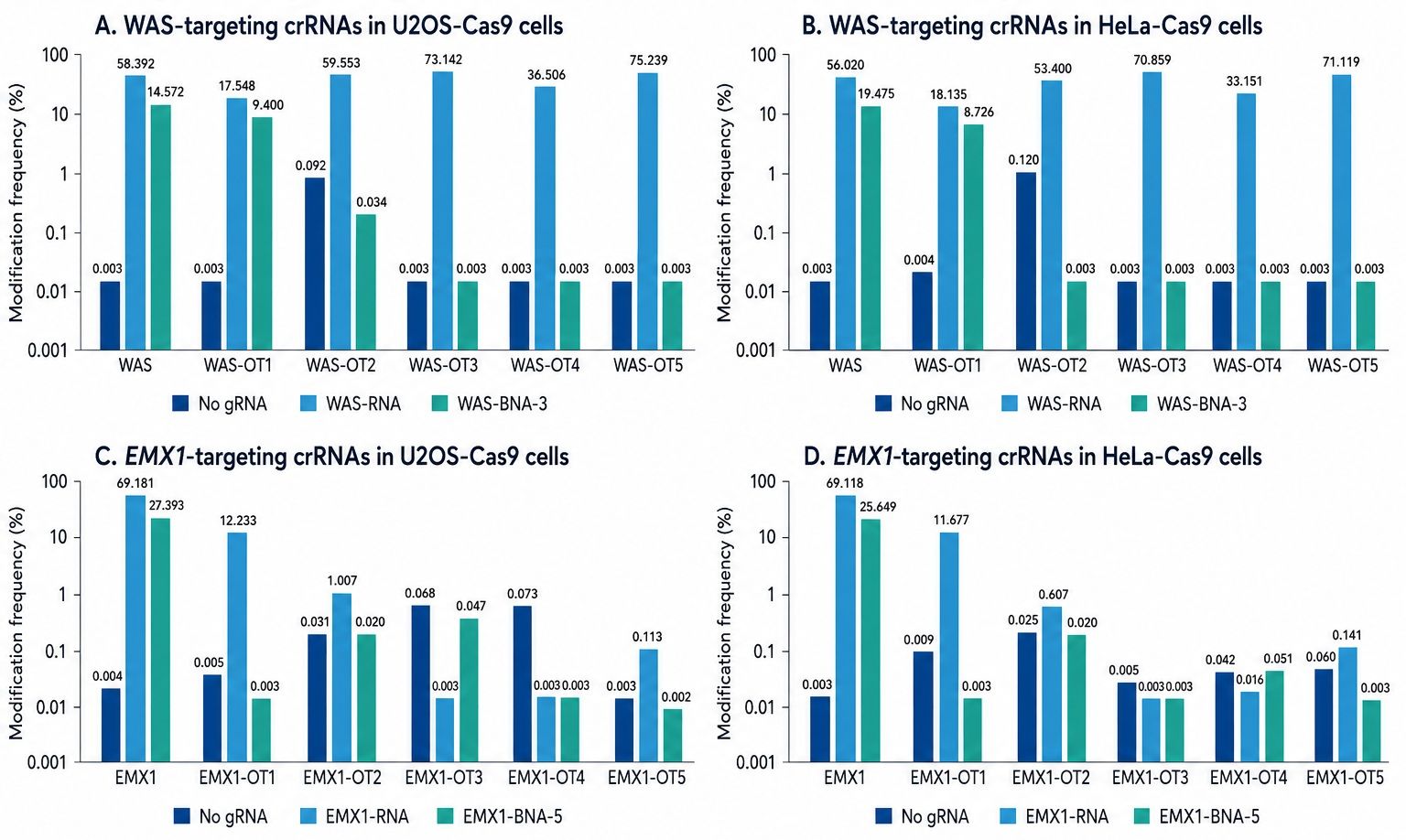
Figure adapted from Cromwell et al. (2018) showing high-throughput sequencing-based modification frequencies of unmodified and BNANC-modified CRISPR guide RNAs at selected WAS and EMX1 on-target and off-target loci (CC BY 4.0).
FAQs of CRISPR Constructs Analysis
What types of CRISPR constructs can be analyzed?
We support analysis of CRISPR-related components such as sgRNA, Cas9 mRNA, and selected predicted off-target loci. Depending on the project design, the analysis may also support comparison of different guide candidates, RNA preparations, construct formats, or preparation conditions.
Can you analyze both sgRNA and Cas9 mRNA in the same project?
Yes. sgRNA and Cas9 mRNA can be evaluated separately or as part of an integrated CRISPR construct analysis project. The analytical plan can be adjusted based on the sample format, quality attributes of interest, and downstream application.
What information can sgRNA integrity analysis provide?
sgRNA integrity analysis can provide information on the expected guide RNA species, length-related variants, truncation products, degradation-related signals, and sequence-related quality features. This helps assess the molecular profile of the sgRNA preparation before downstream CRISPR workflows.
How is off-target evaluation supported?
Off-target evaluation can include in silico prediction, candidate off-target site prioritization, and targeted amplicon sequencing for selected loci. This approach helps researchers focus on guide-specificity concerns that are most relevant to the project design and edited sample type.
Can this service compare multiple guide RNA candidates?
Yes. Multiple sgRNA candidates can be compared based on analytical profiles and guide-specificity-related information. This can support candidate selection during early CRISPR system design or optimization.
What samples are required for CRISPR constructs analysis?
Sample requirements depend on the analysis type, RNA length, sample concentration, purity, and the number of constructs or loci to be evaluated. For guide design, in silico off-target prediction can support guide selection before edited samples are generated. Targeted sequencing of selected off-target loci can subsequently be performed once edited samples are available.
Is this service suitable before cell-based editing studies?
Yes. CRISPR constructs analysis can be used as a pre-experiment assessment step before transfection, electroporation, LNP formulation, or other cell-based editing workflows. For sgRNA and Cas9 mRNA inputs, the analysis can help confirm RNA-related profiles and identify degradation, truncation, or preparation-related concerns. For guide design, off-target prediction and selected-locus evaluation can support guide selection before edited samples are generated or further analyzed.
References
- Cromwell CR.; et al. Incorporation of bridged nucleic acids into CRISPR RNAs improves Cas9 endonuclease specificity. Nature Communications. 2018, 9(1):1448. doi: 10.1038/s41467-018-03927-0
- Ryan DE.; et al. Improving CRISPR-Cas specificity with chemical modifications in single-guide RNAs. Nucleic Acids Res. 2018, 46(2):792-803. doi: 10.1093/nar/gkx1199