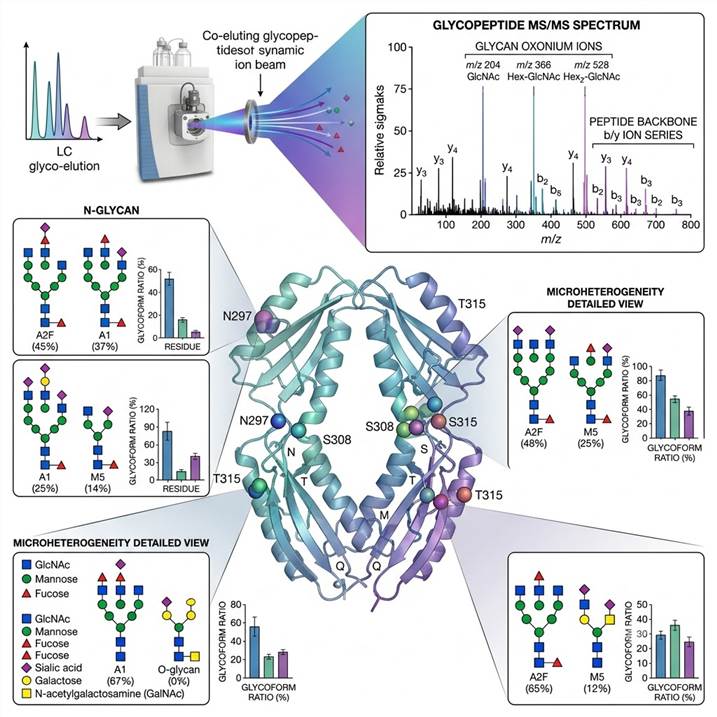
Why Site-Specific Glycosylation Analysis Matters
Glycosylation is the most structurally diverse post-translational modification, and its biological functions are inherently site-specific. The same glycan structure at different positions on a protein can have entirely different functional consequences. Site-specific glycosylation analysis addresses this complexity by resolving three critical dimensions of glycoprotein characterization.
Glycosylation Site Mapping and Localization
Identifying which residues carry glycans is the foundation of glycoprotein characterization. For N-glycosylation, the sequon N-X-S/T provides a predictable motif, but occupancy at each sequon is regulated independently — a protein may carry a glycan at one site while an identical sequon elsewhere remains unoccupied. For O-glycosylation, there is no consensus sequence, making site mapping entirely dependent on mass spectrometry with electron-based fragmentation methods. Without site-level resolution, the relationship between glycosylation and protein function remains correlative rather than mechanistic.
Glycan Microheterogeneity at Individual Sites
Unlike most PTMs where a modification is binary (present or absent), a single glycosylation site can display dozens of different glycan structures — a phenomenon known as microheterogeneity. The ratio of these glycoforms at a specific site can shift in disease, during biotherapeutic production, or in response to environmental stimuli. Measuring microheterogeneity at each site — rather than bulk glycan release — reveals the functionally relevant glycoform distribution that traditional glycomics approaches miss.
Site Occupancy and Macroheterogeneity
Not every potential glycosylation site is occupied in every protein molecule. The fraction of protein molecules carrying a glycan at a specific site — the site occupancy — determines whether a glycosylation event is functionally dominant or minor. This distinction is critical for biotherapeutic quality assessment (glycosylation site occupancy directly affects efficacy and immunogenicity) and for understanding the biological regulation of glycoprotein function.
Our Approach to Site-Specific Glycosylation Analysis
We deploy an integrated glycoproteomics pipeline combining multiple enrichment strategies, advanced mass spectrometry acquisition methods, and specialized bioinformatics tools to achieve comprehensive site-specific glycosylation characterization.
Glycopeptide Enrichment
Glycopeptides are typically low abundance in complex digests and require enrichment prior to LC-MS/MS analysis. We offer multiple enrichment strategies selected based on your glycoprotein type and research question: HILIC-based enrichment (broad coverage, suitable for both N- and O-glycopeptides), lectin affinity capture (targeted enrichment of specific glycan classes), and chemical enrichment methods (hydrazide chemistry, click chemistry). For comprehensive glycoproteome coverage, we combine complementary enrichment methods to maximize the depth of site-specific glycosylation characterization. Our Glycopeptide Enrichment service provides detailed information on enrichment strategy selection.
LC-MS/MS with Advanced Fragmentation
Site-specific glycosylation analysis requires fragmentation strategies that simultaneously generate information about both the glycan structure and the peptide backbone. We deploy stepped HCD (higher-energy collisional dissociation) for glycan oxonium ion fingerprints and peptide sequence identification, combined with EThcD (electron-transfer/higher-energy collision dissociation) for unambiguous O-glycosylation site localization. Where additional resolution is needed, we apply ion mobility separation (FAIMS or TIMS) to resolve isomeric glycopeptides that co-elute in standard LC separations.
Glycan Assignment and Bioinformatics
Glycopeptide identification requires specialized search algorithms that account for the combinatorial complexity of glycan-peptide combinations. We employ multiple complementary search engines — including Byonic, pGlyco3, MSFragger-Glyco, and O-Pair — to maximize identification coverage and cross-validate glycan assignments. Each glycopeptide identification is manually reviewed for key quality metrics including oxonium ion presence, peptide backbone coverage, and site localization confidence. The resulting data is compiled into site-specific glycosylation tables with complete annotation of glycan composition, putative structure, and relative abundance at each modification site.
For broader integration of glycosylation with other modification types, our PTM Crosstalk Analysis service provides multi-PTM co-regulation analysis and functional interpretation. Explore our GlycoRNA Sequencing Service Map Glycosylated RNAs with Precision.
Compatible Sample Types and Requirements
Our site-specific glycosylation analysis pipeline accepts a wide range of sample types. Requirements vary based on the complexity of the glycoprotein sample and the depth of analysis required.
| Sample Type |
Recommended Amount |
Typical Coverage |
| Purified glycoproteins (e.g., antibodies, recombinant proteins) |
≥10 μg |
Complete site mapping with microheterogeneity at each site |
| Immunoprecipitated glycoproteins |
≥5 μg per pull-down |
Site-specific glycosylation of target protein |
| Total cell lysate (global glycoproteomics) |
≥500 μg protein |
Hundreds of glycosylation sites across the proteome |
| Tissue homogenates |
≥20 mg wet weight |
Proteome-wide N- and O-glycosylation site profiling |
| Biofluids (serum, plasma, CSF) |
≥50 μL (≥100 μL for O-glycoproteomics) |
Site-specific glycosylation of abundant glycoproteins |
| Formalin-fixed paraffin-embedded (FFPE) tissue |
≥5 sections (10 μm each) |
Glycosylation site mapping from archived samples |
For quantitative comparisons across conditions, our Quantitative Glycoproteomics Analysis service provides integrated site-specific glycosylation quantification with label-free or labeled approaches.
Workflow: From Sample to Site-Specific Glycosylation Data
Step 1: Sample Preparation and Glycopeptide Enrichment
Proteins are extracted, reduced, alkylated, and digested using optimized proteases (trypsin, chymotrypsin, or multi-protease combinations for enhanced coverage). Glycopeptides are enriched using the strategy best suited to your sample type — HILIC, lectin affinity, or chemical enrichment — with parallel processing of non-enriched aliquots for protein abundance normalization.
Step 2: LC-MS/MS Data Acquisition
Enriched glycopeptides are analyzed on high-resolution Orbitrap or TIMS-TOF platforms using optimized LC gradients for glycopeptide separation. Data-dependent acquisition (DDA) with stepped HCD fragmentation is used for broad glycoproteome discovery, with supplementary EThcD scans for O-glycosylation site localization. For targeted analysis of specific glycoproteins, scheduled PRM methods are developed.
Step 3: Glycopeptide Identification and Glycan Assignment
Raw MS data are searched against protein databases using multiple glycoproteomics search engines. Glycan databases are curated based on the expected modification type and species. Each glycopeptide identification requires glycan oxonium ion validation, peptide backbone coverage ≥80%, and site localization confidence scoring. Ambiguous assignments are resolved through manual spectral interpretation.
Step 4: Site-Specific Quantification and Microheterogeneity Analysis
For each glycosylation site, the relative abundance of all detected glycoforms is calculated from extracted ion chromatogram areas. Glycoform distribution profiles are generated per site, displaying the fractional abundance of each glycan structure. For multi-condition experiments, differential analysis identifies sites and glycoforms with significant abundance changes.
Step 5: Data Integration and Biological Annotation
Site-specific glycosylation data is integrated with protein-level information including protein abundance, known functional domains, and pathway context. For biotherapeutic samples, critical quality attribute (CQA) assessment is performed against established glycosylation profiles. Results are cross-referenced with public glycoprotein databases for biological context.
Step 6: Deliverables and Review
Site-specific glycosylation table with complete glycan assignments and relative abundances per site, annotated MS/MS spectra for each identified glycopeptide, microheterogeneity bar charts per glycosylation site, differential glycosylation analysis for multi-condition experiments, quality metrics including false discovery rates and site localization confidence, and a scientist consultation session for biological interpretation.
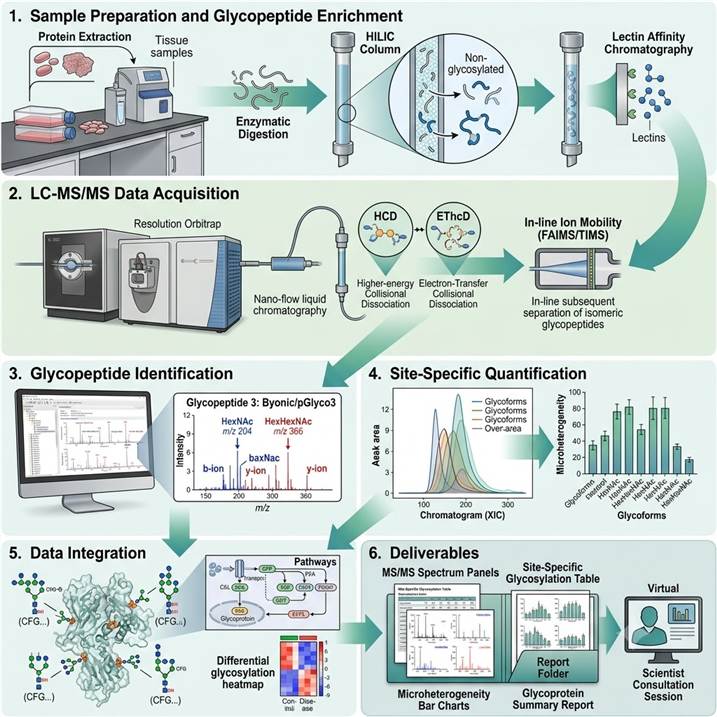
For comprehensive N-glycosylation profiling from discovery to detailed characterization, our N-Glycosylation Profiling service provides complementary glycan-level and glycopeptide-level analysis workflows.
Why Choose Our Site-Specific Glycosylation Analysis Service
Multi-Strategy Fragmentation for Complete Coverage
No single fragmentation method provides complete information for site-specific glycosylation characterization. Our pipeline integrates HCD (for glycan oxonium ions and peptide identification), EThcD (for O-glycosite localization), and optional ion mobility (for isomeric glycan separation), ensuring that both N- and O-glycosylation sites are fully characterized with unambiguous localization.
Deep Glycoproteomics Expertise
Glycopeptide identification and glycan assignment require specialized expertise that extends beyond standard proteomics bioinformatics. Our team has extensive experience with glycoproteomics search engines, glycan database curation, and manual spectral validation of glycan assignments — ensuring that every reported glycopeptide identification meets rigorous quality standards.
Biotherapeutic-Ready Analytical Framework
For biopharmaceutical clients, our site-specific glycosylation analysis is performed within a regulatory guidelines-compliant framework with full documentation suitable for ICH M10-aligned submissions. Our Antibody Glycosylation Analysis and Biopharma PTM Characterization services provide additional specialized capabilities for therapeutic glycoprotein characterization.
Flexible Project Scope
From a single purified glycoprotein with detailed microheterogeneity analysis to proteome-wide N- and O-glycoproteome mapping in complex samples, our pipeline scales to match your research question. Pilot studies can be completed rapidly, while comprehensive glycoproteome surveys provide systems-level glycosylation landscapes across experimental conditions.
Case Study: pGlycoNovo — Uncovering Missing Glycans for Site-Specific Glycosylation Analysis Across Species
In a 2024 study published in Nature Communications, Zeng et al. developed pGlycoNovo, a software tool that substantially expands the coverage of site-specific glycosylation analysis through a glycan-first, open-search strategy for intact glycopeptide identification.
Background: Conventional glycoproteomics search methods rely on predefined glycan databases that are inherently limited in scope, systematically missing unexpected or rare glycan structures. This limitation is particularly acute for cross-species studies and the analysis of non-canonical glycosylation where the glycan repertoire is poorly characterized.
Approach: The team developed pGlycoNovo, a de novo glycopeptide identification tool that uses a glycan-first, full-range Y-ion dynamic searching strategy. Unlike database-dependent methods that restrict the search to known glycan compositions, pGlycoNovo considers all possible monosaccharide combinations, expanding the glycan search space 16- to 1,000-fold compared to conventional methods. The tool was integrated into the pGlyco3 environment and validated against six other glycoproteomics search engines including pGlyco3, MSFragger-open, StrucGP, Byonic, GlycanFinder, and Glyco-Decipher.
Key Findings:
- pGlycoNovo identified 230 additional site-specific N-glycans and 30 previously unreported O-glycans in SARS-CoV-2 spike protein data that had been missed by conventional closed-search approaches
- The tool demonstrated superior search speed while maintaining high complementarity with existing tools — recovering the majority of identifications from other engines while adding thousands of novel glycopeptide identifications
- Applied across five evolutionarily distant species (plant, worm, fly, zebrafish, mouse), pGlycoNovo generated a dataset of 32,549 site-specific glycans on 4,602 proteins, including 2,409 site-specific rare glycans
- The open-search strategy revealed biologically significant rare glycan structures — such as phosphorylated N-glycans and glycans with unusual monosaccharide compositions — that would be systematically excluded from database-dependent searches
- pGlycoNovo's glycan-first approach addresses a fundamental limitation of existing tools: peptide-first search strategies cannot identify glycopeptides carrying glycans absent from the search database
Significance: This study demonstrates that site-specific glycosylation analysis is fundamentally limited by search strategy — and that open-search approaches can substantially expand the detectable glycoproteome. The findings have direct implications for both research glycoproteomics (enabling discovery of unexpected glycan structures) and biotherapeutic characterization (ensuring comprehensive glycan coverage for critical quality attribute assessment).
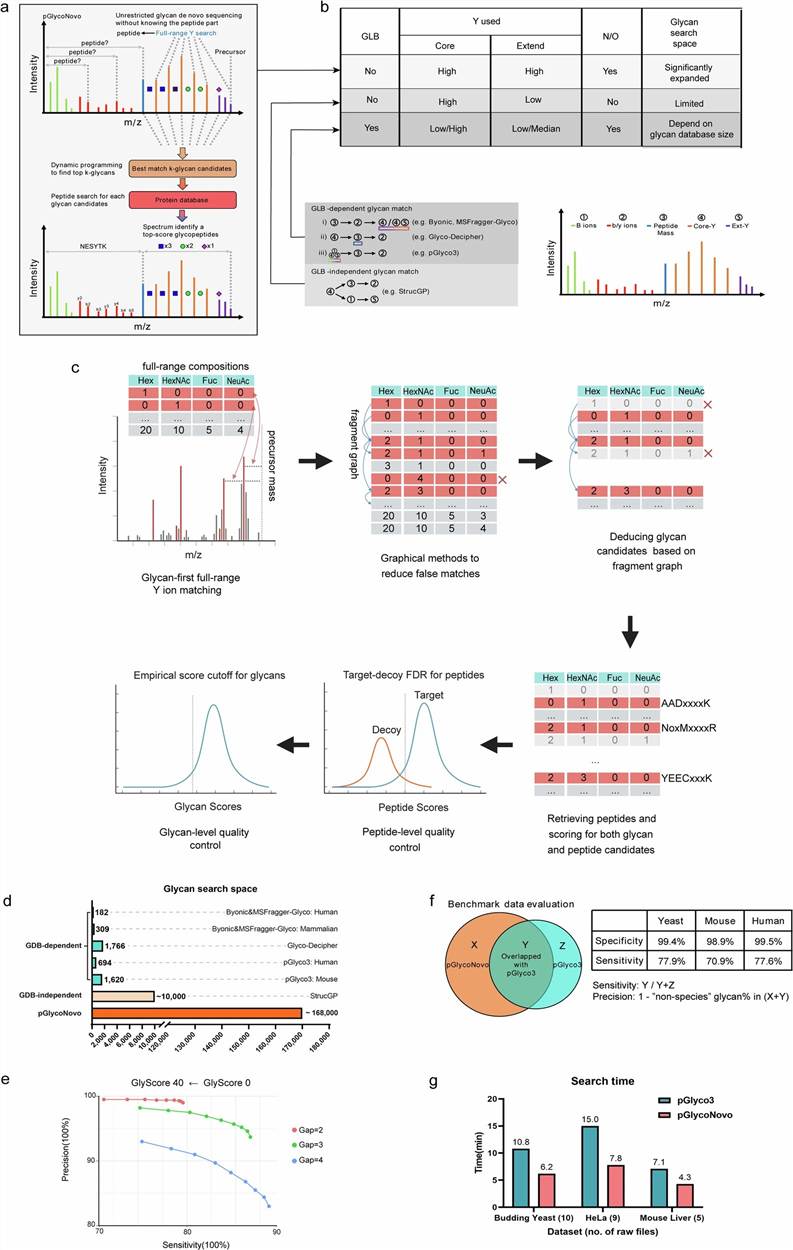
Figure 1 from Zeng et al. (2024). pGlycoNovo workflow: glycan-first, full-range Y-ion dynamic searching strategy for site-specific glycosylation analysis across species, with performance characterization and comparison with existing glycoproteomics search engines. (CC BY 4.0)
Representative Site-Specific Glycosylation Analysis Results
Our site-specific glycosylation analysis delivers integrated data packages with multiple annotation and visualization layers, enabling immediate biological interpretation and publication-quality figure generation.
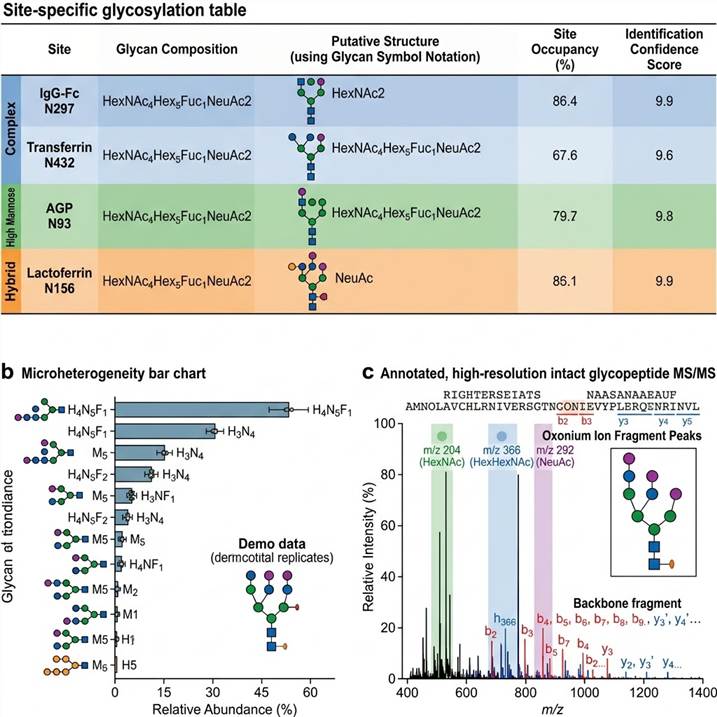
Representative data outputs from our site-specific glycosylation analysis pipeline. Left: Site-specific glycosylation table with glycan assignment and occupancy. Center: Microheterogeneity profile at individual glycosylation sites. Right: Annotated glycopeptide MS/MS spectrum with glycan oxonium ions and peptide backbone fragments.
Key deliverables included in every project package:
- Site-specific glycosylation table — For each glycosylation site: protein ID, site position, glycan composition and putative structure, site occupancy, and identification confidence
- Microheterogeneity profile per site — Bar charts and tables showing the relative abundance of each glycoform at each modification site, enabling comparison of glycan utilization patterns across conditions
- Annotated MS/MS spectra — For each reported glycopeptide, the annotated fragmentation spectrum with oxonium ion markers and peptide backbone ion assignments
- Differential glycosylation analysis — For multi-condition experiments, site- and glycoform-specific abundance changes with statistical testing
- Glycan structure summary — Comprehensive list of all identified glycan compositions with putative structures and their distribution across modification sites
Related Services
Our site-specific glycosylation analysis is one component of a comprehensive glycoproteomics and PTM analysis platform. These services can be used independently or integrated into a complete glycoprotein characterization workflow.
FAQs
What is the difference between site-specific glycosylation analysis and bulk glycan analysis?
Bulk glycan analysis (glycomics) releases all glycans from a protein or proteome and analyzes them as a pool, providing information about total glycan types present but losing all site-specific information. Site-specific glycosylation analysis (glycoproteomics) analyzes intact glycopeptides, preserving the connection between each glycan and its attachment site. This reveals which glycans are present at each individual modification site — information that bulk glycan analysis cannot provide.
What types of glycosylation can you analyze?
We analyze both N-linked glycosylation (via the N-X-S/T sequon) and all major classes of O-linked glycosylation including mucin-type O-GalNAc, O-GlcNAc, O-fucose, and O-mannose. We also support analysis of glycosphingolipid glycans and glycation. The specific protocols and fragmentation strategies are optimized for each glycosylation type.
What fragmentation methods do you use for glycopeptide analysis?
We use stepped HCD for broad glycoproteome discovery (providing glycan oxonium ions and peptide sequence information), EThcD for unambiguous O-glycosylation site localization, and supplemental activation methods where needed for complete glycopeptide characterization. Ion mobility separation (FAIMS, TIMS) is available for resolving isomeric glycopeptides.
Can you quantify site-specific glycosylation changes across conditions?
Yes — we offer both label-free quantification (extracted ion chromatogram-based comparison of glycopeptide abundance across runs) and labeled quantification approaches depending on your experimental design. Differential analysis includes both changes in overall site occupancy and shifts in glycoform distribution at individual sites.
What software tools do you use for glycopeptide identification?
We deploy multiple search engines to maximize coverage and cross-validate identifications: Byonic (for targeted glycopeptide analysis with extensive glycan databases), pGlyco3/pGlycoNovo (for open-search glycoproteomics), MSFragger-Glyco (for comprehensive glycoproteome discovery), and O-Pair (for O-glycopeptide identification). Each identification undergoes manual spectral validation for critical quality metrics.
What is glycopeptide microheterogeneity and why does it matter?
Microheterogeneity refers to the distribution of different glycan structures at a single glycosylation site. For example, one site on a monoclonal antibody may carry G0F, G1F, and G2F glycoforms in specific ratios. These ratios affect protein function — antibody glycoform distribution directly impacts Fc receptor binding, complement activation, and immunogenicity. Measuring microheterogeneity at each site provides functionally relevant information that is lost in bulk glycan analysis.
How long does a typical glycoproteomics project take?
A standard project for a purified glycoprotein (sample to final data) typically completes in 3–4 weeks. Global glycoproteome profiling projects require 4–6 weeks depending on sample complexity and the depth of analysis required. Timelines are confirmed during the initial project consultation.
Can you analyze glycoproteins from non-mammalian species?
Yes — we have extensive experience with glycoproteomics across diverse species including plants, insects, yeast, and bacteria. Glycosylation pathways differ significantly across species, and our glycan databases and search strategies are customized for each organism type. For plant glycoproteomics, we account for plant-specific glycan structures including core α1,3-fucose and xylose modifications.
References
- Zeng WF, Yan G, Zhao HH, Liu C, Cao W. Uncovering missing glycans and unexpected fragments with pGlycoNovo for site-specific glycosylation analysis across species. Nat Commun. 2024;15:8055.
- Chongsaritsinsuk J, Rangel-Angarita V, Lucas TM, Mahoney KE, Enny OM, Katemauswa M, Malaker SA. Quantification and Site-Specific Analysis of Co-occupied N- and O-Glycopeptides. bioRxiv. 2024.07.06.602348.
- Zhang Y, Zhao Y, Liu L, Li J, Li Y, Yang Y. Mass spectrometry-based structure-specific N-glycoproteomics and biomedical applications. Acta Biochim Biophys Sin. 2024;56(8):1172-1183.
For research use only. Not for use in diagnostic procedures.