Biotherapeutic PTM Analysis — From ADC Payload Mapping to Fusion Protein Glycosylation
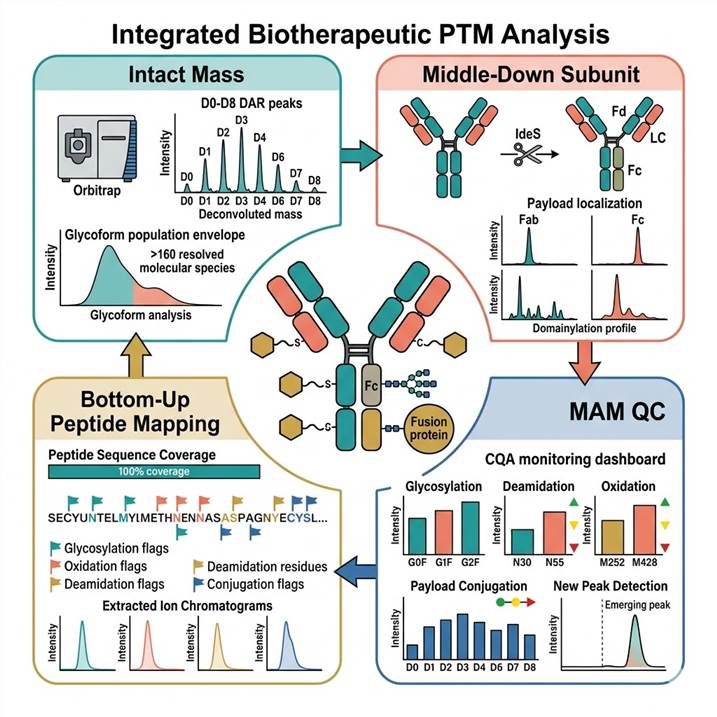
Protein-based biotherapeutics are the fastest-growing drug class, with over 200 approved products and hundreds in clinical development. Their PTMs — engineered (payload conjugation, PEGylation) or endogenous (glycosylation, deamidation, oxidation) — define critical quality attributes (CQAs) that regulatory agencies require you to characterize, monitor, and control. Our platform provides MS-based PTM analysis at every structural level:
- ADC PTM characterization: Intact and native MS for DAR distribution across D0–D8 species; middle-down IdeS/Lys-C subunit analysis for payload localization to Fab vs. Fc; bottom-up peptide mapping for conjugation site identification (cysteine, lysine, engineered residue), linker-payload catabolite profiling, and deconjugation/degradation monitoring in biological matrices.
- Fusion protein and Fc-fusion PTM analysis: Intact mass profiling of glycosylation heterogeneity with glycoform-level annotation; site-specific N- and O-glycosylation analysis at each sequon; linker-region PTM mapping (oxidation, deamidation, clipping); aggregation and fragmentation monitoring by SEC-MS and native MS.
- Bispecific antibody characterization: Chain-pairing analysis and mispaired species identification; subunit-level PTM profiling across heavy chains, light chains, and engineered domains; asymmetric glycosylation analysis between Fab arms; disulfide bond mapping and scrambled disulfide detection.
- Recombinant protein drug PTM profiling: Comprehensive modification mapping by bottom-up LC-MS/MS covering deamidation, oxidation, isomerization, glycation, N-terminal pyroglutamate, C-terminal lysine clipping, disulfide bond integrity, and host cell protein (HCP) contamination monitoring.
All data are reported in a format aligned with ICH Q6B and ICH M10 framework expectations, supporting preclinical advancement characterization through commercial QC lot release.
| Service Module |
Biotherapeutic Types |
Analytical Approach |
Key Deliverable |
| ADC DAR & Payload Analysis |
Cys-ADC, Lys-ADC, engineered ADC, bispecific ADC |
Native MS, HIC-MS, RPLC-MS for DAR; IdeS/Lys-C subunit MS; peptide mapping for site localization |
DAR distribution (D0–D8); payload occupancy per site; linker stability & deconjugation data |
| Fusion Protein Glycosylation Profiling |
Fc-fusion, albumin-fusion, cytokine-Fc, peptide-Fc |
Intact mass PTCR for glycoform distribution; glycopeptide LC-MS/MS for site-specific N-/O-glycans |
Glycoform population map per sequon; sialylation, galactosylation, fucosylation, mannosylation data |
| Bispecific Antibody PTM Analysis |
IgG-like bsAb, fragment-based bsAb, appended bsAb |
Native MS for chain pairing; subunit MS with IdeS/LysC; peptide mapping for PTM profiling |
Correct vs. mispaired species ratio; asymmetric modification map; disulfide bond integrity |
| Protein Drug Degradation PTM Mapping |
mAbs, recombinant proteins, enzymes, hormones |
Bottom-up LC-MS/MS; MAM with New Peak Detection; forced degradation study design |
Modification site table with relative abundance; degradation pathway map; stability trend data |
| Host Cell Protein & Impurity Profiling |
All biotherapeutic classes |
DIA LC-MS/MS HCP analysis; di-MAM integrated PTM+HCP monitoring |
HCP identification & quantification; process-related impurity clearance data |
| Multi-Attribute Method (MAM) QC |
mAbs, ADCs, fusion proteins, bsAbs |
HRAM Orbitrap MS with automated data processing; NPD for new/modified species detection |
Multi-CQA monitoring report; batch-to-batch comparability data; method qualification documentation |
LC-MS Platforms for Biotherapeutic PTM Analysis
Intact & Native Mass Spectrometry
Native SEC-MS and RPLC-MS on Orbitrap platforms for intact DAR determination (D0–D8) without denaturation. Proton-transfer charge-reduction (PTCR) with gas-phase fractionation resolves glycoform populations on heavily glycosylated fusion proteins — >160 molecular species from a single analysis. Intact mass deconvolution for MW confirmation, aggregation monitoring, and batch comparability at the intact protein level.
Middle-Down Subunit Analysis
IdeS and Lys-C limited digestion generates Fc, Fd, and LC subunits for domain-level PTM mapping. Pinpoints payload localization to Fab vs. Fc for ADCs; resolves chain pairing in bispecific antibodies; identifies domain-specific glycosylation and degradation hotspots. Middle-down CID/ETD fragmentation enables payload quantification without enzymatic digestion of cleavable or non-cleavable linker ADCs.
Bottom-Up Peptide Mapping
Trypsin/Lys-C/trypsin+Glu-C multi-enzyme digestion for 100% sequence coverage. LC-MS/MS with HCD/ETD/EThcD fragmentation for unambiguous PTM site localization. Quantifies deamidation, oxidation, isomerization, glycation, N-terminal pyroglutamate, C-terminal lysine truncation, and conjugation site occupancy at single-residue resolution. Integrates with PTM site occupancy analysis.
Glycosylation Site-Specific Analysis
Glycopeptide enrichment (HILIC or lectin) combined with stepped HCD/ETD LC-MS/MS for site-specific N-glycan and O-glycan profiling at every glycosylation sequon. Released glycan analysis by 2-AB labeling with UPLC-FLR for quantitative glycan profiling. Intact glycoprotein analysis with PTCR for glycoform distribution across all glycosylation sites simultaneously. Supported by antibody glycosylation analysis and site-specific glycosylation analysis platforms.
Multi-Attribute Method (MAM)
Single LC-HR-MS method simultaneously monitors all critical quality attributes — glycosylation profiles, deamidation, oxidation, isomerization, glycation, N-/C-terminal variants, disulfide bond integrity, sequence variants, and payload conjugation (ADC CQAs). New Peak Detection (NPD) identifies emerging or unexpected species. Automated data processing with GMP-ready reporting. Supports lot release, stability testing, and process characterization per ICH Q6B.
Disulfide Bond & Free Thiol Analysis
Non-reduced peptide mapping with LC-MS/MS for disulfide bond connectivity determination — critical for IgG interchain and intrachain disulfide mapping, ADC conjugation site cysteine identification, and scrambled disulfide detection. Free thiol quantification by Ellman's assay or maleimide-based LC-MS. Integrates with disulfide bond analysis and free thiol quantification services.
Applications in Biotherapeutic Development
ADC Development & Characterization
- DAR determination by native MS, HIC-MS, and RPLC-MS across D0–D8 species
- Payload conjugation site mapping — cysteine-linked, lysine-linked, and engineered site-specific ADCs
- Linker-payload stability in plasma/serum — deconjugation kinetics and catabolite profiling
- Payload metabolite identification from in vitro and in vivo matrices by LC-HR-MS
Fusion Protein & Fc-Fusion Analysis
- Glycosylation heterogeneity profiling with intact-mass PTCR resolving >160 glycoforms per analysis
- Site-specific N-glycan occupancy and antennarity at each Fc and fusion-domain sequon
- Sialic acid content, galactosylation, fucosylation, and high-mannose quantitation
- Linker-region PTM susceptibility — oxidation, deamidation, clipping in the fusion linker
Bispecific Antibody QC
- Chain-pairing analysis — correct heterodimer vs. homodimer species identification
- Asymmetric glycosylation profiling between different Fab arms
- Mispairing quantification and disulfide scrambling detection
- MAM for bispecific-specific CQAs — chain assembly, domain-specific PTMs, aggregation
Stability & Forced Degradation
- Forced degradation study design — thermal, oxidative, photolytic, pH stress conditions
- Degradation product identification and pathway mapping by LC-MS/MS peptide mapping
- PTM kinetics — deamidation, oxidation, isomerization rates under accelerated and long-term storage
- Formulation comparability — PTM profiles across buffer, pH, and excipient conditions
Biosimilar Comparability
- Head-to-head PTM comparison between reference product and biosimilar candidate
- Glycosylation fingerprinting with statistical comparability assessment
- Higher-order structure (HOS) comparison by hydrogen-deuterium exchange MS (HDX-MS)
- Forced degradation comparability — matching degradation pathways and rates
Process Development & QC
- Clone selection support — glycosylation profile screening across clonal cell lines
- Process parameter impact on PTMs — temperature, pH, media composition effects
- Purification process monitoring — PTM changes across Protein A, IEX, and HIC steps
- GMP-aligned MAM for lot release with automated data processing and trend analysis
ADC / Fusion Protein PTM Analysis Workflow
1. Project Scoping & Sample Intake
- Define analytical objectives: DAR, glycosylation, degradation PTMs, MAM CQA panel
- Biotherapeutic class assessment: ADC (conjugation chemistry), fusion protein (linker, glycosylation sites), bsAb (chain architecture)
- Sample requirements: 100 µg–5 mg protein; formulation buffer compatibility check
- Method selection: intact, middle-down, bottom-up, or MAM based on CQAs and development phase
2. Sample Preparation
- ADC: buffer exchange, deglycosylation (PNGase F, optional), IdeS/Lys-C digestion for subunit DAR
- Fusion protein: reduction/alkylation, multi-enzyme digestion; glycopeptide enrichment by HILIC
- MAM: automated sample preparation with standardized digestion, reduction, and alkylation protocols
- QC checks: digestion completeness, deamidation artifact control, oxidation artifact minimization
3. LC-MS Data Acquisition
- Intact/native MS: Orbitrap Ascend or Exploris 480 with PTCR for glycoform resolution
- Subunit MS: RPLC-MS or SEC-MS for DAR; IdeS/Lys-C subunit profiling for domain-level analysis
- Peptide mapping: nanoLC-MS/MS with HCD/ETD/EThcD for site-specific PTM localization
- Glycopeptide analysis: stepped HCD with oxonium ion triggering for glycopeptide identification
4. Data Processing & PTM Annotation
- Intact deconvolution: BioPharma Finder or PMI-Intact for MW and glycoform assignment
- Peptide mapping: PEAKS, Byonic, or Mascot for modification identification and quantification
- MAM: automated processing with custom CQA monitoring workflows and NPD algorithms
- Glycosylation: glycan library matching with manual verification for unusual glycoforms
5. Comparability & Trend Analysis
- Batch-to-batch comparability: statistical equivalence testing (TOST) for individual PTMs
- Stability trend analysis: PTM kinetics modeling across time points and storage conditions
- Biosimilarity assessment: quantitative PTM comparison with reference product quality range
- Forced degradation pathway mapping: identification of degradation-prone residues and mechanisms
6. Reporting & Regulatory Support
- PTM characterization report with modification site tables, abundance data, and spectral evidence
- CQA monitoring summary: trends, outliers, and comparability conclusions for regulatory dossiers
- MAM method qualification documentation: specificity, precision, linearity, and robustness data
- ICH M10-aligned bioanalytical reports; raw data files (RAW, mzML) and processed results provided
Why Choose Our Biotherapeutic PTM Analysis Platform
Multi-Level MS — Intact to Peptide Resolution
- Single-provider PTM analysis at intact, subunit, and peptide levels — no need to contract separate labs for DAR, glycosylation, and degradation PTMs
- Data from all MS levels are cross-referenced: intact DAR confirmed by subunit analysis, glycosylation quantified at intact and glycopeptide levels, degradation PTMs localized by peptide mapping
- Consistent instrumentation and processing pipelines ensure inter-experiment comparability across your development program
ADC, Fusion, Bispecific — One Platform, All Formats
- Proven methods for cysteine-ADC, lysine-ADC, site-specific ADC, Fc-fusion, albumin-fusion, cytokine-Fc, IgG-like bsAb, fragment-based bsAb, and appended bsAb format characterization
- Chemistry-agnostic DAR methods: cleavable (val-cit, GGFG, disulfide) and non-cleavable (SMCC, maleimide) linker ADCs
- Bispecific chain-pairing analysis covering knob-into-hole, CrossMab, DuoBody, and Fab-arm exchange formats
MAM-Ready for GMP QC Integration
- Multi-attribute method development and qualification aligned with ICH Q2(R1) and USP <1060> guidelines
- New Peak Detection (NPD) identifies emerging PTM species — critical for stability and comparability studies
- Automated data processing with GMP-compliant audit trails; method transfer support to your internal QC laboratory
Case Study — Exposing Molecular Heterogeneity of Glycosylated Biotherapeutics by Intact Mass Spectrometry
Schachner, Mullen, Phung, and colleagues at Genentech and Thermo Fisher Scientific developed a charge-reduction mass spectrometry approach to resolve the glycoform complexity of heavily glycosylated biotherapeutics — demonstrating how intact-mass PTCR analysis reveals molecular heterogeneity invisible to conventional methods (Schachner et al., 2024, Nature Communications, CC BY 4.0).
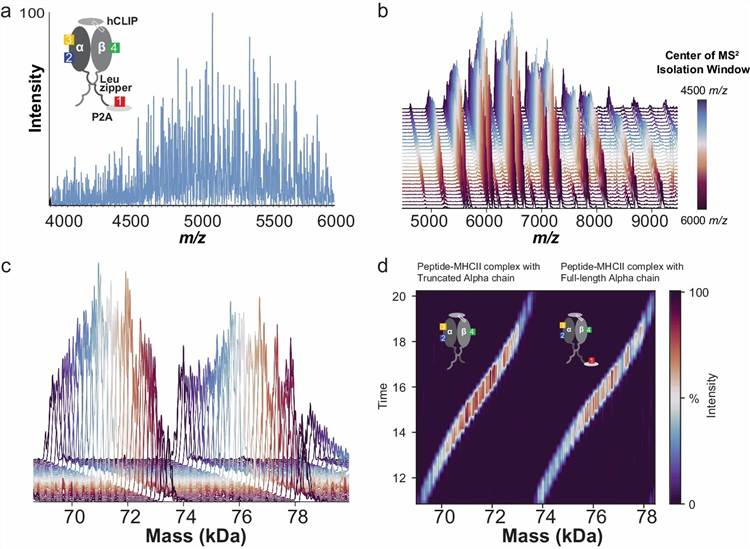
Background: Glycosylation heterogeneity in biotherapeutics directly impacts drug safety, efficacy, and pharmacokinetics. Fc-fusion proteins and monoclonal antibodies carry complex N-glycan populations that vary with cell line, culture conditions, and purification processes. Standard intact mass spectrometry cannot resolve individual glycoforms of heavily glycosylated proteins — the spectral congestion from overlapping charge states and glycoform variants obscures the molecular detail needed for process development, batch comparability, and regulatory characterization. The team developed a method combining proton-transfer charge-reduction (PTCR) with data-independent acquisition and gas-phase fractionation to deconvolve this complexity, enabling glycoform-level analysis of intact biotherapeutics directly from a single MS experiment.
Methods: The DIA-PTCR platform integrated three innovations: (1) proton-transfer charge-reduction using a quadrupole mass filter to reduce charge states of intact glycoproteins, collapsing spectral congestion into a narrow m/z window; (2) gas-phase fractionation to sequentially isolate and analyze narrow m/z segments, dramatically increasing the number of molecular species detected; and (3) data-independent acquisition on an Orbitrap Ascend Tribrid mass spectrometer for comprehensive fragment ion data. The method was applied to three biotherapeutic classes: IL22-Fc (an 8×-glycosylated fusion protein drug, UTTR1147A), VHH-Fc fusion proteins, and peptide-bound MHC class II complexes. Glycoform assignments were validated by integrating intact-mass data with glycoproteomic peptide mapping and released glycan analysis.
Results: The DIA-PTCR method resolved >160 distinct molecular weight species from a single analysis of IL22-Fc — an 8×-glycosylated fusion drug whose glycoform complexity had been inaccessible to intact-mass analysis. Glycan "barcoding" using monosaccharide mass fingerprints enabled glycoform annotation at each glycosylation site, revealing correlations between glycoform sub-populations and pharmacological properties. The method detected batch-to-batch differences in sialic acid content that were validated by orthogonal glycopeptide and released glycan analyses. For VHH-Fc fusion proteins, the platform resolved domain-specific glycosylation heterogeneity; for MHC class II complexes, it detected peptide-loading heterogeneity. Critically, the method required only micrograms of material and a single LC-MS run — making it practical for routine biotherapeutic characterization, clone selection, and QC lot release.
Significance for Biotherapeutic PTM Analysis: This study demonstrates that intact-mass charge-reduction MS provides glycoform-level resolution for heavily glycosylated biotherapeutics — the same analytical challenge that ADC, fusion protein, and bispecific antibody programs face daily. For ADC development, the approach enables rapid DAR and glycoform profiling in a single experiment; for fusion protein programs, it reveals the glycoform heterogeneity that drives effector function and serum half-life; for biosimilar developers, it provides an orthogonal intact-mass comparability method that directly visualizes molecular differences between products. The integration of PTCR-based intact MS with our multi-level LC-MS platform — peptide mapping for site-specific PTM localization, subunit analysis for domain-level characterization, and MAM for CQA monitoring — provides the comprehensive biotherapeutic PTM analysis capability that regulatory agencies expect and that your development program requires.
Reference: Exposing the molecular heterogeneity of glycosylated biotherapeutics. Schachner LF, Mullen C, Phung W, Hinkle JD, Beardsley MI, Bentley T, Day P, Tsai C, Sukumaran S, Baginski T, DiCara D, Agard NJ, Masureel M, Gober J, ElSohly AM, Melani R, Syka JEP, Huguet R, Marty MT, Sandoval W. Nature Communications. 2024;15:3259. (CC BY 4.0)
Related Services
Our ADC and fusion protein PTM analysis platform integrates with the following biotherapeutic characterization, glycosylation, and degradation analysis services:
Frequently Asked Questions
What ADC conjugation chemistries can you characterize?
We support all major ADC conjugation chemistries: cysteine-linked ADCs (interchain disulfide reduction + maleimide/ haloacetamide conjugation), lysine-linked ADCs (activated ester chemistry), engineered site-specific ADCs (THIOMAB, unnatural amino acid, enzyme-mediated), and bispecific ADCs. Our DAR methods are chemistry-agnostic — native MS, HIC-MS, and RPLC-MS work regardless of linker-payload type. For cleavable linker ADCs (val-cit-PABC, GGFG-AM, disulfide, hydrazone), we offer linker-payload catabolite profiling in biological matrices. For non-cleavable linker ADCs (SMCC, maleimidocaproyl), we offer digestion-free middle-down MS for payload quantification. Each ADC characterization includes DAR distribution, conjugation site identification, site occupancy, and linker stability assessment.
How do you determine DAR for ADCs?
We use three complementary MS approaches for DAR determination: (1) Native SEC-MS or RPLC-MS at the intact level for D0–D8 distribution profiling, capturing the full DAR species distribution without denaturation artifacts. (2) IdeS or Lys-C subunit analysis to determine payload distribution between Fab and Fc regions, identifying domain-specific conjugation bias. (3) Bottom-up peptide mapping to confirm conjugation site identity and occupancy at single-residue resolution. Each level provides orthogonal verification: intact DAR confirmed by subunit analysis, site occupancy validated by peptide-level quantification. For in vivo studies, we offer affinity-capture LC-MS for DAR monitoring in plasma/serum, tracking average DAR changes over time to assess linker-payload stability in circulation.
Can you analyze glycosylation on fusion proteins with multiple N-glycosylation sites?
Yes. Heavily glycosylated fusion proteins (e.g., IL22-Fc with 8 glycosylation sites) are analyzed using our intact-mass PTCR platform, which resolves >160 distinct molecular weight species from a single experiment — capturing the full glycoform landscape. This is complemented by glycopeptide LC-MS/MS for site-specific N-glycan profiling at each individual sequon, and released glycan analysis by 2-AB labeling with UPLC-FLR for quantitative glycan population data. For fusion proteins with engineered glycosylation sites, we map site occupancy (% glycosylation at each sequon), glycan antennarity, sialylation, galactosylation, fucosylation, and high-mannose content — the critical CQAs that impact effector function, serum half-life, and immunogenicity.
What is the Multi-Attribute Method (MAM) and how can it support my QC workflow?
MAM is a single LC-HR-MS method that simultaneously monitors all PTM-based critical quality attributes (CQAs) of a biotherapeutic — glycosylation profiles, deamidation, oxidation, isomerization, glycation, N-/C-terminal variants, disulfide bond integrity, sequence variants, and payload conjugation (for ADCs) — replacing multiple conventional QC assays (CE-SDS, IEX, HILIC, etc.) with one mass spectrometry platform. The New Peak Detection (NPD) capability is central to MAM: it identifies any new or unexpected molecular species that appear, for example, during stability studies, process changes, or between batches — enabling out-of-specification detection that conventional targeted assays miss. We develop and qualify MAM methods aligned with ICH Q2(R1) and USP <1060> guidelines, providing method qualification reports suitable for regulatory submissions, and offer method transfer to your internal QC laboratory.
How do you handle bispecific antibody chain-pairing analysis?
Bispecific antibody chain-pairing analysis requires determining whether the correct heterodimeric species has formed or if mispaired homodimers are present. We use native MS at the intact level to resolve correctly paired heterodimer vs. mispaired homodimer species by mass — these species differ in molecular weight, and native MS preserves the non-covalent assembly for accurate measurement. Subunit analysis with IdeS or Lys-C digestion localizes pairing fidelity to specific domains (Fc heterodimerization, Fab-arm identity). Peptide mapping confirms disulfide bond connectivity and detects scrambled disulfide pairing. This multi-level approach covers all major bispecific formats: knob-into-hole, CrossMab, DuoBody, Fab-arm exchange, and appended formats (BiTE, DART, tandem scFv-Fc).
What regulatory framework do your biotherapeutic PTM analyses support?
Our biotherapeutic PTM analyses are designed to support regulatory submissions across development phases. For early development (preclinical through Phase I), we provide comprehensive PTM characterization — glycosylation profiling, degradation PTM mapping, disulfide bond analysis, and higher-order structure data — suitable for regulatory quality modules. For late-stage development (Phase II–III), we offer MAM method development and qualification per ICH Q2(R1) guidelines, forced degradation studies, and biosimilar comparability assessments. For commercial QC, we support MAM method validation and transfer to your internal laboratory. All analytical methods follow ICH Q6B principles for biotechnological product characterization, and bioanalytical methods are aligned with ICH M10 framework expectations. Reports include methods documentation, raw data, and processed results formatted for direct inclusion in CTD Module 3 quality sections.
References
- Exposing the molecular heterogeneity of glycosylated biotherapeutics. Schachner LF, Mullen C, Phung W, Hinkle JD, Beardsley MI, Bentley T, Day P, Tsai C, Sukumaran S, Baginski T, DiCara D, Agard NJ, Masureel M, Gober J, ElSohly AM, Melani R, Syka JEP, Huguet R, Marty MT, Sandoval W. Nature Communications. 2024;15:3259.
- Identification of sorbitol esterification of glutamic acid by LC-MS/MS in a monoclonal antibody stability assessment. Yu B, Williams S, Yang Z, Young G. PLOS ONE. 2024;19(5):e0295735.
- Direct glycosylation analysis of intact monoclonal antibodies combining ESI MS and MALDI-in-source decay MS. Senini I, Tengattini S, Rinaldi F, Massolini G, Gstöttner C, Reusch D, Donini M, Marusic C, van Veelen PA, Domínguez-Vega E. Communications Chemistry. 2024;7:203.
This service is provided for research use only (RUO). Not for diagnostic or clinical applications. All analytical methods support ICH Q6B and ICH M10 regulatory framework expectations.