Why Crotonylation Matters — Metabolite-Sensitive PTM at the Crossroads of Epigenetics and Metabolism
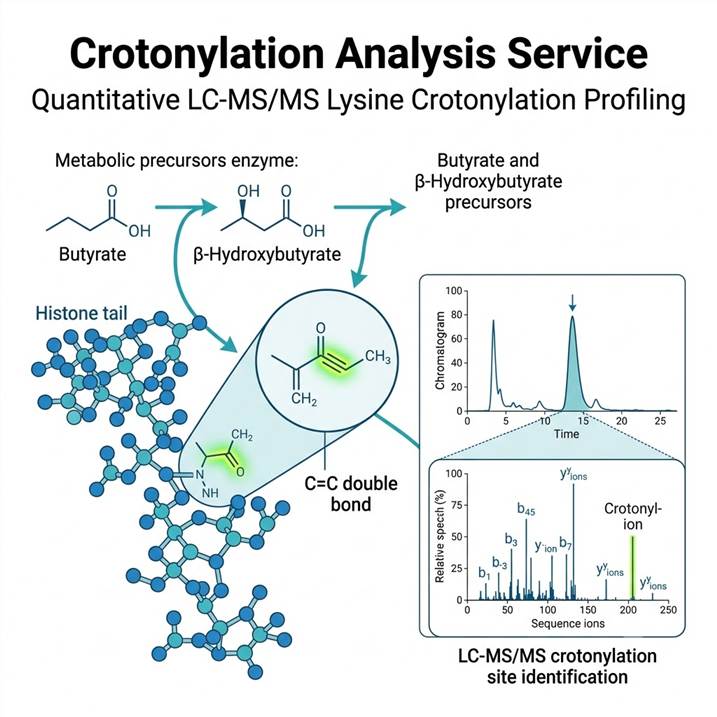
Discovered in 2011 by Zhao et al., lysine crotonylation is structurally and functionally distinct from acetylation. The crotonyl group contains a planar C=C double bond that confers unique structural rigidity and recognition specificity. YEATS domain-containing proteins (AF9, YEATS2) preferentially bind crotonyl-lysine over acetyl-lysine with up to 6-fold higher affinity, while class I HDACs (HDAC1–3) and sirtuins (SIRT1–3) serve as erasers. This dedicated writer–reader–eraser system marks crotonylation as a bona fide regulatory PTM with unique signaling properties.
Critically, crotonylation directly links to metabolism. Crotonyl-CoA — the donor substrate — is derived from multiple metabolic pathways: gut microbiota-derived butyrate metabolism, ketone body (β-hydroxybutyrate) metabolism, and amino acid catabolism. Changes in cellular crotonyl-CoA levels directly reshape the crotonylome, making Kcr a immediate readout of metabolic state. Our service provides the quantitative depth to capture these metabolic–epigenetic dynamics.
Lysine Crotonylation — From Histone Marks to Non-Histone Regulation
Crotonylation was first identified on histones H3 and H4, where it marks active promoters and enhancers. Key sites include H3K9cr, H3K14cr, H3K18cr, H3K23cr, H4K5cr, H4K8cr, and H4K12cr. Unlike acetylation, crotonylation at H3K18 exhibits a distinct genomic distribution and is preferentially enriched at promoters of genes involved in metabolic processes, reflecting its metabolic sensitivity.
Beyond histones, crotonylation regulates non-histone proteins involved in metabolism, signaling, and disease. Key non-histone Kcr substrates include glycolytic enzymes (ENO1, PKM2), splicing factors (HNRNP proteins), and DNA repair proteins. Dysregulated crotonylation has been linked to acute kidney injury, HIV latency, Alzheimer's disease, and multiple cancer types including colorectal cancer, glioblastoma, and hepatocellular carcinoma. For complementary analysis of other acyl modifications, our Acetylomics Analysis service provides parallel profiling capabilities.
Crotonylation Analysis Workflow — Pan-Kcr Enrichment to Site-Level Quantification
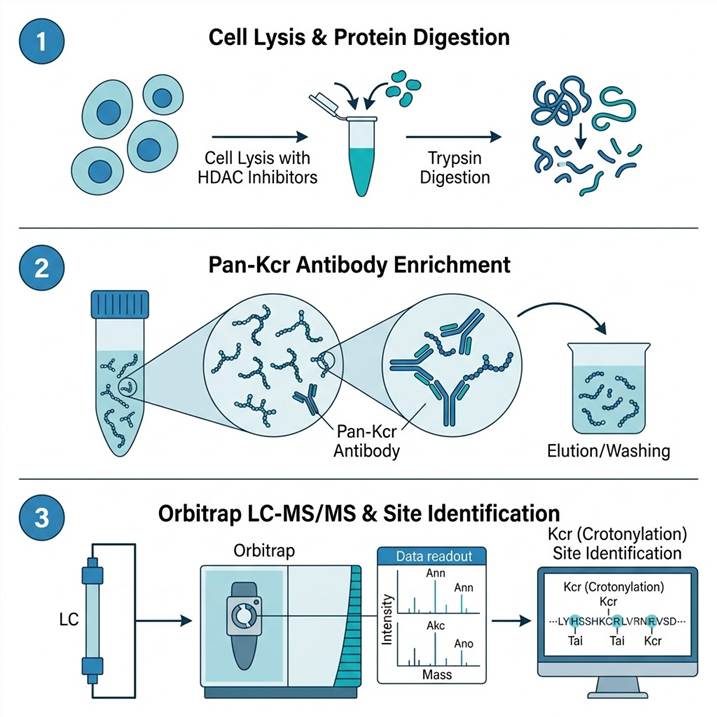
Step 1: Protein Extraction & Digestion
- Cell/tissue lysis in urea buffer with protease inhibitors + HDAC inhibitors (TSA, NAM)
- Trypsin digestion at optimized enzyme-to-substrate ratio
- Peptide desalting and quantification
Step 2: Pan-Kcr Enrichment
- Immunoprecipitation using anti-pan-crotonyl-lysine antibody conjugated to agarose beads
- Stringent washes to remove non-specific peptides
- Elution of crotonylated peptides under acidic conditions
- Desalting and concentration
Step 3: LC-MS/MS & Quantification
- Orbitrap Eclipse or Q-Exactive HF-X in DDA or PRM mode
- Database search: Kcr (+70.042 Da) on K as variable modification
- Label-free or TMTpro quantification
- Site localization, FDR filtering, and functional annotation
For broader modification mapping, our Global PTMs Profiling and Pan PTM Proteomics platforms provide complementary multi-PTM coverage.
Research Applications — Metabolic Disease to Cancer Epigenetics
Metabolite–Epigenetics Crosstalk
Crotonylation serves as a direct sensor of cellular metabolic state. Gut microbiota-derived butyrate increases crotonyl-CoA levels and globally elevates histone crotonylation. Ketone body β-hydroxybutyrate produced during fasting or ketogenic diet also feeds into crotonyl-CoA pools. Our profiling service captures these metabolic–epigenetic dynamics with quantitative precision.
Cancer Epigenetics
Crotonylation plays emerging roles in cancer biology. Glioblastoma stem cells reprogram lysine metabolism to promote histone crotonylation, suppressing interferon signaling and T cell infiltration. ENO1 crotonylation in colorectal cancer promotes proliferation and metastasis. Systematic crotonylome profiling across tumor vs normal tissues identifies dysregulated pathways and potential therapeutic targets.
Neuropsychiatric & Neurodegenerative Disease
CDYL-mediated suppression of histone crotonylation affects VGF neuropeptide expression and synaptic plasticity in depression. NEAT1 lncRNA regulates H3K27cr levels in Alzheimer's disease, impacting autophagy genes and Aβ clearance. For complementary analysis of other emerging acyl modifications, our 2-Hydroxyisobutyrylation Analysis service provides parallel coverage.
Sample Requirements for Crotonylation Analysis
| Sample Type |
Recommended Amount |
Critical Notes |
| Cultured cells (mammalian) |
1 × 10⁷ – 5 × 10⁷ cells |
Include HDAC inhibitors (TSA + NAM) in lysis buffer |
| Tissue (mammalian) |
50–200 mg |
Snap-freeze; homogenize with HDAC inhibitors |
| Cell lysate (pre-extracted protein) |
2–10 mg total protein |
Include protease + deacetylase inhibitors |
Deliverables — Quantitative Crotonylation Reports
- Crontonylation site identification table — protein, site, sequence, localization probability
- Quantification results — label-free or TMT-based fold-changes with p-values
- Enrichment efficiency report — percent of identified peptides carrying Kcr
- Functional annotation — GO, KEGG, PPI network, motif analysis
Case Study: Deep Crotonylome Profiling in Mammalian Ovarian Tissue
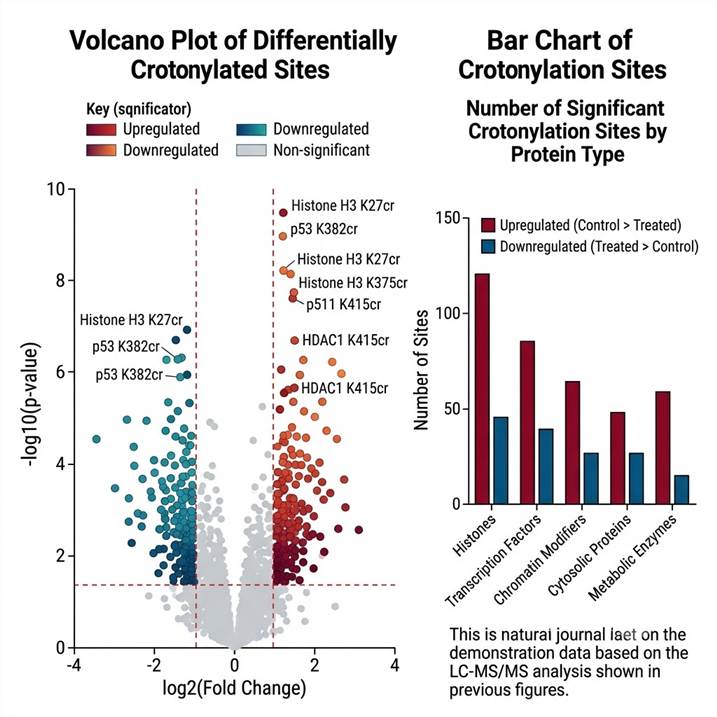
To demonstrate the depth of quantitative crotonylation analysis achievable by LC-MS/MS, we highlight a study by Yang et al. (Frontiers in Cell and Developmental Biology, 2023) that profiled the lysine crotonylome in piglet ovarian tissue using pan-Kcr antibody enrichment coupled with LC-MS/MS.
Study Design and Depth
Ovarian tissue proteins from piglets were extracted, digested with trypsin, and subjected to pan-Kcr antibody enrichment followed by LC-MS/MS analysis. The study identified 3,149 high-confidence crotonylation sites on 895 proteins.
Conclusions
This study demonstrates that pan-Kcr antibody enrichment coupled with LC-MS/MS can identify thousands of crotonylation sites from complex mammalian tissue samples, providing a comprehensive view of the crotonylome.
Source
Yang, D.; Li, X.; Yu, B.; Peng, H. Front. Cell Dev. Biol. 2023, 11, 1176212. DOI: 10.3389/fcell.2023.1176212.
Crotonylation Analysis: Frequently Asked Questions
How many crotonylation sites can you identify?
Typically 2,000–5,000 high-confidence crotonylation sites from 500–1,500 proteins per experiment.
Can you distinguish crotonylation from acetylation?
Yes. Crotonylation adds +70.042 Da vs acetylation +42.011 Da — these mass shifts are unambiguously resolved.
What sample types are compatible?
Cultured cells, snap-frozen tissues, and protein lysates. Include HDAC inhibitors (TSA + NAM) in lysis buffer.
References
- Yang, D.; Li, X.; Yu, B.; Peng, H. "Qualitative Lysine Crotonylation and 2-Hydroxyisobutyrylation Analysis in the Ovarian Tissue Proteome of Piglets" Front. Cell Dev. Biol. 2023, 11, 1176212.
- Tan, M.; Luo, H.; Lee, S.; Jin, F.; Yang, J. S.; Montellier, E.; Buchou, T.; Cheng, Z.; Rousseaux, S.; Rajagopal, N.; Lu, Z.; Ye, Z.; Zhu, Q.; Wysocka, J.; Ye, Y.; Khochbin, S.; Ren, B.; Zhao, Y. "Identification of 67 Histone Marks and Histone Lysine Crotonylation as a New Type of Histone Modification" Cell 2011, 146, 1016–1028.
- Guo, Y.; Li, J.; Zhang, K. "Crotonylation Modification and Its Role in Diseases" Front. Mol. Biosci. 2024, 11, 1492212.