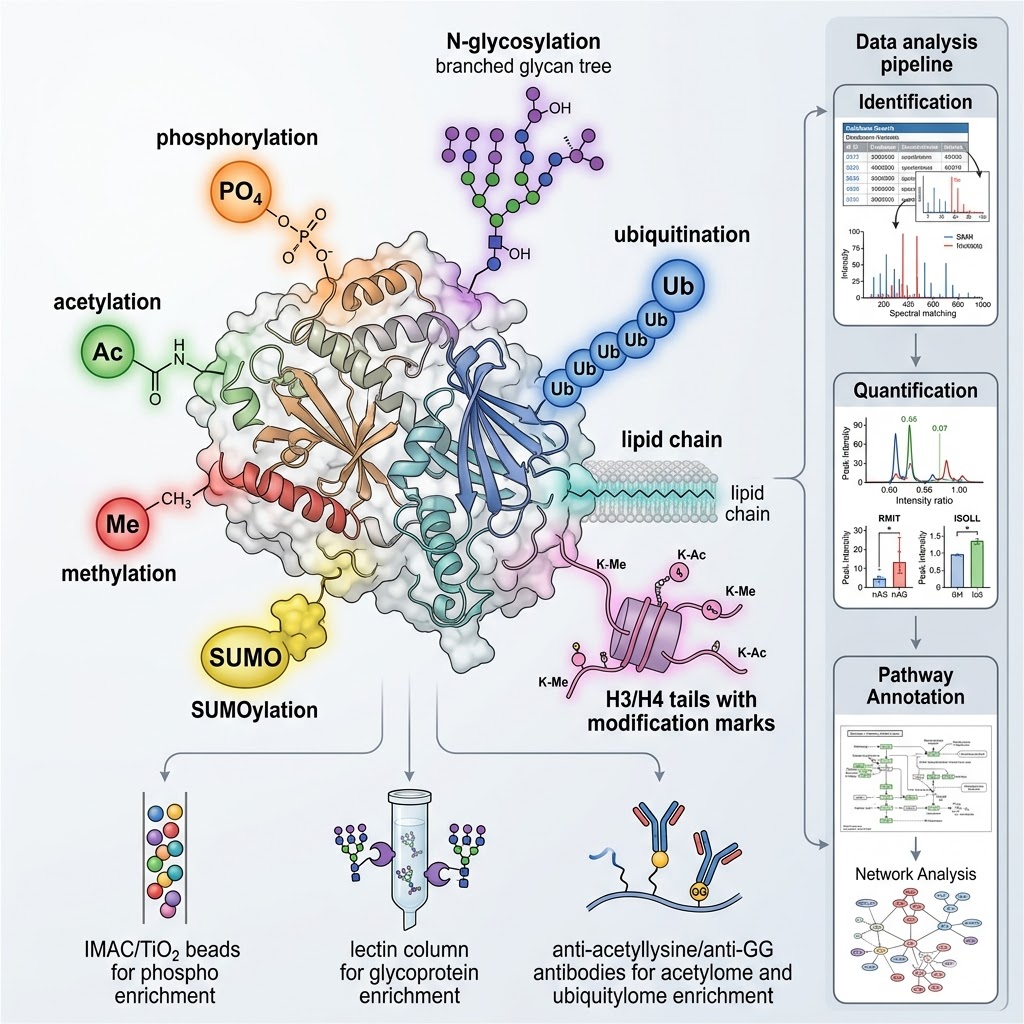
Core PTM Types Service Catalog — Complete Directory
Our core PTM type analysis services comprise dedicated workflows for each major modification class. Use the links below to navigate to detailed service pages, or browse the sub-services available within each category.
Acetylomics
Global acetylation profiling covering lysine acetylation — a key regulatory modification in metabolism, chromatin structure, and cell signaling. Pan anti-acetyllysine antibody enrichment combined with high-resolution LC-MS/MS for comprehensive acetylome mapping and quantitative comparison.
Glycoproteomics
Comprehensive glycoproteomics analysis covering N-linked and O-linked glycosylation — critical modifications in protein folding, cell-cell communication, immunity, and therapeutic protein function. Lectin enrichment and hydrophilic interaction LC (HILIC) coupled with high-resolution MS.
Histone PTM Analysis
Specialized histone PTM analysis covering acetylation, methylation, phosphorylation, and crotonylation on histone tails — essential for epigenetic regulation, chromatin structure, and gene expression control. Acid extraction, chemical derivatization, and middle-down/top-down MS strategies.
Phosphoproteomics
Comprehensive phosphoproteomics analysis — the most widely studied reversible PTM governing signal transduction, cell cycle regulation, and kinase signaling networks. IMAC and TiO2 enrichment with deep phosphopeptide coverage and phosphorylation site localization.
Ubiquitylomics / Ubiquitinomics
Global ubiquitination analysis — a critical PTM regulating protein degradation via the ubiquitin-proteasome system, as well as cellular signaling, endocytosis, and DNA repair. K-ε-GG antibody enrichment for di-glycine remnant capture after tryptic digestion.
Methylation Proteomics
Global protein methylation analysis covering lysine and arginine methylation — key modifications in epigenetic regulation, RNA metabolism, and signal transduction. Pan anti-methyllysine and anti-methylarginine antibody enrichment.
SUMOylation Proteomics
Global SUMOylation analysis — a ubiquitin-like modification regulating protein-protein interactions, nuclear transport, transcription, and DNA repair. SUMO-specific enrichment including His6-SUMO pull-down and SUMO remnant antibody approaches.
Lipidation Analysis
Comprehensive protein lipidation analysis covering N-myristoylation, palmitoylation, and prenylation — hydrophobic modifications that govern membrane targeting, protein trafficking, and signal transduction. Metabolic labeling with alkyne fatty acid analogs and click-chemistry enrichment.
Kinase-Substrate Network Analysis
Integrated kinase-substrate network analysis combining phosphoproteomics with kinase activity profiling to map signaling pathways and identify kinase-substrate relationships in disease contexts.
Why Choose Our Core PTM Types Analysis Services
Breadth of PTM Coverage Under One Platform
Our integrated platform covers all major PTM classes — phosphorylation, glycosylation, acetylation, histone modifications, ubiquitination, methylation, SUMOylation, and lipidation — enabling researchers to coordinate multi-PTM studies across modification types without engaging separate providers. Each PTM class is served by dedicated specialists with modification-specific expertise.
Modification-Specific Optimization Across the Workflow
Each PTM class demands unique analytical strategies — from enrichment chemistry (IMAC vs. lectin vs. pan-antibody) through fragmentation method selection (HCD vs. EThcD) to database search parameters (variable modification definitions, site localization scoring). Our workflows are individually optimized for each modification type, not adapted from generic protocols.
Quantitative Flexibility Across All PTM Classes
All core PTM services support label-free (LFQ), isobaric labeling (TMT/iTRAQ), and metabolic labeling (SILAC) quantification strategies, with targeted PRM/MRM validation available for candidate sites. Standardized normalization approaches enable cross-PTM comparison within multi-modification studies.
End-to-End Service with Dedicated Support
From experimental design through sample preparation, LC-MS acquisition, data analysis, and biological interpretation — every project is supported by a scientist with PTM-specific domain expertise. Multi-PTM projects are coordinated by a single project manager to ensure seamless data integration across modification types.
Related Services
Our core PTM analysis services are complemented by specialized offerings for emerging modifications, discovery-based approaches, and advanced data analysis.
- Emerging PTMs Analysis — Detection and quantification of 30+ novel and low-abundance PTMs including lactylation, crotonylation, succinylation, and 2-hydroxyisobutyrylation
- Global PTM Profiling — Broad multi-PTM discovery analysis across diverse modification classes for comprehensive PTM landscape mapping
- Open-Search PTM Discovery — Unbiased open-search MS approach for detecting unexpected and novel PTMs
- Modified Peptide Enrichment Services — Specialized enrichment strategies for low-abundance modifications across PTM classes
- PTM Bioinformatics Analysis — Advanced bioinformatics for PTM data integration, cross-talk analysis, and functional annotation
Frequently Asked Questions
Which core PTM types does your service cover?
We offer dedicated analysis services for all major PTM classes: phosphorylation, glycosylation (N-linked and O-linked), acetylation (acetylomics), histone modifications, ubiquitination (ubiquitylomics), methylation, SUMOylation, and lipidation (myristoylation, palmitoylation, prenylation). Each category includes specialized sub-services for site identification, quantitative profiling, and data analysis.
Can multiple PTM types be analyzed from the same biological sample?
Yes — we offer multi-PTM profiling workflows that analyze multiple modification classes from the same biological sample. Strategies include parallel enrichment from fractionated lysate, sequential immunoprecipitation protocols, and orthogonal enrichment methods for modifications with different chemical properties. Multi-PTM datasets enable integrated analysis of PTM cross-talk and coordinated regulatory mechanisms.
What quantification methods are available for core PTM analysis?
We support label-free quantification (LFQ) for broad discovery, TMT/iTRAQ multiplexing for simultaneous comparison of up to 16 samples, SILAC for accurate ratio measurements in cell culture models, and targeted PRM/MRM quantification for validation of specific modification sites across larger sample cohorts. The optimal quantification strategy depends on experimental design, sample type, and the specific PTM class.
What sample types are compatible with your core PTM services?
Our platform is compatible with a wide range of sample types including cultured cells (adherent and suspension), fresh-frozen and FFPE tissues, xenograft tumors, laser-capture microdissected specimens, biofluids (plasma, serum, CSF, urine), subcellular fractions (nuclear, cytoplasmic, mitochondrial), and immunoprecipitated protein complexes. Sample requirements vary by PTM class and are determined during the experimental design consultation.
How do you ensure modification site localization confidence?
Site localization is assessed using established probability-based scoring algorithms (MaxQuant localization probability, PhosphoRS, Ascore) with a minimum threshold of ≥0.75 for confident site assignment. For ambiguous site assignments, we deploy orthogonal fragmentation methods (EThcD for labile modifications) and, where necessary, synthetic peptide standard validation to confirm site identity.
For research use only. Not for use in diagnostic procedures.