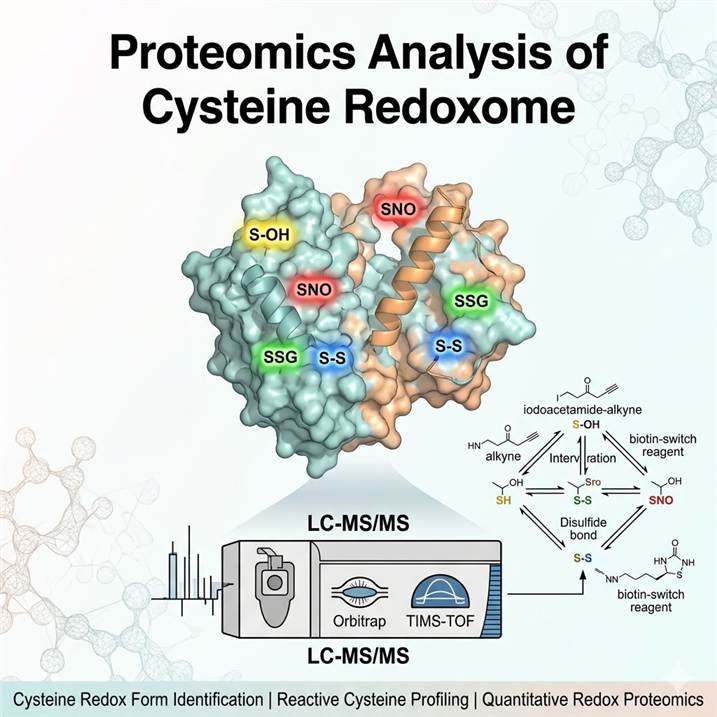
Meeting the Challenge of Cysteine Redoxome Analysis
Cysteine is the most redox-sensitive amino acid in the proteome, with its thiol side chain (-SH) serving as a nucleophilic sensor that responds to changes in cellular redox environment through a spectrum of reversible and irreversible oxidative modifications. Each redox form — from mildly oxidized sulfenic acid (Cys-SOH) through disulfide bonds (Cys-S-S-Cys) and S-nitrosylation (Cys-SNO) to more extensively oxidized sulfinic (Cys-SO₂H) and sulfonic (Cys-SO₃H) acids — carries distinct structural and functional consequences, modulating enzyme activity, protein-protein interactions, subcellular localization, and signaling output. The ensemble of these redox-vulnerable cysteines across the entire proteome defines the "cysteine redoxome," a dynamic network that translates cellular redox state into functional protein regulation.
Why the Cysteine Redoxome Demands Specialized Analytical Approaches
Cysteine redoxome analysis presents unique challenges that distinguish it from standard PTM proteomics and from each other across individual redox forms. Many cysteine modifications are chemically labile — S-nitrosylation and sulfenic acid are particularly susceptible to reduction during sample handling — requiring specialized alkylation, blocking, and stabilization strategies to preserve the endogenous modification state. The low stoichiometry of most cysteine redox forms demands efficient enrichment methods, while the structural diversity across modifications (ranging from +16 Da for sulfenylation to +305 Da for S-glutathionylation) requires tailored mass spectrometric detection parameters and database search strategies. Our integrated platform addresses each of these challenges with validated chemical probes, optimized LC-MS/MS acquisition methods, and multi-engine search strategies purpose-built for cysteine redox proteomics. For broader context on protein oxidation analysis across the proteome, our MS-Based PTM Analysis platform provides the foundational analytical infrastructure supporting all cysteine redox workflows.
Our cysteine redoxome platform integrates multiple analytical strategies — from global discovery of redox-modified cysteines in oxidative stress models to targeted quantification of specific redox forms at individual sites — allowing researchers to select the analytical depth that matches their biological or pharmacological question. Whether mapping the S-nitrosoproteome of a neurodegeneration model, profiling S-glutathionylation dynamics in cardiac ischemia-reperfusion injury, identifying ligandable cysteines for covalent drug development, or quantifying disulfide bond rearrangements in secreted proteins, our services deliver the site-resolved, redox form-specific data needed for confident biological and therapeutic interpretation.
Our Cysteine Redoxome Analysis Service Portfolio
We offer a structured portfolio of cysteine redoxome analysis services designed to address specific research objectives — from global redox form discovery to targeted cysteine modification quantification. The table below maps common research goals to our recommended service modules.
| Research Objective |
Recommended Service |
Key Technology |
| Global cysteine redox form identification and discovery |
Cysteine Redoxome Global Profiling |
Chemical labeling (ICAT, iodoacetyl-alkyne), high-resolution Orbitrap MS, multi-engine redox search |
| Reactive cysteine profiling and ligandability assessment |
Reactive Cysteine Chemoproteomics |
Iodoacetamide-alkyne (IAA) probe competition, desthiobiotin enrichment, LC-MS/MS quantification |
| Site-specific S-nitrosylation (SNO) identification and quantification |
S-Nitrosylation Analysis |
Biotin-switch method (BST), ascorbate reduction, anti-SNO antibody enrichment |
| S-glutathionylation (SSG) dynamics under oxidative stress |
S-Glutathionylation Profiling |
GRX-based reduction, biotin-labeled glutathione, LC-MS/MS quantification |
| Disulfide bond mapping and free thiol quantification |
Disulfide Bond & Free Thiol Analysis |
Differential alkylation, sequential reduction/alkylation, non-reducing/reducing 2D LC-MS/MS |
| Covalent drug target engagement and cysteine druggability |
Reactive Cysteine Target Engagement |
Competitive chemoproteomics, dose-response profiling, target occupancy determination |
Each service module is available independently or can be combined into an integrated cysteine redoxome characterization workflow. For studies at the interface of redox biology and covalent drug discovery, our Covalent Drug PTM Profiling and Reactive Cysteine Target Engagement services provide complementary capabilities for cysteine-targeted therapeutic development.
Complete Redox & Cysteine PTM Sub-Service Portfolio
Our cysteine redoxome platform coordinates a comprehensive suite of specialized sub-services, each targeting specific cysteine redox forms and biological contexts. Click on any service below for detailed methodology and applications.
| Sub-Service |
Cysteine Redox Form / Focus |
Key Application |
| Carbonylation Analysis |
Protein carbonylation (Cys and other residues) |
Oxidative stress markers, aging, metabolic disease |
| Cysteinylation Analysis |
Cysteine-cysteinylation (Cys-S-S-Cys) |
Redox regulation, protein function modulation |
| Disulfide Bond Analysis |
Intra- and inter-molecular disulfide bonds |
Protein folding, structural proteomics, biopharma QC |
| Free Thiol Quantification |
Reactive cysteine free thiol (-SH) content |
Redox state assessment, oxidative stress quantification |
| Oxidation Analysis |
Protein oxidation (sulfenic, sulfinic, sulfonic acids) |
Oxidative damage, redox signaling pathways |
| Persulfidation / S-Sulfhydration |
Cysteine persulfide (Cys-SSH) |
Hydrogen sulfide signaling, cardioprotection, neuroprotection |
| Reactive Cysteine Profiling |
Hyperreactive cysteine discovery |
Functional cysteine annotation, covalent probe development |
| S-Glutathionylation Analysis |
Protein S-glutathionylation (Cys-SSG) |
Oxidative stress response, redox signaling |
| S-Nitrosylation Analysis |
Protein S-nitrosylation (Cys-SNO) |
Nitric oxide signaling, cardiovascular disease, neurodegeneration |
Integrated Technical Platform for Cysteine Redoxome Proteomics
Reliable cysteine redoxome analysis depends on optimized methods spanning the entire analytical pipeline — from chemical stabilization of labile modifications and selective enrichment through high-resolution mass spectrometry to computational assignment of redox forms and site localization. Our platform integrates best-in-class approaches at each stage, configurable to match the redox form of interest and sample complexity.
Cysteine Labeling and Redox Form Stabilization
The labile nature of many cysteine redox modifications demands immediate stabilization during sample preparation to preserve the endogenous modification state. We deploy differential alkylation strategies using iodoacetamide (IAM) and N-ethylmaleimide (NEM) to block free thiols before selective reduction of specific redox forms, and chemical probes such as iodoacetyl-alkyne (IAA) and dimedone-based reagents for direct labeling of sulfenic acid (Cys-SOH). The biotin-switch technique (BST) enables selective enrichment of S-nitrosylated proteins through ascorbate-specific reduction followed by biotinylation, while GRX-based methods provide specific detection of S-glutathionylation. For persulfidation (Cys-SSH), we use tag-switch methods with selective cyanoacetate blocking to distinguish SSH from other thiol modifications.
High-Resolution LC-MS/MS Acquisition
Cysteine redox-modified peptides are analyzed on high-resolution Orbitrap platforms optimized for the mass shifts and fragmentation characteristics of specific redox forms. The diagnostic mass shifts — from sulfenylation (+16 Da) through S-nitrosylation (+29 Da) and disulfide formation (-2 Da per disulfide) to S-glutathionylation (+305 Da) — are resolved through high-resolution precursor ion measurement (≥60,000 at m/z 200) combined with targeted inclusion lists for known redox-modified sites. Nano-flow LC configurations maximize sensitivity for limited sample inputs, while capillary-flow platforms provide throughput for large-scale chemoproteomic screens. For reactive cysteine profiling and target engagement studies, we employ competitive chemoproteomic workflows with isotopically labeled probe standards for precise occupancy quantification.
Multi-Engine Database Search and Redox Form Assignment
Redox form identification requires specialized search strategies that account for the combinatorial diversity of cysteine modifications within a single experiment. We deploy a multi-engine approach using MaxQuant with redox-form-specific variable modifications, Proteome Discoverer with customized PTM workflows incorporating dynamic cysteine mass shifts, and FragPipe/MSFragger with closed and open search capabilities for unexpected modifications. For chemoproteomic datasets, we implement the two-stage FDR-controlled search strategy within FragPipe for confident identification of probe-labeled peptides and isotope-coded quantification. Redox form assignment is validated against key quality criteria including mass accuracy tolerance, fragment ion coverage, retention time consistency with synthetic standards where available, and competition ratio profiles in drug-treated samples.
Quantitative Redox Proteomics Strategies
Cysteine redox modifications are dynamically regulated by cellular redox state, making quantitative information essential for biological interpretation. Our platform supports label-free quantification using extracted ion chromatogram alignment for discovery redox profiling and pilot experiments, TMT labeling for multiplexed comparison of up to 16 conditions involving different redox perturbations, ICAT (isotope-coded affinity tag) labeling for targeted redox pair quantification, and PRM-based targeted methods with synthetic redox-modified peptide standards for site-specific validation of individual cysteine modifications. For drug target engagement studies, we deploy competitive chemoproteomic quantification with dose-response profiling to determine half-maximal inhibitory concentrations (IC₅₀) for covalent ligands at individual cysteine residues across the proteome.
Cysteine Redoxome Proteomics Workflow: From Sample to Publication-Ready Data
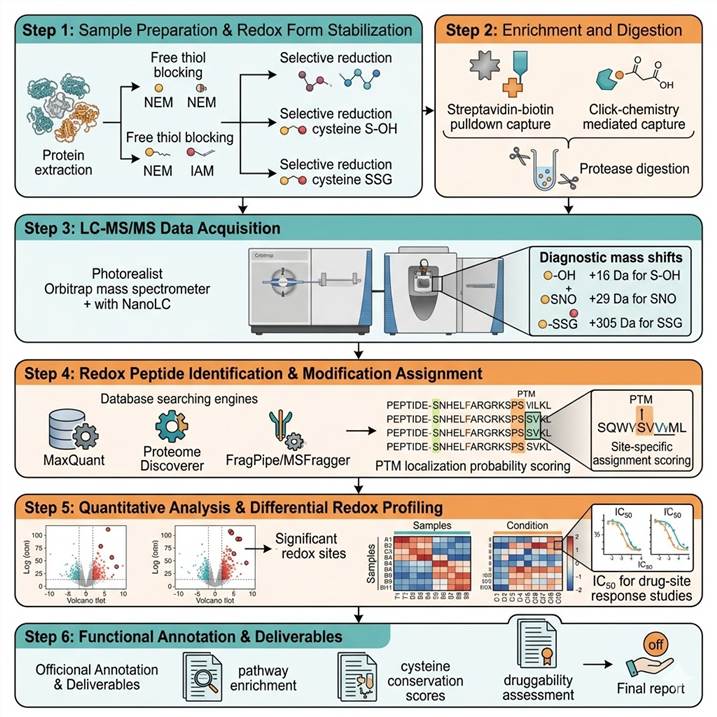
Step 1: Sample Preparation and Redox Form Stabilization
Proteins are extracted under conditions that preserve endogenous redox states, with free thiols blocked using NEM or IAM in the first alkylation step. Selective reduction targets specific redox forms (ascorbate for SNO, GRX for SSG, DTT for disulfides), followed by second alkylation with isotope-coded or affinity tags for enrichment. Chemical probes (IAA-alkyne, dimedone) are applied for direct labeling of specific redox forms. Input controls are retained for normalization.
Step 2: Enrichment and Digestion
Affinity-tagged redox-modified proteins or peptides are enriched using streptavidin-biotin pulldown, antibody-based immunoaffinity, or click-chemistry capture depending on the labeling strategy. Enriched samples are digested with optimized proteases (trypsin, Lys-C, or chymotrypsin for hydrophobic membrane proteins), desalted, and fractionated as needed for deep coverage projects.
Step 3: LC-MS/MS Data Acquisition
Redox-modified peptides are analyzed on high-resolution Orbitrap platforms with optimized LC gradients and data-dependent or data-independent acquisition. Mass spectrometry parameters are tuned to the specific redox form — diagnostic neutral losses for SNO, characteristic fragment ions for SSG, and accurate mass for disulfide-bonded peptides. Stepped HCD fragmentation provides sequence-informative ions for site localization.
Step 4: Redox Peptide Identification and Modification Assignment
Raw MS data are searched using MaxQuant and Proteome Discoverer with redox-form-specific variable modifications, and FragPipe/MSFragger with closed and open-search capabilities for comprehensive cysteine modification discovery. Modification localization is scored using localization probability algorithms and validated against mass accuracy, spectral quality, and fragment ion coverage criteria. Multi-engine cross-validation maximizes identification confidence.
Step 5: Quantitative Analysis and Differential Redox Profiling
Redox-modified peptide abundance is quantified using label-free (XIC alignment), TMT (reporter ion intensities), or targeted PRM approaches depending on experimental design. Differential expression analysis identifies significantly regulated cysteine sites across conditions with appropriate statistical testing. For drug studies, dose-response curves and IC₅₀ values are calculated for cysteine occupancy by covalent probes.
Step 6: Functional Annotation and Deliverables
Complete cysteine redoxome dataset including site identification table with redox form assignments and localization confidence scores, quantitative data with statistical analysis, annotated MS/MS spectra for identified redox-modified sites, oxidative stress pathway enrichment and protein-protein interaction networks, cysteine conservation and druggability assessment, and a scientist consultation session for biological interpretation of redox findings.
For targeted analysis of specific cysteine redox forms beyond global discovery, our PTM Quantitative Analysis Services platform provides integrated multiplexed quantification workflows for targeted cysteine redox form validation across large sample cohorts.
Cysteine Redoxome Proteomics in Biomedical and Pharmaceutical Research
Cysteine redoxome research spans a rapidly expanding range of biological and therapeutic contexts, reflecting the fundamental role of cysteine redox regulation in cellular homeostasis, stress response, and disease pathogenesis. Our platform is configured to support the specific requirements of each application domain.
Cancer Redox Biology and Metabolic Stress
Cancer cells maintain elevated levels of reactive oxygen species (ROS) that reshape the cysteine redoxome, creating both vulnerabilities and adaptive mechanisms. Reactive cysteine profiling in cancer cell lines has identified hundreds of hyperreactive cysteines on proteins driving proliferation, metastasis, and therapy resistance, including redox-sensitive nodes in the PI3K/AKT, MAPK, and NRF2 pathways. Our chemoproteomic platform enables comprehensive reactive cysteine discovery in tumor tissues and cell lines, providing both fundamental insight into cancer redox adaptation and actionable targets for covalent inhibitor development.
Drug Discovery and Covalent Inhibitor Development
The resurgence of covalent drugs — targeting non-catalytic cysteines in kinases, GTPases, and other enzyme classes — has created urgent demand for proteome-wide cysteine ligandability profiling. Our platform supports the full spectrum of drug discovery applications from early-stage reactive cysteine discovery through lead optimization target engagement studies, including competitive chemoproteomic screening of covalent fragments and drugs, dose-dependent target occupancy profiling at individual cysteine residues, and off-target selectivity assessment across the proteome. For integrated workflows at the redox-drug discovery interface, our PTMs in Drug Discovery platform provides integrated chemoproteomic solutions for covalent ligand development.
Cardiovascular Redox Signaling
Oxidative stress is a central pathogenic mechanism in cardiac ischemia-reperfusion injury, heart failure, and atherosclerosis. S-nitrosylation and S-glutathionylation of cardiac ion channels, contractile proteins, and metabolic enzymes regulate myocardial function under both physiological and pathological conditions. Our quantitative redox proteomics platform enables identification of redox-modified cysteine sites in cardiac tissues and mapping of their regulation by ischemia, reperfusion, and pharmacological interventions, providing molecular-level understanding of redox-dependent cardiac dysfunction.
Neurodegeneration and Aging
Accumulation of oxidized proteins is a hallmark of aging and neurodegenerative diseases including Alzheimer's, Parkinson's, and ALS. Cysteine oxidation patterns in brain tissue — particularly S-nitrosylation of synaptic proteins, disulfide bond formation in aggregation-prone proteins, and carbonylation of metabolic enzymes — provide molecular signatures of disease progression and potential therapeutic intervention points. Our platform supports deep cysteine redoxome profiling in neural tissues and biofluids for biomarker discovery and mechanism-of-action studies.
Case Study: Chemoproteogenomic Stratification of the Missense Variant Cysteinome Reveals Widespread Cysteine Acquisition in Cancer Genomes
A 2024 study by Desai et al. published in Nature Communications applied an integrated chemoproteogenomics platform combining cysteine chemoproteomics with whole exome and RNA-seq data to characterize the landscape of cysteine genetic variation across cancer genomes. This work demonstrates the power of combining cysteine-reactive probe-based proteomics with genomic data to uncover the functional significance of cysteine mutations in disease.
Background: Missense mutations represent the most common type of cancer-associated genetic variation, yet the functional impact of the majority of these mutations — particularly those that alter cysteine residues or introduce new cysteines — remains poorly understood. The authors hypothesized that a systematic integration of chemoproteomic profiling of the cysteinome with genomic variant data could reveal the prevalence and functional significance of cysteine-acquiring mutations across cancer types.
Approach: The team developed a chemoproteogenomics platform using iodoacetamide-alkyne (IAA) labeling and isotopically labeled biotin-azide reagents for enrichment and quantification of probe-labeled cysteines, coupled with high-resolution LC-MS/MS analysis. A customized two-stage FDR-controlled search strategy within the FragPipe platform was implemented for confident variant peptide identification. Chemoproteomic data were integrated with whole exome and RNA-seq data from cancer cell line panels to stratify the missense variant cysteinome by cysteine acquisition, loss, and proximal effects.
Key Findings:
- The platform identified over 1,400 unique variant peptides, including 677 chemoproteomic-enriched variant-proximal cysteines from cancer cell lines
- Cysteine acquisition was identified as a widespread feature of both healthy and cancer genomes, with 104 gain-of-cysteine variants detected across diverse cancer types, elevated particularly in DNA mismatch repair (dMMR)-deficient cell lines
- Gain-of-cysteine variants were enriched in functional domains including kinase catalytic sites, transcription factor DNA-binding domains, and protein interaction interfaces, suggesting broad functional impact
- The study demonstrated that dMMR context creates a permissive environment for cysteine acquisition, linking DNA repair deficiency to the expansion of the functional cysteinome in cancer
- Validation experiments confirmed that specific gain-of-cysteine variants alter protein function and create differential reactivity with cysteine-targeting small molecules, opening opportunities for variant-specific therapeutic targeting
Significance: This study establishes a generalizable chemoproteogenomic strategy for characterizing the functional landscape of cysteine genetic variation in cancer and other diseases. The finding that cysteine acquisition is a widespread feature of cancer genomes — particularly in the context of decreased DNA repair — has direct implications for understanding tumor evolution and for identifying variant-specific cysteines that represent chemically actionable targets. For researchers investigating cysteine redox biology in any disease context, our proteomics platform provides the analytical depth to map the cysteine redoxome, identify functional cysteine sites, and prioritize targets for therapeutic development.
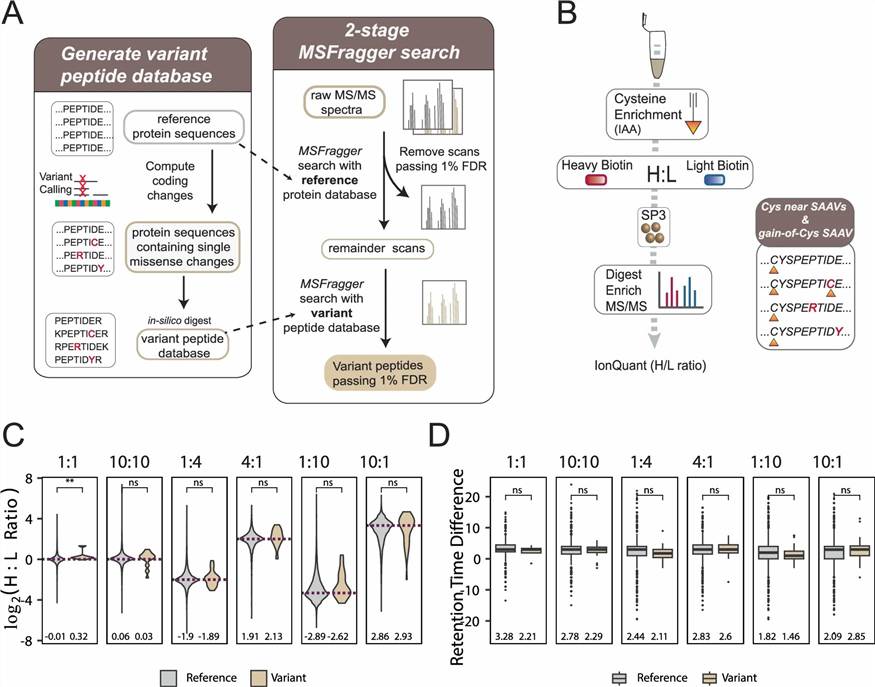
Figure 1 from Desai et al. (2024). Chemoproteogenomic stratification of the missense variant cysteinome. (a) Experimental strategy — IAA-alkyne chemoproteomic labeling, LC-MS/MS analysis, and integration with whole exome and RNA-seq data. (b) Numbers of detected variant peptides and variant-proximal cysteines. (c) Cysteine acquisition frequency across cancer types. (d) Enrichment of gain-of-cysteine variants in dMMR cell lines. (e) Domain-level distribution of acquired cysteines. (f) Functional validation of variant-specific small molecule reactivity. (CC BY 4.0)
Representative Cysteine Redoxome Proteomics Data Outputs
Our cysteine redoxome analysis pipeline delivers multi-dimensional data outputs that provide a complete picture of cysteine redox form identity, site-specific localization, and quantitative dynamics across experimental conditions. Below are representative examples of the key data types included in every project deliverable.
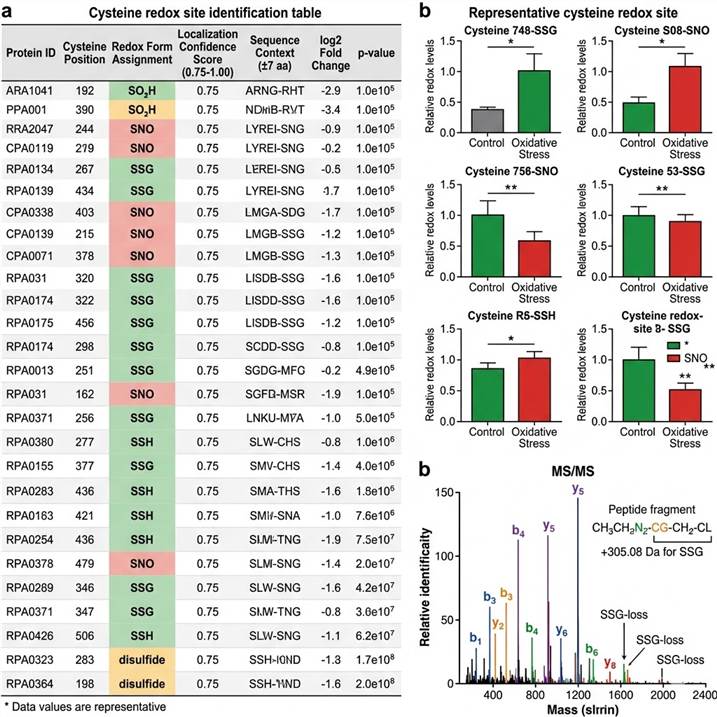
Representative cysteine redoxome proteomics data. (Left) Cysteine redox site identification table with protein ID, cysteine position, redox form assignment (SO₂H, SNO, SSG, SSH, disulfide), localization confidence score, and abundance ratios across conditions. (Center) Quantitative comparison of cysteine redox levels across control and oxidative stress conditions — significant sites colored by regulation direction and redox form type. (Right) Annotated MS/MS spectrum showing diagnostic fragment ions confirming cysteine redox modification identity and site localization.
Every data deliverable is reviewed by our redox proteomics scientists, who verify spectral quality, confirm redox form assignments, and provide biological context for results in the framework of oxidative stress signaling and redox regulation. Custom visualization and data formatting options are available to match publication requirements or internal reporting standards.
Why Choose Our Cysteine Redoxome Proteomics Analysis Services
Comprehensive Redox Form Coverage
Our platform covers the full spectrum of cysteine redox modifications — from mildly oxidized forms (sulfenic acid, S-nitrosylation) through disulfide bonds and S-glutathionylation to persulfidation and terminal oxidation products. Each redox form is addressed with dedicated chemical probes, enrichment strategies, and mass spectrometric acquisition parameters validated for modification-specific detection.
Chemoproteomic Drug Discovery Integration
We provide seamless integration of cysteine redoxome profiling with covalent drug discovery workflows, including competitive reactive cysteine profiling, dose-dependent target occupancy quantification, and off-target selectivity assessment. This combined capability enables translation from redox biology discovery to therapeutic targeting within a single analytical platform.
Validated Chemical Probe and Enrichment Toolbox
Our method portfolio includes validated chemical probes (iodoacetyl-alkyne, dimedone analogs, biotin-switch reagents, tag-switch compounds), antibody-based enrichment reagents (anti-SNO, anti-SSG), and enzymatic methods (GRX-based SSG reduction) that have been optimized and cross-validated across diverse sample types, ensuring reliable and reproducible redox form assignment.
Multi-Dimensional Quantitative Strategies
We offer the full spectrum of quantification approaches — label-free, TMT, ICAT, and PRM — from discovery redox profiling to targeted cysteine modification quantification. Each strategy is optimized for the specific redox form and experimental design, ensuring appropriate statistical power to detect regulated cysteine sites even when modification occupancy changes are modest.
Related Services
Our cysteine redoxome analysis services are supported by a broader PTM characterization platform offering complementary analytical capabilities across modification types and research applications.
- Global PTM Profiling — Broad multi-PTM discovery analysis encompassing redox modifications alongside phosphorylation, acetylation, ubiquitination, and other PTM classes
- PTM Proteoform Mapping — Detailed characterization of combinatorial PTM patterns on individual protein proteoforms including co-occurring redox and non-redox modifications
- PTM Bioinformatics Analysis — Advanced bioinformatics for PTM data integration, redox pathway annotation, cysteine conservation analysis, and druggability assessment
- PTM Crosstalk Analysis — Multi-modification co-regulation analysis identifying interplay between cysteine redox forms and other PTM classes at individual residue positions
- Pan PTM Proteomics — Comprehensive multi-modification profiling across diverse PTM classes for systems-level PTM landscape characterization
- Open-Search PTM Discovery — Unbiased open-search approach for detecting unexpected or novel modifications alongside targeted cysteine redox analysis
- Modified Peptide Enrichment Services — Specialized enrichment strategies for low-abundance PTM peptides including redox-modified cysteine enrichment
- Antibody-Based Immunoaffinity Precipitation — Targeted enrichment of specific cysteine redox forms using validated modification-specific antibodies
- PTM Functional Analysis — Functional annotation and pathway enrichment analysis of redox-modified proteins for biological context interpretation
Frequently Asked Questions
What is the cysteine redoxome and why is it biologically important?
The cysteine redoxome encompasses all cysteine residues across the proteome that are susceptible to reversible and irreversible oxidative modifications. Cysteine's thiol side chain (-SH) can be converted to multiple redox forms including sulfenic acid (S-OH), S-nitrosylation (SNO), S-glutathionylation (SSG), disulfide bonds (S-S), persulfidation (SSH), and more extensively oxidized sulfinic (SO₂H) and sulfonic (SO₃H) acids. Each form carries specific functional consequences for protein activity, interactions, and localization, making the cysteine redoxome a central mediator of redox biology in health and disease.
How do you preserve labile cysteine redox modifications during sample preparation?
Preserving endogenous cysteine redox states requires immediate stabilization during sample collection and processing. Free thiols are blocked using NEM or IAM in the first alkylation step under denaturing conditions, preventing artifactual oxidation. Specific reduction steps (ascorbate for SNO, GRX for SSG, DTT for disulfides) are performed sequentially to distinguish individual redox forms. All steps are performed under controlled pH and temperature with alkylation reagents in excess to ensure complete thiol blocking. Samples are processed in the presence of metal chelators to minimize transition metal-catalyzed oxidation.
How do you distinguish between different cysteine redox forms?
Cysteine redox forms are distinguished through a combination of differential chemical reactivity, diagnostic mass shifts, and targeted fragmentation signatures. Sequential alkylation strategies using form-specific reducing agents (ascorbate for SNO, GRX for SSG, TCEP for disulfides, DTT for general reduction) enable selective detection of each redox class. The distinct mass shifts — sulfenylation (+16 Da), S-nitrosylation (+29 Da), S-glutathionylation (+305 Da), disulfide formation (-2 Da), persulfidation (+32 Da) — are resolved by high-resolution precursor ion measurement (≥60,000 at m/z 200), with modification identity confirmed through diagnostic neutral losses and fragment ions.
What sample types are compatible with cysteine redoxome analysis?
Our pipeline accepts a wide range of sample types including cultured cells (≥1×10⁷ cells for global redox profiling), tissue samples (≥20 mg, including tumor, cardiac, brain, and liver tissues), and biofluids (≥100 μL for targeted redox analysis). For chemoproteomic studies, cell lysates or intact cells are treated with cysteine-reactive probes (IAA-alkyne, desthiobiotin-iodoacetamide) prior to enrichment and digestion. Samples should be collected with rapid freezing or in the presence of alkylation reagents to preserve endogenous redox states.
What quantification strategies are available for cysteine redoxome analysis?
We offer label-free quantification using extracted ion chromatogram alignment for discovery redox profiling, TMT labeling for multiplexed comparison of up to 16 conditions involving different redox states or treatments, ICAT (isotope-coded affinity tag) labeling for targeted light/heavy redox pair quantification, and PRM methods with synthetic redox-modified peptide standards for site-specific validation and absolute quantification. For drug studies, competitive chemoproteomic platforms provide dose-dependent IC₅₀ determination for covalent probes at individual cysteine residues.
Can you analyze multiple cysteine redox forms from the same sample?
Yes — our platform supports sequential differential alkylation workflows that enable parallel detection of multiple redox forms from a single biological sample. The strategy involves sequential reduction steps targeting specific redox forms, each followed by isotopically distinct alkylation to create a mass-differentiated signature for each form. This multi-form approach enables comprehensive redoxome mapping and direct comparison of different redox modifications at shared cysteine sites, providing a complete picture of the cellular cysteine redox landscape under a given condition.
How does your bioinformatics analysis support cysteine redoxome data interpretation?
Our bioinformatics pipeline extends beyond standard identification workflows to include cysteine-specific analysis modules — redox form assignment and validation with FDR-controlled multi-search engine cross-validation, oxidative stress pathway enrichment analysis (GO, KEGG, Reactome, NRF2-targeted), cysteine conservation scoring across species and protein families, structural mapping of modified cysteines to protein domains and active sites, protein-protein interaction network analysis of redox-sensitive protein complexes, and druggability assessment of reactive cysteines for covalent targeting. Results are delivered with interactive visualization and a scientist consultation session.
References
- Desai H, Andrews KH, Bergersen KV, Ofori S, Yu F, Shikwana F, Arbing MA, Boatner LM, Villanueva M, Ung N, Reed EF, Nesvizhskii AI, Backus KM. Chemoproteogenomic stratification of the missense variant cysteinome. Nat Commun. 2024;15:9284.
- Meng J, Fu L, Liu K, Tian C, Wu Z, Jung Y, Ferreira RB, Carroll KS, Blackwell TK, Yang J. Global profiling of distinct cysteine redox forms reveals wide-ranging redox regulation in C. elegans. Nat Commun. 2021;12:1415.
- Tian C, Sun L, Liu K, Fu L, Zhang Y, Chen W, He F, Yang J. Proteome-wide ligandability maps of drugs with diverse cysteine-reactive chemotypes. Nat Commun. 2025;16:4863.
For research use only. Not for use in diagnostic procedures.