Rare PTM Library: Full Catalog of Emerging Modifications
Below is the complete catalog of rare PTM analysis services currently available. Each modification family uses enrichment and detection strategies matched to its unique chemical properties. Click any service name to visit its dedicated service page for detailed protocols, deliverables, and sample guidelines.
Novel Lysine Acylations
Lysine acylation beyond acetylation has emerged as a major regulatory layer connecting cellular metabolism to protein function. These modifications use short-chain acyl-CoAs as donor substrates and are frequently dysregulated in metabolic disease, cancer, and inflammation.
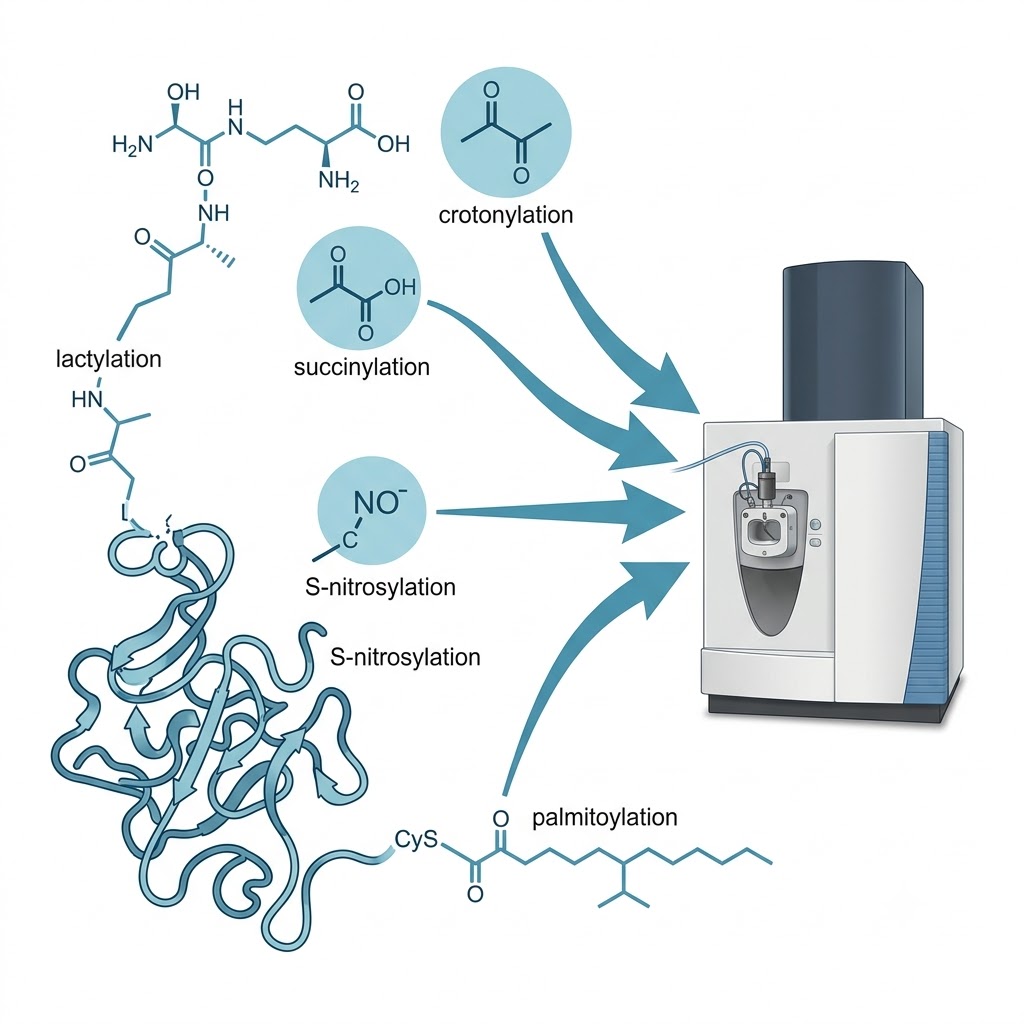
- Lactylation — Regulated by lactate availability; plays a key role in macrophage polarization, tumor immunity, and cardiac remodeling. Our workflow uses pan-anti-lactyllysine antibody enrichment combined with high-resolution LC-MS/MS to achieve deep coverage of lactylated peptides.
- Crotonylation — Enriched at active promoters and enhancers; crotonyl-CoA is a metabolic intermediate derived from short-chain fatty acid metabolism. We apply crotonyl-specific enrichment followed by tandem MS for site-level identification.
- Succinylation — TCA cycle-derived modification that alters protein charge and function; prevalent in mitochondria. Our service combines succinyllysine immuno-affinity enrichment with label-free or TMT quantification.
- 2-Hydroxyisobutyrylation — A recently characterized acylation discovered by bio-orthogonal chemistry and validated in both histones and non-histone proteins. Detection requires specialized antibody enrichment and optimized MS parameters for the +86 Da mass shift.
- Malonylation — Linked to fatty acid synthesis and metabolic flux; enriched on metabolic enzymes in liver and adipose tissue.
- Propionylation — Associated with propionyl-CoA accumulation in propionic acidemia and gut microbiota-host interactions.
- Butyrylation — Derived from butyrate produced by gut microbiota; regulates chromatin structure and inflammatory gene expression.
- Glutarylation — A +100 Da modification linked to glutaryl-CoA dehydrogenase deficiency and mitochondrial dysfunction.
- Lysine β-Hydroxybutyrylation — A ketone body-derived acylation regulated by nutritional status; implicated in fasting response and neuroprotection.
Redox & Cysteine PTMs
Cysteine residues are uniquely sensitive to cellular redox state. Their reversible modification by reactive oxygen, nitrogen, and sulfur species governs enzyme activity, signaling complex assembly, and stress adaptation.
- S-Nitrosylation — Covalent attachment of NO to cysteine thiols, regulating G-protein signaling, ion channels, and inflammatory cascades. We use the biotin-switch method coupled with LC-MS/MS for site-specific identification.
- S-Glutathionylation — Protective modification that prevents irreversible cysteine oxidation under oxidative stress. Our protocol includes reduction-alkylation and glutathione-specific enrichment.
- Persulfidation (S-Sulfhydration) — Hydrogen sulfide-mediated modification that regulates cardiovascular signaling and inflammation. We apply modified biotin-switch or tag-switch chemistry for selective enrichment.
- Cysteine-Redoxome Proteomics — Global profiling of cysteine oxidation states across the proteome using differential alkylation and quantitative MS.
- Reactive Cysteine Profiling — Activity-based profiling of hyper-reactive cysteine residues across the proteome, identifying drug-targetable hotspots.
- Carbonylation — Irreversible oxidative damage marker on Lys, Arg, Pro, and Thr residues; a biomarker for aging, neurodegeneration, and metabolic disorders.
- Cysteinylation — Mixed disulfide formation between protein cysteines and free cysteine, reflecting cellular redox buffering capacity.
- Oxidation (Met/Trp/His) — Targeted detection of oxidized methionine, tryptophan, and histidine residues as markers of oxidative stress and protein damage.
- Free Thiol Groups Analysis — Quantification of solvent-accessible free thiols to assess protein oxidation status and conformational changes.
- Disulfide Bond Analysis — Mapping native disulfide connectivity patterns under non-reducing conditions; critical for biologics structural characterization.
Lipidation
Protein lipidation anchors signaling proteins to membranes, regulates trafficking, and modulates protein-protein interactions at the lipid interface. These hydrophobic modifications require specialized extraction and MS-compatible enrichment protocols.
- Palmitoylation — S-acylation on Cys residues, reversible and dynamically regulated; we use acyl-biotin exchange (ABE) or acyl-PEG exchange (APE) enrichment for palmitoyl-proteome profiling.
- N-Myristoylation — Co-translational N-terminal modification with myristic acid; enrichment via metabolic labeling with alkyne-myristate analogues and click chemistry.
- Prenylation — C-terminal farnesylation/geranylgeranylation of CaaX-motif proteins; enrichment uses metabolic labeling with alkyne-isoprenoid analogues.
Other Emerging Modifications
- O-GlcNAc Modification — Nutrient-sensitive O-linked β-N-acetylglucosamine on Ser/Thr residues; integrates glucose metabolism with transcription, translation, and stress signaling. We use lectin enrichment or chemoenzymatic labeling for O-GlcNAc profiling.
- SUMOylation — Ubiquitin-like modification on Lys residues; regulates nuclear transport, transcription, and DNA damage repair. Enrichment via His-tagged SUMO or SUMO-specific antibody pull-down.
- Histone PTM Profiling — Comprehensive histone modification analysis covering acetylation, methylation, crotonylation, lactylation, and other tail modifications using bottom-up histone MS.
Unified Analysis Pipeline for Rare PTM Detection
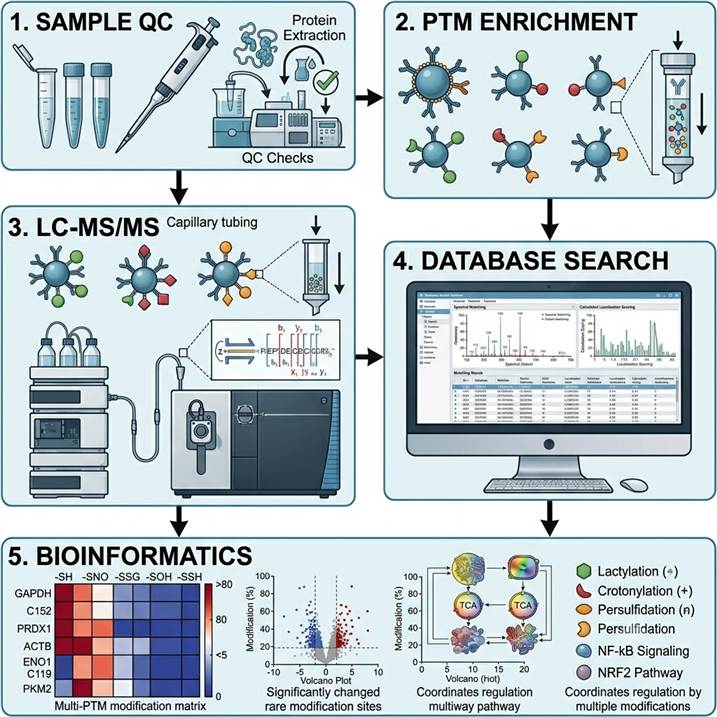
While the enrichment chemistry differs for each modification family, the core analytical pipeline follows a unified framework. This means you can submit samples for multiple rare PTM types through a single point of contact and rely on the same quality standards across all projects.
Step 1: Sample QC & Preparation
- Protein extraction under PTM-preserving conditions (protease inhibitors, deacetylase inhibitors, reducing agents as needed)
- Protein quantification (BCA or Bradford)
- Enzymatic digestion (trypsin, Lys-C, or multi-enzyme) optimized for each PTM type
- Desalting and peptide quantification before enrichment
Step 2: PTM-Specific Enrichment
- Acylations: Pan anti-acyllysine antibody immuno-affinity enrichment (individual antibodies for each acylation type)
- Redox/Cys: Biotin-switch, tag-switch, or differential alkylation chemistry
- Lipidation: Metabolic labeling with alkyne analogues + click chemistry enrichment
- O-GlcNAc: Lectin enrichment (WGA) or chemoenzymatic labeling (GalT1 Y289L)
Each enrichment protocol is validated with positive controls and assessed by Western blot before MS injection.
Step 3: LC-MS/MS Acquisition
- Platform: Orbitrap or Q-TOF high-resolution mass spectrometers
- Chromatography: nanoLC with C18 reversed-phase separation
- Acquisition mode: DDA or DIA depending on depth requirements
- PTM-specific MS parameters: optimized collision energy and neutral loss scanning for labile modifications
Step 4: Database Search & PTM Site Localization
- Search engines: Proteome Discoverer, Mascot, or MaxQuant with PTM-specific variable modifications
- Localization scoring: site probability ≥ 0.75 for high-confidence assignment
- FDR control: peptide-level and protein-level FDR ≤ 1%
- Manual spectral validation for novel or unexpected modification sites
Step 5: Quantification & Bioinformatics
- Label-free quantification (LFQ) or TMT/iTraq multiplexed quantification
- Differential expression analysis: Limma or t-test with multiple-testing correction
- Functional enrichment: GO, KEGG, Reactome pathway analysis
- Kinase/substrate network mapping (for phospho-related PTMs)
- Publication-ready figures: volcano plots, heatmaps, motif logos, bar charts
Rare PTM Analysis vs. Standard Proteomics: Key Differences
Researchers familiar with standard phosphoproteomics or acetylomics may wonder how rare PTM workflows differ. The table below outlines the key distinctions in enrichment strategy, measurement depth, and analytical complexity.
| Dimension |
Standard PTM Analysis (Phospho/Acetyl) |
Rare PTM Analysis (Acylation/Redox/Lipidation) |
| Enrichment Method |
Widely available commercial kits (TiO₂, IMAC, pan-AcK) |
Custom antibody or chemical probe enrichment; validated in-house |
| Antibody Availability |
High — many validated suppliers |
Limited — often 1–2 commercial antibodies; specificity must be confirmed |
| Typical Peptide Yield |
5,000–20,000 phosphosites per project |
500–5,000 modified sites (lower abundance, smaller modification mass shifts) |
| MS Parameter Optimization |
Well-established methods (HCD, neutral loss) |
Requires fine-tuning (collision energy for labile modifications, inclusion lists) |
| Bioinformatics Complexity |
Mature workflows (MaxQuant, PTM-Tablet, Skyline) |
Modified variable mods; some modifications lack comprehensive spectral libraries |
| Turnaround Expectation |
3–5 weeks |
4–8 weeks (enrichment validation adds time) |
Sample Requirements for Rare PTM Analysis
Sample preparation requirements vary by PTM family. The table below provides general guidelines for each modification class. Detailed protocols are provided upon project initiation.
| PTM Family |
Recommended Starting Material (Protein) |
Critical Additives |
Special Notes |
| Novel Lysine Acylations |
5–10 mg total protein per enrichment (≥ 2 mg per IP) |
Deacetylase inhibitors (TSA, NAM); avoid acid-based extraction |
Pilot IP with 1 mg recommended to test antibody lot before full-scale |
| Redox & Cysteine PTMs |
2–5 mg total protein per condition |
Fresh iodoacetamide for alkylation; N-ethylmaleimide for free thiol trapping |
Work under dark/low-light conditions for photo-labile probes; include H₂O₂-treated or DTT-treated controls |
| Lipidation |
10–20 mg total protein per enrichment (low stoichiometry) |
Hydroxylamine for acyl-ester cleavage control; metabolic labeling requires live cells |
Metabolic labeling with alkyne analogues only works in cultured cells — tissue samples require ABE/APE methods |
| O-GlcNAc / SUMO / Histone |
1–5 mg total protein |
O-GlcNAcase inhibitors (Thiamet G); protease inhibitors |
O-GlcNAc enrichment efficiency varies by tissue type — pilot testing recommended |
Note: All samples must be shipped on dry ice with complete metadata (treatment conditions, species, tissue type, expected modification target). A minimum of two biological replicates is recommended for statistical rigor.
Rare PTM Analysis: Frequently Asked Questions
What is the difference between rare PTM analysis and standard phosphoproteomics?
The core technology platform is the same — nanoLC coupled to high-resolution tandem mass spectrometry. The primary differences lie in the enrichment strategy and MS acquisition parameters. Rare PTMs require custom enrichment approaches (e.g., specific anti-acyllysine antibodies, biotin-switch chemistry, or metabolic labeling) rather than the standardized TiO₂/IMAC enrichment used for phosphorylation. Additionally, the collision energy settings must be optimized for each modification's unique fragmentation behavior. Rare PTM yields are typically lower than phosphoproteomics due to lower stoichiometry and more limited enrichment efficiency.
Can you detect multiple rare PTM types from a single sample?
Yes, if sufficient material is available. Each PTM enrichment requires its own aliquot of digested peptides (2–5 mg per IP for acylations; 2–5 mg per redox condition). We recommend at least 10 mg total protein per project to support 2–3 enrichment types with biological replicates. For exploratory projects, we offer a pilot screening panel that analyzes your sample against 3–4 modifications of your choice from the catalog.
How do you validate rare PTM site identification?
Site confidence is assessed at three levels. First, database search engines compute a site localization probability score (Ascore or equivalent), with ≥ 0.75 as our internal threshold. Second, we manually inspect MS² spectra for the diagnostic neutral loss or immonium ions characteristic of each modification — for example, the 129.04 Da lactyl fragment ion for lactylation or the 100.02 Da succinyl fragment for succinylation. Third, where antibodies permit, we validate selected hits by Western blot with the same enrichment antibody used for MS. The final report lists site probabilities and spectral quality flags for each identified modification site.
What modifications are included in the Rare PTM Library?
The library currently covers 20+ rare PTM types across four families: (1) Novel Lysine Acylations — lactylation, crotonylation, succinylation, 2-hydroxyisobutyrylation, malonylation, propionylation, butyrylation, glutarylation, and β-hydroxybutyrylation; (2) Redox & Cysteine PTMs — S-nitrosylation, S-glutathionylation, persulfidation, carbonylation, cysteinylation, cysteine-redoxome profiling, reactive cysteine profiling, oxidation, free thiol analysis, and disulfide bond mapping; (3) Lipidation — palmitoylation, N-myristoylation, and prenylation; and (4) Other emerging modifications — O-GlcNAc, SUMOylation, and comprehensive histone PTM profiling. The catalog is updated as new modifications are validated in our pipeline.
What is the minimum sample amount for rare PTM analysis?
Minimum requirements vary. For lysine acylations: 2 mg total protein per immunoprecipitation, 5–10 mg for deep coverage. For redox PTMs: 2 mg per condition. For lipidation: 10 mg per enrichment due to low stoichiometry. For O-GlcNAc/SUMO: 1 mg may suffice for abundant targets, but 5 mg is recommended for discovery-level profiling. Pilot-scale projects using 1 mg of protein per enrichment are available for initial feasibility testing.
How do I start a rare PTM profiling project?
Submit a consultation request through our Rare PTM Inquiry form. Our scientific liaisons will discuss your specific modification of interest, sample type, and experimental design. We will recommend the most suitable enrichment strategy, confirm minimum sample requirements, and provide a project proposal within 2–3 business days. Pilot studies are offered for new collaborations to validate enrichment efficiency before scaling to full discovery projects.