Why Reactive Cysteine Profiling Matters for Covalent Drug Discovery
Cysteine occupies a unique position in the druggable proteome. Its thiol side chain exhibits enhanced nucleophilicity under physiological conditions, enabling selective targeting by covalent warheads — acrylamides, Michael acceptors, cyanoacrylamides, and others — that form irreversible or reversible covalent bonds. This chemical property has been exploited to develop some of the most impactful covalent drugs across oncology, inflammation, and infectious disease, including osimertinib (EGFR), ibrutinib (BTK), sotorasib (KRAS G12C), and others currently in clinical development.
From Reactive Cysteine to Druggable Target
Not all cysteines are equally reactive or equally ligandable. Cysteine reactivity is governed by local electrostatic environment, solvent accessibility, pKa depression, and structural dynamics that vary dramatically across the proteome. Only a subset of cysteines — the hyper-reactive and ligandable cysteinome — is amenable to covalent inhibitor targeting. Chemoproteomic reactive cysteine profiling directly measures this reactivity landscape, transforming an abstract chemical property into an actionable drug discovery dataset by quantifying the intrinsic reactivity and drug-competitive engagement of thousands of cysteines in parallel.
Accelerating Covalent Drug Discovery
Reactive cysteine profiling accelerates covalent drug programs at multiple stages: target identification (discovering novel ligandable cysteines in disease-relevant proteins), hit validation (confirming that covalent fragments or compounds engage their intended cysteine), selectivity assessment (profiling off-target cysteine engagement across the proteome to guide medicinal chemistry optimization), and mechanism of action studies (identifying the full target landscape of electrophilic compounds). Integrated with our Covalent Drug Reactive Cysteine PTM Profiling and broader PTMs in Drug Discovery platforms, reactive cysteine profiling provides the fundamental reactivity data layer that underpins rational covalent drug design.
Our Approach to Reactive Cysteine Profiling
Our reactive cysteine profiling platform integrates multiple complementary chemoproteomic strategies designed to capture different dimensions of cysteine reactivity and ligandability. The choice of strategy depends on your specific research question — from global reactivity ranking to competitive target engagement profiling.
isoTOP-ABPP: Quantitative Cysteine Reactivity Profiling
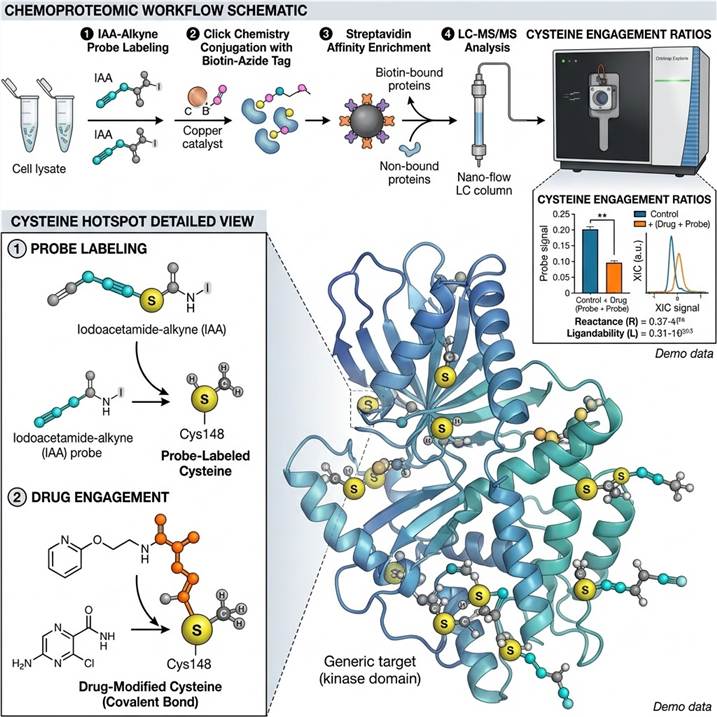
Isotopic tandem orthogonal proteolysis-activity-based protein profiling (isoTOP-ABPP) remains the gold-standard method for quantitative cysteine reactivity mapping. In this approach, an iodoacetamide-alkyne (IAA) probe is used to label reactive cysteines in native proteomes, followed by copper-catalyzed azide-alkyne cycloaddition (CuAAC) to append isotopically light or heavy tags. The ratio of light-to-heavy peptide abundances from LC-MS/MS analysis directly reports on the relative reactivity or target engagement state of each cysteine across paired experimental conditions.
Label-Free DIA Chemoproteomics for Fragment Screening
For higher-throughput fragment-based covalent ligand screening, we deploy label-free DIA chemoproteomics workflows. Cysteine-reactive fragments are incubated with native proteomes at screening concentrations, and the residual IAA-alkyne labeling at each cysteine site is quantified by DIA LC-MS/MS. Cysteines with reduced labeling in fragment-treated samples represent bona fide engagement events. This approach enables screening of 50–200+ fragments in a single campaign, delivering coverage of 10,000–25,000 cysteine sites per run without the cost and complexity of isotopic labeling.
Integrated Data Analysis and Target Prioritization
Raw MS data are processed through optimized search pipelines incorporating custom modification definitions for IAA-alkyne-labeled cysteine. Site localization confidence is assessed using fragment ion coverage, and quantitative comparison across conditions reports engagement ratios with statistical significance. The interplay between reactive cysteine status and broader redox PTM networks — including S-Nitrosylation and S-Glutathionylation — can be integrated for a complete picture of cysteine regulation in your biological context.
Compatible Sample Types and Requirements
Reactive cysteine profiling is compatible with diverse sample types. The following table provides recommended starting amounts and expected coverage for standard workflows.
| Sample Type |
Recommended Amount |
Expected Cysteine Site Coverage |
| Cultured cells (mammalian) |
≥1 × 10⁷ cells |
8,000–15,000 cysteine sites (standard); 15,000–25,000+ (deep profiling) |
| Tissue samples (snap-frozen) |
≥25 mg wet weight |
6,000–12,000 cysteine sites |
| Tumor biopsy samples |
≥5 mg (micro-biopsy compatible) |
3,000–8,000 cysteine sites |
| Blood-derived samples (PBMCs, plasma) |
≥1 × 10⁷ PBMCs or 200 μL plasma |
4,000–10,000 cysteine sites |
| Subcellular fractions (cytosol, membrane, nuclear) |
≥200 μg protein |
Compartment-specific reactivity profiling |
| Microbial cell pellets |
≥1 × 10⁹ cells |
3,000–8,000 cysteine sites |
For broader assessment of cysteine oxidative state, our Cysteine-Redoxome Proteomics and Free Thiol Quantification services provide complementary information on cysteine redox status and thiol availability.
Workflow: From Sample to Cysteine Reactivity Data
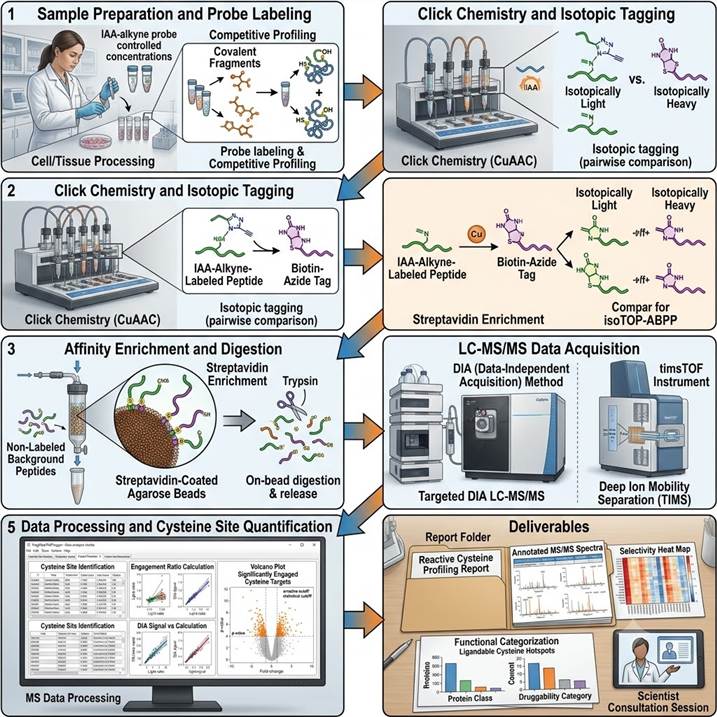
Step 1: Sample Preparation and Probe Labeling
Samples are lysed under native or denaturing conditions optimized for cysteine reactivity preservation. IAA-alkyne probe is added at controlled concentrations to label reactive cysteines. For competitive profiling, samples are pre-incubated with covalent fragments or compounds before probe labeling. Labeling reactions are quenched, and samples are prepared for click chemistry conjugation.
Step 2: Click Chemistry and Isotopic Tagging
CuAAC click chemistry conjugates isotopically light or heavy tags (for isoTOP-ABPP) or biotin affinity handles to the IAA-alkyne-labeled peptides. For label-free DIA workflows, samples are processed individually with biotin tag conjugation. Control and treatment samples are combined for pairwise quantitative comparison where applicable.
Step 3: Affinity Enrichment and Digestion
Biotinylated cysteine-labeled peptides are captured on streptavidin-agarose beads with stringent washing to remove non-labeled background. On-bead trypsin digestion releases enriched cysteine-labeled peptides. Eluted peptides are desalted, concentrated, and spiked with retention time standards for LC-MS/MS analysis.
Step 4: LC-MS/MS Data Acquisition
Enriched cysteine-labeled peptides are separated using nano-flow reversed-phase chromatography on high-resolution Orbitrap platforms. For maximum coverage, we deploy deep-scanning DIA methods on timsTOF or Orbitrap Astral platforms where available. HCD fragmentation parameters are optimized for IAA-alkyne-modified cysteine characterization with diagnostic fragment ion detection.
Step 5: Data Processing and Cysteine Site Quantification
Raw MS data are processed through FragPipe/MSFragger or equivalent pipelines with custom modification definitions for IAA-alkyne-labeled cysteine. Cysteine site quantification is performed using light-to-heavy ratios (isoTOP-ABPP) or label-free DIA signal comparison. Hits are filtered by engagement ratio, statistical significance, and site localization confidence.
Step 6: Deliverables and Biological Interpretation
Reactive cysteine site table with protein IDs, modified cysteine positions, engagement ratios, and statistical confidence, annotated MS/MS spectra for identified cysteine labeling events, selectivity and off-target profiles for compound-treated samples, functional annotation of target proteins, and a scientist consultation session for data interpretation and follow-up planning.
Why Choose Our Reactive Cysteine Profiling Service
Deep Chemoproteomics Expertise
Our team has extensive experience deploying the full spectrum of cysteine chemoproteomics platforms — isoTOP-ABPP, IAA-alkyne labeling, DIA-based fragment screening, and targeted cysteine engagement assays. We understand the nuance of each method and recommend the optimal approach based on your specific program stage and sample constraints.
Covalent Drug Discovery Integration
Unlike generic proteomics services, our platform is purpose-built for covalent drug discovery workflows. We integrate reactive cysteine profiling with downstream target engagement validation, selectivity assessment, and structure-based interpretation — providing the connectivity between cysteine reactivity data and medicinal chemistry decision-making that generic profiling cannot deliver.
Scalable Throughput and Broad Coverage
From single-target cysteine engagement queries to pan-proteome fragment screening campaigns spanning 200+ compounds, our platform scales to meet your program needs. Deep profiling workflows deliver up to 25,000 cysteine sites per experiment, providing the coverage depth needed to identify rare but therapeutically important ligandable cysteines.
Integrated Redox PTM Context
Cysteine reactivity does not exist in isolation — it is modulated by the broader cellular redox environment, oxidative stress status, and competing PTM occupancy. Our integrated platform provides the unique ability to contextualize cysteine reactivity data within the complete cysteine modification landscape, including S-nitrosylation, S-glutathionylation, persulfidation, and disulfide bond status.
Case Study: Robust Proteome Profiling of Cysteine-Reactive Fragments Using Label-Free Chemoproteomics
In a 2024 preprint posted on bioRxiv, Biggs et al. (GSK and collaborating institutions) developed a high-throughput, label-free chemoproteomics platform for profiling cysteine-reactive fragments against the native human proteome, demonstrating the scalability and reproducibility needed for industrial fragment-based covalent ligand discovery.
Background: While isoTOP-ABPP had established the feasibility of proteome-wide cysteine reactivity profiling, the field lacked a robust, cost-effective, and scalable platform suitable for screening large fragment libraries against the native cysteinome. Existing approaches relied on costly isotopic labeling reagents and complex multiplexing schemes that limited throughput.
Approach: The team implemented a streamlined plate-based workflow using SP4 (solid-phase extraction) sample preparation, rapid LC gradients, and DIA acquisition on a timsTOF Pro 2 mass spectrometer. Competitive cysteine profiling was performed by pre-incubating native HEK293T or Jurkat cell lysates with cysteine-reactive fragments, followed by IAA-alkyne probe labeling, biotin-click chemistry enrichment, and label-free DIA quantification. The entire workflow was optimized for reproducibility across multi-well plate formats.
Key Findings:
- The platform consistently identified approximately 23,000 cysteine sites per single run, with a cumulative total of over 32,000 unique cysteine sites mapped across the complete dataset
- 80 cysteine-reactive fragments were screened in parallel across two cell lines, identifying over 400 fragment–protein interaction events with quantitative engagement data
- The label-free DIA approach demonstrated reproducibility comparable to isotopic labeling methods (median CV < 20%) while eliminating the cost and complexity of multiplexed tag reagents
- Fragment selectivity profiles were generated for each hit, revealing structure-activity relationships that distinguish selective covalent ligands from promiscuous electrophiles
- The plate-based format enabled 96-well processing with automated liquid handling compatibility, establishing a clear path to industrial-scale fragment screening campaigns
Significance: This study established that label-free DIA chemoproteomics can deliver the robustness, coverage, and throughput required for industrial fragment-based covalent ligand discovery. The platform's ability to screen 80+ fragments against 20,000+ cysteine sites in a single campaign represents a step-change in the scale of cysteine reactivity profiling — directly enabling the type of broad fragment screening that pharmaceutical discovery programs require for covalent inhibitor development.
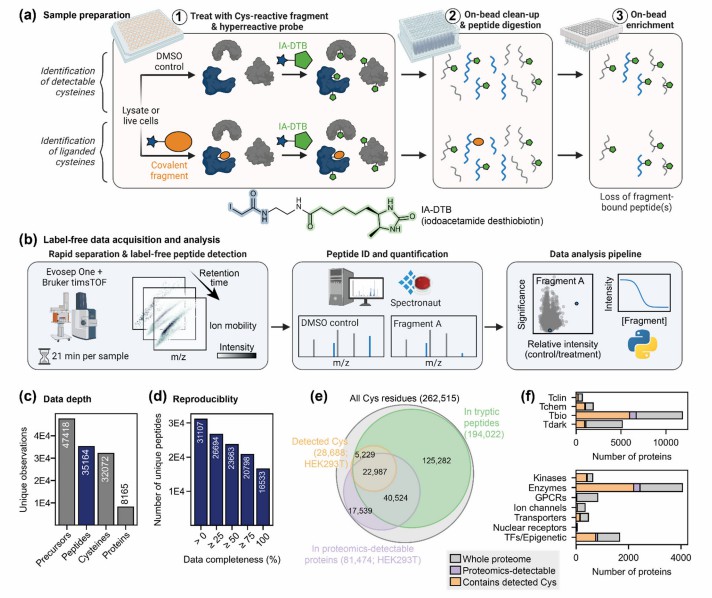
Figure 1 from Biggs et al. (2024). Label-free DIA chemoproteomics workflow for cysteine-reactive fragment profiling, cysteine site coverage and reproducibility statistics, and fragment selectivity characterization. (CC BY 4.0)
Representative Reactive Cysteine Profiling Results
Our reactive cysteine profiling analysis delivers integrated data packages designed for immediate drug discovery decision-making and publication-quality visualization.
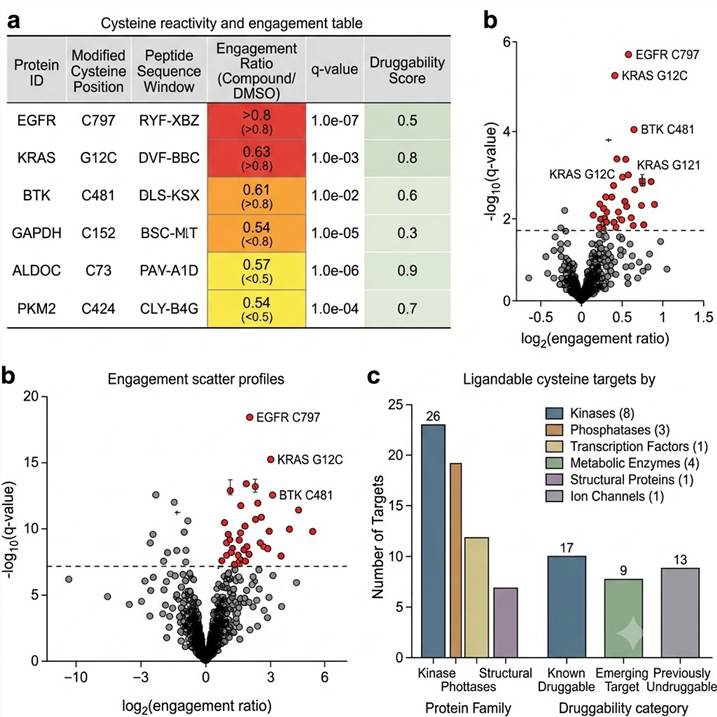
Representative data outputs from our reactive cysteine profiling pipeline. Left: Cysteine engagement table. Center: Quantitative engagement scatter plot. Right: Functional categorization of ligandable cysteine targets.
Key deliverables included in every project package:
- Cysteine reactivity and engagement table — For each identified cysteine site: protein ID, modified cysteine position, peptide sequence, engagement ratio (compound/control), statistical confidence (p-value, q-value), and site localization score
- Target selectivity profiles — Quantitative engagement data across all identified cysteine sites for compound-treated samples, enabling selectivity ranking, off-target assessment, and structure-engagement relationship analysis
- Annotated MS/MS spectra — Fragmentation spectra for each IAA-alkyne-labeled cysteine peptide with diagnostic fragment ion assignments
- Functional and structural annotation — Target classification by protein family, subcellular localization, functional category, and druggability assessment including structural context where available
- Enrichment efficiency and reproducibility QC — Probe labeling efficiency, streptavidin capture yield, replicate reproducibility metrics, and site coverage statistics
Related Services
Our reactive cysteine profiling platform is part of an integrated cysteine modification and drug discovery service portfolio. These services can be used independently or combined for comprehensive cysteine-focused drug development programs.
- Disulfide Bond Analysis — Mapping of disulfide bridge formation, isomerization, and cysteine pairing in proteins under native and oxidative conditions
- Carbonylation Analysis — Detection and quantification of protein carbonylation as a marker of oxidative stress and cysteine-targeting compound effects
- Oxidation Analysis — Comprehensive profiling of oxidative PTMs including sulfenylation, sulfinylation, and sulfonylation of cysteine residues
- Persulfidation / S-Sulfhydration Analysis — Detection and site mapping of cysteine persulfidation for H₂S signaling and redox biology research
- Reactive Cysteine Target Engagement Assay — Targeted quantitative assays for monitoring engagement of specific cysteine residues by covalent inhibitors
- PTM Bioinformatics Analysis — Downstream computational analysis, pathway mapping, and druggability assessment for cysteine profiling datasets
FAQs
What is reactive cysteine profiling?
Reactive cysteine profiling is a chemoproteomic approach that uses chemical probes (typically IAA-alkyne) to label, enrich, and quantify reactive cysteine residues across the proteome. By measuring the relative labeling efficiency of each cysteine in the presence versus absence of a covalent compound, the method reports on both the intrinsic reactivity of each cysteine and its engagement by drug-like molecules.
How many cysteine sites can you detect in a typical experiment?
In standard workflows using mammalian cell lysates, we typically identify 8,000–15,000 cysteine sites per experiment. With deep-profiling workflows on high-resolution platforms (Orbitrap Astral, timsTOF Ultra), coverage can reach 20,000–25,000+ cysteine sites per run. Coverage depends on sample type, input amount, and the specific profiling strategy employed.
What is the difference between isoTOP-ABPP and label-free DIA profiling?
isoTOP-ABPP uses isotopic tags (light/heavy) for pairwise quantitative comparison and is ideal for high-precision ratio measurements in focused experiments (e.g., comparing two treatment conditions). Label-free DIA profiling uses spectral library-based quantification without isotopic reagents, offering higher throughput and scalability for multi-condition fragment screening campaigns. Each method has specific advantages, and we recommend the optimal approach based on your experimental design.
How do you distinguish specific cysteine engagement from general electrophile reactivity?
Specific engagement is distinguished through concentration-response profiling, competition with excess IAA probe, and comparison against inert structural analogs. Cysteines that show concentration-dependent, saturable, and structure-specific competition are classified as specific engagement events. Statistical filtering using false discovery rate control and replicate consistency provides additional confidence in hit selection.
Can reactive cysteine profiling be used for PROTAC and targeted degradation programs?
Yes — reactive cysteine profiling is increasingly applied to targeted protein degradation programs. The method can identify ligandable cysteines on E3 ligases for covalent recruiters, map the cysteine engagement landscape of bifunctional degrader molecules, and assess selectivity of degradation-tagging warheads. Cysteine profiling data directly informs warhead selection and optimization in covalent PROTAC and molecular glue discovery.
What types of covalent compounds can you profile?
We profile a broad range of cysteine-targeting electrophiles including acrylamides, Michael acceptors, cyanoacrylamides, vinyl sulfonamides, chloroacetamides, and epoxides, as well as activated esters and other reactive warhead chemotypes. For each compound class, we optimize the competition assay conditions including pre-incubation time, concentration range, and buffer composition to ensure reliable engagement data.
How should I select which fragments or compounds to screen?
Fragment selection strategy depends on your program goals. For target-agnostic discovery, we recommend diverse electrophile fragment libraries (100–200 compounds) to maximize cysteine ligandability coverage. For target-focused campaigns, we recommend directed libraries incorporating known warheads against your target family of interest. We provide consultation on library design and can accommodate pre-selected fragment sets from your internal collection.
What are the sample preparation considerations for reactive cysteine profiling?
Samples should be flash-frozen and stored at -80°C without prior fixation or thiol-reactive treatment. Fresh-frozen tissue or freshly harvested cell pellets are preferred. For compound-treated samples, cells should be harvested with excess compound washed out before lysis. Reducing agents (DTT, TCEP) should be avoided in lysis buffers as they consume the IAA-alkyne probe. We provide detailed sample preparation protocols upon project initiation.
References
- Biggs GS, Cawood EE, Vuorinen A, McCarthy WJ, Wilding H, Parliament K, et al. Robust proteome profiling of cysteine-reactive fragments using label-free chemoproteomics. bioRxiv. 2024.07.25.605137.
- Tian F, Wang Y, Zhang L, Liu J, Chen X, Wu Z, et al. Proteome-wide ligandability maps of drugs with diverse cysteine-reactive chemotypes. Nature Communications. 2025;16:4863.
- Kaur G, Lee H, Chen S, Zhang Y, Kim J, Park S, et al. A platform for mapping reactive cysteines within the immunopeptidome. Nature Communications. 2024;15:9698.
For research use only. Not for use in diagnostic procedures.