Covalent Drug Reactive Cysteine Profiling — From Cysteinome Map to Validated Covalent Lead
Targeted covalent inhibitors represent over 30% of clinically approved kinase inhibitors and an expanding fraction of clinical-stage oncology and immunology programs. The appeal is clear: covalent engagement of a non-catalytic cysteine can achieve sustained target occupancy, enhanced selectivity against closely related proteins lacking the reactive cysteine, and pharmacological efficacy that outlasts compound exposure. But realizing these advantages requires chemoproteomic data that answers three questions at each stage of the pipeline:
- Hit identification: Which cysteines in the proteome does my electrophilic fragment or scaffold engage, and are any of those cysteines on proteins relevant to my disease biology?
- Lead optimization: What is the quantitative target occupancy across the cysteinome at each compound concentration, and how does structural modification shift the selectivity profile?
- Candidate selection: Does target engagement at the intended cysteine translate to downstream pathway modulation in disease-relevant cellular models, and are any off-target cysteines engaged at concentrations within the therapeutic window?
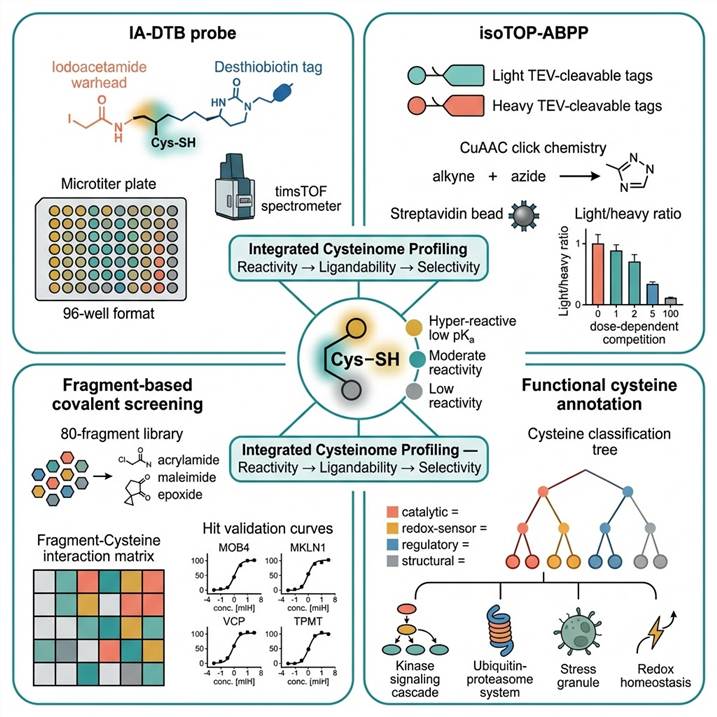
We address all three questions with a unified chemoproteomics platform that integrates four complementary cysteine profiling modes, backed by cysteine-redoxome annotation and cellular pharmacodynamic readouts. Every dataset you receive places your compound's cysteine engagement profile in the context of the functional cysteine landscape — so you know not just which cysteines are engaged, but which engagements are likely to matter pharmacologically.
| Service Module |
Technology |
Key Deliverable |
Application Stage |
| Cysteine Ligandability Mapping |
HT-LFQ IA-DTB chemoproteomics (DIA, timsTOF) |
30,000+ cysteine site map with reactivity scores and ligandability annotation |
Target ID, hit finding |
| Competitive Cysteine Profiling |
isoTOP-ABPP / TMT-based competitive ABPP |
Dose-resolved target engagement across cysteinome (apparent Kd / IC₅₀ per cysteine) |
Hit-to-lead, selectivity profiling |
| Fragment-Based Covalent Screening |
IA-DTB competition with electrophilic fragment libraries |
Ligandable cysteine–fragment interaction matrix across 80+ fragments |
Hit identification, scaffold hopping |
| Functional Cysteine Annotation |
Cysteine-redoxome integration with chemoproteomic data |
Cysteine classified as redox-sensor, catalytic, regulatory, or structural; reactivity pKa inferred |
Hit triage, mechanism inference |
| Cellular Target Engagement |
Live-cell IA-DTB labeling + MS; cysteine-redoxome shift assays |
Cellular target occupancy; redox-state change upon covalent modification |
Lead optimization, candidate selection |
| Selectivity Panel & Off-Target ID |
Multiplexed TMTpro-16 competitive ABPP |
Proteome-wide selectivity heat map; off-target cysteine enumeration with occupancy values |
Candidate selection, safety profiling |
Chemoproteomic Platforms for Reactive Cysteine Profiling
HT-LFQ IA-DTB Chemoproteomics — High-Throughput Cysteine Ligandability Mapping
The IA-DTB (iodoacetamide-desthiobiotin) probe is a broad-spectrum cysteine-reactive probe that enriches cysteine-containing peptides via desthiobiotin–streptavidin affinity capture. Our HT-LFQ platform combines SP4-based sample preparation with data-independent acquisition (DIA) on a Bruker timsTOF Pro 2 using diaPASEF, delivering consistent identification of 23,000+ cysteine sites per single run and 30,000+ cysteine sites across a typical cell-line experiment. The 96-well plate format supports 384 samples processed in 2–3 days by a single operator — suitable for screening compound libraries against the cysteinome at throughput that matches medicinal chemistry timelines.
Quantitative cysteine reactivity scores (IA-DTB labeling ratio relative to vehicle control) are reported for every detected cysteine, enabling identification of hyper-reactive cysteines — those with low pKa that are preferentially targeted by mild electrophiles — as well as cysteine sites whose reactivity is modulated by compound treatment, cellular state, or disease context.
isoTOP-ABPP — Quantitative, Site-Specific Cysteine Target Engagement
isoTOP-ABPP (isotopic tandem orthogonal proteolysis–activity-based protein profiling) provides quantitative, site-level resolution of cysteine target engagement. In a competitive isoTOP-ABPP experiment, cell lysates or live cells are treated with your compound at a concentration series, followed by labeling with a broad cysteine-reactive alkyne probe (IA-alkyne). Control and treated samples are conjugated to isotopically differentiated (light/heavy) TEV-cleavable biotin tags via copper-catalyzed azide-alkyne cycloaddition (CuAAC), mixed 1:1, enriched on streptavidin beads, and released by TEV protease digestion. LC-MS/MS analysis quantifies the light/heavy ratio for each cysteine-containing peptide — a direct measure of compound competition at each site.
This workflow delivers apparent Kd or IC₅₀ values for every cysteine engaged by your compound, enabling proteome-wide selectivity assessment from a single experiment. For covalent inhibitor programs, isoTOP-ABPP is the gold-standard method for demonstrating that a compound's target engagement profile is consistent with its proposed mechanism of action.
TMT-Based Competitive ABPP — Multiplexed Selectivity Profiling
For programs requiring quantitative comparison of cysteine target engagement across multiple compounds, concentrations, or time points, TMTpro-16-based competitive ABPP enables 16-plex quantification in a single LC-MS/MS experiment. This platform is ideal for: head-to-head selectivity comparison of lead compounds, concentration-response profiling (8-point dose-response in duplicate), time-course target engagement studies, and cysteine-redoxome-integrated selectivity panels that annotate each engaged cysteine with its redox functional class.
Fragment-Based Covalent Ligand Screening
Our electrophilic fragment library (chloroacetamide, acrylamide, and custom warhead chemotypes, MW 150–350 Da) is screened in competitive IA-DTB format to identify fragment–cysteine interactions across the proteome. Each fragment is profiled at a single concentration (typically 100 µM or 500 µM) against the IA-DTB probe, and cysteine sites showing >50% competition are flagged as fragment-liganded. The output is a fragment–cysteine interaction matrix that identifies: (1) which cysteines in the proteome are ligandable by your preferred electrophilic chemotype, (2) which fragments show the most selective engagement profiles, and (3) which liganded cysteines reside on proteins relevant to your therapeutic area. This data directly informs scaffold selection, fragment growing, and selectivity optimization.
Applications in Covalent Drug Discovery
Covalent Kinase Inhibitor Selectivity Profiling
- Map covalent engagement of acrylamide-, butyneamide-, and maleimide-based kinase inhibitors against the cysteinome
- Quantify target occupancy at the catalytic cysteine (e.g., EGFR C797, BTK C481, HER2 C805) alongside off-target cysteines
- Integrate with kinase activity profiling for structure–activity–selectivity relationships
Covalent Fragment-Based Drug Discovery
- Screen electrophilic fragment libraries (80+ fragments) against the cysteinome to identify novel liganding hotspots
- Prioritize fragments engaging cysteines on targets relevant to your indication
- Use fragment–cysteine interaction matrices to guide fragment growing and merging strategies
Covalent PROTAC and DUB Inhibitor Development
- Profile covalent recruiters for E3 ligase cysteine engagement (e.g., RNF4, HECTD1, DCAF16)
- Validate DUB active-site cysteine targeting with DUB activity assays and ABPP
- Confirm ternary complex formation does not introduce off-target cysteine reactivity
Redox Cysteine Drug Targeting
- Identify hyper-reactive, low-pKa cysteines using reactivity profiling integrated with cysteine-redoxome proteomics
- Distinguish catalytic cysteines from regulatory redox-sensor cysteines — targeting the right cysteine for the desired pharmacology
- Monitor redox-state shifts upon covalent modification for mechanism-of-action studies
Covalent Inhibitor Pharmacodynamic Profiling
- Correlate cysteine target engagement with downstream pathway modulation (phosphoproteomics, acetylomics, ubiquitylomics)
- Demonstrate that target engagement at the intended cysteine produces the expected pharmacological effect
- Establish target engagement–efficacy relationships to guide dose selection and candidate nomination
Drug Repurposing via Latent Cysteine Reactivity
- Profile approved drugs for uncharacterized cysteine reactivity across the proteome
- Identify drugs with latent electrophilicity that engage disease-relevant cysteine targets
- Repurpose clinical-stage compounds as covalent chemical probes for novel targets
Reactive Cysteine Profiling Workflow for Covalent Drug Discovery
1. Experimental Design and Probe Selection
- Define profiling objective: cysteine ligandability map, competitive target engagement, fragment screen, or selectivity panel
- Select probe chemistry: IA-DTB for broad coverage, IA-alkyne for isoTOP-ABPP, or custom warhead probe for project-specific needs
- Sample matrix selection: cell lysate (in vitro), live cells (in cellulo), or tissue lysate
- Compound concentration range and replicate structure defined per project objectives
2. Sample Preparation and Cysteine Labeling
- Cell/tissue lysis in native buffer with cysteine-protective additives (catalase, iodoacetamide-free)
- Compound treatment at specified concentrations with vehicle and no-probe controls
- Cysteine probe labeling: IA-DTB (1 h, RT) or IA-alkyne (1 h, RT) under controlled pH to preserve cysteine reactivity hierarchy
- For live-cell experiments: compound treatment in complete medium, followed by lysis and probe labeling
3. Enrichment and Sample Processing
- CuAAC click chemistry (for alkyne probes): conjugation to biotin-azide or isotopically labeled TEV-cleavable tags
- Streptavidin affinity enrichment of probe-labeled, cysteine-containing peptides
- On-bead trypsin digestion and TEV protease cleavage (isoTOP-ABPP) to release cysteine-containing peptides
- SP4-based peptide clean-up for label-free workflows; TMTpro labeling for multiplexed quantitative experiments
4. LC-MS/MS Data Acquisition
- HT-LFQ: DIA with diaPASEF on Bruker timsTOF Pro 2 (21-min gradients, 60 SPD)
- isoTOP-ABPP / TMT-based: DDA on Orbitrap Exploris 480 or Fusion Lumos (120-min gradients)
- Targeted quantification of low-abundance cysteine peptides by PRM for occupancy verification
5. Data Processing and Cysteine Assignment
- DIA data: library-free analysis with DIA-NN or library-based with Spectronaut
- Cysteine site localization: FDR < 1% at peptide and site level
- isoTOP-ABPP: light/heavy ratio extraction and dose-response curve fitting for apparent Kd / IC₅₀ determination
- Functional cysteine annotation: each cysteine classified by reactivity score, predicted pKa, and redox functional class (derived from cysteine-redoxome reference data)
6. Selectivity Analysis, Reporting, and Data Delivery
- Cysteinome-wide target engagement heat map with compound concentration gradient
- Volcano plots highlighting dose-dependent cysteine competition events with statistical thresholds
- Functional annotation overlay: redox-sensor, catalytic, and regulatory cysteines flagged on all visualizations
- Comprehensive report with raw data (mzML, DIA-NN output), cysteine-level quantification tables, and publication-ready figures
Why Choose Our Covalent Drug Cysteine Profiling Platform
Integrated Cysteine Biology — Not Just a Peak List
- Every cysteine in your dataset is annotated with functional context: redox-sensor vs. catalytic vs. structural classification
- Cysteine-redoxome data provides the biological filter — distinguishing druggable functional cysteines from background reactivity
- Hyper-reactivity scores (inferred pKa) flag the cysteines most likely to be targetable by mild electrophiles
Four Complementary Platforms, One Provider
- HT-LFQ IA-DTB for broad cysteine ligandability mapping at screening throughput
- isoTOP-ABPP for quantitative, site-specific target engagement with apparent Kd determination
- TMTpro-16 competitive ABPP for multiplexed selectivity profiling across compounds and concentrations
- Fragment-based covalent screening for ligandable hotspot identification
Cellular Target Engagement, Not Just Lysate Data
- Live-cell cysteine labeling captures target engagement in the native cellular environment — where protein complexes, subcellular localization, and endogenous redox conditions determine true cysteine accessibility
- Cellular cysteine-redoxome shift assays confirm that covalent modification produces a measurable biochemical change at the target cysteine
- Pathway-level pharmacodynamic readouts connect cysteine engagement to downstream biology
Case Study — High-Throughput Label-Free Chemoproteomics for Cysteine Fragment Screening
Biggs, Cawood, Vuorinen, and colleagues at the Francis Crick Institute and GSK developed and applied a high-throughput label-free quantitative (HT-LFQ) chemoproteomics platform to systematically profile cysteine-reactive fragments across the human proteome — a study that directly demonstrates the workflow our service provides for covalent drug discovery programs (Biggs et al., 2025, Nature Communications, CC BY 4.0).
Background: Chemoproteomic cysteine profiling is the foundational technology for covalent drug discovery — it tells you which cysteines in the proteome are reactive, which are ligandable by specific electrophilic chemotypes, and which engagements are selective enough to pursue as drug targets. Historically, the gold-standard isoTOP-ABPP method, while quantitative and site-specific, has been limited by throughput, cost, and the data completeness challenges inherent to isotopic labeling and DDA-based acquisition. The team set out to establish whether a label-free, DIA-based platform could match or exceed isoTOP-ABPP in cysteine coverage while dramatically improving throughput and data completeness — enabling routine screening of electrophilic fragment libraries at a scale relevant to drug discovery.
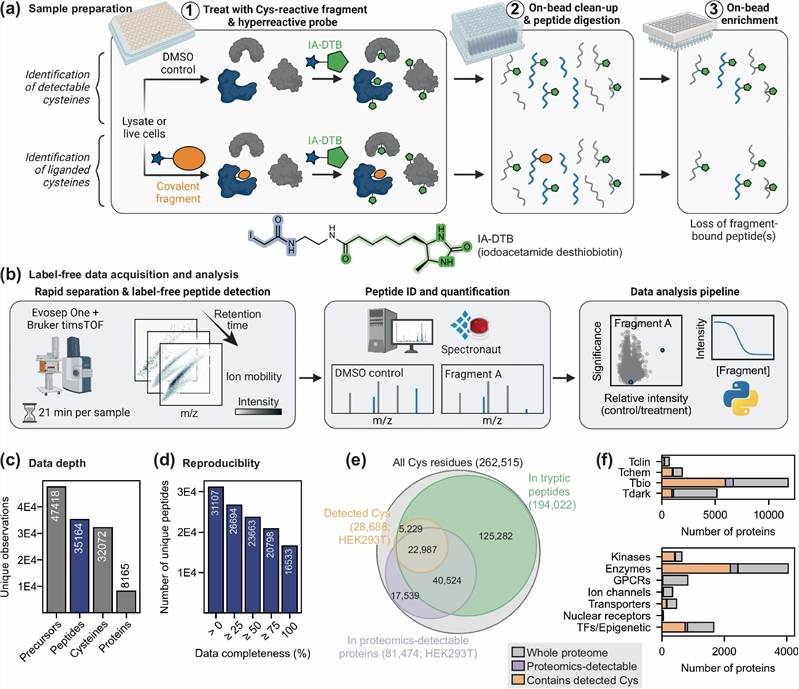
Methods: The HT-LFQ platform integrated four key innovations: (1) IA-DTB as a broad-spectrum cysteine-reactive probe with desthiobiotin affinity enrichment; (2) SP4 (solvent precipitation on glass beads) plate-based sample preparation eliminating peptide-level desalting steps; (3) data-independent acquisition with diaPASEF on a Bruker timsTOF Pro 2 using 21-minute active gradients (60 samples per day); and (4) library-free DIA-NN analysis for cysteine site identification and quantification. The platform was benchmarked against isoTOP-ABPP for cysteine coverage, reproducibility, and data completeness. A library of 80 chloroacetamide fragments (MW 160–320 Da) was then screened in competitive format — each fragment at 100 µM competed against the IA-DTB probe in HEK293T and Jurkat cell lysates, with cysteine engagement quantified as the reduction in IA-DTB labeling relative to DMSO control.
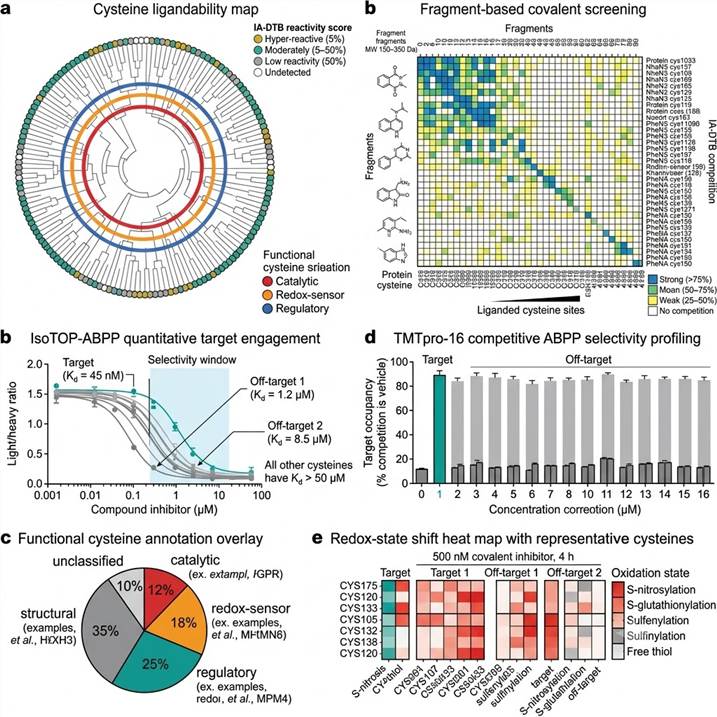
Results: The HT-LFQ platform consistently identified ~23,000 cysteine sites per individual run and ~32,000 cysteine sites across the full HEK293T and Jurkat experiment, mapping to over 8,000 proteins (~40% of the human proteome). Median data completeness between replicates was 82% — substantially higher than typical isoTOP-ABPP experiments — and the 96-well format enabled a single operator to process 384 samples in 2–3 days. The 80-fragment screen identified 742 liganding events at 438 cysteine sites across 413 proteins, representing >400 distinct fragment–protein interactions. Notably, many of these liganded proteins are classified as Tbio (biological dark) or Tdark (completely uncharacterized) targets for which no chemical probe previously existed. Concentration-response experiments validated key hits, including MOB4 Cys134 (a STRIPAK complex component), MKLN1 Cys82 (a transcriptional co-activator), VCP Cys522 (p97/VCP, an AAA+ ATPase and emerging drug target), and TPMT Cys70 (thiopurine S-methyltransferase). Live-cell experiments confirmed that the platform's lysate-based hits translated to cellular target engagement for the majority of validated interactions.
Significance for Covalent Drug Discovery: This study demonstrates that label-free DIA chemoproteomics can now serve as a primary cysteine profiling platform for covalent drug discovery — matching or exceeding the cysteine coverage of isoTOP-ABPP while providing the throughput needed to screen fragment libraries and compound collections at scale. The identification of ligandable cysteines on Tbio/Tdark proteins highlights the power of unbiased chemoproteomic screening to discover covalent chemical matter for targets that lack established small-molecule probes. For covalent drug discovery programs, this workflow directly enables the three-stage pipeline our service provides: (1) proteome-wide cysteine ligandability mapping to identify drug-targetable cysteines; (2) fragment-based screening to find starting points for covalent probe development; and (3) quantitative selectivity profiling to optimize covalent leads. The integration of this chemoproteomic data with cysteine-redoxome functional annotation — distinguishing catalytic, redox-sensor, and regulatory cysteines — further enables prioritization of the cysteine engagements most likely to drive pharmacology.
Reference: Robust proteome profiling of cysteine-reactive fragments using label-free chemoproteomics. Biggs GS, Cawood EE, Vuorinen A, McCarthy WJ, Wilders H, Riziotis IG, van der Zouwen AJ, Pettinger J, Nightingale L, Chen P, Powell AJ, House D, Boulton SJ, Skehel JM, Rittinger K, Bush JT. Nature Communications. 2025;16:73. (CC BY 4.0)
Representative Reactive Cysteine Profiling Results
| Profiling Mode |
Throughput |
Cysteine Coverage |
Quantitative Output |
Best For |
| HT-LFQ IA-DTB |
60 SPD / 384 samples in 3 days |
23,000–30,000+ cysteine sites |
IA-DTB labeling ratio (relative to vehicle) |
Ligandability mapping, fragment screening |
| isoTOP-ABPP |
48 samples per batch |
15,000–20,000 cysteine sites |
Light/heavy ratio; apparent Kd per cysteine |
Quantitative target engagement, selectivity |
| TMTpro-16 Competitive ABPP |
16-plex per MS run |
12,000–18,000 cysteine sites |
Reporter ion intensity; dose-response occupancy |
Multiplexed selectivity, time-course |
| Fragment-Based Covalent Screening |
80+ fragments per campaign |
30,000+ cysteine sites (IA-DTB readout) |
Fragment–cysteine competition matrix |
Hit finding, scaffold selection |
| Cellular Cysteine Target Engagement |
Project-dependent |
10,000–20,000 cysteine sites |
Cellular target occupancy; redox shift |
PD validation, candidate selection |
Related Services
Our covalent drug reactive cysteine profiling integrates with the following PTM proteomics and drug discovery services:
Frequently Asked Questions
What is the difference between IA-DTB and IA-alkyne cysteine probes?
IA-DTB (iodoacetamide-desthiobiotin) is a direct-labeling probe: the desthiobiotin group enables direct streptavidin enrichment without click chemistry, making it faster and compatible with the HT-LFQ DIA workflow for high-throughput cysteine mapping. IA-alkyne (iodoacetamide-alkyne) requires CuAAC click chemistry to conjugate a biotin tag after labeling, which adds a step but enables the use of isotopically differentiated (light/heavy) cleavable tags — essential for isoTOP-ABPP quantitative target engagement experiments. We recommend IA-DTB for initial cysteine ligandability mapping and fragment screening; IA-alkyne for quantitative dose-response target engagement and selectivity profiling.
How many cysteine sites can you detect and quantify in a typical experiment?
Our HT-LFQ IA-DTB platform consistently identifies ~23,000 cysteine sites per individual DIA run and 30,000+ cysteine sites across a full experiment (multiple cell lines or conditions). isoTOP-ABPP typically quantifies 15,000–20,000 cysteine sites with light/heavy ratios, and TMTpro-16 competitive ABPP captures 12,000–18,000 cysteine sites with multiplexed quantification. Actual coverage depends on sample type, proteome complexity, and cysteine abundance distribution in your biological system.
Can you distinguish functional cysteines (catalytic, redox-sensor) from background cysteines?
Yes — this is a core capability of our platform. We integrate chemoproteomic cysteine profiling data with cysteine-redoxome reference data to classify every detected cysteine by functional category: (1) catalytic cysteines — active-site nucleophiles in enzymes (proteases, DUBs, thiol isomerases); (2) redox-sensor cysteines — cysteines whose oxidation state changes with cellular redox conditions; (3) regulatory cysteines — sites of post-translational modification (S-nitrosylation, S-glutathionylation, persulfidation) that regulate protein function; (4) structural cysteines — metal-binding or disulfide-bonded cysteines. Hyper-reactivity scores (inferred pKa) further identify cysteines most likely to be targetable by mild electrophiles. This functional annotation helps you prioritize the covalent engagements most likely to produce pharmacology.
Can you work with live cells, or only cell lysates?
Both. For cysteine ligandability mapping and competitive fragment screening, we typically use cell lysates prepared under native, cysteine-preserving conditions — this provides the highest cysteine coverage. For target engagement validation and selectivity profiling, we offer live-cell cysteine labeling: your compound is added to intact cells in complete medium, followed by lysis and IA-DTB or IA-alkyne probe labeling. Live-cell experiments capture target engagement in the native cellular context — where protein complexes, subcellular localization, membrane permeability, and endogenous redox conditions determine true cysteine accessibility. We also offer cysteine-redoxome shift assays in live cells to confirm that covalent target engagement produces a measurable biochemical change at the cysteine oxidation state level.
What electrophile chemotypes can you profile?
Our standard electrophilic fragment library covers chloroacetamide and acrylamide chemotypes (MW 150–350 Da). We can also profile compounds with: chloroacetamide, acrylamide, maleimide, vinyl sulfonamide, butyneamide, epoxide, nitrile, sulfonyl fluoride, and α-cyanoacrylamide warheads. For custom or proprietary chemotypes, we design the profiling experiment around your compounds — the IA-DTB or IA-alkyne competition format works with any electrophile that covalently modifies cysteine thiols. We also support profiling of reversible covalent inhibitors (e.g., nitrile-based) using washout protocols to distinguish reversible from irreversible engagement.
How does cysteine profiling integrate with the rest of your PTM proteomics and drug discovery platform?
Cysteine profiling sits at the intersection of our redox PTM and drug discovery capabilities. Upstream: our cysteine-redoxome proteomics provides the functional annotation layer — which cysteines are redox-active, which are modified by S-nitrosylation or S-glutathionylation, and how the cellular redox environment shapes cysteine reactivity. Our reactive cysteine profiling service provides the hyper-reactivity map — which cysteines have low pKa and are preferentially targeted by electrophiles. Downstream: our PTM enzyme activity and inhibitor screening platform validates whether your covalent compound's target engagement produces the expected enzyme inhibition. Our phosphoproteomics and ubiquitylomics services provide the pathway-level pharmacodynamic readout — confirming that cysteine target engagement translates to downstream signaling modulation. Our PROTAC and degrader proteomics services support covalent recruiter characterization for targeted protein degradation applications. This integration — from cysteine reactivity map through enzyme activity confirmation to pathway pharmacology — delivers the complete data package for covalent drug candidate advancement.
References
- Robust proteome profiling of cysteine-reactive fragments using label-free chemoproteomics. Biggs GS, Cawood EE, Vuorinen A, McCarthy WJ, Wilders H, Riziotis IG, van der Zouwen AJ, Pettinger J, Nightingale L, Chen P, Powell AJ, House D, Boulton SJ, Skehel JM, Rittinger K, Bush JT. Nature Communications. 2025;16:73.
- Quantitative reactivity profiling predicts functional cysteines in proteomes. Weerapana E, Wang C, Simon GM, Richter F, Khare S, Dillon MBD, Bachovchin DA, Mowen K, Baker D, Cravatt BF. Nature. 2010;468(7325):790–795.
- Accelerating multiplexed profiling of protein-ligand interactions: High-throughput plate-based reactive cysteine profiling with minimal input. Yang K, Whitehouse RL, Dawson SL, Zhang L, Martin JG, Johnson DS, Paulo JA, Gygi SP, Yu Q. Cell Chemical Biology. 2024;31(3):565–576.
This service is provided for research use only (RUO). Not for diagnostic or clinical applications.