Exploring the Expanding Universe of Emerging PTMs by Mass Spectrometry
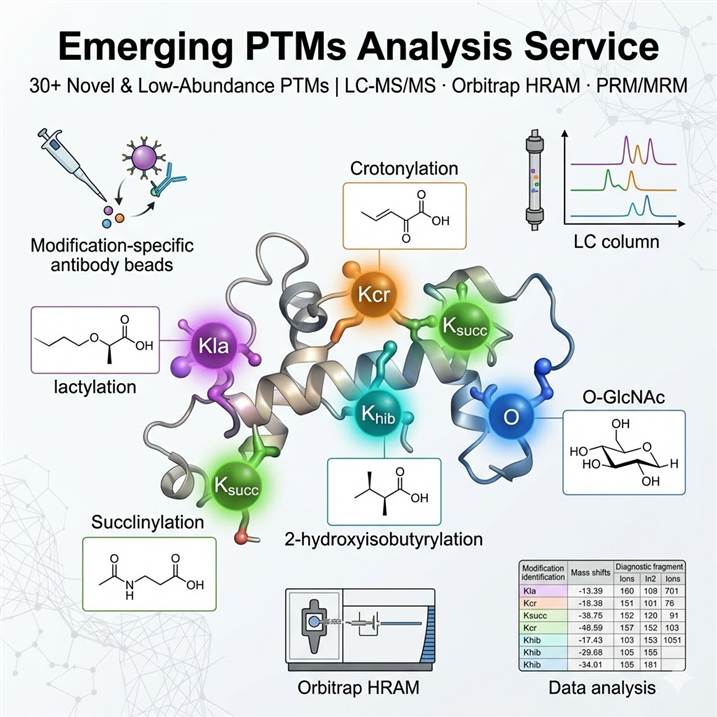
The discovery of novel post-translational modifications has accelerated dramatically over the past decade, driven primarily by advances in high-resolution mass spectrometry and modification-specific enrichment technologies. These emerging PTMs — many of which are short-chain lysine acylations derived from metabolic intermediates — have revealed intimate connections between cellular metabolism, chromatin regulation, and gene expression. Unlike classical PTMs such as phosphorylation or ubiquitination, emerging PTMs often share similar mass shifts with other modifications (e.g., the +14.016 Da of methylation vs. butyrylation's +70.042 Da), require unique fragmentation signatures for unambiguous identification, and demand modification-specific sample preparation to achieve detection at physiologically relevant stoichiometries. Our integrated emerging PTMs analysis platform brings together specialists, protocols, and instrumentation optimized for each modification class, providing researchers with a single entry point for accessing the full breadth of our emerging PTM detection capabilities.
The Biological Significance of Emerging PTMs
Emerging PTMs have been functionally linked to a remarkably diverse range of biological processes. Lactylation, driven by lactate accumulation, connects metabolic state to chromatin regulation and gene expression in immune cells, macrophages, and tumors. Crotonylation marks active promoters and enhancers, regulated by the same writers and erasers as acetylation but with distinct genomic distributions and functional consequences. Succinylation and malonylation are TCA cycle-derived modifications that regulate metabolic enzyme activity through charge-altering chemistry. 2-Hydroxyisobutyrylation links branched-chain amino acid metabolism to chromatin regulation in spermatogenesis and beyond. O-GlcNAcylation serves as a cellular nutrient sensor integrating glucose and hexosamine biosynthetic pathway flux with protein function. Glycation and its downstream advanced glycation end-products (AGEs) are central to aging and diabetic complications. Each modification type requires dedicated analytical strategies for reliable detection and quantification, which are detailed in the individual service pages linked below.
Why LC-MS for Emerging PTM Analysis
High-resolution liquid chromatography-tandem mass spectrometry (LC-MS/MS) is the method of choice for emerging PTM analysis due to its ability to simultaneously detect and distinguish modifications with different mass shifts, fragment signatures, and chromatographic behaviors. Our platform employs Orbitrap HRAM systems operating at ≥60,000 resolution for accurate mass confirmation of diagnostic fragment ions — critical for distinguishing modifications with similar precursor masses (e.g., trimethylation vs. butyrylation, or acetylation +14.016 Da from other modifications). Modification-specific enrichment using pan-modification antibodies, chemical derivatization methods, or metabolic labeling strategies is deployed to achieve the detection depth required for low-abundance emerging PTMs.
Emerging PTMs Service Catalog — Complete Directory
Our emerging PTMs analysis services comprise 16 dedicated workflows, each optimized for the detection, identification, and quantification of specific novel post-translational modifications. Click on each service link for detailed methodology, validated protocols, application examples, and publication-ready deliverables.
| Modification |
Biological Context |
Service Link |
| 2-Hydroxyisobutyrylation (Khib) |
Branched-chain amino acid metabolism; chromatin regulation in spermatogenesis, male fertility |
2-Hydroxyisobutyrylation Analysis |
| Acylation (comprehensive) |
General acyl modification profiling covering multiple short-chain acyl species; metabolic signaling, epigenetic regulation |
Acylation Quantitative Proteomics Service |
| Benzoylation |
Xenobiotic metabolism; emerging drug-induced PTM with functional implications in protein function |
Benzoylation Analysis |
| Butyrylation |
Short-chain fatty acid metabolism; histone butyrylation in chromatin regulation, gut microbiota-host interaction |
Butyrylation Analysis |
| Crotonylation (Kcr) |
Active promoter/enhancer mark; spermatogenesis, inflammation, cancer epigenetics; TCA cycle metabolism linkage |
Crotonylation Analysis |
| Glutarylation |
TCA cycle-derived modification; metabolic enzyme regulation, mitochondrial function, protein charge modulation |
Glutarylation Analysis |
| Glycation |
Non-enzymatic sugar adduction; aging, diabetic complications, AGE formation, protein crosslinking |
Glycation Analysis |
| Kbz (p-aminobenzoyl) |
Synthetic chemical probe; bioorthogonal labeling strategy for PTM discovery and profiling |
Kbz Analysis |
| Lactylation (Kla) |
Lactate-driven modification; macrophage polarization, tumor immunity, metabolic reprogramming, histone regulation |
Lactylation Analysis |
| Lipoylation |
Mitochondrial enzyme cofactor; TCA cycle dehydrogenase regulation, metabolic disease, redox homeostasis |
Lipoylation Analysis |
| Lysine β-Hydroxybutyrylation (Kbhb) |
Ketone body metabolism; starvation/ketogenic diet signaling, chromatin regulation, metabolic adaptation |
Lysine β-Hydroxybutyrylation Analysis |
| Malonylation |
TCA cycle-derived malonyl-CoA; fatty acid metabolism regulation, mitochondrial protein function |
Malonylation Analysis |
| O-GlcNAc (O-linked N-acetylglucosamine) |
Glucose/hexosamine nutrient sensing; insulin signaling, transcription, neurodegeneration, cancer metabolism |
O-GlcNAc Analysis |
| Propionylation |
Short-chain fatty acid metabolism; metabolic regulation, histone propionylation in gene expression control |
Propionylation Analysis |
| Protein Monoaminylation |
Serotonin/dopamine conjugation to proteins; neuropsychiatric signaling, platelet function, hormone regulation |
Protein Monoaminylation Analysis |
| Succinylation |
TCA cycle-derived succinyl-CoA; metabolic enzyme regulation, mitochondrial function, cardiac disease, cancer |
Succinylation Analysis |
Integrated Platform for Emerging PTM Detection and Quantification
Reliable detection and quantification of emerging PTMs demands modification-specific optimization across the analytical pipeline. Our platform integrates established and emerging strategies for each step, configured according to the chemical properties, abundance, and biological context of each modification class.
Modification-Specific Enrichment Strategies
Most emerging PTMs are present at very low stoichiometry (typically <0.1–1% of the total proteome for a given modification site) and require highly efficient enrichment prior to LC-MS analysis. Our portfolio includes: pan anti-modified lysine antibodies optimized for short-chain acylation motifs (crotonylation, succinylation, 2-hydroxyisobutyrylation, β-hydroxybutyrylation, glutarylation, malonylation); chemical derivatization and enrichment methods based on reactive group chemistry (for glycation, lipoylation); lectin-based and click-chemistry enrichment (for O-GlcNAc); and metabolic labeling strategies for specific synthetic probes (Kbz). Each enrichment method is validated against standard peptide mixtures to confirm modification specificity, enrichment efficiency, and compatibility with downstream LC-MS analysis.
High-Resolution LC-MS/MS Acquisition
Enriched modified peptides are analyzed on Orbitrap HRAM systems (Q Exactive HF-X, Orbitrap Fusion Lumos) operating at 60,000–120,000 resolution for full-scan MS and 30,000–60,000 resolution for data-dependent MS/MS acquisition. Higher-energy collisional dissociation (HCD) with stepped normalized collision energy is the primary fragmentation method, with electron-transfer/higher-energy collision dissociation (EThcD) deployed for modifications that produce labile fragment ions or require unambiguous site localization. Targeted quantification by parallel reaction monitoring (PRM) on Orbitrap platforms or multiple reaction monitoring (MRM) on triple quadrupole (QQQ) systems is available for hypothesis-driven quantification of specific modification sites across multiple samples.
Data Analysis and Modification Identification
Modified peptide identification is performed using database search engines (MaxQuant, Proteome Discoverer with Mascot/Sequest HT, pFind) with modification-specific variable modifications defined at precise monoisotopic mass shifts. Identification confidence is assessed through target-decoy-based FDR control (≤1% at peptide and protein level), diagnostic fragment ion matching (where available from synthetic standards), and site localization probability scoring (≥0.75 for confident site assignment). For emerging PTMs with limited MS/MS spectral libraries, we employ open-search strategies (ANN-SoLo, MODa) to detect unexpected modifications, followed by targeted validation using synthetic peptide standards.
Why Choose Our Emerging PTMs Analysis Services
Breadth of Modification Coverage
Our portfolio encompasses 30+ emerging and low-abundance PTMs — from well-characterized short-chain lysine acylations (crotonylation, succinylation, lactylation, 2-hydroxyisobutyrylation, β-hydroxybutyrylation, glutarylation, malonylation, propionylation, butyrylation, benzoylation) to specialized modifications (O-GlcNAc, glycation, lipoylation, monoaminylation, Kbz). This breadth enables researchers to compare multiple PTM classes within a single project and explore modification cross-talk using consistent analytical platforms.
Modification-Optimized Enrichment and Acquisition
Each emerging PTM presents unique analytical challenges — from the labile nature of O-GlcNAc during CID fragmentation to the mass-shift ambiguity between crotonylation and other modifications. Our protocols are optimized individually for each modification class, including modification-specific antibodies, digestion conditions, LC gradients, fragmentation methods, and data analysis parameters, ensuring optimal detection sensitivity and identification confidence for each PTM type.
Quantitative Flexibility
Our emerging PTM services support multiple quantitative strategies including label-free quantification (LFQ) for broad discovery across conditions, TMT/iTRAQ multiplexing for simultaneous comparison of up to 16 samples, SILAC-based metabolic labeling for accurate ratio measurements in cell culture models, and PRM/MRM targeted quantification for validation of specific modification sites across large sample cohorts.
Integrated Bioinformatics for Emerging PTMs
Our bioinformatics pipeline provides modification-specific analysis including: PTM cross-talk analysis for co-occurring modification combinations; motif analysis for modification site sequence preferences; functional enrichment (GO, KEGG, Reactome) of modified proteins; modification-centric pathway mapping — particularly for metabolism-derived PTMs linked to TCA cycle, fatty acid oxidation, and ketone body pathways; and comparative analysis across modification types for integrated multi-PTM studies.
Related Services
Our emerging PTM analysis platform is part of a broader post-translational modification characterization ecosystem offering complementary capabilities across modification discovery, quantification, and biological interpretation.
- DNA/RNA Modification LC-MS Analysis — Nucleic acid modification profiling including epigenetic and epitranscriptomic modifications
- Global PTM Profiling — Broad multi-PTM discovery analysis across diverse modification classes for comprehensive PTM landscape mapping
- Open-Search PTM Discovery — Unbiased open-search MS approach for detecting unexpected and novel PTMs without predefined modification lists
- Modified Peptide Enrichment Services — Specialized enrichment strategies for low-abundance modifications including emerging PTM classes
- PTM Bioinformatics Analysis — Advanced bioinformatics for PTM data integration, cross-talk analysis, and functional annotation
- MS-Based PTM Analysis — Comprehensive mass spectrometry platform for protein-level PTM discovery, quantification, and characterization
Frequently Asked Questions
What are emerging PTMs and how do they differ from classical PTMs?
Emerging PTMs refer to post-translational modifications that have been discovered and characterized relatively recently — primarily over the past decade. Most are short-chain lysine acylations derived from metabolic intermediates (crotonylation from crotonyl-CoA, succinylation from succinyl-CoA, lactylation from lactate, etc.) or modifications that were previously technically challenging to detect (O-GlcNAc, glycation, monoaminylation). Unlike classical PTMs (phosphorylation, acetylation, ubiquitination), emerging PTMs often require modification-specific enrichment, specialized LC-MS acquisition parameters, and careful distinction from modifications with similar mass shifts.
Which emerging PTMs can be detected and quantified by your service?
We offer dedicated analysis services for 16 emerging PTM classes: 2-hydroxyisobutyrylation, acylation (comprehensive profiling), benzoylation, butyrylation, crotonylation, glutarylation, glycation, Kbz, lactylation, lipoylation, lysine β-hydroxybutyrylation, malonylation, O-GlcNAcylation, propionylation, protein monoaminylation, and succinylation. Custom method development is available for additional emerging modifications upon request. Each service includes modification-specific enrichment, optimized LC-MS acquisition, and expert data interpretation.
What sample types and amounts are required for emerging PTM analysis?
Sample requirements vary by modification type and abundance. For global emerging PTM profiling with enrichment, we typically recommend 1–5 mg of total protein lysate per IP/enrichment experiment. For targeted PRM/MRM quantification of known modification sites, as little as 50–200 µg of protein digest may be sufficient. Our platform is compatible with cultured cells, fresh-frozen and FFPE tissues, xenograft tumors, biofluids, and subcellular fractions. A pre-study consultation is recommended to determine optimal sample requirements for specific modification types and biological questions.
How do you distinguish between different emerging PTMs that have similar mass shifts?
Distinguishing modifications with similar or identical mass shifts (e.g., trimethylation +42.047 Da vs. acetylation +42.011 Da, or crotonylation +68.026 Da from other C4 acylations) relies on multiple orthogonal criteria: accurate mass measurement at high resolution (≥60,000, ±5 ppm), diagnostic MS/MS fragment ions characteristic of each modification (e.g., neutral losses of 86 Da for crotonylation, 100 Da for succinylation), retention time behavior under standardized LC conditions, and comparison against synthetic modification standards. For ambiguous assignments, we employ EThcD fragmentation and site localization scoring to confirm modification identity and site.
Can multiple emerging PTMs be analyzed simultaneously from the same sample?
Yes — we offer multi-PTM profiling workflows that simultaneously enrich and analyze multiple emerging modification classes from the same biological sample. Our portfolio includes parallel pan-antibody enrichment strategies for short-chain lysine acylations, sequential enrichment protocols for orthogonal modification types, and sequential rounds of immunoprecipitation to maximize PTM coverage from limited sample quantities. Multi-PTM datasets enable integrated analysis of modification cross-talk and metabolic pathway connectivity across modification types.
Do you offer quantitative analysis for emerging PTMs?
Yes — our emerging PTM services support multiple quantitative strategies including label-free quantification (LFQ) for broad discovery across experimental conditions, TMT/iTRAQ multiplexed quantification for simultaneous comparison of multiple samples, SILAC-based quantification for accurate ratio measurements in cell culture, and targeted PRM/MRM quantification for validation of specific modification sites across larger sample cohorts. Quantification is performed with appropriate normalization strategies (total peptide amount, spike-in standards, or total modification signal) to ensure accurate cross-sample comparison.
For research use only. Not for use in diagnostic procedures.