
Mutation-Specific Protein Quantification by PRM/MRM: Distinguishing Mutant vs Wild-Type
Mutation-specific protein quantification by PRM/MRM is feasible when a sequence variant produces a mutation-bearing peptide that can be released reproducibly, observed above background, and distinguished from the wild-type peptide and matrix interferences. A DNA or RNA variant alone does not establish that its altered protein product is present; targeted mass spectrometry tests the expressed peptide directly.
For drug-discovery, functional-genomics, and translational research teams, the central question is rarely whether PRM or MRM is generally sensitive. It is whether a particular amino-acid substitution, insertion, deletion, fusion junction, or engineered edit creates an analytically usable target. The answer determines peptide design, control selection, whether stable-isotope-labeled standards are needed, and whether the project should begin with a feasibility screen.
Key Takeaways for Mutation-Specific PRM/MRM Quantification
- A mutation is measurable only when it yields an observable peptide that is unique enough to assign with confidence in the intended sample matrix.
- The mutant peptide confirms variant-protein expression; one or more mutation-free peptides help interpret total protein abundance, but do not substitute for the variant peptide.
- PRM is often useful during assay development because full product-ion spectra support post-acquisition transition review. MRM is efficient for focused, established panels with many samples.
- Heavy peptide standards strengthen retention-time, fragment-ion, and response-ratio confirmation. They are especially useful when an absolute amount or a defensible mutant-to-wild-type comparison is required.
- A feasibility review should identify isobaric substitutions, digestion effects, paralogous proteins, low expected abundance, and matrix background before a larger study is committed.
Mutation-Specific Protein Quantification Starts with Protein-Level Feasibility
The analytical target is not the genomic coordinate. It is a peptide sequence produced from the expressed protein after the chosen proteolytic workflow. A single-amino-acid variant (SAAV) may create a distinctive peptide, but it may also fall outside an observable peptide, alter a cleavage site, or produce a peptide with poor chromatographic or mass-spectrometric behavior. Recent reviews of mutation-focused targeted proteomics emphasize that protein-variant detection remains more selective than broad discovery alone, but that only a fraction of variants found by DNA or RNA sequencing are observed at the peptide level (Fu et al., 2023).
From a sequence variant to a measurable peptide
An initial in-silico assessment maps the altered residue or junction to the protein sequence and evaluates the expected digestion products for both variant and reference sequences. The preferred mutation-bearing peptide contains the altered residue away from either terminus, is sufficiently unique in the relevant proteome, and is plausible to detect by LC-MS/MS. Empirical evidence from prior discovery data is valuable because it confirms that the peptide is released and observed in a related matrix; peptide predictions are useful for prioritization but cannot guarantee recovery in a complex digest (Hoofnagle et al., 2016).
The same assessment should consider whether the biological question requires a mutant-to-wild-type fraction, a mutant amount, a total-protein amount, or a longitudinal relative change. These endpoints require different peptide sets. A mutation-bearing peptide directly supports variant-specific evidence. A non-variant peptide shared by both proteoforms reflects the combined pool, provided it is not influenced by an alternative splice event or nearby modification.
When PRM/MRM cannot distinguish mutant from wild-type proteins
Not every coding change is resolvable by bottom-up targeted proteomics. Leucine-to-isoleucine substitutions are isobaric and cannot normally be separated by standard precursor mass and conventional fragment ions. A variant may also create a peptide identical to a peptide from a paralog, or a mutation may lie in a region that yields an unsuitable peptide after digestion. Missed cleavage, oxidation-prone residues, labile modifications, and low endogenous expression can further reduce assay robustness.
For these cases, the appropriate conclusion is not to force a nominal result. A project may need an alternative protease, an enrichment strategy, a larger protein region assessed by a different method, or a workflow that measures a linked but non-variant molecular readout. If the mutation-bearing peptide itself remains analytically inseparable, PRM/MRM should not be presented as direct evidence of mutant protein expression. This feasibility boundary is a major reason to evaluate the exact variant and sample matrix before panel construction.
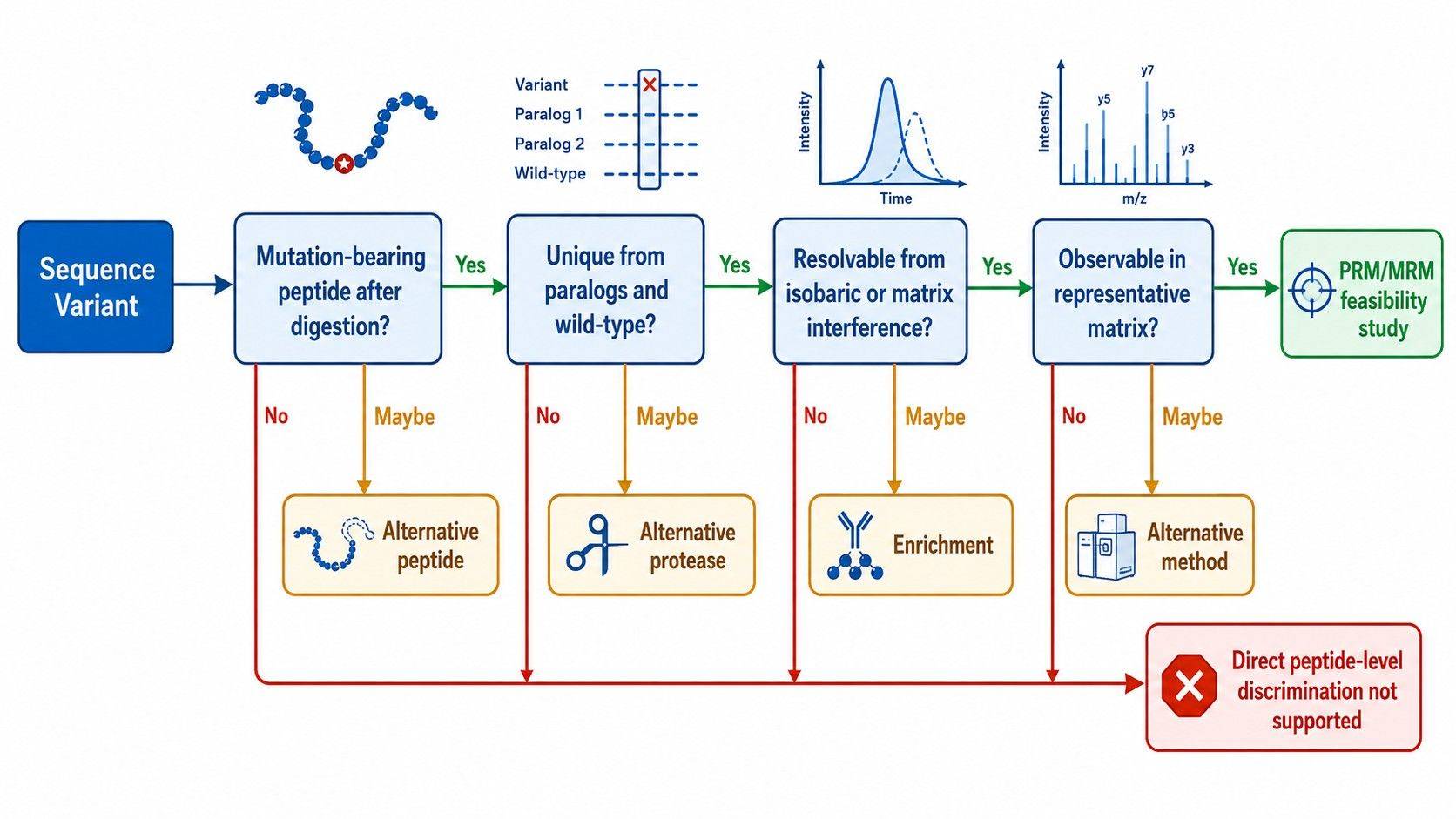 Figure 1. Mutation-specific targeted proteomics feasibility assessment from sequence variant to measurable peptide.
Selecting Mutant and Wild-Type Peptides for PRM/MRM Assays
A well-designed assay separates three roles: the mutation-bearing peptide, a reference peptide or peptides for total protein context, and optional standards that confirm identity or support quantification. Treating these roles separately prevents an apparently simple mutant-versus-wild-type question from becoming an ambiguous protein-abundance result.
Mutation-bearing peptides establish variant specificity
The mutation-bearing peptide should contain the altered residue or a fusion junction and be unique to the variant protein sequence. Its precursor, retention time, and multiple product ions are evaluated together. A PRM experiment records a high-resolution product-ion spectrum for the selected precursor, allowing the analyst to review co-elution and relative fragment-ion patterns rather than relying on one signal alone. PRM was developed precisely to combine targeted precursor selection with high-resolution, high-mass-accuracy product-ion detection (Peterson et al., 2012; Gallien et al., 2016).
For an MRM assay, the same selectivity logic applies through a predefined set of precursor-to-product transitions. MRM is often efficient once the peptide and transitions are established, particularly for a focused, high-sample-number study. However, transition selection must be evaluated in the real matrix; a transition that appears clean in a standard may not remain selective in tissue, plasma, or cell lysate.
Reference peptides provide wild-type and total-protein context
If the study asks whether the mutant protein changes relative to the wild-type background, measure the mutation-bearing peptide together with one or more proteotypic peptides outside the variant site. These reference peptides should be unique to the target protein, absent from relevant paralogs, and selected independently of the mutation-bearing peptide. They represent the combined abundance of proteoforms carrying that shared region, not the wild-type form alone.
Direct wild-type quantification requires a reference-sequence peptide spanning the same variant position, where the wild-type and mutant peptide pair can each be individually resolved. This paired design is stronger for a mutant-to-wild-type ratio than comparing a mutant peptide with a distant shared peptide. If the reference and mutant sequences have different digestion efficiencies or peptide responses, interpretation should state that the ratio is assay-specific unless calibration and controls demonstrate comparability.
Practical peptide exclusion criteria
Candidate peptides deserve extra review when they are non-unique, excessively short or long, prone to known chemical modification, poorly soluble, or close to a cleavage site changed by the variant. Peptides containing methionine, cysteine, or other residues susceptible to variable modification are not automatically excluded, but they need controls that show the measured form is stable and interpreted consistently. Consensus guidance also recommends using empirical MS evidence whenever possible and defining peptide material quality before relying on peptide calibrators (Hoofnagle et al., 2016).
PRM vs MRM for Mutant and Wild-Type Protein Quantification
Both methods are targeted LC-MS/MS approaches. The choice should follow the project stage, panel size, and level of spectral confirmation needed, not a blanket assumption that one acquisition mode is universally better.
| Decision factor | PRM | MRM |
| Product-ion acquisition | High-resolution MS/MS spectrum for each targeted precursor | Predefined precursor-to-product transitions |
| Useful stage | Variant-peptide assessment, transition review, targeted confirmation | Mature focused panels and repeated measurement across many samples |
| Selectivity review | Multiple fragments can be reviewed after acquisition | Depends on the selected transitions and their matrix behavior |
| Panel planning | Flexible during early method refinement | Efficient once transitions and scheduling are established |
| Best fit | Complex or uncertain variant-peptide evidence | Stable, predefined assays with clear targets |
Choose PRM when the key risk is whether a mutation-bearing peptide can be confidently identified in a complex matrix, or when several fragment ions should remain available for later review. Choose MRM when the peptide behavior and transitions are already demonstrated and the study needs an efficient, focused assay across a larger sample set. Some programs begin with PRM feasibility work and then transfer stable targets into an MRM panel; others retain PRM because spectral review remains valuable for the specific variant context.
For a discovery-to-verification project, discovery proteomics services can establish empirical evidence for candidate-peptide observability before the final confirmation panel is defined. When a complex discovery matrix benefits from an additional ion-mobility separation dimension, 4D proteomics services can support deeper precursor separation before a focused validation panel is fixed.
When Stable-Isotope-Labeled Standards Are Needed
Stable-isotope-labeled (SIL) peptides are not mandatory for every research question, but they add a useful layer of identity and response control. A heavy standard has the same peptide sequence as the endogenous target except for its isotopic mass shift. It should co-elute closely with the light peptide and generate corresponding fragment-ion behavior, allowing retention time, signal pattern, and light-to-heavy response to be evaluated together.
Relative, ratio-based, and absolute endpoints
For an exploratory comparison of mutant signal across well-controlled groups, label-free relative peptide abundance may be sufficient if the target is observable and the question is explicitly comparative. For a mutant-to-wild-type comparison, paired light peptides and standards can improve the confidence of the ratio, especially when variant abundance is expected to be low.
Absolute protein quantification is a stricter claim. It requires a defined calibration approach, appropriately characterized standards, and an explicit statement of the reporting level: peptide amount, digest-normalized amount, or an inferred protein amount. A synthetic peptide added after digestion does not correct for variability occurring before that addition, including extraction and digestion. Full-length labeled proteins or other pre-digestion standards can address more of that workflow, but their use should be justified by the study endpoint rather than assumed by default (Gallien et al., 2016; Hoofnagle et al., 2016).
The practical decision is straightforward: if the study needs to rank samples or confirm directionality, a fit-for-purpose relative design may be appropriate. If it needs a defensible concentration value, cross-batch comparison, or a quantitative mutant-to-wild-type relationship, plan standards and calibration during project design rather than adding them after data acquisition.
QC Controls That Support a Defensible Variant Call
Mutation-specific quantification requires more than observing a peak at an expected precursor mass. QC should test the identity, selectivity, and consistency of each target in the intended matrix.
Identity and selectivity controls
For each mutation-bearing peptide, review retention time, multiple co-eluting product ions, relative ion ratios, and agreement with a reference standard where available. Include a wild-type or variant-negative biological control when the experimental design permits. This control helps expose matrix signals that may imitate a target transition or fragment pattern. A positive material, engineered model, or synthetic standard may be useful when naturally occurring variant-positive material is limited.
Process and quantification controls
Replicate preparations, pooled matrix controls, blank or carryover checks, and reference materials should be selected according to the sample type and cohort design. For a multi-batch project, balance variant groups across batches and use a shared reference to identify drift before interpreting biology as an assay difference. If a peptide standard is used, its storage, purity, and concentration assignment should be documented because peptide handling can alter the apparent quantitative result (Hoofnagle et al., 2016).
The deliverable should make these decisions visible: target and transition list, peptide-level evidence, QC summary, normalized quantitative matrix, and an interpretation that distinguishes direct variant-peptide evidence from supporting total-protein context. This is more useful for study decisions than a single mutant/WT number without supporting assay evidence.
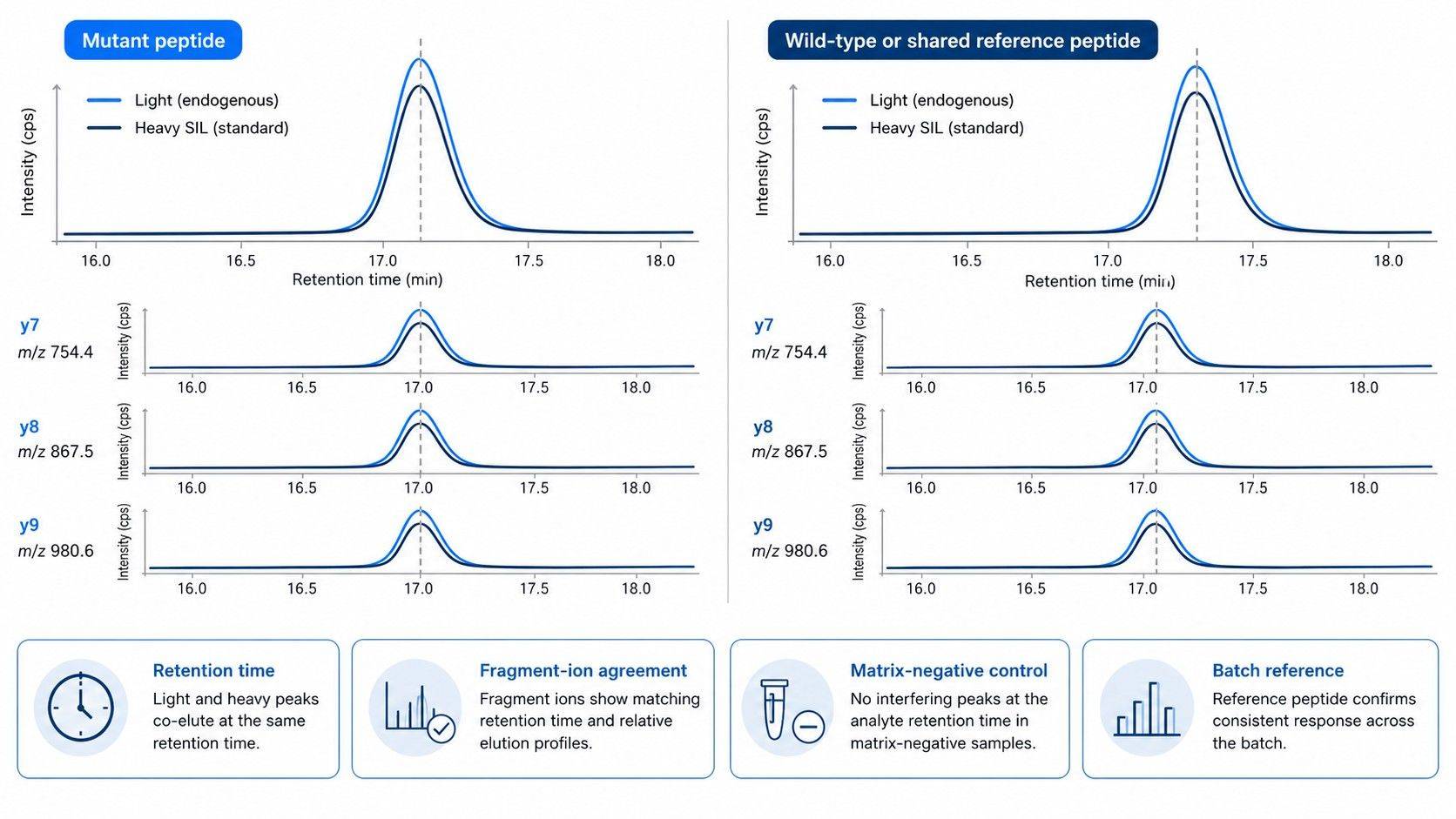 Figure 2. Mutation-bearing and reference peptide evidence, supported by heavy standards and matrix-matched QC.
From Variant Discovery to a Targeted Proteomics Panel
The strongest mutation-specific projects start with the decision the data must support. A discovery dataset or sequencing result may generate many candidate variants, but only a subset will meet the sequence, abundance, and matrix requirements for targeted protein measurement. A staged process limits unnecessary standard synthesis and avoids carrying non-observable candidates into an extended cohort.
First, prioritize variants with a clear biological rationale and a feasible mutation-bearing peptide. Next, evaluate mutant and reference peptides in representative matrix material, then confirm identity and performance with appropriate standards and controls. Finally, expand only the targets that pass feasibility into the larger panel. The 2024 DIA-SAAV assessment illustrates why variant peptide identification benefits from explicit confirmation rather than treating discovery evidence as a final quantitative result (Fierro-Monti et al., 2024).
NGPro can scope this progression through targeted proteomics services, from variant-sequence review and candidate-peptide prioritization to fit-for-purpose PRM/MRM assay design and data interpretation. For programs that begin with a broader screen, the targeted phase can be designed to preserve the link between discovery candidates, validation evidence, and downstream pathway interpretation.
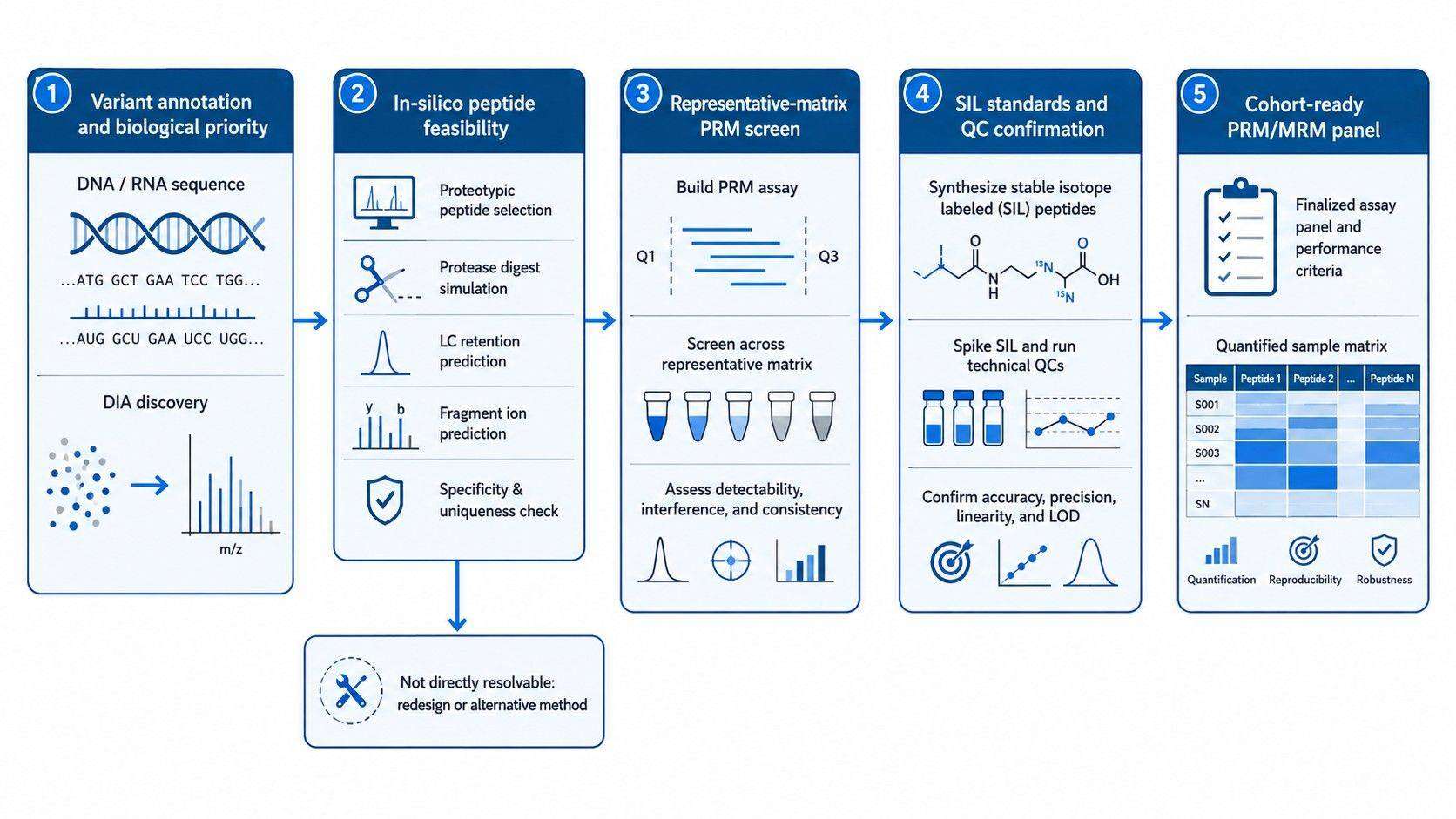 Figure 3. From variant discovery to a mutation-specific PRM/MRM validation panel.
What to Prepare for a Mutation-Specific Targeted Proteomics Feasibility Review
An effective feasibility assessment begins with the exact reference sequence, amino-acid change or junction, species, sample type, and the biological comparison of interest. If sequencing or discovery proteomics data exist, include the variant annotation, expected abundance context, and any observed peptide evidence. It is also useful to specify whether the endpoint is relative change, mutant-to-wild-type ratio, or absolute amount.
For cohort studies, provide the planned number of groups, replicates, sample matrices, storage history, and whether material will be distributed across batches. These details affect peptide selection, standard strategy, controls, and the achievable evidence level. A concise pre-study review can therefore answer the most important question before material is consumed: is direct mutation-specific protein quantification feasible for this variant in this matrix, and what design will produce an interpretable result?
Frequently Asked Questions
Only if the altered protein produces a detectable mutation-bearing peptide that can be distinguished from the wild-type sequence and matrix background. Sequencing supplies the candidate variant; targeted proteomics tests whether its protein product is present and analytically measurable in the submitted material.
The strongest design measures a mutant peptide and a separately resolved wild-type peptide spanning the same variant position. A mutation-free peptide elsewhere in the protein can provide total-protein context, but it usually reflects both proteoforms and should not be labeled as a direct wild-type measurement.
No. They are most valuable when identity confirmation, cross-run consistency, mutant-to-wild-type ratios, or absolute results are important. A relative exploratory study may use a label-free design, provided the limitations and QC evidence are appropriate to the question.
Not reliably by conventional bottom-up LC-MS/MS because leucine and isoleucine have the same elemental composition and mass. A feasibility review should identify such isobaric substitutions early and recommend a different analytical strategy if direct peptide-level discrimination is essential.
PRM is often useful when peptide feasibility and fragment-ion selectivity are still being evaluated because it retains broader product-ion information. MRM can be a strong choice after a small, stable target set and its transitions are established for the intended matrix.
Yes. DIA data can help prioritize expressed candidates and provide empirical evidence for peptide observability. A mutation-specific PRM/MRM assay should still independently confirm the variant peptide with targeted selectivity criteria and appropriate controls.
Glossary
- Mutation-bearing peptide: A peptide that contains the altered amino acid or fusion junction and can provide direct evidence for a variant protein.
- Proteotypic peptide: A peptide selected because it is unique to a target protein or proteoform and suitable for MS measurement.
- PRM: Parallel reaction monitoring, a targeted acquisition mode that records high-resolution MS/MS data for a selected precursor.
- MRM: Multiple reaction monitoring, a targeted mode that measures predefined precursor-to-product ion transitions.
- SIL peptide: A stable-isotope-labeled peptide used as an internal standard or calibrator.
- SAAV: Single amino acid variant, a protein-level sequence change produced by a coding variant.
References:
- Fu, X., et al. Mass spectrometry-based targeted proteomics for analysis of protein mutations. Mass Spectrometry Reviews 42, 796-821 (2023). https://doi.org/10.1002/mas.21741
- Peterson, A. C., et al. Parallel reaction monitoring for high resolution and high mass accuracy quantitative, targeted proteomics. Molecular & Cellular Proteomics 11, 1475-1488 (2012). https://doi.org/10.1074/mcp.O112.020131
- Gallien, S., et al. Targeted proteomic quantification on quadrupole-Orbitrap mass spectrometer. Molecular & Cellular Proteomics 11, 1709-1723 (2012). https://doi.org/10.1074/mcp.O112.017327
- Hoofnagle, A. N., et al. Recommendations for the generation, quantification, storage and handling of peptides used for mass spectrometry-based assays. Clinical Chemistry 62, 48-69 (2016). https://doi.org/10.1373/clinchem.2015.250563
- Fierro-Monti, I., et al. Assessment of data-independent acquisition mass spectrometry for the identification of single amino acid variants. Proteomes 12, 33 (2024). https://doi.org/10.3390/proteomes12040033
- Wingo, T. S., et al. Integrating next-generation genomic sequencing and mass spectrometry to estimate allele-specific protein abundance in human brain. Scientific Reports 7, 10324 (2017). https://doi.org/10.1038/s41598-017-09919-z
 4D Proteomics with Data-Independent Acquisition (DIA)