
Proteomics After Gene Knockout: From Edit to Mechanism
Gene knockout proteomics is used when the project has moved beyond editing and the next decision is biological: what did loss of the gene do to the protein system? The answer may involve direct loss of the target protein, downstream pathway remodeling, compensatory proteins, signaling-state changes, or clone-specific effects that should not be attributed to the knockout.
The analytical route should therefore follow the study design. A WT-versus-one-clone comparison can support exploration, while multi-clone and rescue designs provide stronger evidence when the goal is causal interpretation. Proteomics contributes protein-level and systems-level evidence; it does not replace DNA-level verification of the edit itself.
Content Guide
- Common Challenges
- Study Design
- Protein-Level Evidence
- Quantitative Strategy
- Clone Effects
- Workflow
- QC & Interpretation
- Deliverables
- When to Use This Service
Common Gene Knockout Proteomics Challenges
Protein-level confirmation, clone concordance, batch-aware interpretation, and follow-up strategy for real knockout projects.

DNA Edit Confirmed, Protein May Remain
Residual or altered target products can persist after frameshift editing. We review target-derived peptide evidence in sequence context and recommend focused protein measurement when target-level confirmation is essential.

Independent KO Clones Disagree
Clone selection, parental-cell heterogeneity, culture history, or unrelated genomic differences can confound genotype effects. Concordance across clones and rescue logic help separate stronger target-associated signals.

Strong Phenotype, Modest Proteome Change
The key biology may lie in phosphorylation, activity, localization, interactions, or another regulatory layer. A PTM or orthogonal follow-up is considered when total abundance is not the right readout.

Target Not Detected in WT
Non-detection in both WT and KO cannot prove complete protein loss. The result is treated as an analytical limitation rather than converted into a knockout claim.

PCA Separates, but Batches Also Differ
Batch, passage, harvest, or run-order structure can mimic genotype separation. Metadata and analytical structure are reviewed before biological interpretation.

Knockout Alters Treatment Response
A genotype-by-treatment design can test whether gene loss changes response to a drug, ligand, or stressor instead of relying on disconnected pairwise comparisons.
Gene Knockout Proteomics Study Design
The most important decision is not which mass-spectrometry method to use. It is which biological contrast will allow the proteomics data to answer the causal question.
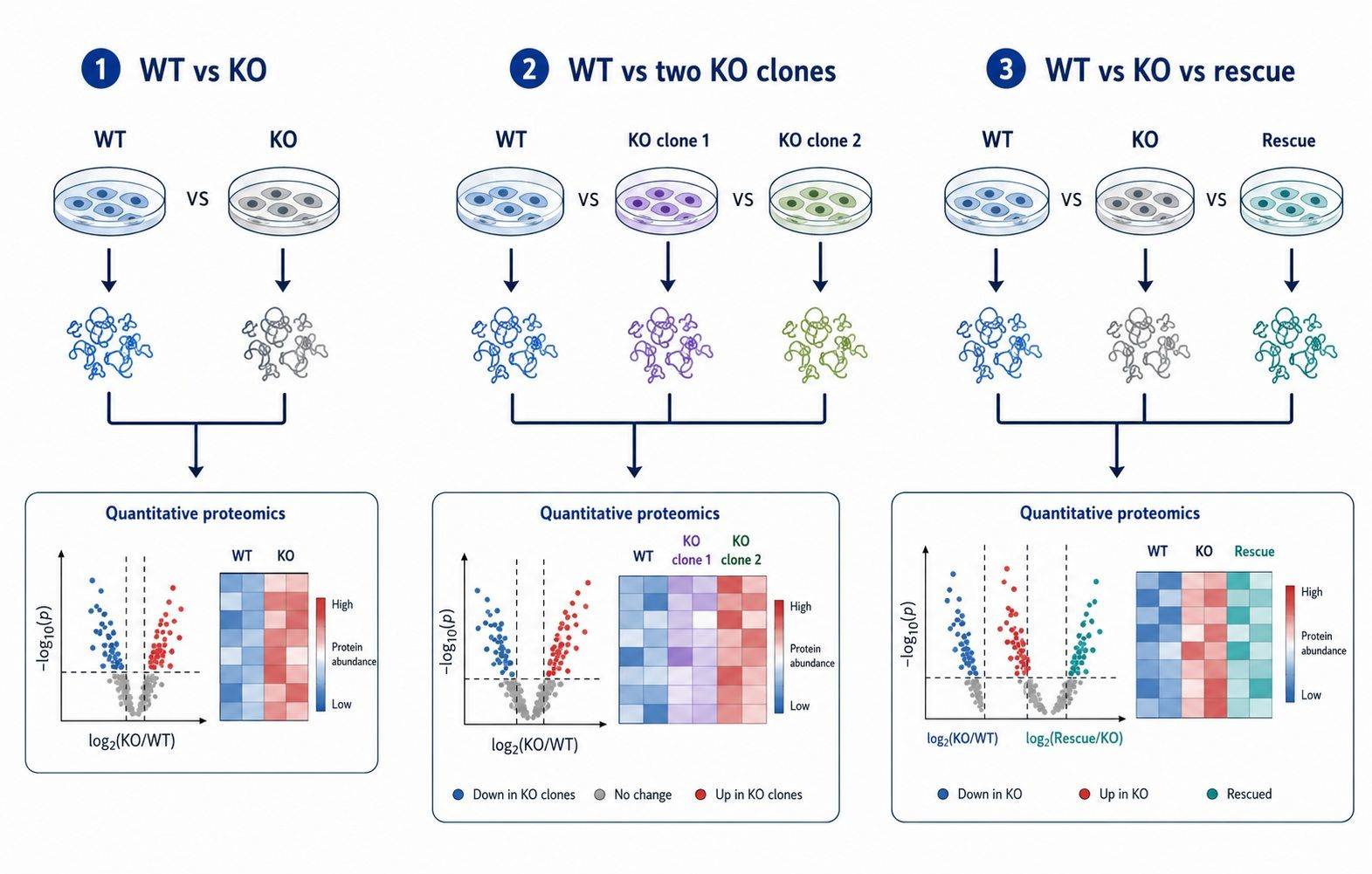
A simple WT-versus-one-KO-clone comparison can be useful for exploration, but it cannot by itself distinguish the effect of gene loss from clone-specific properties. When the goal is mechanism, reproducibility, or causal interpretation, independent clones, matched controls, rescue groups, or factorial treatment designs can materially strengthen the study.
Across all designs, genotype should not be confounded with culture batch, harvest time, passage history, sample-preparation batch, or MS run order. Biological replicates should represent independently handled biological material rather than repeated injections of the same digest.
| Study Design | Best Used For | Main Interpretation Question |
|---|---|---|
| WT vs one KO clone | Exploratory profiling | What differs between this edited clone and the reference control? |
| WT vs multiple independent KO clones | Mechanism-focused studies | Which protein changes are reproducible across independently derived knockouts? |
| WT vs KO vs rescue | Causal interpretation | Which changes move back toward the WT state after target restoration? |
| WT ± treatment vs KO ± treatment | Gene-by-treatment interactions | Does gene loss alter the response to a drug, ligand, stressor, or pathway perturbation? |
| Control pool vs edited pool | Population-level perturbation studies | What is the proteomic consequence of gene depletion without isolating a single clone? |
Protein-Level Evidence Before Mechanism Claims
Genomic editing and protein elimination are related but different measurements. A frameshift, deletion, or disruptive indel may strongly support loss of gene function, but it does not guarantee that no target-derived protein product remains. Large-scale proteomic characterization of genetically verified CRISPR frameshift knockouts has shown that residual target expression can persist through mechanisms including translation reinitiation and edited-exon skipping. In-frame editing, isoform structure, and protein stability can further complicate the relationship between genotype and protein abundance.
1. Genomic Evidence
Was the intended edit introduced? This is answered by DNA-level methods and should be established independently of proteomics. Genomic off-target assessment also requires DNA-level methods; proteomics cannot prove their absence.
2. Protein-Level Evidence
Was the expected target protein or target-derived peptide signal reduced or lost? Peptide-level evidence can help when the target is measurable.
3. Systems-Level Evidence
Which downstream proteins, pathways, complexes, or signaling states changed after the perturbation?
Target Peptide Review
When the target is measurable in the discovery dataset, peptide-level evidence can help determine whether the expected protein region is reduced or absent and whether residual peptides remain detectable. Peptide location relative to the edited exon or disrupted coding region can be informative when the sequence context is known.
When Absence of Detection Is Not Proof of Knockout
Failure to observe the target in a discovery run should not automatically be interpreted as proof of complete protein loss. A low-abundance protein may be below the effective detection range of a global experiment in both WT and KO samples. When target-level confirmation is essential, a focused assay or orthogonal protein method may be more appropriate than relying on non-detection in shotgun data.
Quantitative Proteomics Strategy for WT vs KO Studies
The acquisition strategy should follow the biological question. Gene knockout is the experimental context; DIA, 4D-DIA, phosphoproteomics, and targeted MS are different analytical routes within that context.
| Analytical Route | Best Fit in a Knockout Project | What It Adds |
|---|---|---|
| DIA quantitative proteomics | Broad WT-vs-KO or multi-condition protein-abundance profiling | Consistent global quantification for differential expression, pathway analysis, and candidate discovery |
| 4D-DIA quantitative proteomics | Complex or limited-input samples where added ion-mobility separation is useful | An additional separation dimension that can help resolve complex peptide mixtures |
| 4D phosphoproteomics | Kinase, phosphatase, receptor, adaptor, or signaling-regulator knockouts | Site-level signaling information that may change even when total protein abundance does not |
| Targeted proteomics | Focused confirmation of the edited target or a shortlisted set of downstream proteins | Target-specific PRM/MRM measurement after discovery or when only a defined panel is required |
A common route is to begin with global proteome profiling when the downstream consequences are unknown, then add a more focused layer only where the biology requires it. For a signaling regulator, a paired total-proteome and phosphoproteome design may be more informative than increasing depth in the total proteome alone. For a single target-protein question, targeted measurement may be more efficient than a full discovery experiment.
Information That Helps Us Scope Your KO Study
- Target gene, edited region or exon, model system, and edit type
- Available DNA- or protein-level validation and clone or pool identity
- Rescue availability, passage or culture history, treatments, and time points
- Sample collection details and the biological decision the study should support
Distinguishing Knockout Effects from Clone Effects
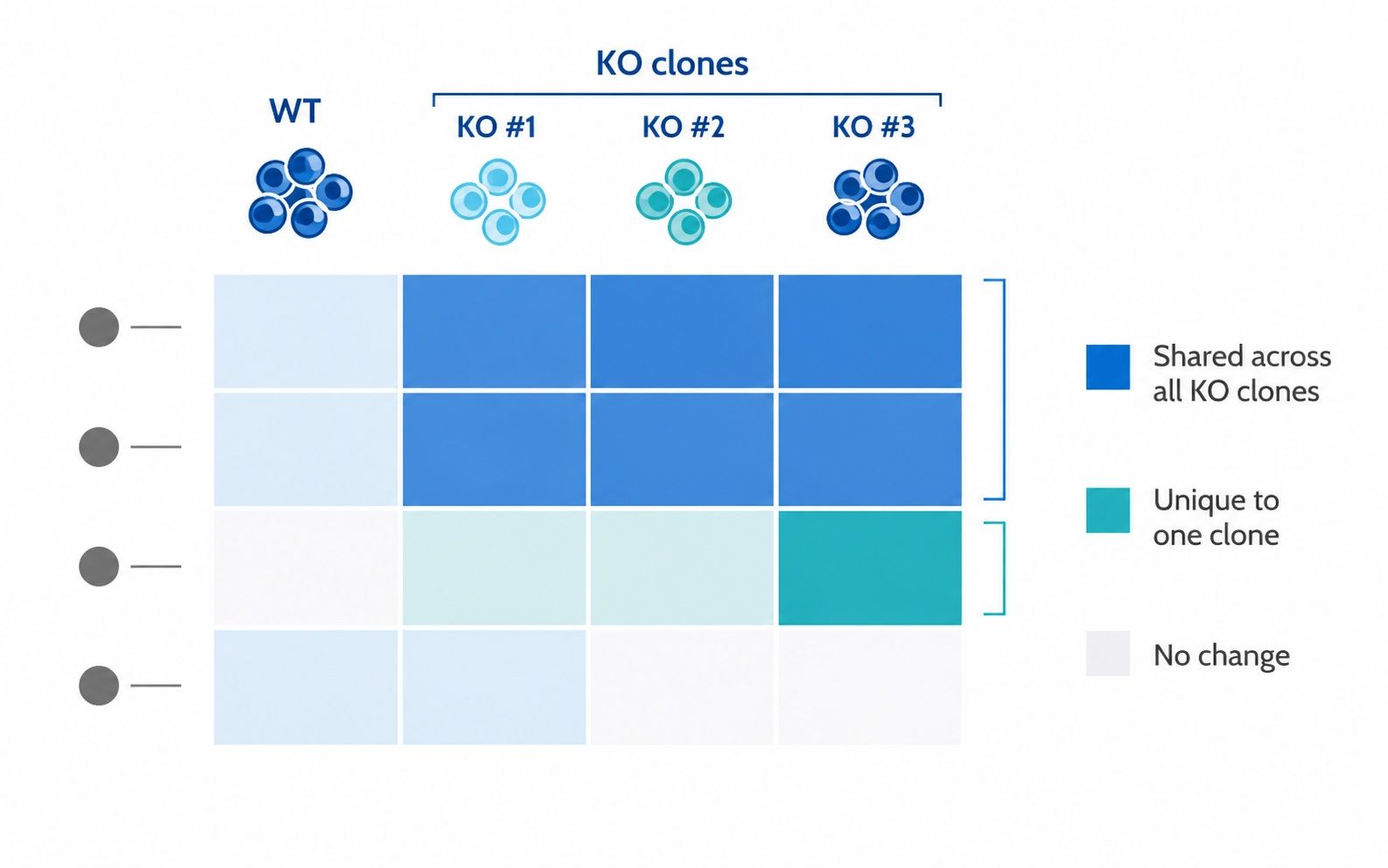
Clone-to-clone variation is one of the most important interpretation risks in gene-editing studies. Published work has shown that independent knockout clones targeting the same gene can exhibit divergent proteome signatures, and that wild-type clonal heterogeneity can itself generate phenotypic and molecular differences. Clonal isolation and culture history therefore need to be treated as biological variables rather than assumed away.
Stronger Evidence for a Target-Associated Change
- The effect is observed in the same direction across independent KO clones.
- The effect is not driven by a single outlier culture or analytical batch.
- The affected proteins form a coherent pathway, complex, or biological process rather than an unrelated list.
- A rescue condition shifts the relevant proteins or pathway state back toward the WT profile.
- The result is compatible with the known role of the target without being circularly filtered to only expected biology.
Pooled Populations vs Single Clones
Pooled edited populations can reduce the interpretive burden created by single-cell cloning, but they introduce a different question: how homogeneous is the editing outcome across the population? A pooled design is useful when the aim is to capture the average consequence of depletion, whereas a clonal design is useful when a genetically defined model is required. The proteomics plan should reflect which source of heterogeneity matters most for the project.
Gene Knockout Proteomics Workflow
The workflow keeps biological design, target evidence, quantitative acquisition, and mechanistic interpretation connected instead of treating proteomics as an isolated measurement.
Define WT-vs-KO, multi-clone, rescue, pooled perturbation, or genotype-by-treatment comparisons. Review editing context, available validation evidence, culture conditions, and sample metadata before acquisition planning.
Matched samples are processed using a consistent extraction, digestion, and peptide-cleanup strategy appropriate for the matrix to reduce preparation differences aligned with genotype or clone identity.
Global DIA or 4D-DIA is selected according to matrix complexity, study size, input constraints, and the biological question. A PTM layer can be added when signaling regulation is central.
Review sample consistency, analytical outliers, missingness, batch structure, genotype separation, and clone concordance before pathway-level interpretation.
Separate target-proximal changes, pathway responses, compensatory proteins, and clone-specific signals where possible, then prioritize candidates for focused verification or additional functional work.
Quality Control and Interpretation Framework
Gene knockout proteomics is not successful merely because PCA separates WT and KO groups or because a volcano plot contains many significant proteins. The key question is whether the analytical pattern supports the biological interpretation.
| QC / Interpretation Question | What We Examine | Why It Matters |
|---|---|---|
| Is the target measurable? | Target protein and peptide evidence | Establishes what the proteome can and cannot say about protein-level knockout status |
| Are biological replicates consistent? | Replicate correlation, clustering, abundance distributions | Detects unstable cultures and technical outliers |
| Is batch aligned with genotype? | PCA or clustering annotated by batch, run order, preparation date, clone, and condition | Prevents analytical structure from being misread as knockout biology |
| Do independent KO clones agree? | Direction and magnitude of shared vs clone-specific changes | Separates stronger genotype-associated effects from clonal divergence |
| Does rescue support causality? | Reversal or attenuation of KO-associated signatures | Adds evidence that a change is related to the intended perturbation |
| Are results biologically coherent? | Pathway, network, complex, and process-level enrichment | Helps distinguish coordinated response from isolated statistical hits |
Data Deliverables and Decision-Ready Outputs
The objective is not simply to return a protein list. Deliverables are organized so the research team can determine what changed, how reliable the change is, and what should be tested next.
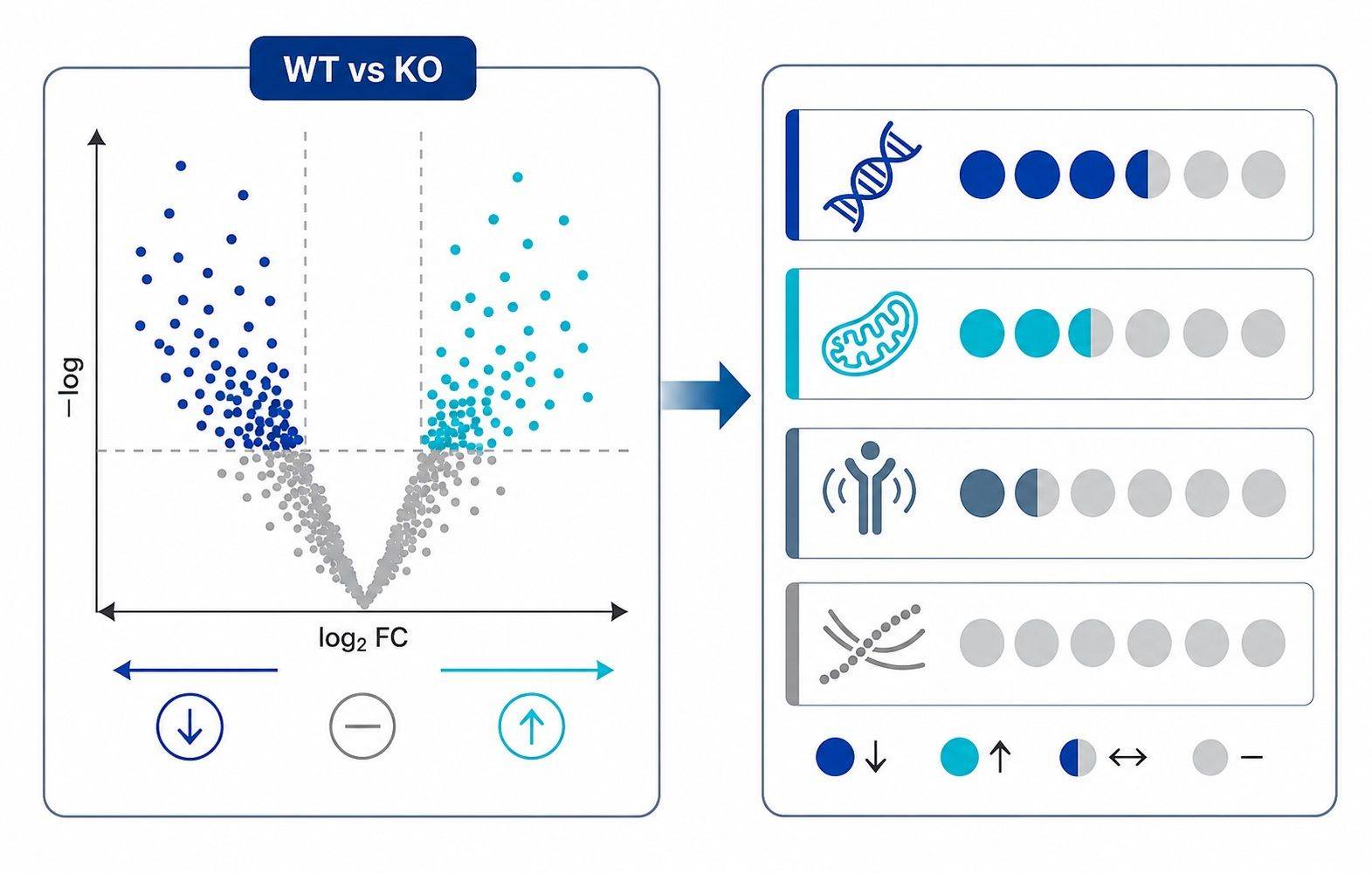
Differential Proteome
WT-versus-KO changes are summarized together with pathway-level interpretation so statistical hits are not treated as isolated biological conclusions.
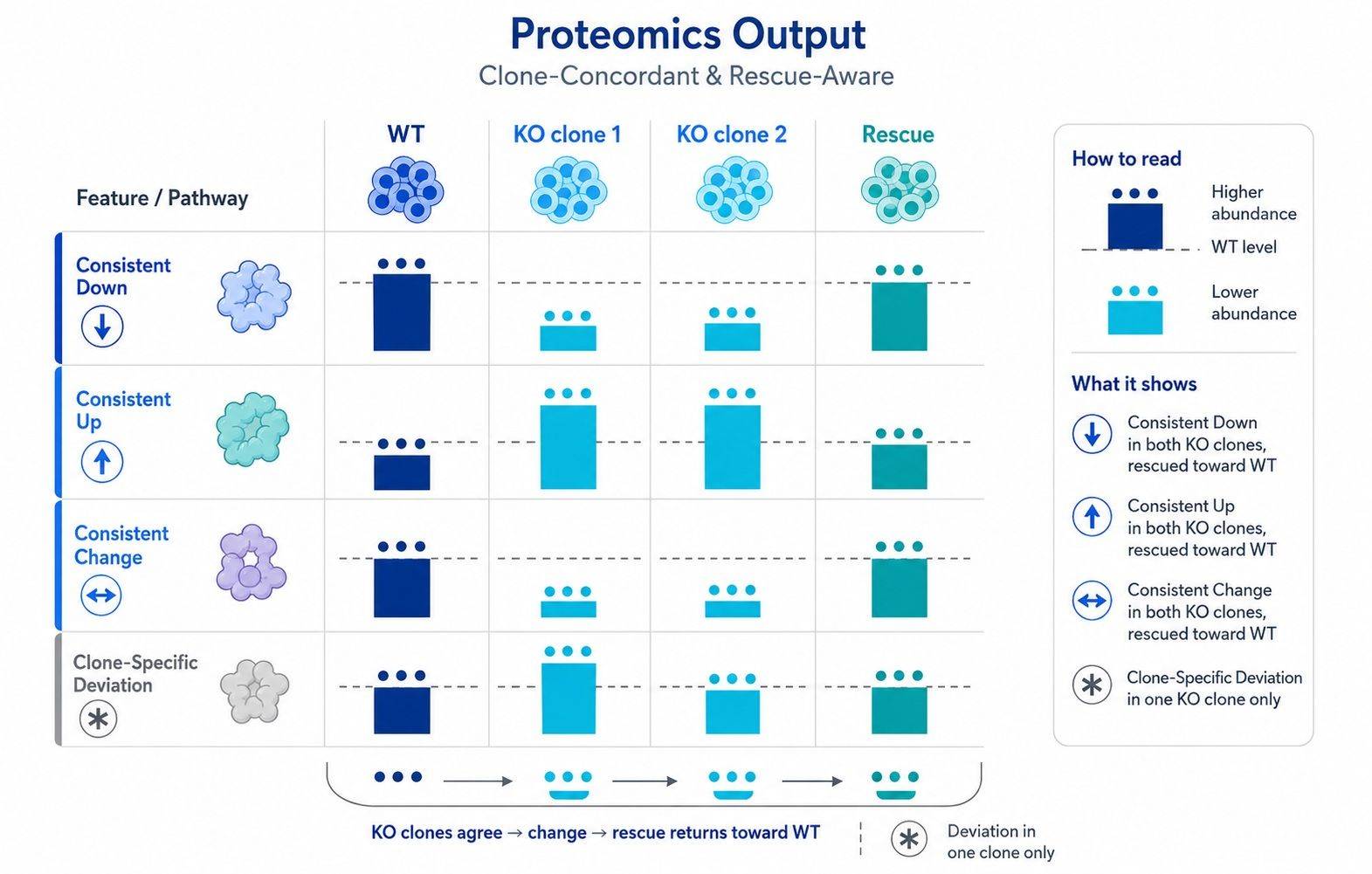
Clone Concordance or Rescue Evidence
Shared changes across independent KO clones, or reversal toward WT after rescue, provide stronger evidence than a single edited-versus-control contrast.
Decision-Ready Project Outputs
Quantitative & QC Outputs
- Protein- and peptide-level quantitative matrices with project annotations
- Sample-level QC, differential contrasts, and outlier review
- Raw and processed project data where included in scope
Interpretation & Follow-Up
- Functional enrichment, target-network, and compensatory-response context
- Prioritized candidates for PRM/MRM, orthogonal assays, or additional PTM analysis
- Clear separation between supported findings and hypotheses requiring additional validation
When Gene Knockout Proteomics Is the Right Starting Point
Choose this service when the main question is what loss of a gene does to the proteome or signaling network. Choose a narrower method when the question is narrower.
| Research Question | Better Starting Point |
|---|---|
| Did the edit occur at the intended DNA locus? | Genomic sequencing or another DNA-level validation method |
| Is one target protein absent or strongly reduced? | Focused protein measurement or orthogonal protein assay |
| What changes across the proteome after knockout? | Gene knockout proteomics |
| Which signaling sites change after knockout? | Phosphoproteomics, ideally interpreted with total-proteome context |
| Which selected proteins should be confirmed across more samples? | Targeted PRM/MRM |
| Which proteins physically interact with the target? | Interaction-focused proteomics rather than abundance profiling |
Knockdown and overexpression projects can use many of the same design principles, but the interpretation differs: incomplete depletion and gene-dosage effects become central instead of complete loss of function.
Selected Scientific References
- Giuliano CJ, Lin A, Girish V, Sheltzer JM. Generating Single Cell-Derived Knockout Clones in Mammalian Cells with CRISPR/Cas9. Current Protocols in Molecular Biology. 2019;128(1):e100. doi:10.1002/cpmb.100.
- Smits AH, Ziebell F, Joberty G, et al. Biological Plasticity Rescues Target Activity in CRISPR Knock Outs. Nature Methods. 2019;16:1087-1093. doi:10.1038/s41592-019-0614-5.
- Mehnert M, Li W, Wu C, Salovska B, Liu Y. Combining Rapid Data Independent Acquisition and CRISPR Gene Deletion for Studying Potential Protein Functions: A Case of HMGN1. Proteomics. 2019;19(13):e1800438. doi:10.1002/pmic.201800438.
- Joberty G, Fälth-Savitski M, Paulmann M, et al. A Tandem Guide RNA-Based Strategy for Efficient CRISPR Gene Editing of Cell Populations with Low Heterogeneity of Edited Alleles. The CRISPR Journal. 2020;3(2):123-134. doi:10.1089/crispr.2019.0064.
- Westermann L, Li Y, Göcmen B, et al. Wildtype Heterogeneity Contributes to Clonal Variability in Genome Edited Cells. Scientific Reports. 2022;12:18211. doi:10.1038/s41598-022-22885-8.
- Panda A, Suvakov M, Mariani J, et al. Clonally Selected Lines After CRISPR-Cas Editing Are Not Isogenic. The CRISPR Journal. 2023;6(2):176-182. doi:10.1089/crispr.2022.0050.
Gene Knockout Proteomics Frequently Asked Questions
Proteomics can provide protein-level evidence, but the strength of that evidence depends on whether the target is measurable. If target-derived peptides are observed in WT samples and are strongly reduced or absent in KO samples, that supports the expected protein-level effect. If the target is not detected in either group, global proteomics cannot prove complete knockout. A targeted or orthogonal protein assay may be needed.
If the goal is causal mechanism, multiple independently derived KO clones are preferable when feasible because clone-specific differences can otherwise be mistaken for gene-dependent biology. A single clone can still support exploratory work, but its limitations should be explicit in the interpretation.
No. It is not required for every project. However, a WT-KO-rescue design can substantially strengthen causal interpretation when the key question is whether a proteomic change is specifically linked to loss of the target. Rescue behavior is especially useful when multiple downstream pathways change.
Yes, if the scientific question supports a population-level perturbation design and the editing outcome has been characterized appropriately. Pooled populations can reduce clone-selection effects, but they may contain heterogeneous editing states. The trade-off should be considered before acquisition.
Both can support global quantitative comparison. Standard DIA is appropriate for many routine WT-vs-KO studies. 4D-DIA is useful when added ion-mobility separation is expected to help with sample complexity, limited input, or analytical interference. The choice should be based on the sample and study design rather than assuming 4D-DIA is always necessary.
The phenotype may be driven by signaling state, protein localization, activity, interaction partners, metabolites, or other biology that total-protein abundance does not capture. For kinase, phosphatase, receptor, or signaling-regulator knockouts, phosphoproteomics may be the most relevant next layer.
Provide the target gene, model system, edit type, how the edit was confirmed, whether the samples are pooled or clonal, number and identity of independent clones, rescue availability, biological groups, treatment or time-course factors, sample matrix, and the main biological decision you want the data to support.
Case Study: diGLY Proteomics Resolves ISG15-Dependent Protein Modification in a Knockout × Pressure-Overload Model
4
experimental groups
n = 3
per proteomics group
1,426
diGLY-modified lysine sites
562
diGLY-tagged proteins
Background
Yerra and colleagues investigated how the ubiquitin-like protein ISG15 contributes to molecular remodeling in pressure-overloaded mouse hearts. Because tryptic cleavage of ISG15-modified proteins leaves a diglycine remnant on modified lysines, quantitative diGLY proteomics was used as a discovery strategy to nominate modification sites that changed with pressure overload and with loss of Isg15. Importantly, diGLY enrichment is not intrinsically specific for ISG15: ubiquitin and NEDD8 can generate the same remnant. The knockout comparison was therefore essential for narrowing candidates rather than treating every enriched site as an ISGylation event.
Study Design & Samples
Left-ventricular tissue was collected from four mouse groups: WT control, Isg15−/− control, WT mice 4 weeks after transverse aortic constriction (TAC), and Isg15−/− mice 4 weeks after TAC. The diGLY proteomics experiment included n = 3 biological samples per group, enabling genotype, pressure-overload condition, and genotype-by-condition effects to be evaluated within one factorial design.
Technical Methods
Sample preparation: LV proteins were extracted, trypsin-digested, and peptides were purified by C18 reversed-phase chromatography. PTM enrichment: K-ε-GG remnant peptides were enriched with anti-K-ε-GG antibody-conjugated agarose beads. LC-MS/MS: In the published study, nano-LC-MS/MS was performed using an Ultimate 3000 nano UHPLC coupled to a Q Exactive HF mass spectrometer. Data analysis: Raw files were searched against the mouse proteome using MaxQuant 2.0.3.0, and two-way ANOVA with post hoc testing was used for quantitative comparisons. The proteomics dataset was deposited to PRIDE under PXD032267. The article explicitly states that diGLY proteomics was performed by Creative Proteomics.
Key Findings
| Evidence Layer | Verified Result | Interpretation |
|---|---|---|
| Site-level discovery | 1,426 diGLY-modified lysine sites across 562 proteins | Provided a broad modification landscape for candidate prioritization, not a direct count of ISGylation sites. |
| Pressure-overload response | 10 candidate proteins contained diGLY sites significantly increased in WT TAC hearts | Focused follow-up on modification events associated with the biological stress condition. |
| Knockout-aware narrowing | Filamin-C K2590 was the only candidate site also significantly decreased in Isg15−/− TAC versus WT TAC | Made filamin-C a stronger candidate for an ISG15-dependent modification event. |
| Orthogonal validation | ISG15 association with filamin-C was supported by coimmunoprecipitation and colocalization experiments | Demonstrated why PTM discovery should be followed by independent biological validation. |
Interpretive boundary: The authors explicitly note that diGLY proteomics cannot by itself distinguish ISGylated peptides from ubiquitinated or NEDDylated peptides. Most detected diGLY sites in this discovery dataset were expected to represent ubiquitination. The strength of the design came from combining the PTM readout with the Isg15 knockout contrast and orthogonal validation.

Published Figure 7: four-group diGLY proteomics design and site-level comparisons used to identify pressure-overload-responsive and ISG15-dependent candidate modifications.
Source: Yerra et al., J Clin Invest. 2023;133(9):e161453, Figure 7. Reused under CC BY 4.0.

Published Figure 8: orthogonal experiments supporting an association between ISG15 and filamin-C after the proteomic candidate-nomination step.
Source: Yerra et al., J Clin Invest. 2023;133(9):e161453, Figure 8. Reused under CC BY 4.0.
What This Means for Gene Knockout Proteomics Studies
- Factorial designs can answer more than a single WT-versus-KO contrast. Combining genotype with a defined stress or treatment helps separate baseline knockout effects from changes that emerge only under a biological challenge.
- The readout should match the mechanism. When the hypothesis concerns protein modification rather than abundance alone, PTM-focused proteomics can be more informative than total-proteome profiling.
- Knockout comparisons can strengthen candidate prioritization. A site that changes with the biological condition and moves in the opposite direction after target loss is more informative than a condition-associated hit alone.
- Discovery evidence still requires orthogonal validation. The diGLY workflow nominated candidates; coimmunoprecipitation and localization experiments were needed to support the biological interpretation.
Reference: Yerra VG, Batchu SN, Kaur H, et al. Pressure overload induces ISG15 to facilitate adverse ventricular remodeling and promote heart failure. Journal of Clinical Investigation. 2023;133(9):e161453. doi:10.1172/JCI161453