
Label-Free DIA for Cohort-Scale Relative Quantification
Label-free Data-Independent Acquisition (DIA) quantitative proteomics is a cohort-oriented bottom-up LC-MS/MS service for comparing relative protein abundance across individually analyzed biological samples. It is designed for research teams that need a reusable protein-by-sample matrix, documented analytical quality control, and a clear route from raw data to differential and pathway-level interpretation—without chemical or isotope labeling.
This is a defined label-free DIA service, not a general overview of every DIA implementation. If you are still choosing between standard DIA and ion-mobility-enabled 4D-DIA, start with our DIA Proteomics Service overview.
Content Guide
- Service Scope
- When to Choose This Service
- Cohort Design & QC Controls
- Analysis Strategy
- Project Workflow
- Sample Requirements & Prep
- Data Quality & Deliverables
When Label-Free DIA Is the Right Study Design
- Individual-sample cohorts: Compare biological replicates, treatment groups, longitudinal collections, or biobank specimens while preserving every sample as an independent measurement.
- Relative protein-abundance questions: Evaluate group-level changes, molecular mechanism, biomarker candidates, or response signatures across cells, tissues, and feasible biofluid matrices.
- Studies requiring matrix governance: Define sample randomization, pooled-QC placement, completeness review, and statistical contrasts before acquisition begins.
- Projects needing reusable data assets: Retain raw files, quality-control documentation, normalized quantitative matrices, and analysis settings for later review or re-analysis.
Choose a different service when the study objective differs: use DDA label-free proteomics for exploratory discovery-oriented projects, TMT/TMTpro quantitative proteomics for within-plex multiplexing, or targeted PRM/MRM proteomics when absolute measurement of a defined protein panel is required.
Cohort Design and Data-Quality Controls
For this service, the quality of the final quantitative matrix depends on the study plan as much as on the acquisition method. Before data collection, we align sample metadata, biological contrasts, matrix-specific preparation, and the quality-control plan with the intended downstream analysis.
Cohort and Queue Planning
Sample order, analytical blocks, biological groups, and batch variables are reviewed before the run sequence is finalized to reduce avoidable confounding.
Matrix-Matched QC Review
Pooled QC and retention-time reference materials are incorporated where appropriate to monitor chromatographic and signal stability throughout the analytical queue.
Transparent Matrix Acceptance
Completeness, missingness, outlier behavior, normalization, and quantitative filters are documented so the delivered matrix can be evaluated in context.
Missing-Data Review Before Differential Analysis
Missing values are evaluated by sample and biological group before differential testing. The delivered documentation distinguishes data filtering from any imputation choice and records the applied completeness criteria, normalization approach, and outlier-handling decisions so the quantitative matrix can be interpreted appropriately.
Cohort Design Considerations by Study Scenario
| Study Scenario | Design Priority | Label-Free DIA Planning Point |
|---|---|---|
| Parallel Group Comparison | Balance biological replicates and record covariates that could confound the group contrast. | Randomize samples from each group across the acquisition queue and review completeness before testing the prespecified comparison. |
| Longitudinal or Paired Study | Preserve sample pairing, time-point order, and subject or donor identifiers in the analysis metadata. | Use a paired or repeated-measures statistical model where appropriate; do not treat linked measurements as independent groups. |
| Multi-Arm Dose or Time-Course Study | Define primary contrasts and account for dose, time, and interaction terms before data collection. | Distribute all arms across analytical blocks and assess trend or interaction models alongside individual pairwise comparisons. |
| Archived or Multi-Batch Cohort | Document preservation history, collection batch, storage conditions, and any matrix differences. | Plan bridge material or pooled QC where feasible, retain batch metadata, and distinguish analytical batch effects from biological structure during review. |
Analysis Strategy: Library-Free or Empirical Spectral Library
The analysis strategy is selected for the cohort and sample matrix rather than treated as a fixed platform feature. We use either library-free processing or a project-specific empirical library according to available material, organism annotation, matrix complexity, and the desired analytical depth:
| Parameter | Library-Free directDIA (DIA-NN / Spectronaut) | Project-Specific Deep Spectral Library (GPF-DIA / DDA) |
|---|---|---|
| Principle & Library Source | In silico predicted spectral library generated from FASTA database via deep learning neural networks | Empirical spectral library generated by fractionation (high-pH RP) or gas-phase fractionation (GPF-DIA) |
| Sample Input Overhead | Zero additional sample needed (directly analyzes project samples) | Requires pooled sample aliquot for fractionation or additional GPF-DIA injections |
| Non-Model Organism Feasibility | High (requires only annotated protein FASTA sequence) | Requires successful MS2 empirical spectral generation and matching |
| PTM & Variant Detection | Ideal for standard proteomes and predefined modifications | Enhanced sensitivity for rare, site-specific PTMs present in empirical library |
| Recommended Use Case | Large cohorts, limited sample volumes, fast turnaround projects | Ultra-deep proteome mapping, specialized tissue reference creation |
Cohort-Aware Label-Free DIA Project Workflow
Our workflow is organized around decisions that protect cross-sample comparability and make the final data matrix interpretable for the stated biological question:
We review sample matrix, cohort structure, biological contrasts, available input, sample metadata, and the planned quality-control sequence before preparation begins.
Matrix-appropriate extraction, digestion, cleanup, and reference-material handling are applied consistently across the cohort. Preparation checkpoints are recorded with the project data package.
Each study sample is analyzed as an individual measurement within a planned queue. Pooled QC and retention-time references are used where appropriate to monitor signal and chromatographic behavior over the sequence.
Library-free or empirical-library analysis generates peptide- and protein-level matrices. Quality filters, missingness review, normalization, and any outlier decisions are documented for transparent downstream use.
Approved contrasts are evaluated through differential analysis and optional functional interpretation. The delivery includes raw files, QC evidence, normalized matrices, result tables, and methods documentation.
- Individual-sample acquisition planned around the cohort and its biological contrasts
- Matrix-specific preparation and quality-control checkpoints documented across the analytical queue
- Protein-by-sample matrices prepared for approved differential and functional analyses
- Traceable raw data, QC evidence, and analysis settings retained for future review
Sample Requirements and Matrix Preparation
Creative Proteomics accommodates a wide variety of biological matrices. Please review our baseline sample input recommendations:
Pre-Analytical Guidelines
- Cell Pellets: Wash twice with ice-cold PBS to eliminate serum proteins before flash freezing.
- Solid Tissue: Snap-freeze in liquid nitrogen within 5 minutes of surgical resection.
- Biofluids: Centrifuge immediately (e.g. 2,000 × g for 10 min) to pellet cellular debris; avoid hemolysis.
- Transport: Ship on sufficient dry ice (≥5 kg per 24 h transit) with temperature monitoring strips.
| Sample Matrix | Recommended Amount | Minimum Amount | Preparation & Shipment Conditions |
|---|---|---|---|
| Cultured Cells | ≥1 × 10⁶ cells | ≥2 × 10⁵ cells | PBS-washed cell pellet, flash frozen in liquid N2, dry ice |
| Animal / Human Tissue | 20–50 mg (wet weight) | 5–10 mg | Snap-frozen biopsy/tissue, dry ice (avoid freeze-thaw cycles) |
| Serum / Plasma | 20–50 µL | 10 µL | Centrifuged to remove cells/debris, unhemolyzed, dry ice |
| CSF / Synovial Fluid | 100–200 µL | 50 µL | Clarified by centrifugation, protease inhibitor added, dry ice |
| Urine / Conditioned Media | 5–10 mL | 2 mL | Centrifuged to remove debris, concentrated if low protein, dry ice |
| Plant / Fungal Tissue | 100–200 mg | 50 mg | Liquid N2 frozen powder, shipped on dry ice |
| Purified Protein / Digest | 10–50 µg | 2 µg | Lyophilized or in MS-compatible buffer (e.g. 50 mM ABC), dry ice |
Data Quality, Deliverables, and Biological Interpretation
Each project is delivered as a traceable data package: first, quality-control evidence establishes whether the quantitative matrix is suitable for downstream comparison; then, differential analysis and pathway-level interpretation translate the matrix into research-relevant findings.
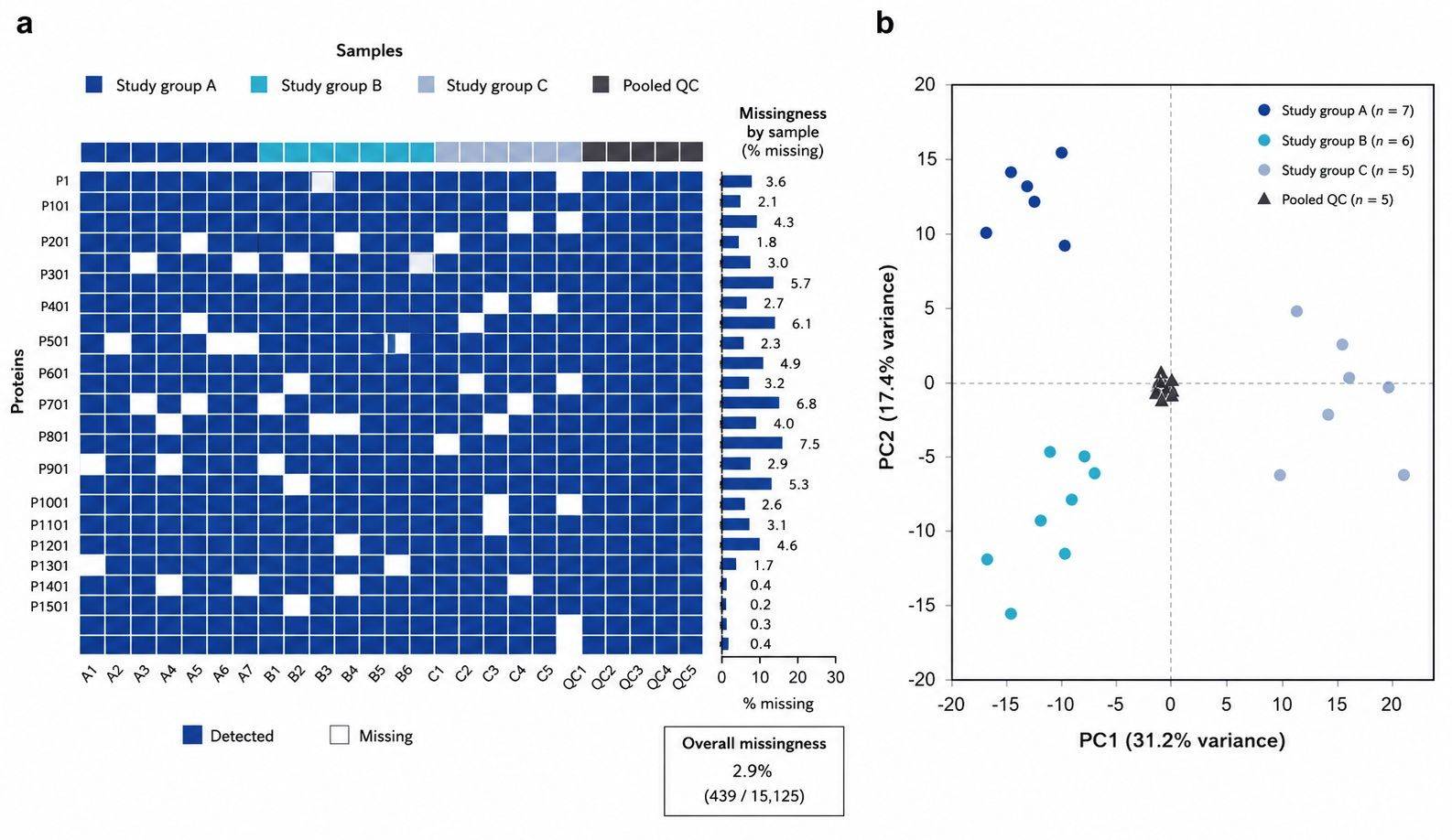
Data Quality Summary: Matrix Completeness, Missingness, and Pooled-QC Reproducibility
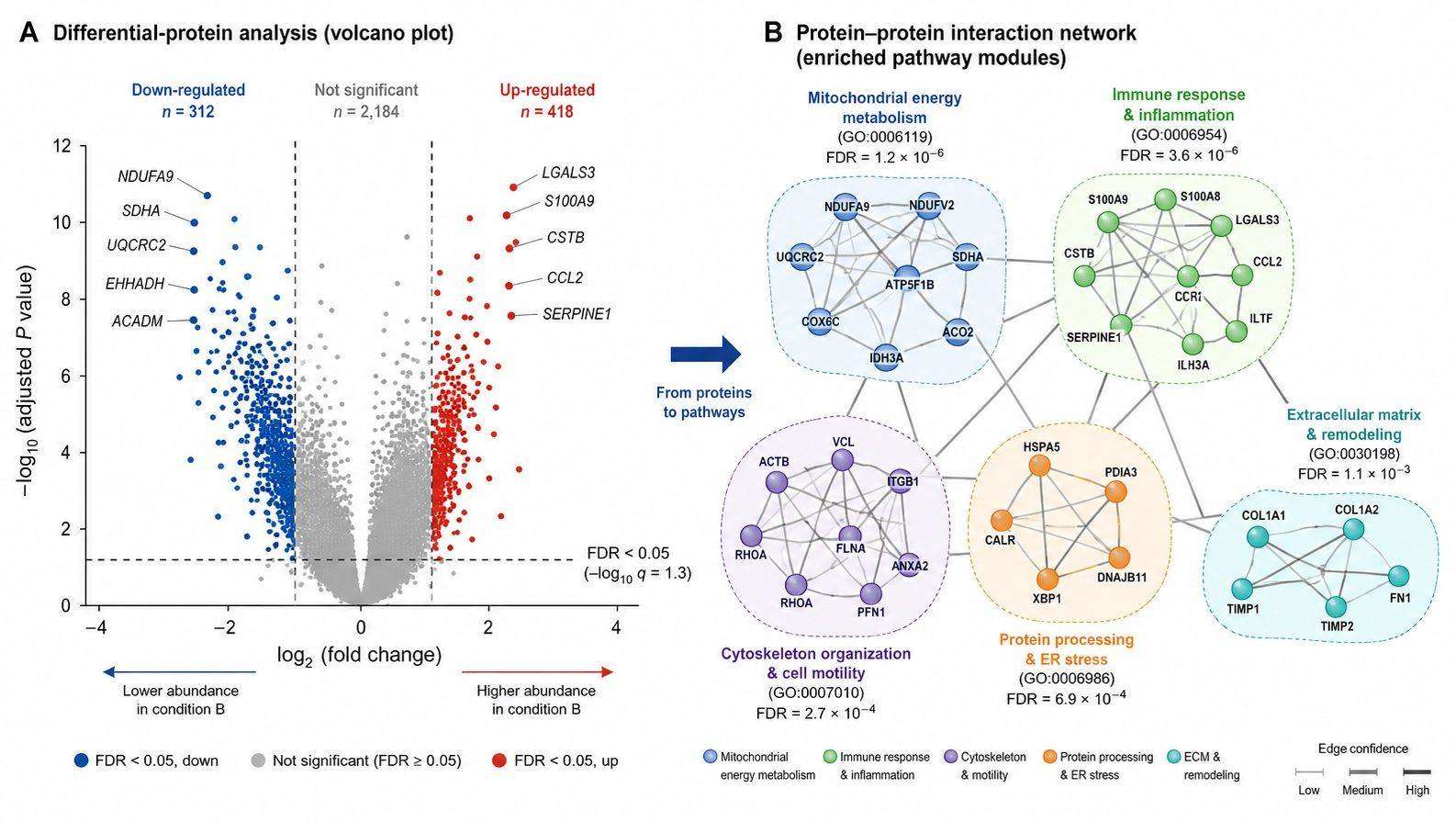
Biological Interpretation: Differential Proteins, Functional Networks, and Pathway Enrichment
Standard Deliverables Checklist
- Normalized Quantitative Protein Matrix: Complete protein-level and precursor-level abundance tables (.xlsx / .csv).
- Differential Expression Statistical Results: Pairwise comparisons with log2 fold changes, raw p-values, and Benjamini-Hochberg FDR q-values.
- Analytical QC Summary: Total Ion Chromatogram (TIC) overlays, iRT retention time stability curves, and pooled QC correlation matrices.
- Advanced Bioinformatic Visualizations: High-resolution vector figures for PCA, Hierarchical Clustering (Heatmaps), Volcano plots, and Violin plots.
- Functional Annotation & Enrichment: Gene Ontology (Biological Process, Molecular Function, Cellular Component) and KEGG/Reactome pathway analysis.
- Complete Raw Data & Methods Package: RAW mass spectrometer files, spectral library files (.speclib/.tsv), DIA-NN / Spectronaut run logs, and detailed publication-ready methods text.
Selected Method References
- Bruderer R, Bernhardt OM, Gandhi T, et al. Extending the limits of quantitative proteome profiling with data-independent acquisition and application to acetaminophen-treated three-dimensional liver microtissues. Molecular & Cellular Proteomics. 2015.
- Demichev V, Messner CB, Vernardis SI, et al. DIA-NN: neural networks and interference correction enable deep proteome coverage in high throughput. Nature Methods. 2020.
- Meier F, Brunner AD, Frank M, et al. diaPASEF: parallel accumulation–serial fragmentation combined with data-independent acquisition. Nature Methods. 2020.