
From DIA Discovery to PRM/MRM Validation: How to Prioritize Candidates, Select Peptides, and Design a Targeted Proteomics Panel
Moving from DIA discovery to PRM/MRM validation means reducing a broad candidate list to a smaller set of proteins and peptides that are relevant to the study question, measurable in the intended matrix, and supported by a prespecified QC plan. The most defensible panel is not the list with the lowest discovery p-values; it is the list whose targets, peptide surrogates, controls, and quantitative endpoint remain interpretable when tested in an independent sample set.
DIA can generate a rich catalogue of proteins, peptides, pathways, and post-translational modifications. That breadth is valuable for hypothesis generation, but a targeted validation study faces a different constraint: every selected peptide consumes analytical attention and must survive matrix effects, chromatographic co-elution, variable digestion, retention-time drift, and cohort-scale QC. Candidate prioritization is therefore an analytical and biological triage process, not a simple handoff from one software report to another.
Key Takeaways for DIA to PRM/MRM Validation
- Rank discovery candidates using effect evidence, biological relevance, peptide observability, and study feasibility together. A protein-level p-value alone is not a targeted-assay specification.
- Select more than one candidate peptide per protein during feasibility when the sequence and sample amount allow; the final reporting peptide should be supported by uniqueness, response, chromatographic behavior, and interference review.
- Use DIA evidence to check matrix-specific observability, fragment-ion behavior, retention time, and consistency. Predicted properties are useful for ranking but do not replace empirical evidence.
- Choose PRM when broad product-ion evidence is useful during peptide and interference review; choose MRM for a stable, established set with predefined transitions and high sample numbers.
- Lock the question before panel design: exploratory relative comparison, confirmation of direction, protein-adjusted phosphosite analysis, mutant-specific evidence, and absolute quantification require different controls and acceptance criteria.
Why DIA Discovery Results Cannot Be Converted Directly into a PRM/MRM Panel
DIA discovery and targeted validation answer related but different questions. DIA is designed to measure many analytes across a sample set and reveal candidate patterns. PRM and MRM focus acquisition and review on a defined peptide list, making them suitable for a narrow, hypothesis-driven comparison. A discovery signal can be statistically interesting and still be a poor targeted candidate if its protein is represented only by a non-unique peptide, a labile modification, a peptide with low response in the intended matrix, or a peak affected by interference.
The initial candidate table should therefore be treated as a source of evidence rather than the final assay list. At minimum, retain the protein or peptide identifier, effect size and uncertainty, abundance or signal information, peptide-level support, missingness pattern, matrix and preparation details, experimental groups, and the data-processing version. This context prevents a common error: selecting targets from a protein summary without checking which peptide evidence created that summary.
Discovery significance and targeted usefulness are separate criteria
Candidate selection should begin with the stated biological contrast. A pathway-level study may prioritize several proteins that represent different positions in a pathway, rather than several correlated proteins with the largest fold changes. A mechanistic perturbation study may give priority to a direct target, proximal response markers, and an orthogonal pathway marker. A complex tissue study may favor proteins with robust, unique peptide evidence over an apparently larger change supported by one marginal feature.
The target list should also distinguish discovery evidence from intended targeted evidence. For example, a protein-level discovery result may need one or more proteotypic peptides for relative confirmation. A phosphosite hypothesis requires the site-containing phosphopeptide plus a defined total-protein context, rather than a generic protein abundance peptide. A sequence variant requires the mutation-bearing peptide, not merely a peptide elsewhere in the protein. The targeted panel must measure the object named in the conclusion.
A practical candidate-prioritization framework
Use a transparent scoring or tiering framework, with the weighting aligned to the study objective. The following categories are commonly useful:
- Biological relevance: direct connection to the perturbation, pathway, phenotype, or predefined hypothesis.
- Discovery evidence: effect estimate, uncertainty, consistency across replicates, missingness, and peptide-level support.
- Analytical feasibility: sequence uniqueness, observable digestion products, empirical DIA signal, chromatographic peak behavior, and anticipated interference risk.
- Panel value: whether the target adds nonredundant evidence, has an appropriate reference or control, and fits the available sample and cohort design.
- Decision consequence: whether confirmation would change the next research decision, such as advancing a mechanistic hypothesis, selecting a protein set for follow-up, or choosing an orthogonal experiment.
The framework should not obscure uncertainty with an arbitrary composite score. Instead, use it to make trade-offs visible. A high-effect candidate with no observable unique peptide can remain a biological lead, but it should be marked as requiring an alternative analytical strategy rather than being silently included in a PRM/MRM list.
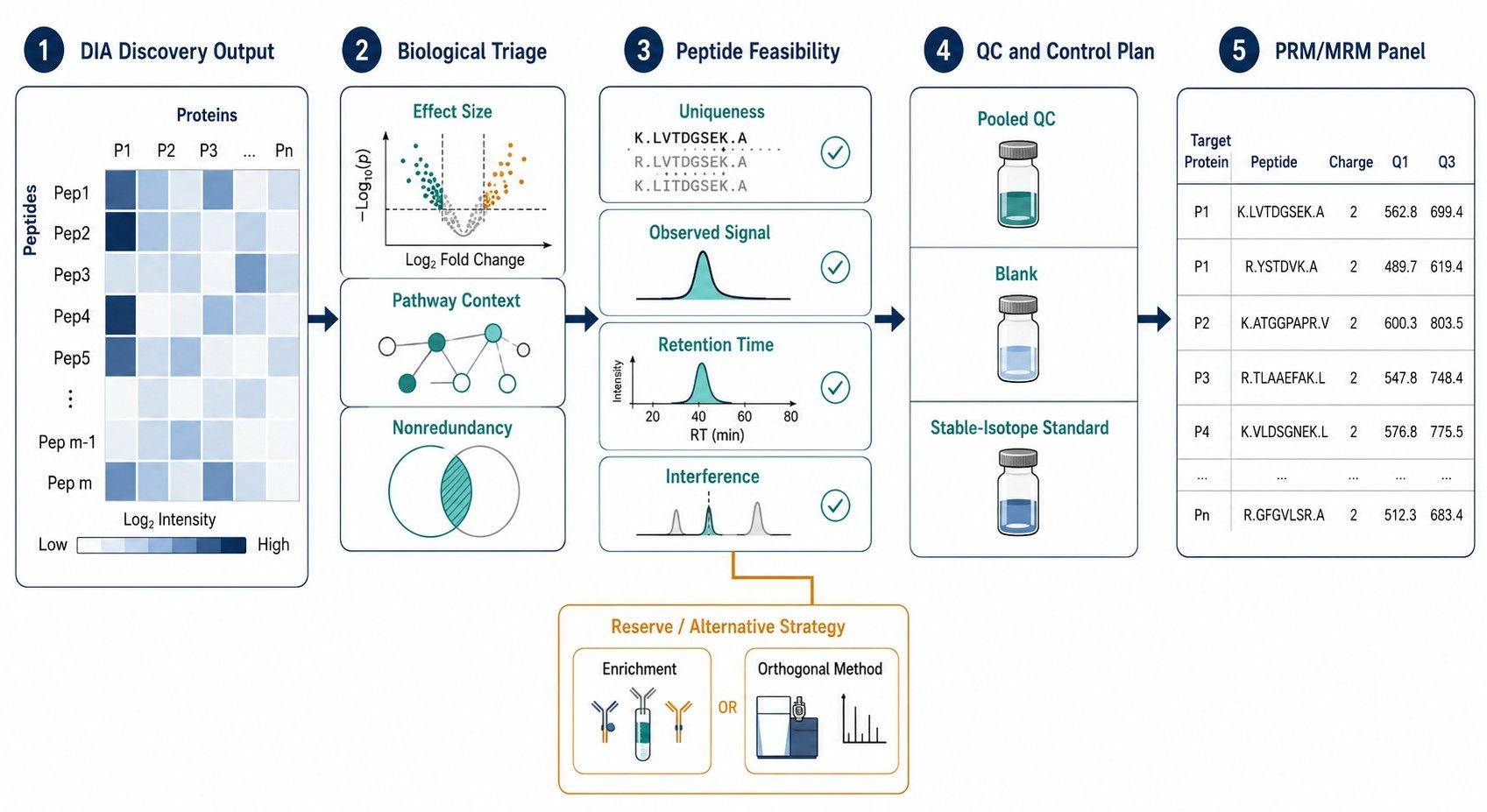 Figure 1. DIA candidates should pass biological and analytical triage before entering a PRM/MRM validation panel.
How to Prioritize DIA Candidates for Targeted Proteomics Validation
Candidate ranking should be performed at two linked levels: the biological target and the peptide surrogate. The protein may be compelling but represented by unsuitable peptides. Conversely, a robust peptide can be analytically excellent but irrelevant to the decision the study needs to make. Keep both views in the project record.
Start with a focused confirmation question
Define whether the objective is to confirm a discovery direction, compare a predefined panel across a new cohort, evaluate a dose or time-course pattern, test a site-specific modification, or estimate an absolute amount. This decision determines panel size, reference materials, sample preparation, and which QC results are essential. A focused relative confirmation panel does not require the same calibration design as an absolute quantification study, and an occupancy-oriented phosphosite study does not use the same denominator as a total-protein comparison.
For a broad discovery data set, a useful starting panel usually contains a limited number of high-priority targets plus contingency candidates. Include candidates that are biologically linked but not redundant, and preserve a short reserve list in case a peptide fails feasibility. Avoid the opposite extreme of sending every discovery hit into targeted development. A panel with too many concurrent targets can compromise dwell allocation, chromatographic sampling, and manual review capacity before it improves biological inference.
Inspect peptide-level evidence from the DIA data
Review the actual peptide features behind each candidate. Useful checks include uniqueness in the relevant proteome, consistency of retention time and peak shape, fragment-ion agreement, precursor and fragment interference, replicate behavior, and whether the peptide is absent selectively in one group or broadly unstable. When a target is supported by multiple peptides, compare their direction and behavior rather than accepting a protein summary automatically.
Recent work showed how gas-phase-fractionated DIA can provide matrix-specific peptide detectability, signal, relative retention time, and transition evidence for targeted assay design. In the reported cerebrospinal-fluid study, candidates were ranked using observed signal and reproducibility, then used to construct an SRM assay without a separate up-front discovery acquisition (Plubell et al., 2025). The general lesson is not that one workflow fits every matrix; it is that empirical DIA evidence can make peptide selection more defensible than sequence rules alone.
Separate biological priority from current analytical feasibility
Some proteins cannot be represented reliably by the peptides available under a standard bottom-up workflow. Causes include shared sequence regions, poorly behaved digestion products, extremely low abundance, structural changes that alter peptide release, or a modification that shifts the relevant peptide outside the selected assay. These targets may require a different protease, enrichment, immunoaffinity support, a broader discovery method, or an orthogonal readout.
Do not discard the biological hypothesis simply because a first peptide candidate fails. Record the feasibility result and distinguish it from biological falsification. At the same time, do not allow a technically convenient protein to dominate the final panel merely because it is easy to measure. The final set should reflect the scientific question, with known feasibility limits stated clearly.
Selecting Proteotypic Peptides for PRM/MRM Panel Design
A proteotypic peptide is used as a surrogate for a specific protein or proteoform. In a targeted panel, the peptide should be unique enough for the intended interpretation, reproducibly released by the preparation workflow, detectable in the matrix, and suitable for confident peak integration. Computational prediction can narrow the list, but empirical refinement remains necessary because ionization response and interference depend on the matrix and instrument context (Bereman et al., 2012).
Sequence and protein-context checks
Start with peptides that uniquely map to the target protein or explicitly map to the intended isoform. Review whether the selected sequence spans a known sequence variant, cleavage site, or modification that changes the meaning of the measurement. Avoid interpreting a shared peptide as isoform specific, or a mutation-free peptide as evidence of a mutation-bearing proteoform. For proteins with known processing or splice variation, verify that the peptide location represents the relevant biological form.
Candidates with frequent oxidation, deamidation, missed-cleavage behavior, labile modification, or known sequence polymorphism may still be usable, but they require a deliberate rationale and appropriate monitoring. A peptide is not invalid because it is difficult; it is invalid when the report cannot support the interpretation the study assigns to it.
Empirical response, selectivity, and chromatographic behavior
Evaluate signal strength together with selectivity. A high-intensity precursor is not necessarily the strongest quantitative surrogate if its fragment ions are interfered with or its chromatographic peak is unstable. PRM retains broad product-ion information and is often advantageous during refinement because fragment selection can be reviewed after acquisition. MRM is effective once the precursor-to-product transitions, retention-time window, and interference behavior are established for a stable target set.
Targeted assay best-practice guidance describes this as fit-for-purpose development: the amount of analytical characterization should match the intended decision and the evidence claimed in the final report (Carr et al., 2014). An exploratory panel may prioritize relative precision and identity evidence; a study designed to report absolute concentration requires more extensive calibrator, recovery, and standardization evidence.
Use more than one peptide when it changes confidence
One peptide can be adequate for a simple, well-characterized target when its identity and behavior are strong. Additional peptides become valuable when the protein is large, has isoforms, contains variable processing regions, or is expected to be affected by the experimental condition. They provide a check against peptide-specific behavior and can identify when a single surrogate is not representing the whole protein as expected.
The appropriate number is not a fixed rule. It depends on the target, matrix, panel size, and endpoint. During feasibility, retain alternatives. In the final report, name the peptide or peptide set used for each protein and explain how discordant peptides, if observed, were handled.
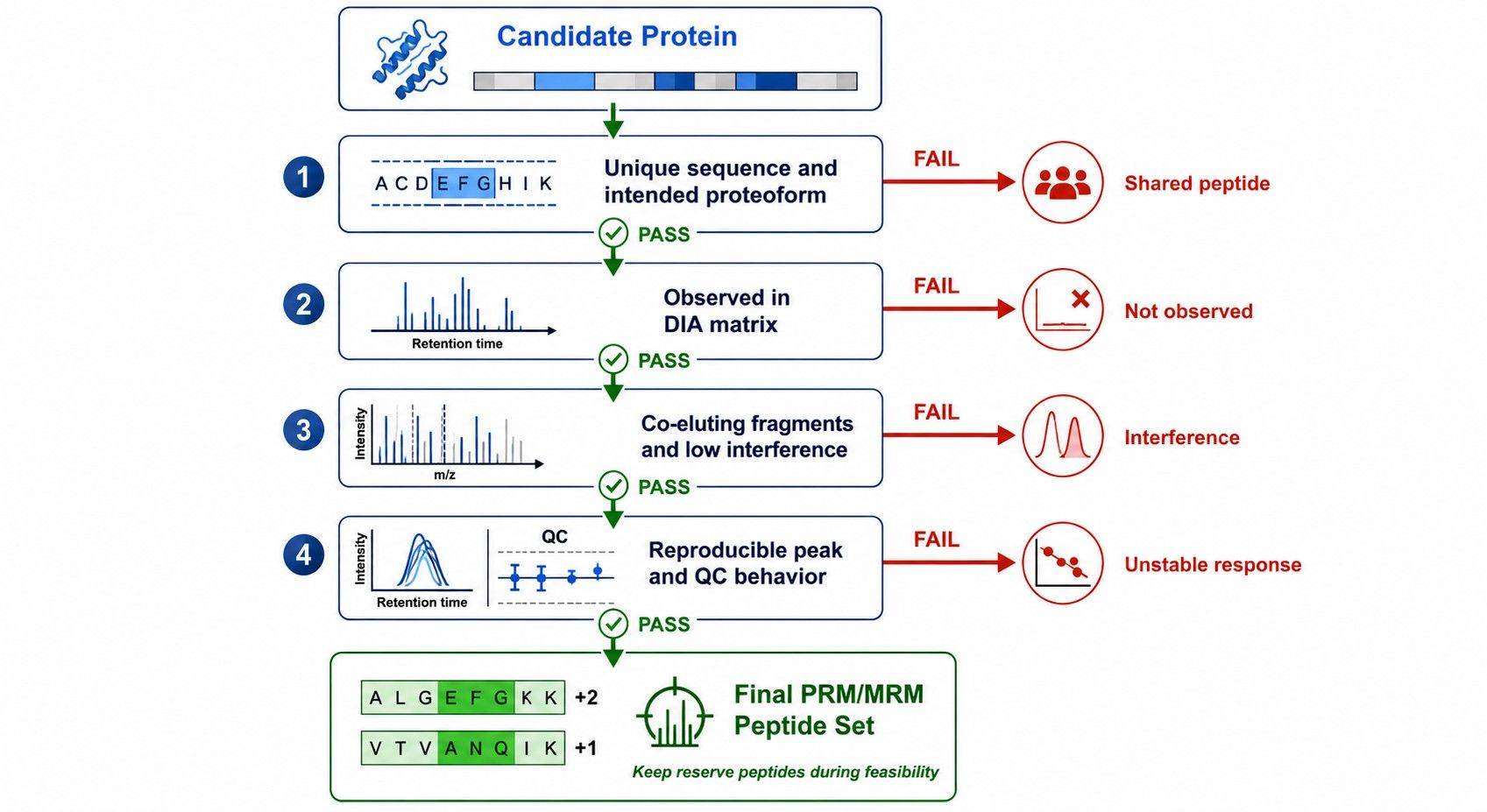 Figure 2. A targeted panel is built from peptide-level evidence, not from protein names alone.
PRM vs MRM for DIA Discovery Follow-Up
PRM and MRM are both targeted LC-MS/MS approaches, but their roles in a discovery-to-validation workflow differ. PRM commonly acquires high-resolution product-ion spectra for predefined precursors, which supports post-acquisition fragment-ion review and can be useful while peptide suitability is still being evaluated. MRM monitors predefined precursor-to-product transitions and is efficient for a mature panel with many samples and well-characterized transitions.
| Decision criterion | PRM for discovery follow-up | MRM for established validation panels |
| Primary strength | Broader product-ion evidence for peptide and interference review | Defined transitions for stable, focused high-throughput monitoring |
| Best project stage | Feasibility, peptide refinement, or panels with evolving evidence | Repeated measurement of a fixed, qualified target list |
| Peptide selection need | Candidate peptides may still be compared after acquisition | Precursors and transitions should already be selected and reviewed |
| Data review emphasis | Retention time, fragment-ion pattern, co-elution, and interference | Transition ratios, co-elution, retention time, and control performance |
| Main planning risk | Too many concurrent targets can reduce useful sampling across peaks | Inherited transitions may be unsuitable in a new matrix if not requalified |
The choice is conditional. If peptide observability, fragment selectivity, or the final target list remains uncertain, choose a PRM-oriented feasibility phase. If the question uses a stable, narrow, previously characterized peptide list and the study needs repeated measurement across many samples, an MRM-oriented panel may be appropriate. The method should follow the evidence maturity of the panel, not the popularity of an acquisition acronym.
For studies that require a coherent discovery-to-targeted route, discovery proteomics services can establish the initial candidate evidence, while targeted proteomics services can be scoped around peptide feasibility, panel design, controls, and fit-for-purpose reporting.
Designing QC and Controls for a Targeted Proteomics Validation Panel
Targeted validation is not simply a second acquisition of selected features. It requires controls that test whether a reported signal is identifiable, comparable across batches, and relevant to the defined endpoint. The appropriate control set depends on whether the panel is relative or absolute, whether the matrix is complex, and whether rare or modified peptides are involved.
Controls that answer distinct questions
A blank or process blank helps identify background and carryover. A pooled study QC follows precision and drift in the study matrix. Technical replicate material helps characterize the combined behavior of preparation and measurement. Stable-isotope-labeled peptide standards can support retention-time matching, fragment-ion confirmation, response normalization, and absolute calculation when the study design calls for them. A reference sample carried through batches links results across the acquisition period.
Do not label every control an internal standard or assume every standard corrects the same source of variation. A peptide added after digestion does not assess protein extraction or digestion recovery in the same way as a full-process standard. State where controls enter the workflow and what uncertainty they address.
Define acceptance and review before the cohort is analyzed
The panel plan should specify peptide identity evidence, peak-integration rules, required co-elution behavior, handling of interferences, reference-sample review, missing-value policy, and conditions for excluding a feature. This avoids a post hoc situation where a target is retained or removed only because it supports a preferred biological narrative.
For larger cohorts, distribute biological groups across acquisition batches and include the relevant QC materials throughout the sequence. The batch-harmonization requirements do not disappear when the panel is smaller. They become more visible because a few targets may carry much of the scientific conclusion. The broader considerations for method transfer and shared controls are addressed in the existing NGPro resource on cross-platform DIA comparability; targeted follow-up should retain the same discipline.
Common Mistakes When Converting DIA Hits to a PRM/MRM Panel
One frequent mistake is selecting candidates only by adjusted p-value or fold change. This can overrepresent proteins from one pathway, exclude modest but mechanistically central targets, and ignore peptide-level feasibility. A tiered list with biological and analytical fields is more useful than a ranked protein table alone.
Another mistake is treating a protein group as a single molecular entity. Protein inference, shared peptides, isoforms, and proteolytic processing matter when targeted validation is supposed to make a more specific claim. Confirm the intended proteoform or site before selecting the peptide surrogate.
A third mistake is carrying discovery processing assumptions into targeted analysis without review. DIA evidence may have been generated with one library and protein-inference approach, while the PRM/MRM panel needs independent peak review, matrix-specific controls, and a fixed integration policy. Consistency is valuable, but reusing a name or peptide list is not equivalent to revalidating its measurement behavior.
Finally, do not design a panel that is too large for the intended acquisition and sample constraints. A smaller panel that captures direct targets, pathway context, and appropriate controls can be more informative than a long list with inadequate chromatographic sampling or incomplete QC. If low sample input or complex co-elution is the dominant limitation, 4D proteomics services can be considered during the discovery stage to improve precursor separation before the focused target list is locked.
What to Prepare for a DIA-to-Targeted Proteomics Feasibility Review
An efficient feasibility review starts with the question and the data context. Provide the candidate protein or peptide list, the discovery result table, group definitions, sample matrix, sample-preparation information, species or sequence database version, and any existing spectral-library or raw-data access permitted for the project. Flag candidate variants, phosphosites, isoforms, known low-abundance targets, and results that must be interpreted as absolute rather than relative.
The resulting plan should identify priority and reserve targets, candidate peptides per target, predicted and empirical concerns, recommended controls, PRM or MRM rationale, required reference materials, and a clear reporting endpoint. This turns the discovery result into a practical panel-development decision rather than an unstructured handoff.
The conditional next step is clear: if the candidate list has robust peptide-level evidence in the intended matrix, proceed to focused targeted feasibility and panel qualification; if the list is biologically important but analytically weak, preserve the hypothesis while reassessing peptide, preparation, enrichment, or discovery depth before committing the full cohort.
Frequently Asked Questions
There is no universal number. Begin with the candidates that are most relevant to the predefined question, analytically supported by peptide-level evidence, and nonredundant in the panel. Add a reserve tier because some biologically strong targets will fail peptide feasibility in the intended matrix.
Yes, DIA data can provide empirical information on peptide detection, retention time, fragment ions, and interference patterns. Synthetic or stable-isotope-labeled standards are particularly valuable when confirmation of identity, cross-run consistency, or absolute quantification is required, but their need should follow the intended claim.
Exclude it from the initial targeted method when no unique and usable peptide can be supported in the intended matrix, when the discovery evidence is peptide-inconsistent, or when the result does not change the study decision. Record the biological lead separately if an alternative method or preparation may make it measurable later.
No. PRM is often useful when peptide refinement and product-ion review are still important. MRM can be appropriate for a fixed, qualified peptide set measured repeatedly across many samples. The correct choice depends on panel maturity, matrix complexity, and the evidence required for the final report.
Use more than one when it materially improves confidence in the protein-level interpretation, such as for isoforms, large proteins, variable processing, or complex matrices. A single peptide can be adequate for a simple target with strong identity and reproducibility evidence, but it should not be presented as more specific than it is.
Yes, but the panel should measure the site-containing phosphopeptide and define the relevant total-protein context. A phospho signal alone may reflect a change in total target protein, so the targeted endpoint should distinguish site abundance, protein-adjusted signal, and true occupancy rather than using those terms interchangeably.
Glossary
- Candidate prioritization: A documented process that ranks discovery findings by biological relevance, statistical evidence, analytical feasibility, and decision value.
- Proteotypic peptide: A peptide selected to represent a defined protein or proteoform in a mass-spectrometry assay.
- PRM: Parallel reaction monitoring, a targeted acquisition approach that collects product-ion evidence for predefined precursors.
- MRM: Multiple reaction monitoring, a targeted approach that monitors predefined precursor-to-product transitions.
- Feasibility review: An early assessment of whether targets and peptide surrogates can be measured and interpreted in the intended matrix.
- Reserve target: A biologically relevant candidate kept in the panel plan in case a higher-priority target fails analytical qualification.
References:
- Plubell, D. L., et al. Data Independent Acquisition to Inform the Development of Targeted Proteomics Assays Using a Triple Quadrupole Mass Spectrometer. Journal of Proteome Research 24, 2885-2891 (2025). https://doi.org/10.1021/acs.jproteome.5c00016
- Carr, S. A., et al. Targeted peptide measurements in biology and medicine: best practices for mass spectrometry-based assay development using a fit-for-purpose approach. Molecular & Cellular Proteomics 13, 907-917 (2014). https://doi.org/10.1074/mcp.M113.036095
- Bereman, M. S., et al. The development of selected reaction monitoring methods for targeted proteomics via empirical refinement. Proteomics 12, 1134-1141 (2012). https://doi.org/10.1002/pmic.201200042
- Borras, E. and Sabido, E. What is targeted proteomics? A concise revision of targeted acquisition and targeted data analysis in mass spectrometry. Proteomics 17, 1700180 (2017). https://doi.org/10.1002/pmic.201700180
- van Bentum, M. and Selbach, M. An Introduction to Advanced Targeted Acquisition Methods. Molecular & Cellular Proteomics 20, 100165 (2021). https://doi.org/10.1016/j.mcpro.2021.100165
- Searle, B. C., et al. Chromatogram libraries improve peptide detection and quantification by data independent acquisition mass spectrometry. Nature Communications 9, 5128 (2018). https://doi.org/10.1038/s41467-018-07454-w
 4D Proteomics with Data-Independent Acquisition (DIA)