
Cross-Platform DIA Proteomics: Method Transfer, Comparability, and Batch Harmonization Across Instruments
Cross-platform DIA proteomics data can be compared when the study is designed around shared samples, qualified workflows, common analysis rules, and evidence that technical variation is separate from the biological effect of interest. A DIA method should not be treated as portable merely because two instruments use the same acquisition label: chromatography, ion mobility, isolation windows, spectral libraries, peak extraction, and normalization can all change the resulting quantitative matrix.
For a growing cohort, a multi-site project, or a study that must continue after an instrument change, the practical objective is not identical raw intensities. It is a clearly defined and adequately supported comparison: the same protein or peptide entities, measured under documented conditions, with batch effects assessed before downstream biological interpretation. Method transfer therefore begins before the first study sample is randomized, not after separate datasets have already been produced.
Key Takeaways for Cross-Platform DIA Proteomics
- Cross-platform comparability is a study-level claim. It requires common reference materials and predefined acceptance checks, not only a shared protein database.
- Preserve what can be controlled: sample preparation, digestion strategy, aliquoting, reference material, run-order randomization, metadata fields, and the data-processing version.
- A transferred DIA method usually needs requalification on the receiving LC-MS configuration. Isolation windows, gradient, retention-time calibration, and library suitability may need adjustment.
- Pooled study QC, system-suitability material, and bridge samples answer different questions. Use all three when a cohort spans multiple batches, instruments, or sites.
- Correct batch effects only after documenting them. A method that removes real group separation is not a successful harmonization method.
Why Cross-Platform DIA Proteomics Needs More Than the Same Acquisition Mode
Data-independent acquisition uses predefined precursor-isolation windows rather than stochastic precursor selection, which can improve consistency across runs. That advantage does not make output from different systems automatically interchangeable. Each platform produces data through a coupled analytical system: sample preparation, LC separation, ion source condition, instrument acquisition, and computational extraction all contribute to the quantified signal (Kirkpatrick et al., 2023; Tsantilas et al., 2024).
The key question is not whether both instruments run DIA. It is whether the study can support the same scientific comparison after an instrument, laboratory, or batch changes. The answer depends on whether the project maintains a common measurement backbone and records the evidence needed to evaluate it.
Cross-platform comparability has several levels
Identification overlap is the least demanding level: both datasets identify a partially shared list of peptides or proteins. Relative-direction agreement is stronger: a defined subset shows the same trend between experimental groups. Quantitative agreement is stronger again: shared entities have acceptable precision and concordance under a prespecified transformation and model. Finally, a transferable decision panel requires explicit assay-level qualification and stable reference behavior.
These levels should not be conflated. A study can have useful biological concordance without matching every peptide or absolute intensity across instruments. Conversely, an impressive protein-count overlap does not establish that small fold changes are comparable. Define the intended level in the study plan and align acceptance criteria to that endpoint.
Where non-biological differences enter a DIA dataset
Differences can arise before acquisition through extraction efficiency, digestion completeness, peptide recovery, or sample storage history. During acquisition, gradient length, flow configuration, ion mobility, isolation-window scheme, collision-energy behavior, retention-time shift, source stability, and detector response can change peptide detectability. Downstream, library source, search engine, false-discovery control, missing-value handling, protein inference, normalization, and summarization can alter the final protein matrix.
Library and analysis choices deserve particular attention. In a controlled comparison, library-based identification improved technical overlap and reduced missing values for both DDA and DIA relative to sequence-database searching alone; the observation shows that computational strategy is part of the reproducibility claim, not an afterthought (Fernandez-Costa et al., 2020). Chromatogram-library workflows similarly use retention time, fragment-ion behavior, and interference information calibrated to a particular LC-MS setup, illustrating why an inherited library should be evaluated rather than assumed to transfer unchanged (Searle et al., 2018).
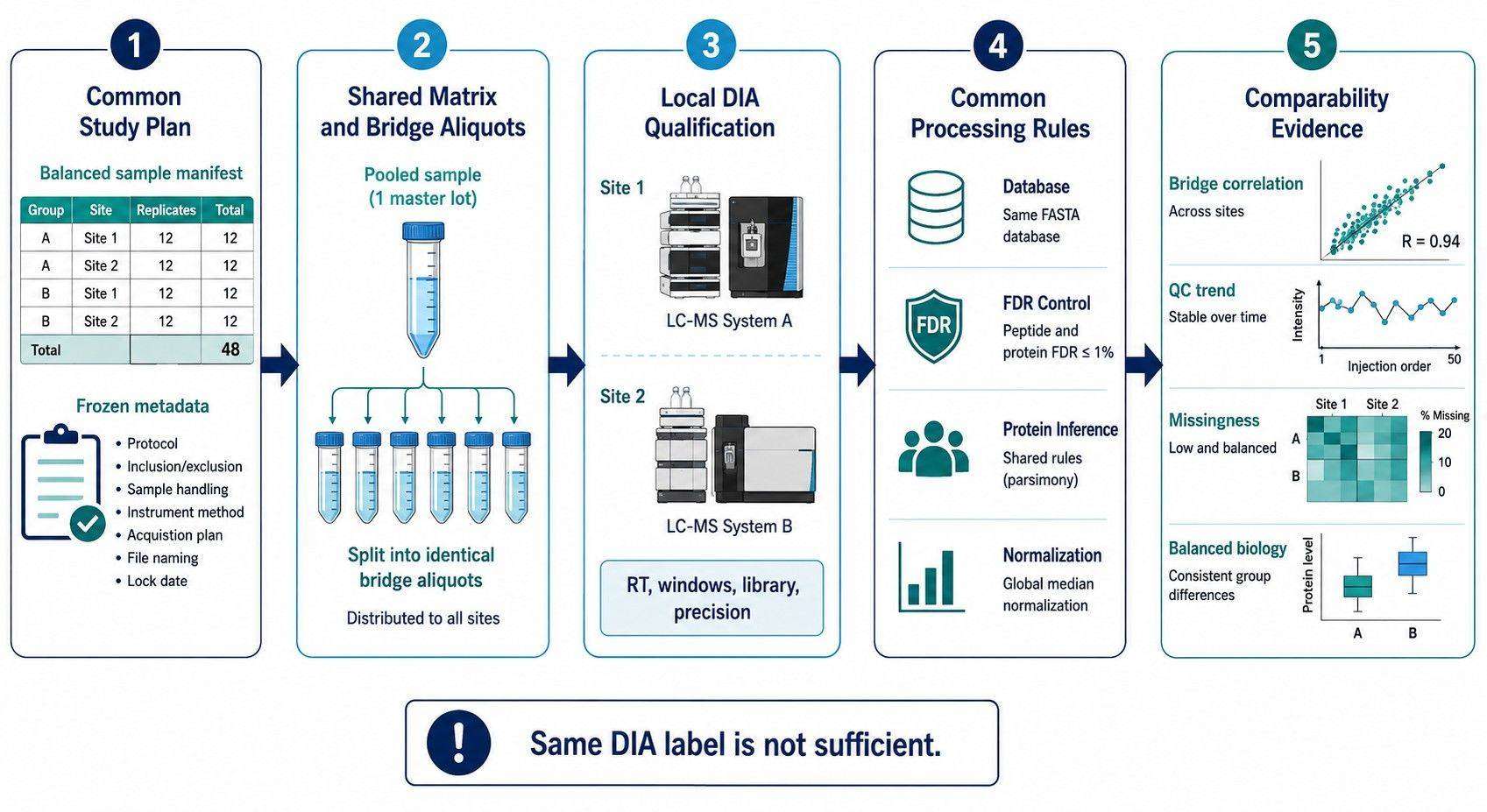 Figure 1. A cross-platform DIA workflow requires shared material, local qualification, harmonized analysis, and documented comparability evidence.
Cross-Platform DIA Method Transfer: What Should Be Held Constant and What Should Be Requalified?
Method transfer should separate immutable study choices from platform-specific parameters. The objective is not to copy every setting character-for-character. It is to retain the scientific measurement intent while verifying that the receiving workflow produces usable peptide evidence, precision, and coverage for the intended matrix.
Keep the shared study backbone constant
Use the same sample-type definition, extraction and digestion strategy, aliquoting plan, reference material, and experimental-group labels wherever possible. Freeze the primary comparison, protein database version, modification rules, false-discovery approach, reporting level, and metadata dictionary before datasets are combined. A common sample manifest prevents a later situation in which batch is confounded with species, tissue, preparation date, experimental group, or instrument.
For multi-site work, process a set of split aliquots from the same pooled material through each site. These bridge aliquots are more informative than a commercially prepared digest alone because they reveal the combined behavior of the project matrix, preparation, LC-MS method, and data-analysis pipeline. System-suitability material should still be used to follow instrument behavior over time, but it does not replace a matrix-matched bridge.
Requalify platform-dependent DIA parameters
The receiving configuration may require an adjusted gradient, injection amount, window scheme, mobility setting, or retention-time calibration strategy. Evaluate these settings with pilot material before study-scale acquisition. The qualification should examine whether the intended peptide space is observable, whether chromatographic behavior is stable enough for extraction, whether high-abundance interference compromises targets, and whether the achieved data completeness supports the planned comparison.
An instrument-specific chromatogram library can be valuable because it captures local retention-time and fragment-ion characteristics. That does not mean every study needs to start from zero. A global or predicted library can provide the initial search space, while narrow-window DIA or pooled study material can create locally relevant evidence when the project calls for it (Searle et al., 2018). The transferable object is the biological question and its validated measurement definition, not a raw library file treated as universal.
Use acceptance criteria that match the scientific question
Qualification metrics should be agreed before examining study-group differences. Useful categories include system suitability, peptide and protein identification consistency, retention-time behavior, reference-sample precision, missingness, and agreement in known-ratio or bridge-sample comparisons. The relevant threshold is matrix- and endpoint-dependent; a low-abundance exploratory tissue study should not claim the same performance boundary as a focused, high-abundance panel.
If the primary objective is ranking broad pathways, assess stable protein-level trends and pathway-level coherence. If it is a small-effect comparison at a defined target, preselect the peptides and evaluate those targets specifically. If a result may later be converted to a focused confirmation panel, specify the transfer path in advance. NGPro can support this progression through 4D-DIA quantitative proteomics services for cohort-scale discovery, followed by a target feasibility review where needed.
Pooled QC, System Suitability, and Bridge Samples in Multi-Batch DIA Studies
Pooled QC is often discussed as if it solves every source of variation. It does not. A robust large-cohort design uses several control types because each control diagnoses a different point in the workflow (Tsantilas et al., 2024).
Pooled study QC tracks the cohort measurement space
A pooled study QC is prepared from representative aliquots of the project material, then injected repeatedly throughout the acquisition sequence. It is used to visualize drift, evaluate feature precision, assess the stability of retention time and intensity, and support cautious normalization or correction when its behavior demonstrates a technical trend. It should be representative of the submitted matrix; a generic cell-line digest may be useful for system monitoring but cannot show whether the actual tissue or biofluid matrix is behaving consistently.
Place pooled QCs across the run rather than clustering them only at the beginning. The goal is to observe time-dependent behavior. If a QC trajectory indicates a major change in chromatography or response, the project should first investigate the analytical cause. Computational correction is not a substitute for accepting an unrecognized system failure.
System suitability separates instrument health from sample-specific variation
System-suitability material is a stable, repeated control used to monitor LC-MS function longitudinally. It can alert the team to shifts in retention time, peak shape, sensitivity, carryover, or identification behavior. The 2024 QC framework from Tsantilas and colleagues distinguishes this longitudinal control from internal and external QC samples, allowing system failures to be separated from sample-preparation or cohort-specific variation.
System suitability is especially important during a platform transfer. It documents whether the receiving configuration is operating consistently before the study matrix is interpreted. However, a system-suitability digest does not establish cross-platform comparability for every endogenous analyte in a complex matrix. That requires the bridge and pooled-QC layers as well.
Bridge samples provide a direct link between batches or instruments
A bridge sample is an intentionally repeated material that connects batches, sites, or instruments. It may be a pooled matrix aliquot, a reference preparation carried through the workflow, or a common set of technical replicates. Its role is to test whether the same material produces comparable quantified entities and trends after the change point.
When a cohort must be split, distribute experimental groups across batches and include bridge material in every batch. Do not process all controls first and all exposed samples later, or run one biological group on one instrument and the comparison group on another. Those layouts make batch correction fundamentally ambiguous because the technical factor and the biological factor are inseparable.
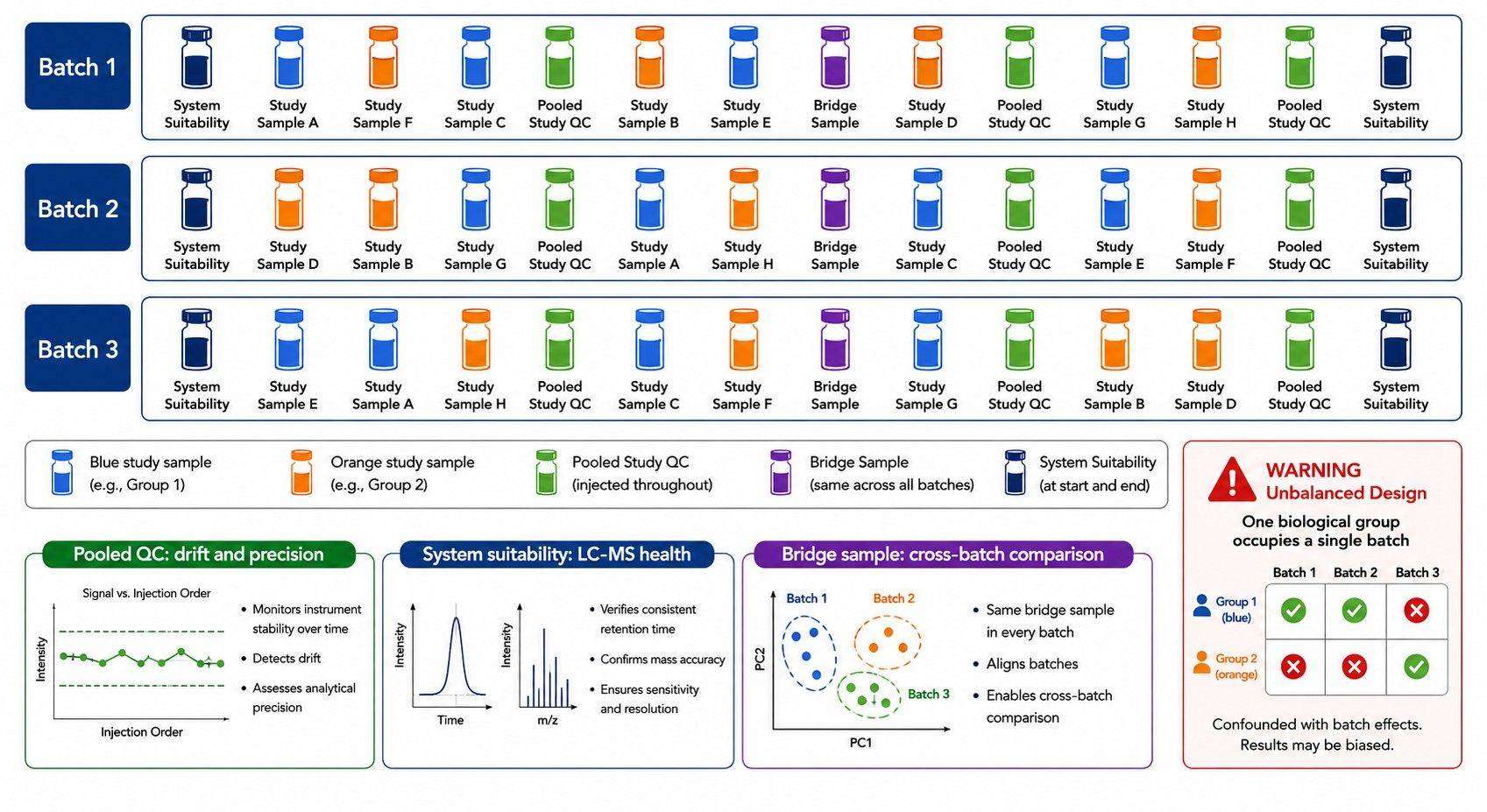 Figure 2. Pooled study QC, system-suitability material, and bridge samples have complementary roles in batch-aware DIA design.
How to Assess DIA Proteomics Comparability Before Harmonizing Batches
Harmonization should follow diagnosis. Before any correction, inspect whether technical factors are associated with run order, preparation batch, instrument, laboratory, or analyst. Then assess whether the biological groups remain balanced within those factors. A batch-correction tutorial for large proteomics studies emphasizes this sequence: assess, normalize, correct if justified, and then evaluate the quality of the adjustment rather than assuming a transformed matrix is automatically improved (Cuklina et al., 2021).
Review comparability at peptide and protein levels
Start with the raw and processed evidence: shared peptide and protein counts, missingness patterns, retention-time alignment, reference-sample distributions, and replicate precision. Peptide-level review is helpful for exposing an interference or a local peak-extraction failure; protein-level review is needed because biological conclusions are often drawn from protein summaries. The 2025 study by Chen and colleagues found that the correction stage interacts with protein quantification, reinforcing the need to state both the summarization and harmonization strategy rather than reporting only the final matrix.
For bridge samples, compare the same peptide or protein entities across the relevant transfer boundary. Evaluate correlation together with bias, distribution shifts, and technical replicate behavior. A high correlation can coexist with a large systematic offset, so correlation alone is not evidence that fold changes or group differences are exchangeable.
Use visualization as a diagnostic, not a proof by itself
Principal-component analysis, hierarchical clustering, density plots, and QC trajectories can reveal whether samples group by batch more strongly than the intended experimental factor. They do not by themselves establish that batch is the sole cause of separation, especially if study design is unbalanced. Use these views alongside the sample manifest, known bridge identities, and per-feature QC statistics.
The desired post-harmonization outcome is not complete disappearance of every visible technical structure. It is a data matrix in which the known technical variation is reduced without erasing expected differences between balanced biological groups. Keep a record of pre- and post-correction diagnostics so that downstream analysts can see what changed and why.
Choose the analysis unit before correcting the data
Correction may be applied to precursor, peptide, or protein-level quantities depending on the workflow and endpoint. These choices are not interchangeable. A protein-level correction can be more robust in some large-cohort settings, but the underlying peptide evidence remains necessary for traceability and issue investigation (Chen et al., 2025). The analysis plan should name the unit of correction, missing-value policy, normalization method, covariates, and the diagnostics used to accept the result.
If the data are strongly confounded, such as all control samples acquired on one instrument and all treated samples on another, no downstream algorithm can create fully defensible causal separation. The correct response is to add balanced bridge measurements or redesign the comparison where possible, not to present a correction as a replacement for experimental balance.
Cross-Platform DIA Proteomics Comparison Table: What the Project Plan Should Define
| Study element | Minimum definition before acquisition | Evidence to review before combining data |
| Biological comparison | Groups, primary contrast, matrix, and required effect interpretation | Groups distributed across preparation and acquisition batches |
| Shared material | Pooled study QC, system-suitability digest, and bridge aliquot identities | Repeated control performance across the full acquisition period |
| Method transfer | Receiving platform, LC configuration, acquisition logic, and local qualification plan | Peptide observability, retention-time behavior, precision, and data completeness |
| Analysis | Database, library strategy, FDR approach, protein inference, normalization, and software version | Same entities and documented processing rules across batches |
| Harmonization | Unit of correction, covariates, acceptance diagnostics, and fallback action | Pre/post QC trajectories, bridge agreement, missingness, and retained biological separation |
| Deliverables | Peptide/protein matrix, QC report, sample manifest, and methods record | Versioned files that explain how comparability was assessed |
The table is deliberately more detailed than a simple same-method or different-method label. Cross-platform projects fail most often at the interfaces: a sample list that cannot be matched to run order, a library that changes silently, a bridge sample absent from one batch, or a correction applied without a predeclared diagnostic. These problems are avoidable when the transfer package is built before data collection.
Common Batch Harmonization Mistakes in DIA Proteomics Studies
The first mistake is treating batch correction as the primary control measure. Correction is a statistical response to residual technical variation; balanced allocation, shared reference material, and longitudinal QC are the first controls. The second is using a control that does not represent the study matrix. A generic digest can show instrument health, but it cannot prove that a complex tissue or low-input preparation behaved the same way.
Another common mistake is changing acquisition and processing at the same time. If the gradient, window scheme, library, software release, and normalization all change at one boundary, it becomes difficult to explain why comparability shifted. Transfer one major element at a time where feasible, document every change, and include a bridge set around the transition.
Finally, avoid defining success by protein count alone. A larger list after correction may reflect changed missing-value handling or identification rules rather than better measurement. Evaluate the features that answer the biological question, their consistency in QCs, and whether group assignment remains balanced. For projects that start with broad discovery and then need a small reproducible confirmation set, targeted proteomics services can provide a defined follow-up route for selected candidates.
When Should You Transfer a DIA Method, Harmonize Existing Data, or Start a New Cohort?
Transfer an existing method when the matrix, scientific endpoint, and analytical backbone remain similar, and a pilot bridge set can demonstrate acceptable performance on the receiving configuration. The transfer package should define what stays fixed and what must be requalified, rather than promising that identical settings will yield identical data.
Harmonize existing data when batches are reasonably balanced, shared reference material exists, processing metadata are available, and diagnostics show that correction reduces technical structure without masking the planned biology. Harmonization is most defensible when it is specified in the analysis plan and supported by pre/post evidence.
Start a new cohort or generate additional bridge measurements when experimental groups are fully confounded with platform or batch, the sample matrix or preparation has changed substantially, or no shared material exists to evaluate a transfer boundary. If the study requires broad cohort discovery with a documented QC architecture, 4D proteomics services can be scoped around the matrix, cohort layout, and intended downstream confirmation strategy.
The conditional decision is straightforward: if the same biological measurement can be qualified locally with a balanced bridge design, transfer the method; if historical batches retain shared controls and sufficient metadata, harmonize only after diagnostics; if neither condition holds, create the missing bridge evidence or define a new, balanced acquisition plan.
Frequently Asked Questions
Yes, but the combined analysis needs a documented definition of comparability. Use shared or bridge samples, harmonized processing, batch-aware design, and diagnostics that show technical variation has been evaluated independently of the intended biological contrast. Matching protein names alone is not sufficient.
No. Pooled QCs reveal and help model technical drift when they are representative and repeatedly measured, but they cannot repair a design where biological groups are completely confounded with batch. They should be used alongside system-suitability material, bridge samples, and balanced randomization.
It may provide a useful starting search space, but it should be evaluated on the receiving LC-MS setup. Retention time, fragmentation, interference patterns, ion mobility, and peptide detectability can differ, so a local chromatogram library or local qualification data may be appropriate for the study matrix.
The strongest bridge is representative of the project matrix and is aliquoted so the same material appears in each relevant batch or platform. A stable system-suitability digest can complement it, but a generic digest does not replace matrix-matched bridge material for evaluating endogenous targets.
Review control and bridge behavior across multiple measures: peptide/protein identification consistency, missingness, retention-time stability, reference-sample precision, distribution shifts, and agreement in the predefined comparison. The appropriate metrics and thresholds should be set in relation to the matrix and intended endpoint rather than copied from an unrelated study.
Not reliably when biological group and batch are perfectly confounded. Algorithms can reduce observed technical structure, but they cannot prove which source produced a difference when no balanced bridge or shared-group evidence exists. Additional balanced measurements are the more defensible solution.
Glossary
- Batch effect: Unwanted technical variation associated with preparation, run order, instrument, laboratory, or other non-biological factors.
- Bridge sample: A common material measured across batches or platforms to connect datasets and assess transfer behavior.
- Pooled study QC: A representative pooled project matrix measured repeatedly to monitor technical performance across the acquisition sequence.
- System suitability: A stable control used to monitor LC-MS function longitudinally.
- Chromatogram library: A DIA library containing experimentally calibrated retention-time and fragment-ion information for a specific LC-MS context.
- Harmonization: A documented processing and correction strategy intended to reduce technical variation while preserving the biological signal under study.
References:
- Kirkpatrick, J., et al. 2019 Association of Biomolecular Resource Facilities Multi-Laboratory Data-Independent Acquisition Proteomics Study. Journal of Biomolecular Techniques 34, 3fc1f5fe.9b78d780 (2023). https://doi.org/10.7171/3fc1f5fe.9b78d780
- Tsantilas, K. A., et al. A Framework for Quality Control in Quantitative Proteomics. Journal of Proteome Research 23, 4392-4408 (2024). https://doi.org/10.1021/acs.jproteome.4c00363
- Cuklina, J., et al. Diagnostics and correction of batch effects in large-scale proteomic studies: a tutorial. Molecular Systems Biology 17, e10240 (2021). https://doi.org/10.15252/msb.202110240
- Searle, B. C., et al. Chromatogram libraries improve peptide detection and quantification by data independent acquisition mass spectrometry. Nature Communications 9, 5128 (2018). https://doi.org/10.1038/s41467-018-07454-w
- Fernandez-Costa, C., et al. Impact of the Identification Strategy on the Reproducibility of the DDA and DIA Results. Journal of Proteome Research 19, 3153-3161 (2020). https://doi.org/10.1021/acs.jproteome.0c00153
- Chen, Q., et al. Protein-level batch-effect correction enhances robustness in MS-based proteomics. Nature Communications 16, 9735 (2025). https://doi.org/10.1038/s41467-025-64718-y
- Wang, Z., et al. Cross-platform proteomics using the Charite open standard for plasma proteomics. Nature Communications 16, 11377 (2025). https://doi.org/10.1038/s41467-025-67264-9
 4D Proteomics with Data-Independent Acquisition (DIA)