
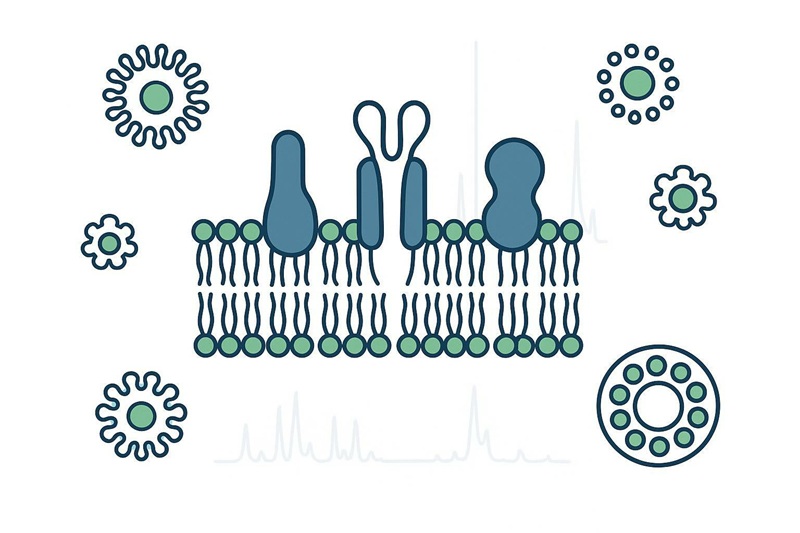
Membrane proteins are usually lost long before you ever get to the instrument. The bottleneck isn't only identification or quantification; it's the chemical environment you create during extraction, purification, and downstream handling.
A detergent choice that looks "strong enough" can unfold a fragile receptor, strip lipids that actually stabilize its fold, or leave behind carryover that crushes electrospray ionization. A detergent that keeps the protein happy can be a disaster for cryo-EM backgrounds or LC–MS cleanliness.
This membrane protein detergent selection guide is built to help you make those trade-offs deliberately. It focuses on three downstream realities that drive most failures: LC–MS compatibility, preservation of binding kinetics for interaction assays, and structural biology readiness.
Strategic Importance of Detergent Selection in Membrane Proteomics
If your end goal is to characterize what's actually present in the membrane fraction (and how it changes across conditions), dedicated plasma membrane-enrichment and LC–MS workflows can complement detergent screening—see Membrane Proteomics.
Solubilization vs. functionality
Solubilization is the first objective, but not the only one. A detergent has to disrupt the lipid bilayer enough to extract your target while keeping enough of the native fold, oligomeric state, and essential protein–lipid contacts intact.
A practical way to think about it is: extraction conditions decide what you can purify, while stabilization conditions decide what you can measure. It's common to use one detergent to solubilize and another to stabilize for assays or structural work. If you treat the first detergent as a permanent decision, you'll often over-penalize performance downstream.
If your target is known to depend on specific lipids (for example, cholesterol-like stabilizers in some eukaryotic membrane proteins), you should treat lipid retention as part of method design rather than an afterthought. In that case, pairing detergent decisions with lipid profiling can prevent a lot of trial-and-error. A dedicated Membrane Lipidomics Service can help confirm whether the lipid class you suspect is actually enriched, depleted, or altered across conditions.
Core variables for success
Detergent selection rarely fails because one detergent is "bad." It fails because key variables weren't treated as a coupled system.
Critical micelle concentration (CMC) determines how much free monomer you'll have in solution and how sensitive the system is to dilution. Working concentration relative to CMC decides whether you're mainly dealing with micelles (above CMC) or mostly monomeric detergent (near/below CMC). Micelle size and shape influence background in cryo-EM, mass spectrometric ion suppression, and often the apparent homogeneity of your purified sample. Buffer composition (salt, glycerol, pH, reducing agents, ligands) can shift what "works" for a given detergent.
In cryo-EM specifically, the background contribution of free micelles is a known failure mode; detergents with low CMC are often preferred because they can keep the protein soluble at lower total detergent concentrations, reducing free micelle populations in the ice. Li's review on cryo-EM detergents summarizes this trade-off clearly in Detergents and alternatives in cryo-EM studies of membrane proteins (2022).
Beyond detergents
Some targets don't tolerate classic micelles well, even when you switch between "mild" non-ionic detergents. In those cases, detergent-free or detergent-minimized mimetics can be more than a nice-to-have.
Four options show up repeatedly in successful workflows:
- Nanodiscs: lipid bilayers wrapped by a scaffold (often a membrane scaffold protein), giving a more native-like environment.
- SMA/SMALP: polymers that directly extract membrane proteins with a belt of native lipids, bypassing detergents.
- Amphipols: amphipathic polymers that wrap around transmembrane surfaces to keep proteins soluble.
- Peptidiscs: peptides that encircle membrane proteins to stabilize them without a traditional detergent micelle.
These aren't universal replacements. They change what can be purified, how it behaves in assays, and the sample preparation rules for MS and structure. But they're often the cleanest path when a protein is stable only in a native-like lipid context.
If you're designing an end-to-end workflow that includes both protein and lipid layers (for example, receptor signaling complexes where lipid microenvironment matters), it can be useful to connect detergent choices to a broader membrane analysis plan. Membrane Omics Analysis Services can support that "protein + lipid" perspective when the biology is tightly coupled.
Guide objectives
This roadmap is designed to make detergent decisions reproducible. It emphasizes:
- choosing detergents based on measurable physicochemical variables
- selecting LC–MS compatible surfactants or robust cleanup strategies
- preserving kinetics and complex integrity for interaction assays and native MS
- using exchange routes (detergent → detergent-free mimetic) when structure quality demands it
Key takeaway: You'll get better results by treating detergent choice as a staged workflow decision (solubilize → purify → exchange → assay), not a single one-time pick.
Detergent Classes and Physicochemical Properties (Membrane Protein Detergent Selection Guide)
Most selection "rules" are shortcuts for two underlying questions:
- How aggressively does the detergent disrupt membranes and protein–protein interactions?
- What kind of micelle environment does it create around your target?
Ionic, non-ionic, and zwitterionic systems
Ionic detergents (classic example: SDS) are strong solubilizers and are often effectively denaturing. They're useful when your downstream step tolerates denaturation (for example, some bottom-up proteomics workflows after robust cleanup) but are generally a poor starting point when you need functional conformation, binding kinetics, or native complexes.
Non-ionic detergents (often the first line for membrane proteins) can provide sufficient solubilization while being less disruptive to native structure. Within this broad class, maltosides and neopentyl glycol detergents are commonly used because they tend to be stabilizing for many targets.
Zwitterionic detergents sit between: they can solubilize efficiently and sometimes preserve activity, but they can also destabilize particular targets or interfere with certain downstream readouts. Their real value often shows up as additives or as part of a screening matrix rather than a single default choice.
A concise way to compare classes is to evaluate them against the specific failure modes you care about.
| System | Typical strength | Denaturation risk | Common use-case fit | Typical failure mode |
|---|---|---|---|---|
| Ionic | Very high | High | Aggressive extraction; certain denaturing workflows | Loss of activity/complex integrity; difficult cleanup if carried over |
| Non-ionic | Moderate | Lower | Functional assays, cryo-EM, native-like handling | Incomplete extraction for some targets; can still strip essential lipids |
| Zwitterionic | Moderate–high | Medium (target-dependent) | Screening; sometimes helps reduce aggregation or orientation issues | Assay interference; destabilization; instrument contamination if not removed |
Mimetics and polymer systems
Detergent-free or detergent-minimized systems are best considered when:
- your target collapses in micelles (loss of activity, oligomer, ligand binding)
- you need to preserve specific lipids as structural cofactors
- free micelles are a dominant background (cryo-EM) or interference (assays)
For cryo-EM, Li's review highlights that alternatives like nanodiscs and amphipols can reduce micelle-derived background and often improve particle behavior, while also noting practical constraints (for example, SMA/SMALP usage is still limited in some mammalian high-resolution cases). See Detergents and alternatives in cryo-EM studies of membrane proteins.
HLB and micelle dynamics
Hydrophilic–lipophilic balance (HLB) is a useful abstraction for predicting whether a detergent will behave more "harsh" or "mild" in aqueous conditions. In practice, HLB correlates with how much hydrophobic surface can be sheltered per unit detergent and how the micelle interacts with a transmembrane domain over time.
For long-term stability and storage, micelle dynamics can matter as much as initial solubilization. If your protein is stable immediately after extraction but degrades after purification, that often points to micelle environment mismatch, loss of stabilizing lipids, or a detergent concentration that drifts near the CMC during dilution.
Here's a pragmatic way to use these variables without overfitting theory:
- Use CMC to plan how dilution steps (wash buffers, SEC, concentration) will shift the system.
- Use micelle size as a proxy for background and heterogeneity risks (especially cryo-EM and some interaction assays).
- Use HLB as a screening axis, not a single "correct" value.
LC–MS Workflows: Compatibility and Cleanup Strategies
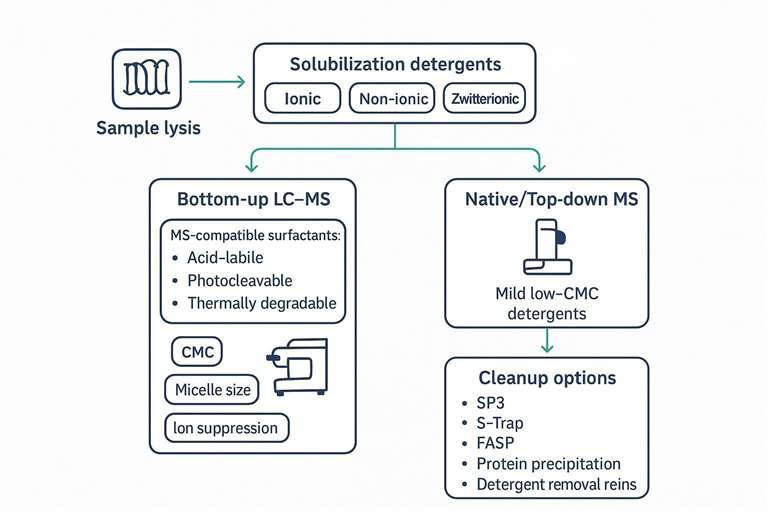
Detergents show up in LC–MS as two separate problems: they suppress ionization and they foul chromatography. Even low "residual" levels can matter.
In practice, detergent removal for LC–MS is not optional; you either remove the surfactant completely or choose a degradable MS-compatible alternative that can be eliminated before injection.
The best workflow depends on whether you're running bottom-up peptide LC–MS/MS or trying to preserve intact complexes for native or top-down approaches. The decision rules for detergent selection for membrane protein LC–MS are therefore different from the rules for keeping a functional complex intact for kinetics or structure.
Bottom-up proteomics and MS-compatible surfactants
If your aim is sequence coverage and identification, you don't need to preserve a native micelle. You need a surfactant that improves solubilization and digestion and then disappears before injection.
That's the logic behind acid-labile or degradable surfactants: they support digestion, then are chemically cleaved into MS-tolerant fragments that can be removed by centrifugation and standard peptide cleanup. This is the core idea behind MS-compatible surfactants for bottom-up proteomics: get the solubilization benefit without carrying the surfactant onto the column.
Just as important is picking a cleanup method that matches your sample type. Comparative evaluations consistently show that method choice changes identifications and reproducibility, especially for hydrophobic proteins.
Cleanup roadmap: SP3, S-Trap, or FASP
If you want a decision table instead of a long debate, start here.
| Cleanup route | What it's good at | Where it can fail | When it's a sensible default |
|---|---|---|---|
| SP3 / SP4 | High-throughput cleanup; strong removal of detergents/salts; bead-based (SP3) or precipitation-based (SP4) workflows | Losses if bead handling is inconsistent; recovery can shift with input and hydrophobicity | Many bottom-up LC–MS workflows with mixed sample types; when scaling matters |
| S-Trap | Fast cleanup from SDS-compatible lysis; on-device digestion; good contaminant removal when protocol is dialed in | Overly fast digests can increase missed cleavages; incomplete removal can still suppress ions | When samples require strong solubilization and you want a fast, reproducible pipeline |
| FASP | Strong buffer exchange; robust detergent removal in many setups | Time and centrifugation burden; throughput limitations | When you already have FASP infrastructure and need maximal buffer exchange control |
| Precipitation | Low cost; effective when input is sufficient | Unreliable at very low inputs; pellet handling losses | When budget is tight and sample amount is not limiting |
For historical context on why detergents must be removed and common strategies, see Removal of detergents from protein digests for mass spectrometry analysis. For modern comparative context across many bottom-up preparation methods, see A comparative survey of bottom-up proteomics sample preparation methods.
Native MS and top-down preferences
Native MS and top-down workflows are the opposite: the chemistry must preserve intact assemblies and non-covalent ligands while still allowing the complex to survive transfer into the gas phase. In other words, you're selecting native mass spectrometry detergents as much as you're selecting a purification buffer.
That changes what "good detergent" means. You're managing at least four coupled issues:
- complex integrity in solution
- micelle release under activation
- charge state (which drives unfolding and dissociation)
- ion suppression from excess detergent
One emerging direction is the use of detergents designed to reduce charge and preserve native-like conformations. Polasky and colleagues describe polyamine detergents developed for native MS and discuss how detergent environment affects charge, unfolding, and subunit dissociation in Polyamine detergents tailored for native mass spectrometry studies of membrane proteins.
A practical, method-first approach for native MS is:
- solubilize in a stabilizing detergent (often a mild non-ionic)
- purify while steadily reducing free micelles
- exchange into a detergent system known to behave well under native MS (or into a mimetic if the complex is extremely sensitive)
Pro tip: In native MS, your "detergent problem" often looks like a "free micelle problem." Most improvements come from controlling detergent concentration and exchange steps rather than hunting for a magical single detergent.
Interaction Assays: Preserving Binding Kinetics
If your assay focuses on extracellular epitopes, receptor accessibility, or ligand engagement at the plasma membrane, pairing detergent optimization with targeted profiling can help validate that the right surface-exposed proteins are retained—see Cell Surface Proteomics.
Interaction assays punish two extremes: harsh detergents that disrupt conformations and overuse of mild detergents that still distort readouts through background and nonspecific effects.
SPR and BLI buffer considerations
For SPR and BLI, detergent conditions have to satisfy three competing constraints:
- keep the membrane protein active (correct fold; ligand binding intact)
- keep the baseline stable (minimize bulk refractive index shifts and viscosity changes)
- minimize nonspecific binding and aggregation
A practical rule is to use the lowest detergent concentration that preserves activity and keep it consistent across sample and reference channels. Problems arise when sample buffers are detergent-matched poorly (bulk shifts) or when micelles interact nonspecifically with surfaces.
Nonspecific binding control
In co-IP and pull-down style interaction workflows, mild detergents are often chosen less for solubilization and more for keeping complexes intact while reducing background.
When background is high, it's tempting to increase detergent strength. That can reduce nonspecific binding, but it can also remove genuine weak interactions. A better approach is to adjust one variable at a time: detergent concentration, salt, and blocking agents, while using negative controls and orthogonal validation.
Detergent-free reconstitution options
Detergent-free mimetics can be especially valuable for interaction assays because they present a more native lipid environment and can reduce artefactual binding caused by micelle surfaces.
- Nanodiscs are often used when the binding interface is lipid-sensitive or when detergent micelles mask epitopes.
- Peptidiscs can be useful when you need detergent-free stabilization without building a full nanodisc assembly workflow.
The operational goal is not "detergent-free at all costs." It's "native-like enough to preserve kinetics without creating a new source of background."
Structural Biology: High-Resolution Optimization
Structural biology workflows reward stability and homogeneity, but the two dominant methods have different preferences.
Cryo-EM is often limited by particle behavior at the air–water interface, preferred orientation, and background contamination from detergent micelles. Crystallography is limited by producing a stable, monodisperse complex that forms productive crystal contacts.
Cryo-EM grid preparation and particle homogeneity
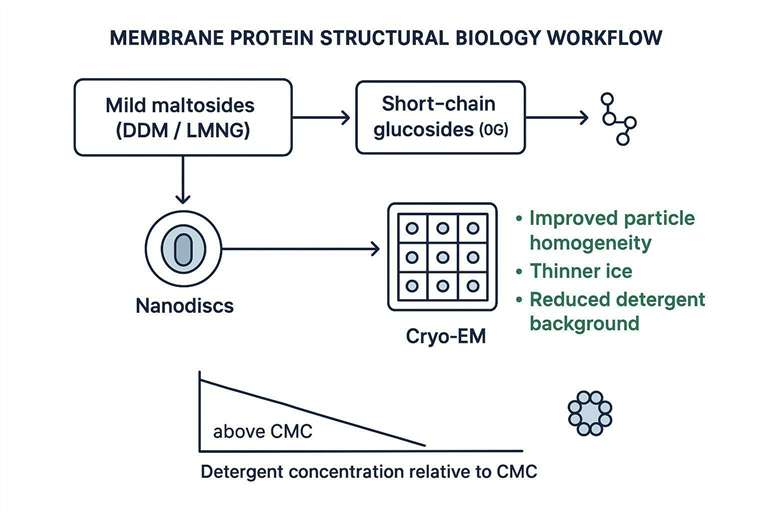
A consistent pattern in cryo-EM membrane protein work is that the detergent that solubilizes best is not always the detergent that grids best.
Li's review notes several practical points that map directly onto everyday optimization:
- free micelles contribute background noise and complicate particle picking and classification
- low-CMC detergents (such as LMNG and GDN) are often preferred to reduce the needed total detergent concentration
- tools like detergent exchange, gradual reduction during purification, and GraDeR can reduce free micelles before grid preparation
- additives like CHAPSO may improve particle orientation by modifying the air–water interface
These points are summarized in Detergents and alternatives in cryo-EM studies of membrane proteins.
Optimization levers (a practical checklist)
| Lever | What you change | What it usually fixes | What it can break |
|---|---|---|---|
| Concentration vs CMC | Move from high multiples of CMC to near-minimal workable | Free micelle background; heterogeneity | Protein precipitation if you go too low |
| Detergent exchange | Switch detergent after purification | Particle distribution; stability | Loss of yield; destabilization if exchange is too abrupt |
| GraDeR or gradient cleanup | Remove free micelles/aggregates | Cleaner ice; better particle picking | Sample dilution; added handling steps |
| Additives (e.g., CHAPSO) | Modify interface behavior | Preferred orientation | New background; altered kinetics |
| Transition to nanodiscs/amphipols | Replace micelle with mimetic | Stability, alignment, heterogeneity | Assembly complexity; lipid composition dependence |
Crystallography-friendly detergents
Crystallography has a different set of constraints: micelle behavior can influence the likelihood of productive crystal contacts, and some higher-CMC detergents can support better crystal packing for certain targets.
One practical strategy is to start with a stabilizing detergent for purification (often a mild non-ionic) and then screen for crystallization with detergents that yield a smaller, more uniform micelle, while controlling residual detergent concentration across screening conditions.
Residual detergent control
Residual detergent is often a hidden variable in crystallization screens because detergents can concentrate during protein concentration steps and vary between batches.
Practical controls include:
- documenting detergent concentration throughout purification and concentration
- keeping detergent consistent during SEC and final buffer exchange
- using the same concentration protocol (spin filters, pressure concentration) across screens
Validation, Troubleshooting, and Best Practices
Detergent optimization becomes reproducible when you validate two things: what detergent remains, and what state your protein is in.
Residual detergent checks
Before downstream analysis, you want to know whether carryover is likely to cause suppression (LC–MS) or background (cryo-EM), and whether your detergent concentration drifted near/below CMC during handling.
Practical validation approaches include:
- track detergent concentration by mass balance (what you add, what you dilute, what you exchange)
- monitor sample behavior after dilution (clouding, aggregation) as a rapid proxy for being too close to CMC
- for LC–MS workflows, run a "blank injection" after your sample to detect carryover effects
For conceptual grounding on why detergent carryover is such a common LC–MS problem, see Removal of detergents from protein digests for mass spectrometry analysis.
Common failure modes
Below are common failure modes that map directly to detergent decisions.
| Failure mode | What it often means | Fix direction |
|---|---|---|
| Protein solubilizes but loses activity | Micelle environment destabilizes fold; essential lipid removed | Screen milder detergents; add stabilizing lipids; consider nanodiscs/amphipols |
| Low LC–MS signal / poor IDs | Detergent carryover or polymer contaminants causing ion suppression | Switch to SP3/S-Trap/FASP; use degradable surfactants; validate removal |
| Cryo-EM images show heavy background | Excess free micelles; concentration too high | Lower detergent; exchange to low-CMC detergent; use GraDeR |
| Inconsistent results between batches | Concentration drift; uncontrolled exchange; variable membrane prep | Standardize detergent:protein ratio, temperature, and timing; document every step |
Emerging reagents
Two trends are worth watching:
- detergents tuned for native MS (for example, charge-reducing or MS-tailored molecules) to preserve complexes under ionization stress
- broader adoption of detergent-free mimetics for high-resolution cryo-EM targets that resist micelle-based approaches
The core point: the solution space is expanding, but the selection logic still comes back to CMC, micelle behavior, and what your downstream method punishes.
FAQs
LC–MS compatibility and detergent removal
Q1. What's the safest way to handle detergents if my endpoint is bottom-up LC–MS/MS?
Use an MS-compatible surfactant strategy or a cleanup method that demonstrably removes detergents before injection. Device-based or bead/precipitation workflows exist because even trace detergent can suppress electrospray and foul chromatography; a classic overview of the problem and removal logic is summarized in Removal of detergents from protein digests for mass spectrometry analysis.
Q2. Can I run SDS-lysed samples directly on LC–MS after digestion?
Not reliably. SDS commonly survives digestion and causes strong ion suppression; plan a removal step (for example, an S-Trap or SP3-style cleanup) and validate with a blank run after your sample to check for carryover.
Q3. SP3 vs S-Trap vs FASP: which one is best for membrane proteins?
There isn't a single best method across all sample amounts and detergent types. Choose based on what you need most: SP3/SP4 for scalable cleanup, S-Trap for fast SDS-tolerant workflows, and FASP when buffer exchange control matters; broad comparative context across common methods is discussed in A comparative survey of bottom-up proteomics sample preparation methods.
Cryo-EM and structural preparation
Q4. Why do detergents create so much background in cryo-EM?
Free detergent micelles vitrify along with the protein and add signal that complicates particle picking and classification. A practical fix is to reduce free micelles by lowering detergent concentration, exchanging detergents, or using gradient cleanup methods; see Detergents and alternatives in cryo-EM studies of membrane proteins.
Q5. DDM vs LMNG: which is better for cryo-EM?
LMNG is often chosen when stability at low detergent concentration is a priority because low-CMC detergents can keep proteins soluble with less total detergent, reducing micelle background. The best choice is still protein-dependent, so treat it as a screening decision rather than a doctrine.
Q6. When should I move from detergents to nanodiscs or amphipols?
Move when micelles are the limiting factor: you see aggregation, loss of activity, or cryo-EM backgrounds that persist despite concentration tuning and exchange. Nanodiscs and amphipols can stabilize targets and reduce micelle-derived artifacts, with practical considerations summarized in Detergents and alternatives in cryo-EM studies of membrane proteins.
Interaction assays and native-like kinetics
Q7. How do detergents affect SPR/BLI binding kinetics?
Detergents can change apparent kinetics by altering protein conformation, changing nonspecific interactions with the sensor surface, and shifting bulk signal if buffers aren't matched. The most robust approach is to use the lowest detergent concentration that preserves activity and keep detergent matched across sample and reference conditions.
Q8. Can nanodiscs improve interaction assays compared to detergents?
Often, yes, when the binding interface is lipid-sensitive or when micelles mask epitopes or create nonspecific background. The benefit is that nanodiscs present a bilayer-like environment that can better preserve native binding behavior, at the cost of additional assembly and optimization.
References
- Detergents and alternatives in cryo-EM studies of membrane proteins
- Polyamine detergents tailored for native mass spectrometry studies of membrane proteins
- Removal of detergents from protein digests for mass spectrometry analysis
Related Services

* For Research Use Only. Not for use in diagnostic procedures.
