Creative Proteomics provides untargeted and targeted LC-MS workflows for mitochondrial fractions prepared from cultured cells, tissues, or submitted mitochondrial preparations. Fraction preparation, rapid quenching, metabolite extraction, LC-MS analysis, and quality control are coordinated to support reliable comparison between biological groups.
Broad LC-MS profiling compares metabolite features across predefined groups and identifies pathways and candidate metabolites for follow-up.
Targeted LC-MS/MS measures predefined metabolites or pathway panels using analyte-specific internal standards and calibration where validated.
Our mitochondrial isolation and fractionation services can be coordinated with rapid quenching, extraction, and fraction-quality assessment.
Metabolite results can be integrated with mitochondrial proteomics, mitochondrial lipidomics, or selected functional measurements.
Mitochondrial metabolomics is appropriate when a study requires organelle-resolved metabolite measurements that cannot be obtained from whole-cell or whole-tissue profiles alone.
| Research Objective | Recommended Analysis | Primary Output |
|---|---|---|
| Compare mitochondrial metabolic responses between groups | Untargeted mitochondrial metabolomics with fraction-quality and analytical controls | Relative metabolite profiles, differential features, and pathway-level summaries |
| Measure predefined mitochondrial pathway metabolites | Targeted LC-MS/MS using validated internal standards and calibration where available | Relative or calibrated measurements for the requested metabolites and predefined comparisons |
| Relate metabolite changes to mitochondrial enrichment | Mitochondrial fraction profiling with mitochondrial and non-mitochondrial marker assessment | Metabolite results reported together with fraction-quality and contamination-control context |
| Select pathways for isotope-tracing follow-up | Untargeted profiling followed by metabolite annotation and pathway analysis | Candidate metabolites and pathways for targeted tracing or functional validation |
When a project centers on oxygen consumption, membrane potential, ATP production, or enzyme activity, our mitochondrial function analysis service may be the more direct starting point. Mitochondrial metabolomics adds molecular context by identifying pathway-associated metabolite changes and candidates for subsequent functional studies.
We select metabolite coverage according to the sample, extraction chemistry, chromatography, ionization mode, and availability of reference standards. Complementary LC-MS methods can be incorporated when one analytical route does not adequately cover the requested chemical classes.
Glycolytic entry points, pyruvate-related metabolites, tricarboxylic acid cycle intermediates, and anaplerotic connections can be examined within the limits of the selected assay.
Amino acids, related organic acids, and selected folate- or methionine-cycle metabolites can support studies of biosynthesis, nitrogen handling, and stress responses.
Acylcarnitines and selected lipid-derived intermediates can indicate changes associated with mitochondrial fatty-acid transport and oxidation, with functional validation where required.
Adenine nucleotides and related metabolites may be included when sampling and extraction can preserve the relevant energy-state information.
Glutathione-related molecules, nicotinamide cofactors, and oxidative-stress products require controlled handling because oxidation and interconversion can occur during preparation.
Selected heme, coenzyme, and biosynthetic intermediates may be evaluated using targeted methods when abundance, stability, and reference standards support the analysis.
These ranges support initial project planning. Final input requirements depend on mitochondrial abundance, tissue or cell type, isolation method, replicate design, requested metabolite coverage, and the material reserved for purity assessment.
| Material | Typical Planning Input and Considerations | Information to Provide |
|---|---|---|
| Cultured cells | Typically 10–50 million viable cells per biological replicate. Inputs below 10 million cells require a limited-input feasibility review and may reduce coverage of low-abundance metabolites. | Cell line, plate or vessel format, confluence, harvest method, media composition, treatment, and available cell count |
| Fresh or frozen tissue | Typically 20–50 mg tissue per biological replicate for initial planning. A larger amount may be recommended for tissue with low mitochondrial yield, multiple analytical modes, or additional fraction-quality assessment. | Species, tissue, mass, collection delay, perfusion status if relevant, freezing method, storage, and pathology or treatment context |
| Isolated mitochondria | Input is planned from mitochondrial protein amount, suspension volume, extraction requirements, and the fraction reserved for purity assessment. | Isolation protocol, buffer, protein amount, volume, enrichment data, time from harvest to quench, storage, and freeze-thaw history |
| Immunocaptured or genetically tagged mitochondria | Can support rapid or cell-type-selective enrichment in a compatible research model; required input depends on capture yield, target coverage, and background controls. | Tag system, capture method, elution or extraction conditions, controls, and evidence that reagents are compatible with the intended analysis |
We standardize the collection-to-quench interval across comparison groups and minimize washing or holding steps that may change small-molecule recovery.
We define fraction-quality, process-control, analytical-QC, and normalization measures during project planning. The selected controls reflect the sample source, enrichment method, metabolite coverage, and the comparisons required for interpretation.
We assess mitochondrial enrichment and non-mitochondrial carryover using source-appropriate markers, such as VDAC1 or TOM20 and cytosolic controls including GAPDH or α/β-tubulin.
Protein recovery, process blanks, and extraction blanks help distinguish biological metabolite changes from material introduced during fraction preparation, reagents, or handling.
Pooled QC samples, internal standards, defined injection order, and signal-stability checks monitor analytical performance across the batch.
We select normalization to mitochondrial protein, starting cell number, tissue mass, or organelle recovery before analysis. When mitochondrial abundance changes between groups, relevant normalization measures are compared.
Experimental Design Review
We define the comparison groups, biological replicates, source material, perturbation, pathway coverage, collection sequence, and relevant orthogonal measurements.
Mitochondrial Enrichment and Rapid Quenching
We minimize the interval from enrichment to extraction. Where method-compatible, we quench isolated fractions with prechilled 80% methanol or another validated cold extraction solvent and standardize handling across comparison groups.
Metabolite Extraction
We select extraction chemistry for the requested metabolite classes and use internal standards and blanks to monitor recovery and background.
High-Resolution LC-MS/MS Analysis
We select chromatography, ionization polarity, and acquisition mode for untargeted profiling or focused measurement. High-resolution MS/MS data are acquired on Thermo Scientific Q Exactive HF-X or Orbitrap Fusion Lumos platforms according to the analytical scope.
Data Processing and Annotation
We filter, align, normalize, and annotate signals using accurate mass, retention behavior, fragmentation, libraries, and standards where available.
Comparative and Pathway Analysis
Our report summarizes predefined comparisons, replicate behavior, metabolite patterns, pathway context, and relevant technical limitations.
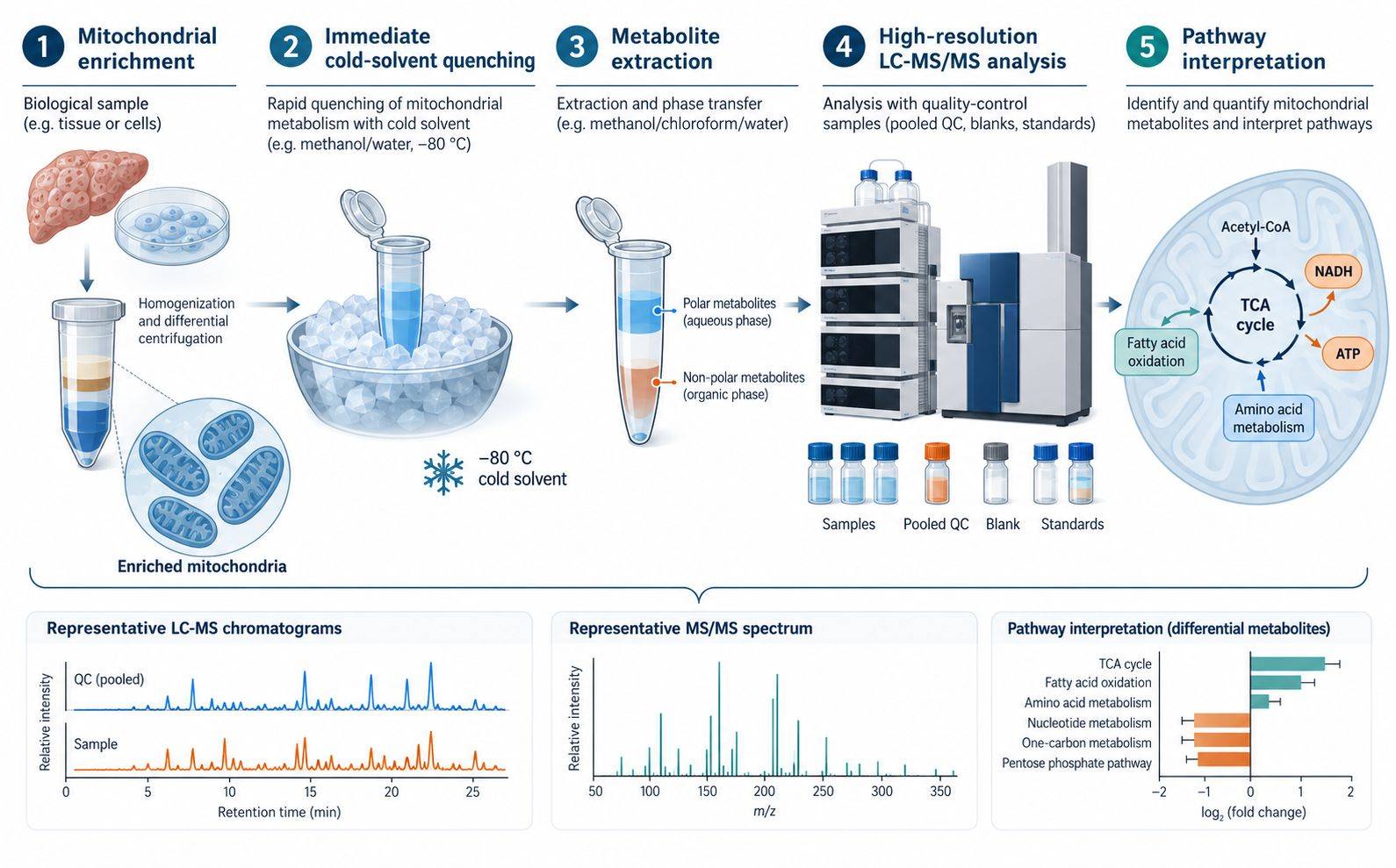
Figure 1. Mitochondrial metabolomics coordinates organelle enrichment, rapid quenching, metabolite extraction, LC-MS quality control, and pathway interpretation.
Our reports describe these results as metabolite abundance at the sampling point, not pathway flux. When the project requires pathway direction or substrate-use evidence, we can plan stable-isotope tracing or dedicated functional assays as complementary work.
Fraction preparation, quenching, extraction, and LC-MS analysis are planned as one workflow for the selected biological comparison.
Untargeted or targeted methods are selected according to pathway scope, analyte chemistry, sample amount, and required quantification.
Normalization can incorporate mitochondrial protein, starting material, organelle recovery, and enrichment measures according to the study design.
We report steady-state metabolite abundance and can add isotope tracing, respiration, enzyme assays, or targeted validation when the research objective requires complementary evidence.
Share the sample source, biological groups, available material, mitochondrial preparation method, and pathways of interest. We will recommend an appropriate analytical and quality-control plan.
Why not use whole-cell metabolomics for a mitochondrial question?
Whole-cell profiling is useful for system-wide changes but averages metabolites across compartments. When the study requires mitochondrial context, we use enriched fractions with controls for enrichment, leakage, and non-mitochondrial background.
Can frozen tissue be used?
Frozen tissue may suit selected workflows, although fresh material is often preferable when intact mitochondria, rapid isolation, or labile metabolite pools are central. During feasibility review, we assess tissue type, freezing method, storage history, and the metabolites of interest.
Can mitochondrial metabolomics measure pathway flux?
Standard untargeted or targeted profiling measures metabolite pools at the sampling point. For pathway flow or substrate contribution, we can plan stable-isotope tracing with an appropriate kinetic design.
How do you control for cytosolic contamination?
We review the isolation method, processing time, mitochondrial and non-mitochondrial markers, recovery, and process blanks. The most informative control set depends on the source material and the biological question.
Can metabolomics be combined with mitochondrial proteomics?
Yes. When sufficient matched material or parallel preparations are available, we plan allocation before processing because the extraction requirements differ. Integrated interpretation can connect pathway metabolites with enzymes, transporters, and respiratory proteins.
For Research Use Only. Not for use in diagnostic procedures.

Hi there - let me know if you have any questions.
×