Cell surface proteomics measures proteins presented on the plasma membrane and exposed to the extracellular space. This surfaceome profiling service helps you bridge the gap between "expression signals" and evidence of surface accessibility, which is critical for antibody-based programs and actionable biomarker discovery.
Workflows combine surface-focused enrichment with LC–MS/MS and optional DIA (data-independent acquisition) quantitative proteomics to support consistent comparisons across conditions.
Surfaceome profiling is used when surface accessibility and model relevance drive decisions. Cell surface proteins include receptors, transporters, and adhesion molecules, and their presentation can shift with disease state, differentiation, and treatment.
| Goal | What surfaceome data can support | Common next steps |
|---|---|---|
| Therapeutic target discovery | Evidence of extracellular exposure and condition-specific changes | Flow cytometry, IHC/IF, functional assays |
| Biomarker discovery | Marker candidates that separate phenotypes across groups | Panel design, assay development planning |
| Cell phenotyping and model selection | Surface marker patterns across cell lines or primary research samples | Cell sorting strategy, model selection |
| Drug-response and MOA studies | Treatment-driven surfaceome remodelling signals | Mechanism follow-up, targeted validation |

Surfaceome data supports shortlisting candidates with evidence of extracellular exposure. Where appropriate, results can be reviewed at the peptide level to support extracellular-domain (ECD) evidence and reduce the risk of pursuing targets that are primarily internal.

Surface profiling helps identify antigens measurable on the cell exterior and supports condition-to-condition comparisons. It can also help prioritise discovery-stage candidates for follow-up safety and specificity assessments.
Surfaceome datasets can reveal marker candidates that separate phenotypes and are compatible with antibody-based assays. This can support development of practical validation panels and translational readouts.

Drug exposure can remodel surface presentation. Surfaceome profiling can support comparisons such as treated vs baseline to help identify resistance markers, compensatory pathways, or combination hypotheses in cell models.

Surface-Accessibility Evidence
Enrichment is designed to prioritise extracellular exposure, not total cellular abundance.

Fit-for-Purpose Enrichment Options
Biotinylation, trypsin shaving, or glyco-capture can be matched to your biology and constraints.

Membrane-Protein Aware Prep
Preparation strategies are built for hydrophobic and multi-pass targets to support LC–MS/MS recovery.

DIA-Ready Quantification
Optional DIA supports consistent comparisons across conditions when quantification is central.

QC for Specificity and Integrity
Marker-based checks help assess enrichment specificity and reduce intracellular carryover risk.

Decision-Ready Deliverables
Outputs are structured for technical review, prioritisation, and downstream validation planning.
This service uses a surface-focused enrichment strategy paired with LC–MS/MS. Optional modules can be selected to align with specific biological questions and membrane protein challenges.
Core platform components
Technical note for difficult multi-pass targets
For GPCRs and other multi-pass transmembrane proteins, membrane-aware solubilisation options (for example, detergents, nanodiscs, or SMA-based extraction) may be evaluated to support recovery and LC–MS/MS performance.
Surface proteins are often low abundance and hydrophobic. Enrichment strategy determines coverage and interpretability.
Enrichment strategy selection
| Method | Key strengths | Best fit for | Typical sample input |
|---|---|---|---|
| Cell-impermeable biotinylation + streptavidin enrichment | Broad coverage with clear extracellular-accessibility logic | Broad discovery; ADC/bispecific screening | Commonly used for cell-based inputs in the 107 range |
| Trypsin shaving (live-cell) | Exposed peptide evidence with reduced background | Topology support; verifying surface exposure | Often requires higher cell input than labelling workflows |
| Glyco-capture (surface glycoproteomics) | Sensitivity for glycosylated receptors and transporters | Deep "receptor-ome" coverage | Frequently used when receptor coverage is the priority |
Cell surface biotinylation enrichment workflow (streptavidin capture)
Biotinylation uses cell-impermeable reagents to label accessible amines on extracellular regions while intact membranes act as a barrier. Labeled material is enriched using streptavidin-based affinity capture, then prepared for MS. Typical steps include: surface labelling → quenching → lysis → affinity capture → stringent washing → elution and digestion → LC–MS/MS.
Trypsin shaving live-cell surface proteomics
Trypsin shaving uses controlled protease exposure on intact cells. It releases peptides from exposed extracellular regions into the supernatant. This can reduce intracellular background when the cell membrane remains intact.
Cell surface glycoproteomics via glyco-capture
Many surface proteins are glycosylated. Glyco-capture strategies can enrich glycopeptides and improve detection of receptors and other glycoproteins. Approaches may include lectin capture or chemistry-based enrichment, depending on study goals.
LC–MS/MS identifies peptides and supports protein-level reporting. DIA proteomics is often used when consistent quantification across groups is a priority. It supports systematic sampling of peptides and can improve comparability across conditions.
The validity of surfaceome data depends on excluding intracellular "contaminants" and confirming labelling on intact, viable cells.
Marker-based QC logic commonly includes:
QC summaries are provided in the final package to support internal review and downstream planning.
| Design Element | Best Practice | Why It Helps |
|---|---|---|
| Group definition | Clear group labels and inclusion rules | Prevents ambiguous interpretation |
| Replicates | Include biological replicates for comparative claims | Improves confidence in differential signals |
| Randomisation / batching | Minimise batch effects; track batches if unavoidable | Reduces technical bias |
| Primary endpoints | Decide whether you prioritise coverage, quantification, or ECD evidence | Aligns method + reporting |
| Reporting focus | Predefine what "decision-ready" means for your program | Makes outputs actionable |
| Sample type (customer-facing) | Recommended sample input | Compatible enrichment routes |
|---|---|---|
| Cell lines (adherent or suspension) | Biotinylation: ~1×10⁷–5×10⁷ cells Trypsin shaving: ≥5×10⁷ cells Glyco-capture: ~1×10⁸ cells |
Biotinylation, Trypsin shaving, Glyco-capture |
| Primary cells (research samples) | Input range depends on availability and chosen route; biotinylation/shaving require intact live-cell membranes | Biotinylation or Trypsin shaving (live-cell) when feasible; Glyco-capture when receptor coverage is the priority |
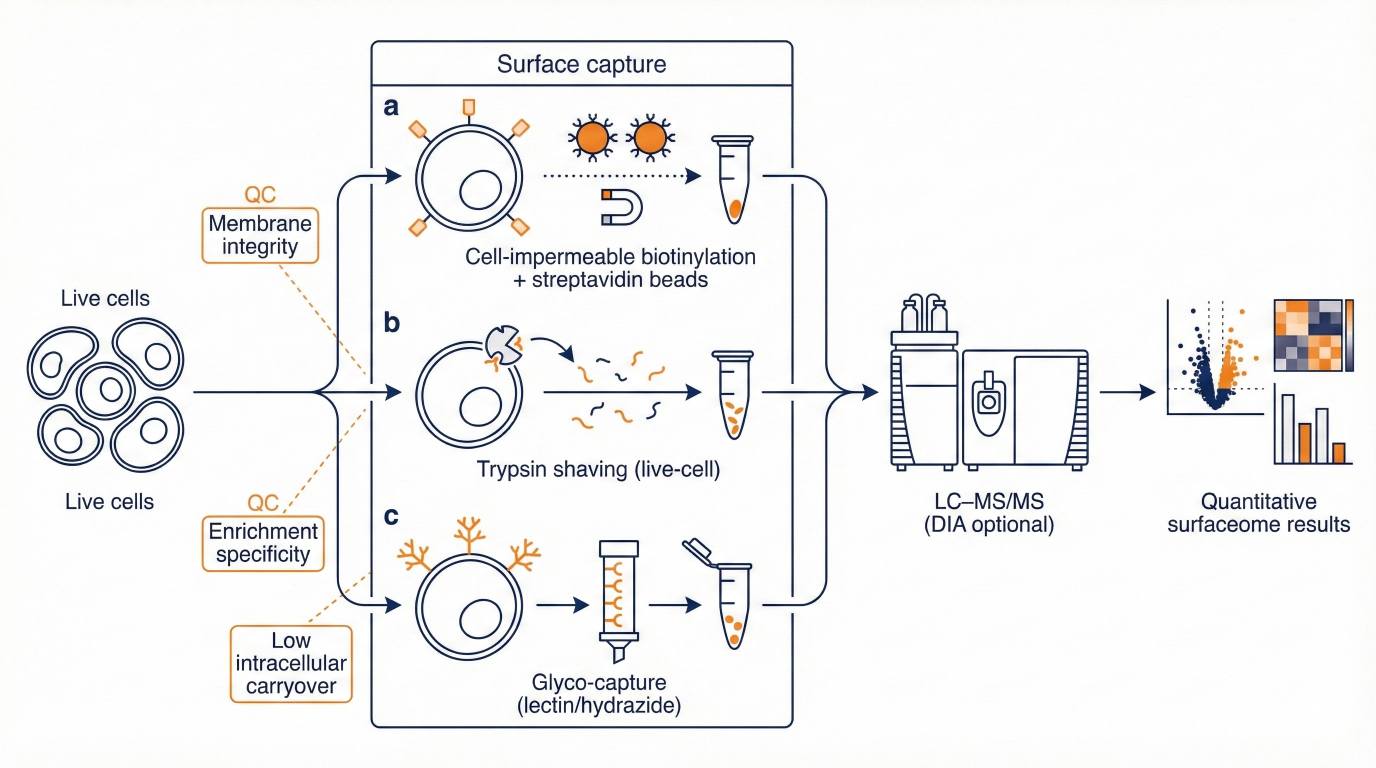
Surfaceome profiling overview: three enrichment routes converge to LC–MS/MS with optional DIA and QC checkpoints.
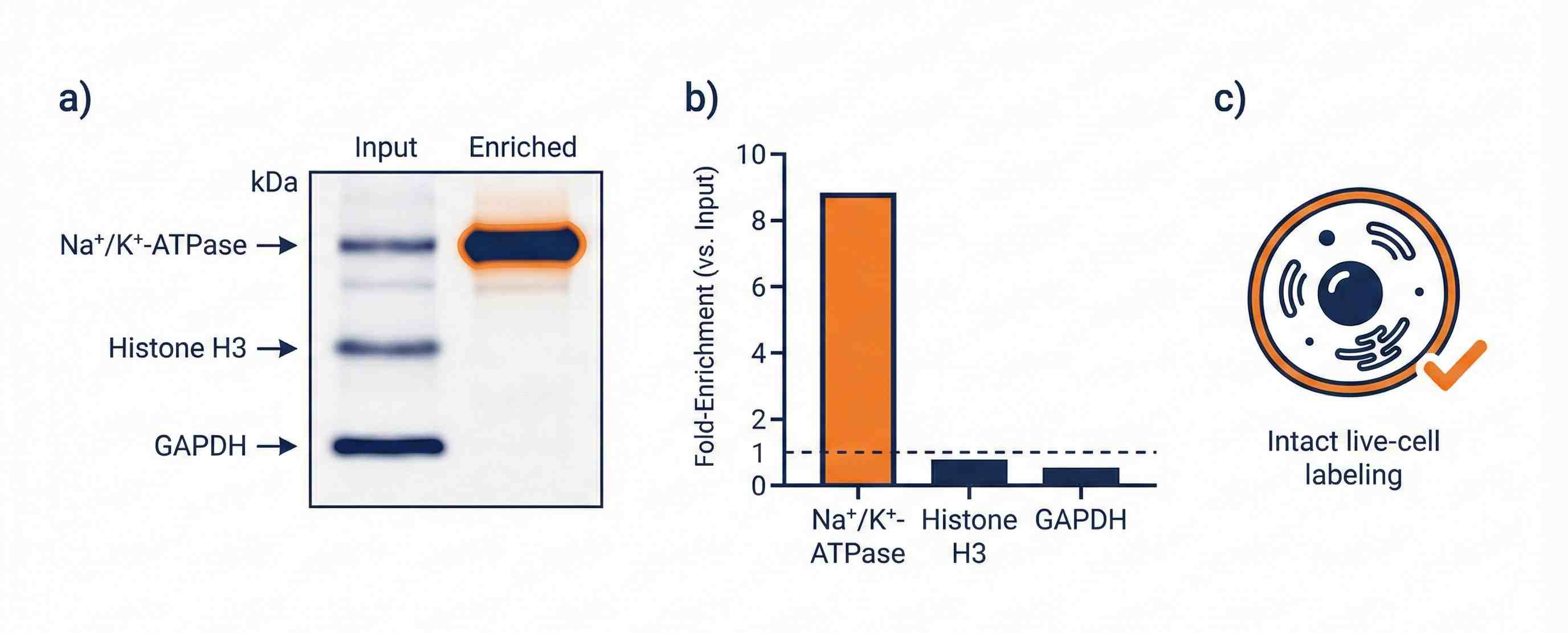
QC summary showing surface marker enrichment and depletion of nuclear/cytosolic markers to confirm specificity.
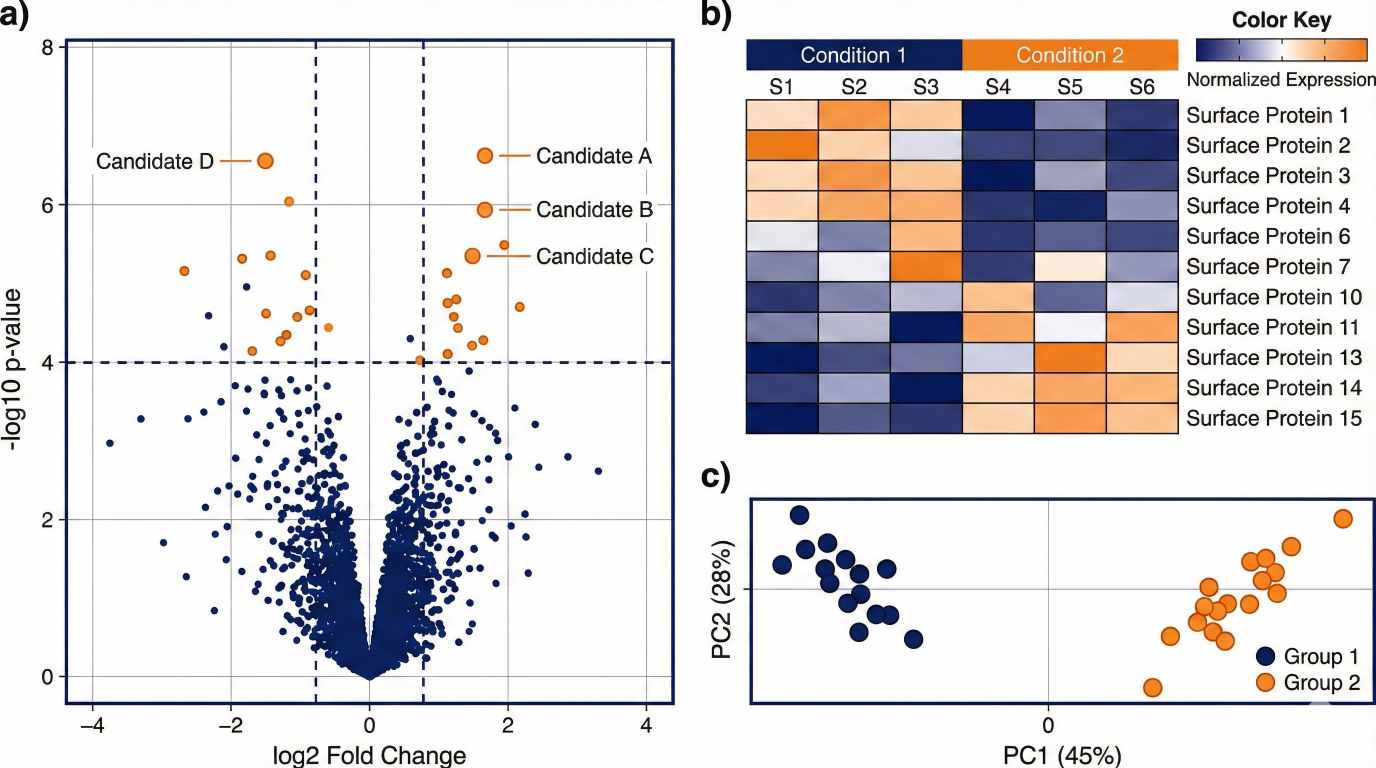
Differential surfaceome results across conditions: volcano plot, heatmap, and PCA highlighting surface candidates.
Case 1: BiDAC-Induced Plasma Membrane Protein Degradation
Objective: Define how BiDAC treatment drives loss of plasma membrane proteins and identify key pathway regulators.
Method: Morphological profiling + genetic screening, supported by mass spectrometry-based analysis for mechanism mapping.
Result: The study links BiDAC action to regulated trafficking/degradation of plasma-membrane targets, supporting drug-induced surfaceome remodeling positioning.
Case 2: Endolysosomal Pathway Drives Plasma Membrane Target Loss
Objective: Validate the route by which BiDACs trigger degradation of plasma membrane proteins.
Method: Mechanistic profiling + screening with TMT-based quantitative proteomics (LC–MS/MS) to quantify treatment-linked changes.
Result: Demonstrates plasma-membrane targets are routed into endolysosomal degradation, aligning with service claims around surface target depletion evidence across conditions.
How does surfaceome abundance correlate with total cellular protein levels?
Correlation is often poor due to post-translational regulation. High mRNA or total protein levels do not guarantee surface translocation; proteins may be sequestered in the ER/Golgi or targeted for lysosomal degradation. Surfaceome profiling directly measures the functionally active pool available for ligand binding or therapeutic targeting. This makes it a superior predictor for antibody-drug efficacy compared to bulk proteomics or RNA-seq, which cannot distinguish between intracellular and membrane-presented fractions.
Why is biotinylation preferred over total membrane fractionation for target discovery?
Total membrane fractionation captures proteins from all lipid bilayers, including the mitochondria, ER, and nucleus, resulting in high intracellular noise. Cell-impermeable biotinylation selectively tags primary amines on the extracellular domains (ECD) of proteins on intact cells. This chemical gating ensures that the enriched fraction represents only the proteins physically accessible from the outside, drastically increasing the signal-to-noise ratio for ADC and CAR-T antigen discovery.
Can LC-MS/MS detect low-abundance receptors like GPCRs?
Yes, through Data-Independent Acquisition (DIA) and optimized solubilization. GPCRs and multi-pass transmembrane proteins are historically "difficult" due to low expression and extreme hydrophobicity. We utilize membrane-mimetic surfactants (e.g., DDM or SMA) and high-sensitivity DIA-MS to overcome these barriers. This approach ensures consistent sampling of low-frequency peptides, allowing for the quantification of signaling receptors that are often missed by standard DDA (Data-Dependent Acquisition) methods.
How do you ensure surfaceome data is not skewed by dead cells?
Cell membrane integrity is critical. If cell viability drops below 90%, "cell-impermeable" labeling reagents can leak into the cytoplasm, leading to the false-positive identification of abundant cytosolic proteins (e.g., Actin, Tubulin). We implement strict viability gating prior to labeling and utilize specialized quenching buffers to stop the reaction instantaneously. Our marker-based QC then audits the final data to confirm the depletion of nuclear and mitochondrial proteins.
How does surface proteomics complement Flow Cytometry (FACS) in drug development?
FACS is a "hypothesis-driven" tool requiring high-quality antibodies for known targets. In contrast, Surfaceome MS is a "hypothesis-generating" discovery tool that identifies thousands of proteins simultaneously without requiring antibodies. In the drug development pipeline, MS is used to generate an unbiased shortlist of condition-specific candidates, which are then validated for absolute quantification and population-specific gating using Flow Cytometry.
What bioinformatic filters are used to define a "true" surface protein?
We apply a multi-layered annotation filter. Beyond simple Gene Ontology (GO) terms, we cross-reference data with the Surfaceome Database and use TMHMM or SignalP algorithms to predict transmembrane helices and signal peptides. This identifies proteins with high "surface propensity." We further categorize results into High, Medium, and Low confidence tiers based on the presence of extracellular domains and experimental evidence of accessibility.


Hi there - let me know if you have any questions.
×