
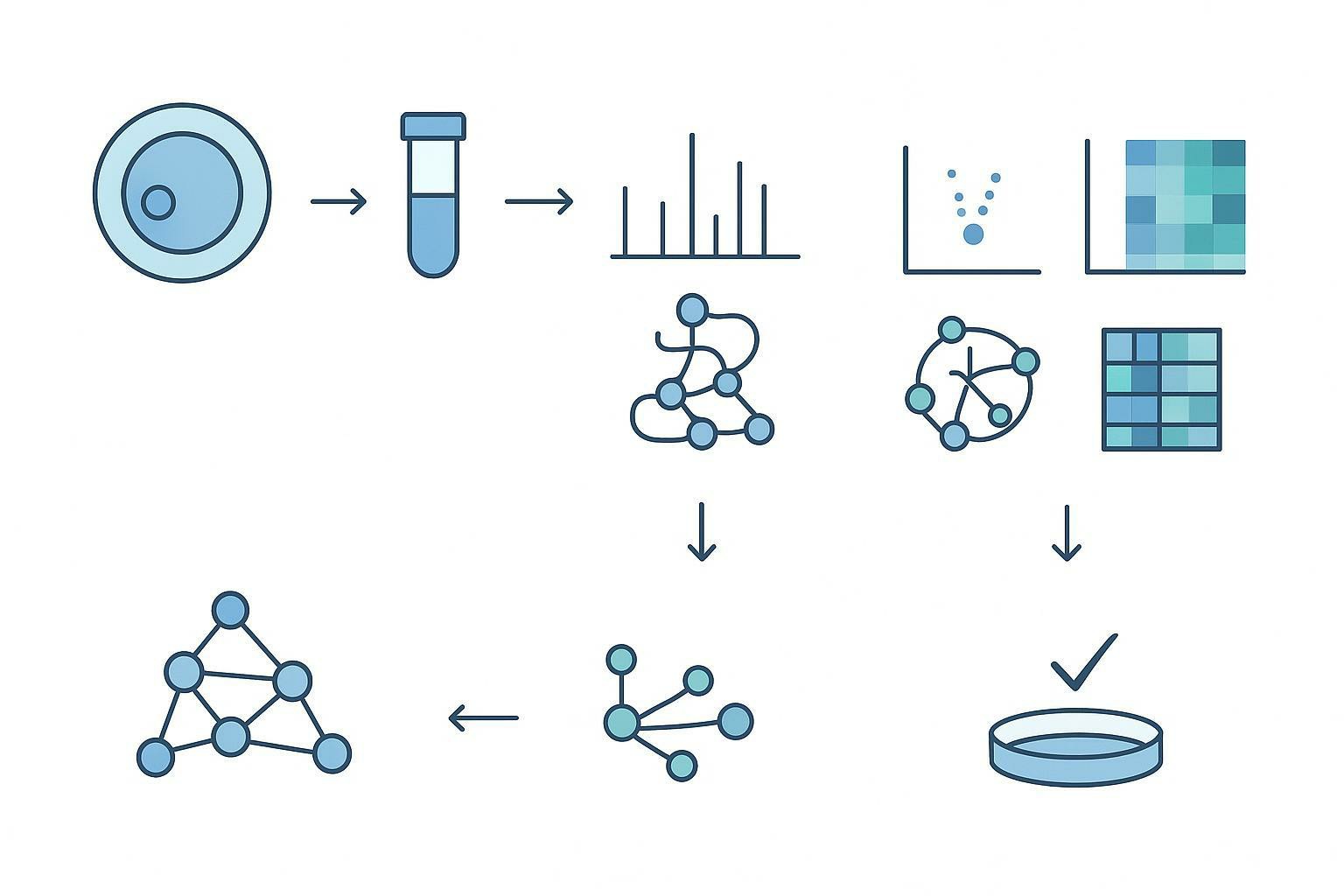
Extracellular vesicle (EV) proteomics can tell a clean, mechanistic story, but only if the data you interpret actually comes from EVs and not whatever hitchhiked through your isolation. This is why interpretation in EV proteomics is less about "running enrichment" and more about building a defensible chain of evidence: EV identity and purity → quantitative robustness → differential proteins with controlled false discovery → functional interpretation with the right background → network context → testable hypotheses.
This resource is a practical template you can reuse section-by-section when you receive an EV proteomics dataset (LFQ, DIA, or TMT). It focuses on interpretation choices that change biological conclusions, and on reporting decisions that make your study reproducible and publishable.
Key takeaway: In EV proteomics, the strongest biological insight usually comes from triangulating three views of the same signal: (1) differential proteins, (2) pathway enrichment, and (3) interaction networks, all grounded in rigorous EV QC.
Why EV Proteomics Data Interpretation Is Crucial for Biological Insights
EV proteomics is often used to connect phenotype to biology: disease mechanism, drug response, cellular communication, biomarker hypotheses, and cargo sorting. The problem is that EV preparations (especially from plasma/serum and other protein-rich biofluids) can contain substantial non-vesicular proteins and particles that bias apparent "EV signatures." When that happens, downstream interpretation becomes a story about contaminants, sample handling, or batch effects rather than EV biology.
A small shift in purity can move the top hits from EV-associated membrane and endosomal proteins to abundant plasma proteins, apolipoproteins, or immunoglobulins. The same is true for differential expression analysis: a poorly controlled batch effect can create a convincing volcano plot that is technically correct and biologically wrong.
For that reason, interpretation should start with one question that sounds boring but decides everything:
Do these proteins plausibly represent EV cargo for this sample type and isolation workflow?
If the answer is "not sure," you should tighten QC and contamination controls before investing in mechanistic narratives.
Confirming EV Specificity and Ensuring Quality Control
Before you interpret differential proteins, confirm EV identity and quantify the risk of co-isolated contaminants. MISEV guidance emphasizes multi-modal characterization and transparent reporting, and EV-TRACK exists specifically to reduce ambiguity in EV methods and metadata across studies.
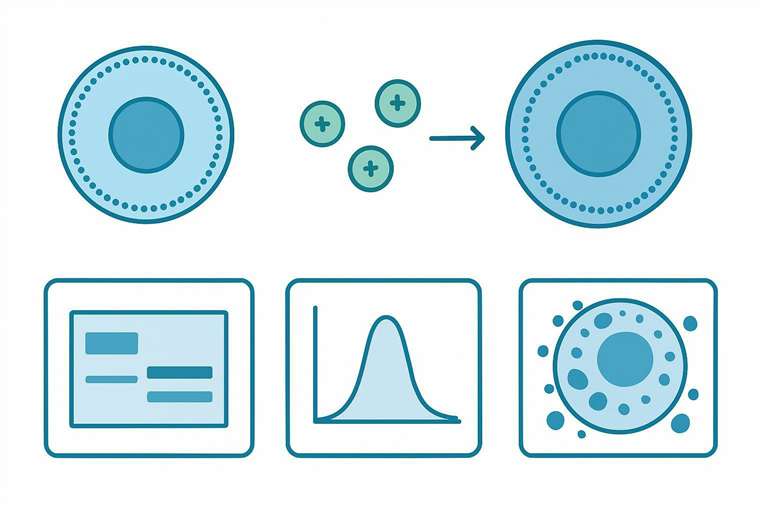
Follow MISEV principles for EV identity confirmation
MISEV2023 updates and expands earlier MISEV recommendations by pushing the field toward orthogonal evidence and clearer reporting of what was measured and what was excluded. For proteomics interpretation, the practical takeaway is simple: you need evidence that the isolate contains vesicles and that non-vesicular entities are assessed rather than assumed away.
If you want the canonical guidance, use the ISEV MISEV2023 document as your anchor (linked in the References section at the end).
Assess and control contaminants that distort EV proteomics
Contaminants differ by sample type and isolation method, but the interpretability failure modes tend to repeat:
- Plasma/serum: lipoproteins and abundant soluble proteins can dominate identifications and drive false pathway enrichments.
- Cell culture: media components and protein aggregates can inflate "extracellular" terms.
- Tissue / biofluid pellets: co-sedimentation artifacts can look like EV biology.
A useful way to make QC actionable is to write down what you would need to believe for your downstream claims to hold. Then measure (or at least report) the variables that test those assumptions.
EV proteomics QC checklist (template)
Use this table as a "minimum interpretation gate." If multiple items are unknown, keep your conclusions at the association level.
| QC dimension | What to record | What it protects you from | Interpretation note |
|---|---|---|---|
| Source input | Sample volume / cell number; handling; freeze-thaw | Apparent biology caused by pre-analytics | Report as metadata; interpret cautiously if variable |
| Particle metrics | Size distribution; concentration; method limitations | Overtrusting particle counts as purity | Don't equate counts with EV-only particles |
| Protein yield | Total protein and how measured | "Protein-rich = EV-rich" assumption | Combine with particle metrics when meaningful |
| EV markers | Evidence for EV-associated proteins (method-specific) | Calling anything in a pellet "EV" | Keep marker reporting consistent across groups |
| Contaminant markers | Evidence for non-EV components (e.g., apolipoproteins) | Pathways driven by co-isolated entities | Use this to annotate (not erase) findings |
| Replicates | Biological and technical replicates | Spurious DEPs from run-to-run noise | Without replicates, treat as exploratory |
| Randomization | Injection order; batch composition | Batch effects masquerading as group effects | Confounding is hard to fix after the fact |
If you need a service workflow that integrates isolation, characterization, and downstream proteomics, see Extracellular Vesicles Proteomics Services for a consolidated offering that spans EV preparation and MS-based analysis.
Quantification and Differential Analysis in EV Proteomics
Differential EV proteins are your primary "signal list," but getting a defensible list requires decisions about normalization, missingness, batch effects, and multiple testing. The goal isn't to make the volcano plot look clean. It's to make the comparisons honest.
If your project starts upstream (before MS) and you're still refining EV isolation and characterization, it can help to anchor the workflow with Exosome Isolation and Purification Service so that downstream quantification isn't dominated by isolation variability.
Normalize and batch-correct with the measurement model in mind (LFQ, DIA, TMT)
Different quantification modes create different technical artifacts:
- LFQ EV proteomics often struggles with missing values (low-abundance cargo, stochastic sampling) and run-to-run drift.
- DIA EV proteomics is more complete but still sensitive to long-run drift and library/parameter choices.
- TMT EV proteomics reduces missingness across a multiplex but introduces ratio compression and channel-specific artifacts.
A practical template is to separate drift control, global scaling, and batch correction rather than hoping one step does everything.
| Dataset type | Common normalization goal | Batch-effect risk pattern | Practical check |
|---|---|---|---|
| LFQ | Stabilize intensity distributions across runs | Injection order, instrument drift, operator day | QC sample trend + PCA before/after correction |
| DIA | Harmonize across long sequences; reduce technical variance | Gradient drift; library differences | CVs on QC pools; retention time stability |
| TMT | Correct mixing and channel effects; control compression | Ratio compression; batch-by-plex | Inspect per-channel distributions; reference channel behavior |
Whatever you choose, document it. Interpretation depends on it, and reviewers will ask.
Differential expression analysis and false discovery control
For EV proteomics differential protein analysis, aim for two forms of error control:
- Identification-level FDR (peptide/protein identification thresholds from the search/quant pipeline).
- Statistical multiple testing correction on differential abundance (e.g., adjusted p-values across proteins).
Then make the biological readout resilient to borderline hits. One robust habit is to interpret signal at two layers:
- Protein-level: strongest DEPs with consistent direction and acceptable missingness.
- Set-level: enrichment and network modules that remain stable under reasonable sensitivity analyses (e.g., changing fold-change cutoff or missingness filter).
Visual tools that should change your interpretation
Three plots earn their place in an EV proteomics interpretation report:
- PCA (or similar): tells you whether group separation is real or whether batch is dominating.
- Volcano plot: summarizes effect size vs statistical confidence, but it's only meaningful after QC and correction.
- Heatmap (top DEPs or curated marker sets): surfaces outliers and subgroup structure.
Pro tip: If the first principal component tracks injection date or operator rather than biology, treat every downstream mechanistic statement as provisional until the design/correction is fixed.
Functional Enrichment: Interpreting Biological Pathways in EV Proteomics
Enrichment analysis is where EV proteomics results often get overinterpreted. Done well, it explains coordinated biology. Done poorly, it turns contaminant lists into "mechanisms." The difference is usually not the software. It's the background set, term selection, and the discipline to avoid claiming causality.
If you're combining proteomics with EV characterization and want the workflow delivered as a cohesive package, Exosome Proteomics Services can be a relevant internal resource to connect experimental design with analysis outputs.
Use GO, KEGG, and Reactome for complementary views
- GO is useful for functional characterization and cellular component signals (often important for EV specificity discussions).
- KEGG provides pathway maps that can help communicate "where" in a signaling cascade your proteins sit.
- Reactome is often more granular and can help avoid overbroad pathway labels.
A practical reporting pattern is to present (1) top terms, (2) a short interpretation grounded in your DEPs, and (3) a sentence that states what the enrichment does not prove.
Choose the right background set (the decision that changes p-values)
In proteomics, enrichment should almost never use "all genes in the genome" as the universe. Your universe is the set of proteins that had a real chance to be detected and tested in your experiment (for example, the proteins quantified after quality filters). This reduces background bias and makes adjusted p-values interpretable.
Enrichment reporting template (minimal but rigorous)
| Item to report | Why it matters | Example phrasing |
|---|---|---|
| Protein universe | Defines what "expected by chance" means | "Universe = proteins quantified in ≥X samples after filtering" |
| Method | ORA vs rank-based (e.g., GSEA-style) | "ORA on DEPs" or "rank-based enrichment on all quantified proteins" |
| Multiple testing | Controls false positives across terms | "BH-adjusted p-values reported" |
| Term pruning | Avoids redundant, generic terms | "Redundant GO terms reduced by semantic similarity" |
| Interpretation guardrail | Prevents mechanism inflation | "Enrichment indicates association, not causal activation" |
Building Protein Interaction Networks from EV Proteomics Data
Protein-protein interaction (PPI) networks add context that enrichment alone cannot: which DEPs may cluster into complexes, which nodes bridge modules, and which interactions suggest a coherent biological program. They can also mislead you if you treat database connectivity as experimental evidence.
Construct networks with clear provenance (STRING and BioGRID)
Two common starting points:
- STRING for functional association networks (useful for broad context, but includes non-physical associations).
- BioGRID for experimentally derived physical interactions (often sparser but closer to "binding").
In practice, many analysts start with STRING, set a confidence threshold, and export to Cytoscape for analysis and visualization.
If you are still selecting an EV subpopulation or improving purification specificity, consider pairing network interpretation with upstream characterization using Exosomes Identification Service so that network modules are more likely to reflect vesicle cargo rather than mixed particles.
Module detection and annotation in Cytoscape
Once you have a network:
- Identify connected components and decide whether to analyze them separately.
- Run a module detection method (MCODE or community detection approaches) to find dense subnetworks.
- Annotate each module with enrichment terms to translate topology into functional hypotheses.
A useful rule: treat modules as "hypothesis clusters," not as confirmed pathways.
Prioritize nodes without confusing centrality for causality
Centrality metrics (degree, betweenness) can help prioritize candidates for validation, but they come with three common biases:
- Study bias: well-studied proteins are more connected in databases.
- Annotation bias: famous pathways have richer edges.
- Expansion bias: adding many neighbors can wash out your DEP signal.
A defensible template is to prioritize candidates that score well across multiple criteria: strong differential signal, module membership, plausible EV biology, and literature support.
From Signals to Mechanisms: Translating EV Proteomics into Testable Hypotheses
This is the step most EV proteomics projects want to reach: moving from lists and plots to a mechanistic hypothesis you can test. The safest way to do it is to treat every inference layer as partial evidence and ask what would falsify your story.
Triangulate DEPs, enrichment, and networks (a repeatable pattern)
Here's a template that works across disease models, perturbations, and EV subpopulation studies:
- Start with a stable DEP core: proteins that remain differential under reasonable analysis choices (normalization method, missingness filter, batch correction).
- Confirm functional coherence: enrichment results that remain consistent when you change the universe definition within justified bounds.
- Use network modules to propose mechanisms: select 1–3 modules that are coherent and supported by DEPs, not just by added neighbors.
- Write the hypothesis in one sentence: "Condition A alters EV cargo to reflect process B, consistent with pathway C and network module D."
- Add two alternative explanations: contamination shift, cell death/lysis, or global secretion changes.
Frame mechanistic hypotheses that are actually testable
A testable hypothesis has:
- A defined direction (increase/decrease; gain/loss of function).
- A defined context (cell type, biofluid, stimulus, EV subpopulation).
- At least one orthogonal readout that does not reuse the same measurement biases.
Example (template, not a claim about your data):
If DEPs point to endosomal sorting and tetraspanin-associated modules, and enrichment highlights vesicle trafficking, a testable hypothesis might be that the perturbation changes EV biogenesis routes rather than simply changing overall secretion. That can be tested by combining targeted protein assays with EV subpopulation profiling.
Plan orthogonal validation experiments (interpretation-friendly design)
Validation is where EV proteomics interpretation becomes credible. A good plan protects you from two traps: validating contaminants, and validating a network edge that isn't real in your context.
| Hypothesis type | Orthogonal validation idea | What it rules out |
|---|---|---|
| Cargo change in specific EVs | Targeted MS/PRM or immunoassay on independent isolates | One-run discovery artifacts |
| Pathway-level shift | Functional assay tied to pathway outcome | "Enrichment = mechanism" overreach |
| Subpopulation effect | Immuno-capture or affinity enrichment of EV subset | Mixed-particle interpretation |
| Interaction/module claim | Co-IP / proximity methods in parent cells + EV content check | Database-only network inference |
Best Practices for EV Proteomics Data Interpretation
This section is a reusable "interpretation checklist." It's designed for teams who need to deliver conclusions that survive peer review and cross-study comparison.
EV proteomics interpretation checklist (short form)
Use this as your final pass before you write the mechanistic story.
| Area | "Done" looks like | Common pitfall |
|---|---|---|
| EV specificity | EV evidence + contaminant assessment reported | Treating any pellet as EVs |
| Quant robustness | Normalization + batch strategy documented | Fixing batch by deleting samples |
| Statistical control | Identification FDR + differential multiple-testing control | Cherry-picking p-value thresholds |
| Enrichment discipline | Correct universe; redundant terms pruned; conservative language | Using genome background by default |
| Network discipline | Database provenance stated; centrality not treated as causality | Over-expanding neighbors |
| Hypothesis clarity | One-sentence hypothesis + alternatives | Jumping from term to mechanism |
Common pitfalls (and how to avoid them)
The fastest way to weaken an EV proteomics paper is to make claims that the dataset cannot support.
- Purity blind spot: You can't "analyze away" co-isolation. Measure it, report it, and interpret accordingly.
- Batch confounding: If biology and batch overlap, correction can remove biology or preserve batch. Design fixes beat computational fixes.
- Missingness denial: EV cargo can be sparse. Treat missingness as information, not only as a nuisance.
- Overconfident enrichment: Enrichment suggests association. It does not prove pathway activation.
- Network storytelling: Network edges are hypotheses. If they matter, validate them.
Ensuring Reproducibility, Data Sharing, and Transparent Reporting
In EV research, "transparent reporting" is not bureaucratic overhead. It is what makes your results comparable across labs and what lets readers judge whether your EV cargo claims are plausible.
Two anchors matter here:
- The ISEV reporting framework (MISEV2023)
- Transparent method metadata and EV-METRIC reporting via EV-TRACK
What to report so others can interpret your EV proteomics
At minimum, document:
- EV source and pre-analytics (volume, handling, storage)
- Separation/isolation details (including parameters that materially change yield/purity)
- Characterization methods and limitations
- Proteomics workflow (instrument type, acquisition mode, search/quant settings at the level needed for reproducibility)
- Statistical analysis decisions (normalization, batch correction strategy, missingness handling, multiple-testing)
- Data availability (raw files, processed matrices, metadata tables)
This reporting discipline has a payoff: it lets you compare your EV proteome to external datasets without guessing what was done.
FAQs (EV Proteomics Data Interpretation)
How do I know whether my differential proteins are EV cargo or contaminants?
Start by checking whether EV-associated proteins and known contaminants behave consistently across groups, then interpret DEPs in that context. If contaminant markers (for example, lipoprotein-related proteins in plasma-derived preparations) shift strongly with your condition, treat downstream enrichment as potentially contamination-driven and prioritize purification/QC improvements before mechanistic claims.
What is the correct background set for GO/KEGG/Reactome enrichment in proteomics?
Use the proteins that were actually quantified (and therefore testable) in your experiment after consistent filtering, not the entire genome. This makes enrichment p-values meaningful because it matches the detection universe to what your workflow could have observed.
Should I use ORA or GSEA-style enrichment for EV proteomics?
Use ORA when you have a clear, high-confidence DEP list and strong effect sizes; use rank-based enrichment when changes are modest and distributed across many proteins. If missingness is high or thresholds are unstable, rank-based approaches often give more robust pathway-level signals.
How many proteins do I need for a reliable EV proteomics enrichment analysis?
There is no single number, but reliability improves when your quantified universe is large enough to support a stable background and when your DEP list is not dominated by missingness artifacts. If small changes in filtering or normalization flip your top enriched terms, treat enrichment as exploratory.
Why do my EV proteomics PCA plots separate by batch instead of biology?
Because technical factors (run date, operator, instrument drift, sample prep day) can create larger variance than the biological condition. If batch aligns with group labels, correction can't fully recover the truth; the most reliable fix is experimental design that mixes groups across batches, supported by QC samples and transparent reporting.
How do I interpret a PPI network if many proteins are disconnected?
Disconnected components are common when you only include DEPs. You can expand the network with first neighbors to add context, but limit expansion and report the rule you used (confidence threshold, maximum interactors). Then prioritize conclusions that hold at the module level and are consistent with enrichment and EV biology.
Can EV proteomics tell me mechanism, or only association?
EV proteomics alone primarily provides association: which proteins change in EV preparations under a condition. Mechanistic claims become defensible when you add orthogonal validation (targeted assays, functional readouts, subpopulation profiling) that tests a specific causal hypothesis.
References
- Minimal information for studies of extracellular vesicles (MISEV2023)
- EV-TRACK: transparent reporting and centralizing knowledge in extracellular vesicle research
- Updating the MISEV minimal requirements for extracellular vesicle research
Related Services

* For Research Use Only. Not for use in diagnostic procedures.
