Get Your Custom Quote

Online Inquiry

Precision Protein Quantification Service

Multiplexed targeted protein quantification by LC-MS/MS — PRM, 4D-PRM, stable isotope internal standards, immunoaffinity enrichment, and IP-MS workflows for absolute and relative quantification of proteins in complex biological matrices. Our precision quantification portfolio supports biomarker validation, drug target engagement studies, and cohort-scale protein measurement with defined analytical performance.

Research Use Only (RUO) Notice: All services and data provided are strictly for non-clinical research purposes. Our analytical results are not intended for clinical diagnosis, patient management, or therapeutic decision-making.

Services Technologies Demo Case Study FAQ Related Services

CORE SERVICE

Comprehensive Precision Protein Quantification for Biomarker, Target & Drug Development

The transition from protein discovery to precisely measured, reproducible quantification requires dedicated targeted mass spectrometry approaches optimised for sensitivity, selectivity, and throughput. Our Precision Quantification portfolio brings together the full spectrum of LC-MS/MS-based targeted quantification capabilities — from PRM and 4D-PRM through stable isotope AQUA assays, multiplexed protein panels, and immunoaffinity-LC-MS/MS to IP-MS absolute quantification. We provide end-to-end support from assay design and method development through sample cohort analysis and comprehensive data reporting.

  • PRM & 4D-PRM Targeted Proteomics: High-resolution parallel reaction monitoring on Orbitrap and timsTOF platforms supporting multiplexed quantification of dozens to hundreds of peptide targets per assay with sub-10 ppm mass accuracy and defined analytical performance metrics.
  • Stable Isotope Internal Standard Quantification: AQUA and custom heavy-labeled peptide strategies for absolute quantification with characterised LOD, LOQ, linear range, and inter-assay reproducibility — enabling direct cross-study comparability.
  • Immunoaffinity & IP-MS Workflows: Antibody-based enrichment coupled to LC-MS/MS readout for low-abundance targets in complex matrices, and immunoprecipitation-MS workflows for protein complex-level absolute quantification with native stoichiometry preservation.
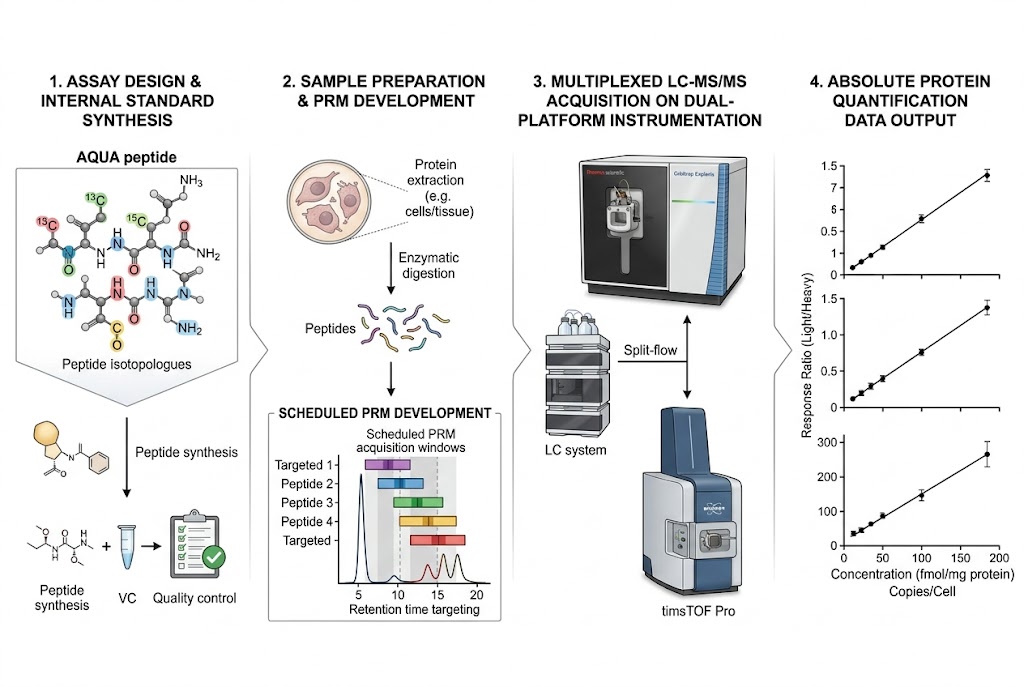
Precision protein quantification workflow illustrating targeted LC-MS/MS analysis with PRM, 4D-PRM and stable isotope internal standard strategies on high-resolution mass spectrometry platforms

Overview of the precision quantification platform ecosystem: from assay design and stable isotope internal standard synthesis through multiplexed LC-MS/MS acquisition to absolute protein quantification across biological matrices.

Understanding Precision Protein Quantification: From Relative Abundance to Absolute Levels

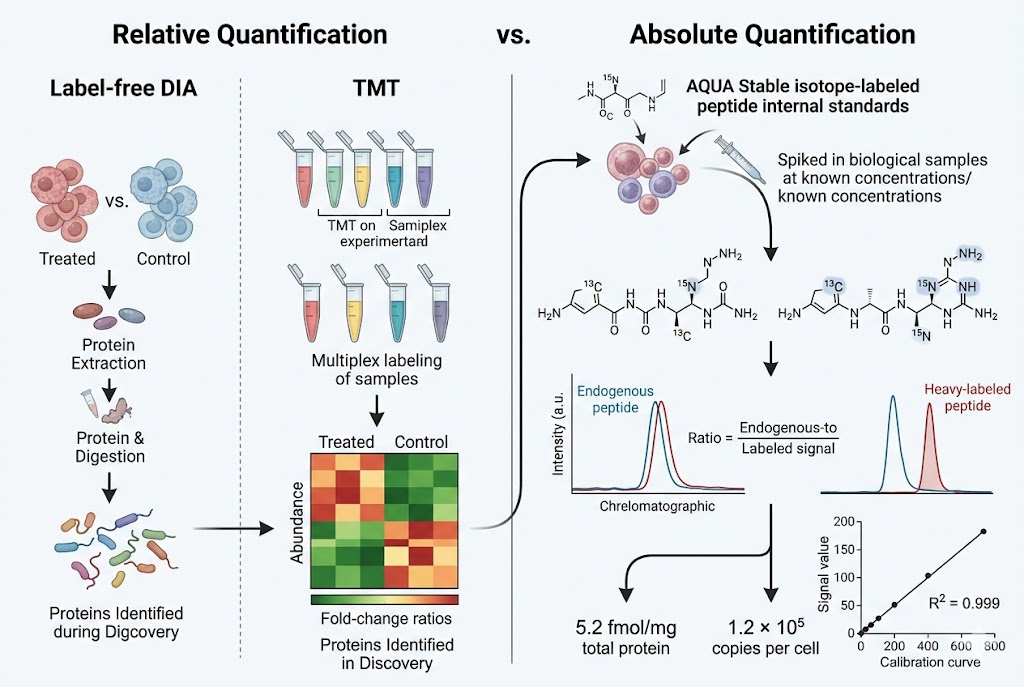
Protein quantification exists on a continuum from relative fold-change measurements to rigorously calibrated absolute values. Relative quantification — as performed in label-free DIA, TMT, or SILAC workflows — measures the change in a protein's abundance between experimental conditions. Our DIA Quantitative Proteomics service provides deep discovery-phase coverage, but the data are inherently comparative within a single experiment and cannot be directly compared across studies, laboratories, or time points without targeted validation.

Absolute quantification addresses these limitations by measuring protein concentration against a known reference — typically a synthetic, stable isotope-labeled peptide (AQUA) or protein (QconCAT) spiked into the sample at a known concentration. The ratio of endogenous-to-labeled signal provides direct measures of absolute abundance in fmol per mg of total protein, copies per cell, or molar concentration. Absolute values enable cross-study comparability, target occupancy assessment for drug discovery, biomarker threshold definition, and protein complex stoichiometry analysis. Our targeted quantification service spans the full quantification continuum, with method selection guided by the specific biological question, sample type, required throughput, and desired assay performance.

Comprehensive Quantification Strategies for Every Research Question

Different stages of the drug discovery and biomarker development pipeline demand different levels of quantitative rigour. For early-stage candidate prioritisation, multiplexed relative quantification across 50-200 targets per assay provides efficient filtering. For lead candidate validation and preclinical studies, absolute quantification with characterised LOD and inter-assay precision is essential. For translational biomarker studies requiring cross-cohort comparability, fully validated Tier 1 or Tier 2 assays with stable isotope internal standards and quality control frameworks are deployed. Our precision quantification platform supports all stages, enabling seamless transition from discovery-stage relative quantification through to validated, absolute quantification methods.

We select the optimal quantification strategy for each project based on target protein abundance, matrix complexity, required throughput, and the statistical power needed for the biological conclusions being drawn. This structured approach ensures that resources are allocated proportionally to the analytical challenge, avoiding both under-powered study designs and unnecessarily expensive over-qualification.

Comparison of relative versus absolute protein quantification strategies illustrating the quantification continuum from label-free DIA through TMT to AQUA-based PRM absolute quantification

Our Precision Quantification Platform & Approaches

Targeted & Absolute Quantification by LC-MS/MS

Targeted LC-MS/MS quantification focuses the instrument's acquisition duty cycle on predefined peptide analytes at scheduled retention times, yielding signal-to-noise ratios that substantially exceed discovery methods. At the foundation is stable isotope dilution — synthetic peptides incorporating 13C and 15N at key residues are spiked at known concentrations as internal standards. These isotopologues are chemically identical to endogenous counterparts but mass-resolved, controlling for variability in digestion, injection volume, and ionisation suppression. Our Targeted & Absolute Quantification by LC-MS/MS service provides end-to-end support from assay design and peptide selection through method development, validation, and sample cohort analysis.

PRM & 4D-PRM Targeted Proteomics

Parallel reaction monitoring (PRM) on high-resolution Orbitrap instruments monitors all fragment ions from targeted precursors simultaneously, capturing full MS/MS spectra for confident peptide identification and post-acquisition assay optimisation. PRM Targeted Proteomics on our Orbitrap Fusion Lumos platform delivers routine sub-10 ppm mass accuracy with scheduled retention time windows and optimised collision energies. 4D-PRM Targeted Proteomics adds ion mobility separation (collisional cross-section) on the Bruker timsTOF Pro, reducing chemical noise and improving signal-to-noise for low-abundance targets in high-complexity matrices such as plasma and tissue lysate.

Multiplexed Panels & Enrichment-Based Quantification

For biomarker validation and pathway profiling, we offer pre-configured and custom multiplexed protein panels covering 15-100 targets per panel, with heavy-labeled internal standards for every analyte and quality control samples at multiple concentration levels. For the most challenging quantification scenarios — low-abundance targets in complex matrices — our Immunoaffinity-LC-MS/MS Quantification workflow combines target-specific antibody enrichment with LC-MS/MS detection. IP-MS Absolute Quantification extends this to protein complexes, providing subunit-level absolute quantification with native stoichiometry preservation.
Precision Quantification Workflow

Step 1 — Study Design & Target Selection: Define the biological question, select target proteins, identify proteotypic peptides, and design the assay configuration including quantification strategy (relative vs absolute), internal standard approach, multiplexing level, and platform selection.

Step 2 — Assay Development & Optimisation: For each target peptide, optimise LC separation conditions, scheduled retention time windows, collision energy parameters, and acquisition settings. For AQUA-based workflows, design, synthesise, and validate heavy-labeled peptides. For IP-MS workflows, establish and verify immunoprecipitation conditions.

Step 3 — Assay Validation: Characterise assay performance according to established guidelines. Construct calibration curves and determine LOD, LOQ, linear range, intra-assay precision, and inter-assay precision. For biomarker quantification projects, perform Tier 2 (CPTAC guidelines) or Tier 1 validation as required.

Step 4 — Sample Cohort Analysis: Apply validated assays to the full sample cohort with systematic quality control at regular intervals — pooled QC samples, blanks, and internal standard-only injections. Data acquisition is performed on the selected platform with scheduled PRM or 4D-PRM methods.

Step 5 — Data Processing & Reporting: Raw data processed using Skyline, Spectronaut, or Xcalibur-based workflows for peak integration, transition quality assessment, and quantification. Results reported with individual peptide-level and protein-level quantification data, assay performance metrics, and annotated chromatograms for every target in every sample.

Sample Requirements for Precision Protein Quantification

Sample Type Recommended Input Key Notes
Cell lysate / tissue homogenate 50–200 µg total protein Standard for most PRM/4D-PRM targeted quantification; compatible with abundant and moderate-abundance targets
Plasma / Serum 10–100 µL High-dynamic-range matrix; depletion or immunoaffinity enrichment recommended for targets below 50 ng/mg total protein
CSF 50–200 µL Low total protein content; sample concentration recommended before digestion
Immunoprecipitated eluate 1–10 µg total protein Post-IP sample; compatible with IP-MS absolute quantification and immunoaffinity workflows
Fresh frozen tissue biopsy 5–20 mg Homogenisation and protein extraction performed; cryopreservation recommended for optimal protein integrity
Cell pellet 1×10⁶ – 1×10⁷ cells Adherent or suspension cells; washed in PBS before lysis; cell count determines per-cell absolute quantification

Precision Quantification in Practice

Our precision quantification platform delivers robust, reproducible data across diverse analytical scenarios. The representative examples below illustrate the depth and quality of quantitative data produced by our PRM, 4D-PRM, and multiplexed panel workflows — from single-target calibration curves through multiplexed biomarker quantification to protein complex stoichiometry analysis.

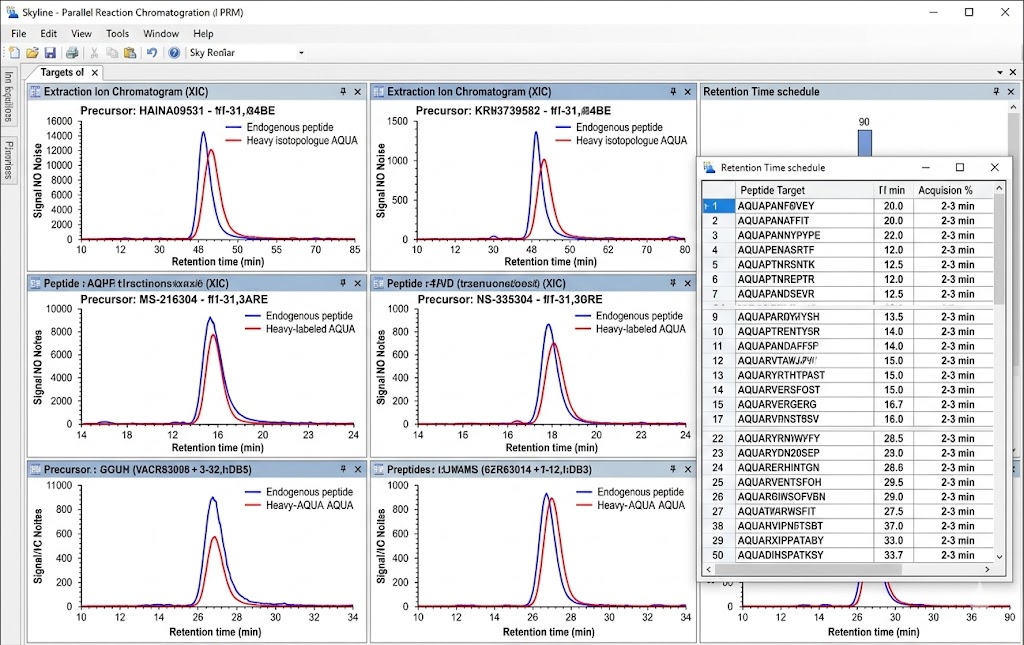
Representative PRM extracted ion chromatograms showing scheduled parallel reaction monitoring for multiplexed peptide quantification with heavy-labeled internal standard peaks overlaid on endogenous peptide signals

Multiplexed PRM chromatograms: overlaid extracted ion chromatograms for targeted peptides and their corresponding heavy-labeled AQUA internal standards, demonstrating scheduled retention time alignment and co-elution of endogenous and isotopologue pairs.

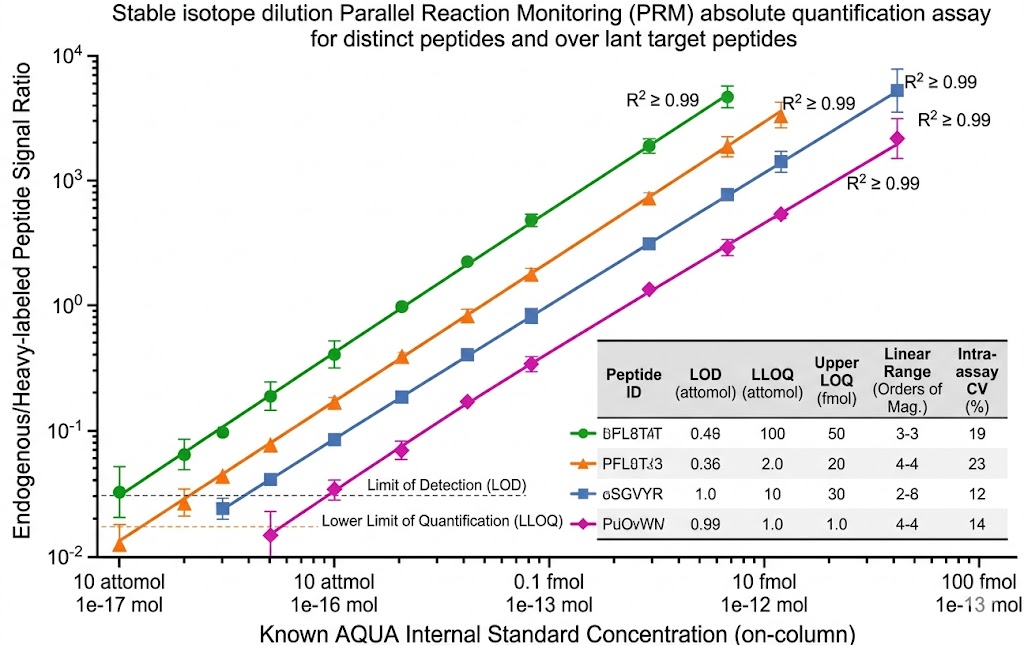
Calibration curves for stable isotope dilution PRM assays showing linear dynamic range spanning four orders of magnitude with LOD and LOQ marked for each target peptide

Absolute quantification calibration curves: linear dynamic range spanning four orders of magnitude (R² ≥ 0.99) for AQUA peptide internal standard dilution series, with limit of detection (LOD) and lower limit of quantification (LLOQ) annotated per target.

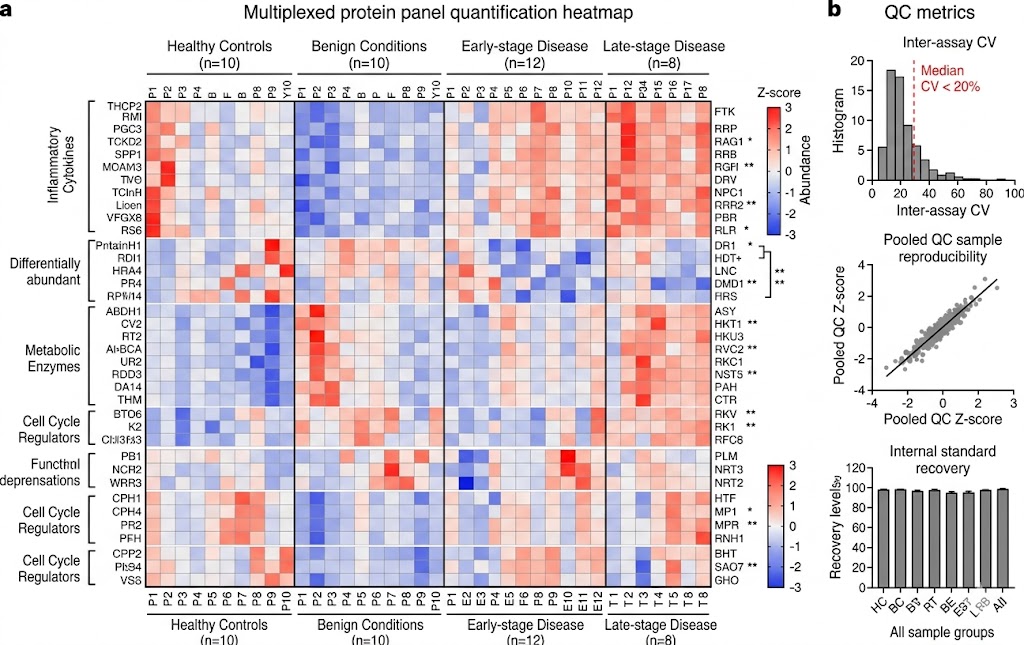
Multiplexed protein panel quantification results displayed as a heatmap showing relative abundance of 30 biomarker candidate proteins across multiple clinical sample groups with quality control metrics

Multiplexed panel quantification: heatmap visualisation of targeted protein abundance across a cohort of clinical samples, demonstrating simultaneous quantification of 30+ biomarker candidates with quality control sample reproducibility metrics displayed alongside the experimental data.

CASE STUDY

Hybrid-PRM/DIA Enables Sensitive, Multiplexed Targeted Quantification of Tumour-Associated Antigens in Melanoma Clinical Samples

Goetze S, van Drogen A, Albinus JB, Fort KL, Gandhi T, Robbiani D, Laforte V, Reiter L, Levesque MP, Xuan Y, Wollscheid B. Clinical Proteomics. 2024;21:26.

Background & Purpose

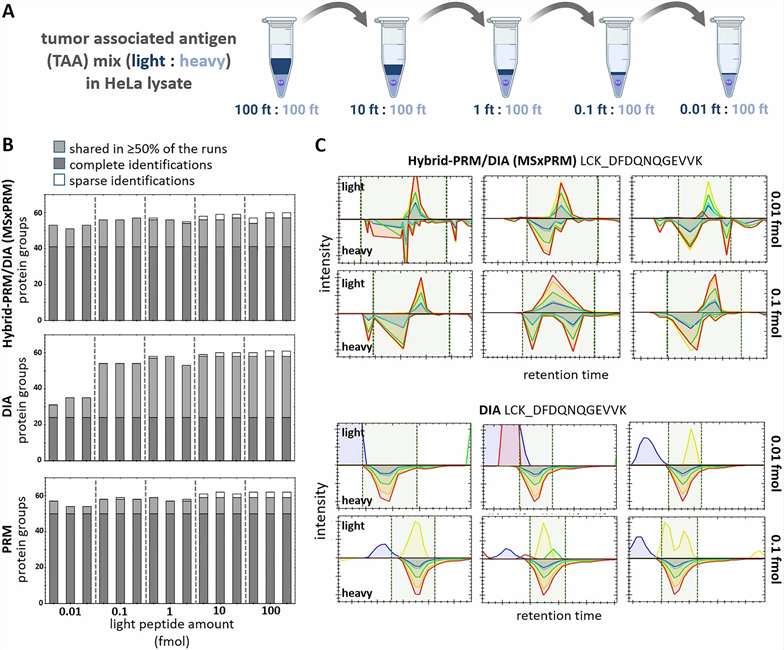
Clinical biospecimens such as tumour biopsies are irreplaceable and limited in quantity, making it essential to extract maximal molecular information from each sample. Data-independent acquisition (DIA) provides comprehensive proteome coverage but has limited sensitivity for low-abundance targets — particularly tumour-associated antigens present at low ng/mL concentrations. Parallel reaction monitoring (PRM) offers superior sensitivity but traditionally requires separate acquisition runs, doubling sample consumption. This study evaluated hybrid-PRM/DIA as a single-injection strategy that simultaneously provides deep DIA proteome coverage and sensitive multiplexed PRM quantification, eliminating the need for separate analyses.

Methods

A panel of 185 proteotypic peptides representing 64 tumour-associated antigen proteins was assembled. Heavy-labeled AQUA peptides were used both as internal standards and as triggers for multiplexed MSxPRM acquisition. The hybrid strategy works by performing a survey DIA scan while simultaneously monitoring for predefined AQUA-triggered MSxPRM targets — when a heavy-labeled trigger peptide is detected at its expected retention time and mass, the instrument shifts priority to collecting high-resolution PRM data for its co-eluting endogenous counterpart. Clinical validation was performed on biobanked melanoma tumour samples (n=8) using 30 AQUA peptides targeting 28 biomarker candidates with relevance to molecular tumour board evaluations.

Results Overview

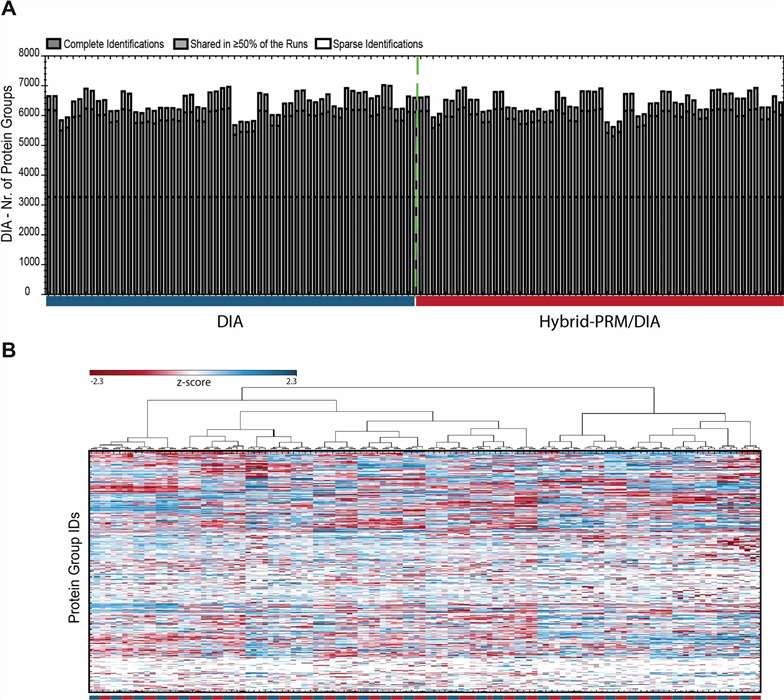
Hybrid-PRM/DIA simultaneously detected approximately 6,500 protein groups by DIA and consistently quantified all 28 targeted biomarker candidates by MSxPRM from the same single-injection analysis. The targeted candidates — including UFO (AXL), CDK4, NF1, and PMEL — were monitored with improved sensitivity near the detection limit compared to DIA alone. Up to 179 MSxPRM scans were multiplexed within a single DIA acquisition without compromising overall DIA coverage. Median CVs remained below 20% across targeted analytes, while the DIA component provided comprehensive proteome context including pathway activation states and stromal signatures.

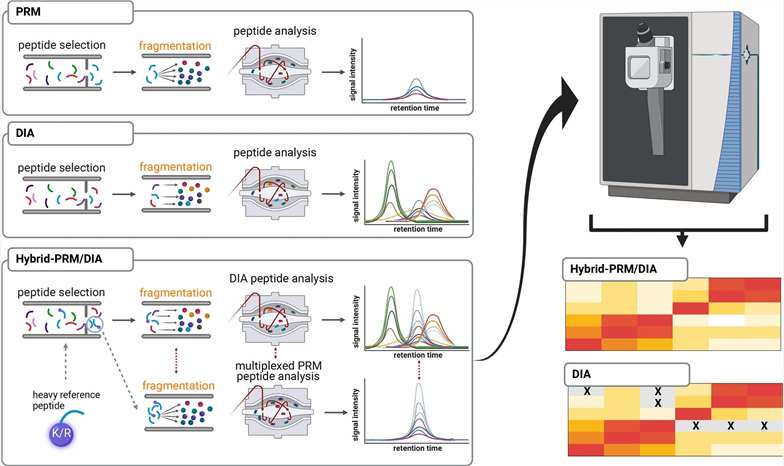
Case study: hybrid-PRM/DIA workflow schematic from Goetze et al. 2024 showing the intelligent data acquisition strategy combining multiplexed parallel reaction monitoring with data-independent acquisition

Figure 1 from Goetze et al. 2024: Schematic of the hybrid-PRM/DIA intelligent data acquisition strategy for simultaneous targeted quantification and discovery-driven clinical proteotyping.

Case study data: multiplexed MSxPRM quantification results for 28 biomarker candidates across 8 melanoma clinical samples showing improved sensitivity over DIA alone at low concentrations

Representative quantification data: comparative analysis of targeted peptide detection sensitivity between MSxPRM and DIA across the 28-biomarker panel, demonstrating improved signal-to-noise for low-abundance targets in the melanoma clinical cohort.

Case study data: quantitative reproducibility assessment for the hybrid-PRM/DIA workflow showing CV distribution across all targeted analytes with median CV below 20 percent

Quantitative reproducibility: distribution of coefficients of variation (CVs) across all MSxPRM-targeted analytes, demonstrating the robust analytical performance of the hybrid-PRM/DIA workflow for clinical sample quantification.

Conclusion

This study validates that multiplexed PRM acquisition delivers robust quantitative data for dozens of target proteins simultaneously from limited clinical samples, and demonstrates that targeted quantification does not require sacrificing proteome-wide discovery data — the hybrid approach provides both in a single injection. For researchers planning biomarker validation or multi-target quantification studies, the results confirm that carefully designed PRM assays with stable isotope internal standards and optimised acquisition strategies provide the sensitivity, multiplexing capacity, and reproducibility required for confident protein quantification in complex biological matrices. Creative Proteomics has implemented analogous PRM and 4D-PRM workflows across our Orbitrap and timsTOF platforms, adapted from the principles established in this work.

Frequently Asked Questions

Q1: What is the difference between PRM and 4D-PRM targeted quantification?

4D-PRM adds ion mobility separation (collisional cross-section or CCS) as an additional filter before precursor selection on Bruker timsTOF instruments. This reduces chemical noise and improves signal-to-noise for low-abundance targets in complex matrices. Standard PRM on Orbitrap platforms provides higher mass resolution (up to 120,000 at m/z 200) and is well suited for most targeted quantification applications. The platform choice is project-dependent: 4D-PRM is preferred for maximum sensitivity from limited sample quantities or high-complexity matrices, while Orbitrap-based PRM is ideal for high-resolution fragment ion confirmation and established assay transfer.

Q2: How many targets can you quantify in a single PRM assay?

For typical targeted proteomics assays with 1-3 peptides per protein and scheduled 2-3 minute retention time windows, we routinely multiplex 50-100 peptide targets (20-50 proteins) per injection on Orbitrap platforms. With 4D-PRM on the timsTOF Pro, the narrower ion mobility-filtered peaks enable tighter scheduling, supporting up to 150-200 peptide targets per injection. Published work (Goetze et al. 2024) has demonstrated up to 179 multiplexed MSxPRM scans within a single DIA acquisition without compromising overall proteome coverage.

Q3: Can you provide absolute quantification in molecules per cell or fmol/mg?

Yes. When a project requires absolute quantification, we deploy AQUA (stable isotope-labeled) peptides at known concentrations as internal standards. The ratio of endogenous-to-labeled signal, combined with known sample input, yields absolute abundance values in fmol/mg total protein, copies per cell, or molar concentration. Absolute quantification requires additional assay development — including peptide selection, heavy-labeled standard synthesis and characterisation, calibration curve construction, and LOD/LOQ determination — but provides data that is directly comparable across studies, laboratories, and platforms.

Q4: What biological matrices are compatible with your targeted quantification workflows?

We have developed and validated PRM and 4D-PRM assays across a comprehensive range of biological matrices: plasma and serum (with or without depletion), CSF, cell lysates, tissue homogenates (fresh frozen and FFPE), urine, saliva, bronchoalveolar lavage fluid, and immunoprecipitated eluates. For each matrix type, we perform an initial feasibility assessment to determine whether matrix-specific depletion, enrichment, or fractionation steps are needed to achieve the required LOD. Contact our team with your specific matrix and target combination for a project-specific assessment.

Q5: Can you develop a custom multiplexed panel for my specific protein targets?

Absolutely. Custom panel development is a core capability. You provide the list of target proteins; we select proteotypic peptides, develop and optimise the PRM or 4D-PRM method, synthesise heavy-labeled internal standards (if absolute quantification is required), and validate performance in your sample matrix. Custom panels typically require 4-6 weeks for method development and validation before sample cohort analysis begins. We provide regular progress updates throughout the development process and a comprehensive assay performance report upon completion.

References

  1. Goetze S, van Drogen A, Albinus JB, Fort KL, Gandhi T, Robbiani D, et al. Simultaneous targeted and discovery-driven clinical proteotyping using hybrid-PRM/DIA. Clin Proteomics. 2024;21:26.
  2. Ryu J, Boylan KLM, Twigg CAI, Evans R, Skubitz APN, Thomas SN. Quantification of putative ovarian cancer serum protein biomarkers using a multiplexed targeted mass spectrometry assay. Clin Proteomics. 2024;21:1.
  3. Gallien S, Kim SY, Domon B. Large-scale targeted proteomics using internal standard triggered-parallel reaction monitoring (IS-PRM). Mol Cell Proteomics. 2015;14:1630-1644.

GET STARTED

Advance Your Protein Quantification Project

From single-target PRM assays to 100-plex biomarker panels — our precision quantification platform delivers the quantitative rigour your research demands. Every project is supported by method development, analytical validation, and comprehensive data reporting.

Ready to discuss your targeted quantification requirements?

Request a Customized Quote