Direct answer
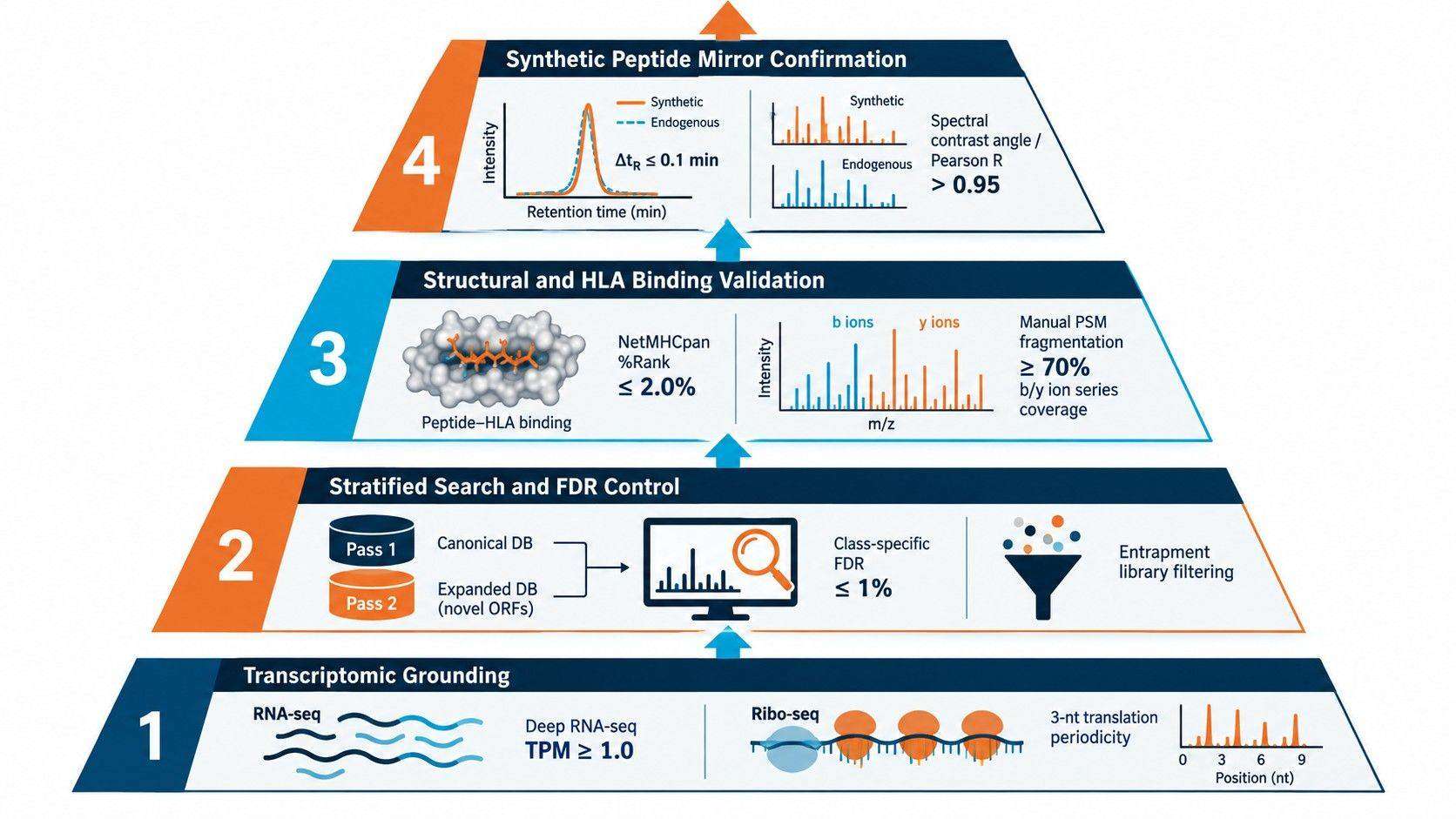
Validating non-canonical and cryptic HLA-presented peptides requires moving past standard single-pass search engine identification. Because translating non-coding genomic regions expands search space by 10- to 50-fold, standard 1% FDR thresholds cause catastrophic false-positive inflation. An audit-ready study mandates a four-tier proteogenomic evidence ladder: (1) matched transcriptomic/Ribo-seq translation grounding; (2) two-pass or class-specific FDR gating supported by non-mammalian entrapment libraries; (3) manual PSM fragmentation verification with contiguous b/y-ion coverage ≥70%; and (4) definitive orthogonal confirmation via retention time (ΔtR ≤ 0.1 min) and spectral contrast angle (Pearson R > 0.95) matching against stable isotope-labeled synthetic peptides.
Key Takeaways: Non-Canonical Immunopeptidomics Validation
- Beyond the Canonical Exome: Up to 10% to 25% of human HLA-presented immunopeptidomes originate from non-canonical genomic regions, including 5′ UTRs, 3′ UTRs, non-coding RNAs, retained introns, and endogenous retroviruses (HERVs).
- The False Discovery Catastrophe: Merging six-frame translations or uncurated ribo-seq databases into a canonical FASTA inflates target database size, shifting the score distribution and allowing thousands of incorrect non-canonical PSMs to pass a nominal 1% global FDR threshold.
- Class-Specific and Two-Pass Gating: Canonical and non-canonical peptide populations must be statistically segregated during false discovery calculation. Class-specific FDR calculations prevent high-scoring canonical spectra from artificially sheltering low-confidence non-canonical assignments.
- The Gold-Standard Synthetic Mirror: No non-canonical candidate can be considered verified without acquiring high-resolution mirror spectra comparing the endogenous LC-MS/MS signal against an authentic heavy or light synthetic counterpart.
- Strict RUO Compliance: Immunopeptidomic identification demonstrates biochemical HLA presentation in the tested specimen; it does not alone establish therapeutic immunogenicity, clinical efficacy, or patient tolerability.
The Non-Canonical Antigen Landscape: Cryptic Translation and Dark Proteomes
In tumor immunology, cancer vaccine design, and cell therapy discovery, conventional neoantigen identification strategies focus almost exclusively on the canonical exome—specifically, nonsynonymous single nucleotide variants (SNVs) that alter protein-coding sequences in annotated open reading frames (ORFs). However, extensive clinical trials targeting canonical neoantigens have highlighted a sobering reality: many solid tumors, particularly those with low tumor mutational burden (TMB), display scarce immunogenic SNV-derived peptides presented on surface MHC molecules.
Recent advances in high-resolution mass spectrometry and ribosome profiling (Ribo-seq) have overturned the dogma that non-coding regions of the mammalian genome are translationally silent. Up to 10% to 25% of the surface-presented HLA class I and class II immunopeptidome originates from previously unannotated or "cryptic" genomic loci. These non-canonical antigens arise from non-AUG initiated translation within 5′ untranslated regions (5′ UTRs), frameshifted alternative open reading frames (altORFs), long non-coding RNAs (lncRNAs), retained introns generated by aberrant tumor splicing, and transcriptionally reactivated human endogenous retroviruses (HERVs).
Because non-canonical sequences are largely repressed or absent during central thymic tolerance, cryptic antigens can trigger high-avidity T-cell receptor (TCR) responses. Furthermore, because certain aberrant transcriptional programs (e.g., HERV-E activation in clear cell renal cell carcinoma, or intron retention driven by SF3B1 mutations) are shared across patient cohorts, non-canonical antigens represent attractive targets for "off-the-shelf" immunotherapies.
Yet the identification of non-canonical peptides is fraught with severe analytical hazards. In published literature, claims of novel cryptic tumor targets are frequently retracted or contested when independent laboratories discover that the identified spectrum was an analytical artifact—a chimeric MS/MS scan, a modified canonical peptide, or a false match arising from uncalibrated bioinformatic algorithms.
For research teams establishing antigen discovery pipelines, our specialized immunopeptidomics service provides certified monoallelic capture, deep discovery profiling, and rigorous proteogenomic validation frameworks.
The Search Space Explosion Trap: Why Conventional 1% FDR Fails
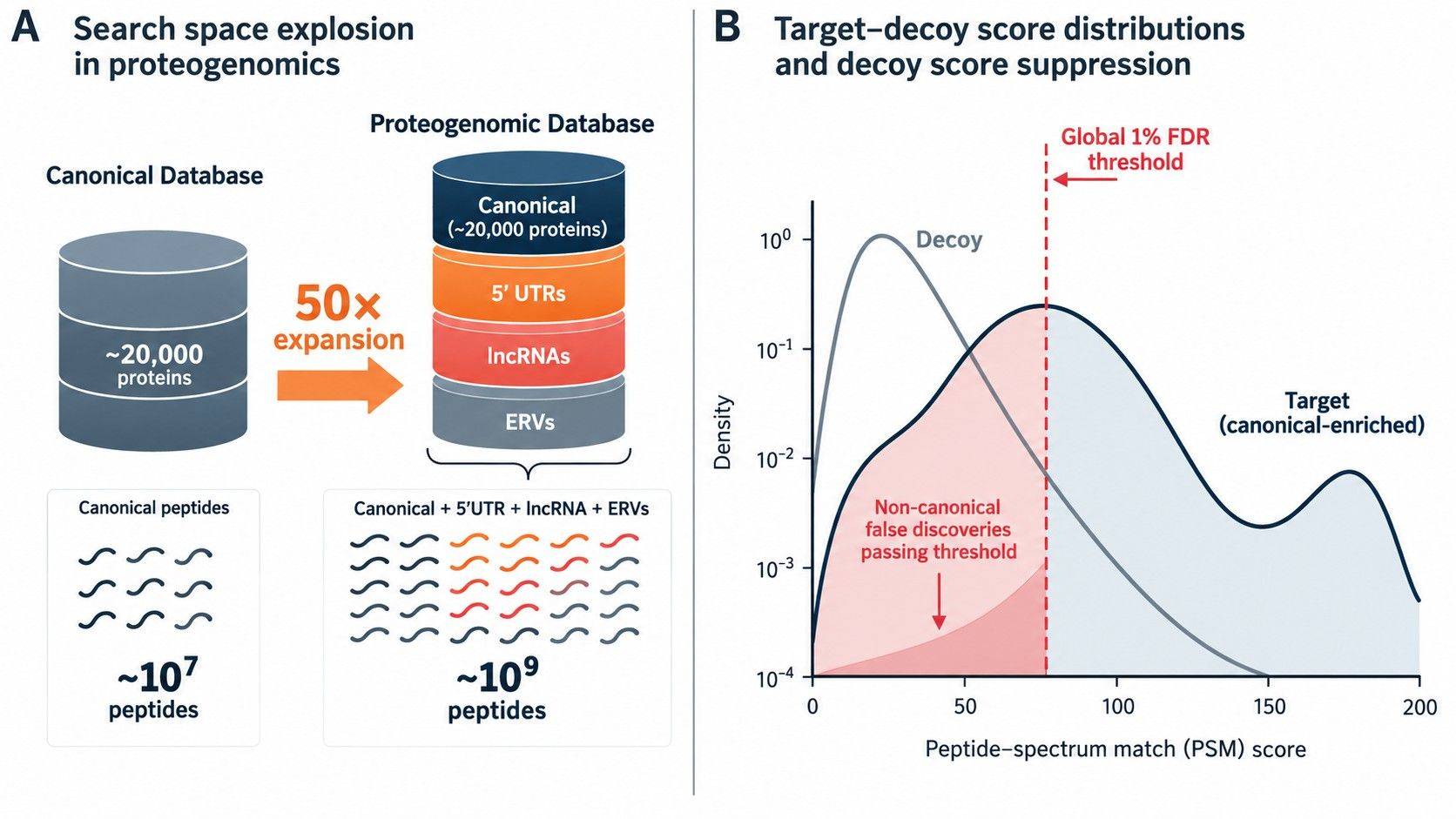
The central bioinformatic pathology in non-canonical immunopeptidomics is search space explosion. In standard bottom-up proteomics, tandem mass spectra are searched against a reference human proteome (UniProt Swiss-Prot, ~20,400 reviewed canonical proteins). Even allowing for common post-translational modifications (PTMs), the target search space comprises roughly 107 theoretical peptide sequences.
The Mechanism of Decoy Score Suppression
When an investigator attempts to identify cryptic antigens by appending three-frame or six-frame translations of the entire transcriptome, or by incorporating millions of unverified sORFs into the FASTA file, the candidate peptide database swells to 108 or 109 entries (a 10- to 50-fold expansion):
- Decoy Score Dilution: False discovery rates in mass spectrometry are governed by the Target-Decoy approach (FDR = 2 × Ndecoy / [Ntarget + Ndecoy]). In a massive, unpartitioned database, the overwhelming majority of acquired high-quality MS/MS spectra originate from abundant canonical proteins. These true canonical matches generate extremely high target scores, heavily populating the top of the score distribution.
- Sheltering of False Non-Canonical Hits: Because canonical targets dominate the statistical denominator, the global score cutoff required to achieve a nominal 1% global FDR remains artificially low. Hundreds of low-quality or chimeric non-canonical matches—which would fail if evaluated independently—slip through the global threshold unnoticed. Empirical benchmarking studies using entrapment databases have revealed that a nominal "1% global FDR" in an expanded proteogenomic search can harbor an actual non-canonical false discovery rate exceeding 15% to 40%.
- Isobaric Canonical Sequence Camouflage: An apparent non-canonical peptide sequence may be entirely isobaric (identical precursor mass and similar fragmentation) to a canonical peptide carrying an unanticipated post-translational modification (e.g., deamidation, methylation, formylation) or a single-amino-acid variant (SAV). Without strict canonical exclusion, search engines default to assigning the spectrum to the non-canonical entry.
The Four-Tier Evidence Ladder: A Methodological Blueprint
To establish reviewer-proof, audit-ready confidence in non-canonical peptide discovery, researchers must replace single-stage database searching with an integrated, progressive Four-Tier Evidence Ladder. Each tier addresses a distinct point of experimental ambiguity, eliminating spurious candidates before proceeding to resource-intensive downstream validation.
Tier 1: Transcriptomic and Ribosomal Grounding
A non-canonical peptide candidate cannot be evaluated in isolation from the cell's transcriptional state. The search space must be restricted strictly to genomic regions with verified transcription in the matching biological specimen:
- Matched Deep RNA-Seq: Execute high-depth paired-end RNA sequencing (≥80 million reads) on the exact cell or tissue cohort used for immunopeptidomics. Exclude any non-canonical ORF whose underlying transcript exhibits zero coverage or transcripts per million (TPM) < 1.0.
- Ribosome Profiling (Ribo-Seq) Triplet Periodicity: For high-priority projects, integrate Ribo-seq data to verify that the putative 5′ UTR, lncRNA, or altORF is engaged by translating 80S ribosomes. Bona fide translation is proven by the characteristic 3-nucleotide P-site periodicity corresponding to active codon stepping, resolving true translation from non-specific RNA-protein binding.
Tier 2: Stratified Database Searching and Class-Specific FDR Control
To eliminate decoy score suppression, search architectures must mathematically separate canonical and non-canonical populations:
- Two-Pass Search Strategy: In Pass 1, Tandem MS spectra are searched exhaustively against the standard canonical reference proteome (UniProt Swiss-Prot + common contaminants + common biological PTMs). All matched spectra passing a strict 1% FDR threshold are locked and excluded from further consideration. In Pass 2, only the unassigned spectra are queried against the curated, sample-specific non-canonical database.
- Class-Specific FDR Gating: If a combined search is deployed, FDR must be calculated independently for the canonical and non-canonical subsets (Class-Specific FDR). The non-canonical target and decoy score distributions are evaluated in isolation, ensuring that non-canonical identifications satisfy the 1.0% FDR criterion entirely on their own merit.
- Entrapment Database Quality Control: Spike the target database with an "entrapment" sequence collection derived from non-mammalian organisms (e.g., Arabidopsis thaliana or bacteriophages). Because these sequences cannot exist in human tissue, any match to an entrapment entry represents an empirical false positive, providing an unvarnished audit of true FDR control.
Tier 3: Structural, Allele-Binding, and Manual PSM Verification
Candidates traversing Tier 2 must undergo rigorous physical and biochemical vetting:
- Contiguous Backbone Fragmentation: The experimental MS/MS spectrum must exhibit a dense, contiguous series of b- and y-ions covering ≥70% of the peptide backbone. Missing internal fragment ions or reliance on a single dominant water-loss peak indicates an unreliable match.
- HLA Binding Motif Congruence: Native MHC class I peptides exhibit strict length distributions (predominantly 8–11 mers, centered on 9-mers) and defined anchor residue motifs at position 2 (P2) and the C-terminus (PΩ). Submit candidate sequences to NetMHCpan-4.1 against the patient or cell line's verified HLA typing. Peptides with predicted binding percentile rank (%Rank) > 2.0% should be viewed with extreme skepticism unless verified by monoallelic cell models.
Tier 4: Synthetic Peptide Orthogonal Confirmation (The Gold Standard)
No non-canonical antigen claim can be considered established without synthetic peptide validation. Synthesize the candidate peptide using solid-phase peptide synthesis (SPPS), incorporating either a light sequence or a heavy stable isotope-labeled residue (e.g., [13C6, 15N4]-Arginine or [13C6, 15N2]-Lysine):
- Retention Time Alignment: Analyze the synthetic standard on the identical liquid chromatography column and mobile phase gradient. The endogenous peak and synthetic standard must co-elute with a retention time deviation ΔtR ≤ 0.1 minutes.
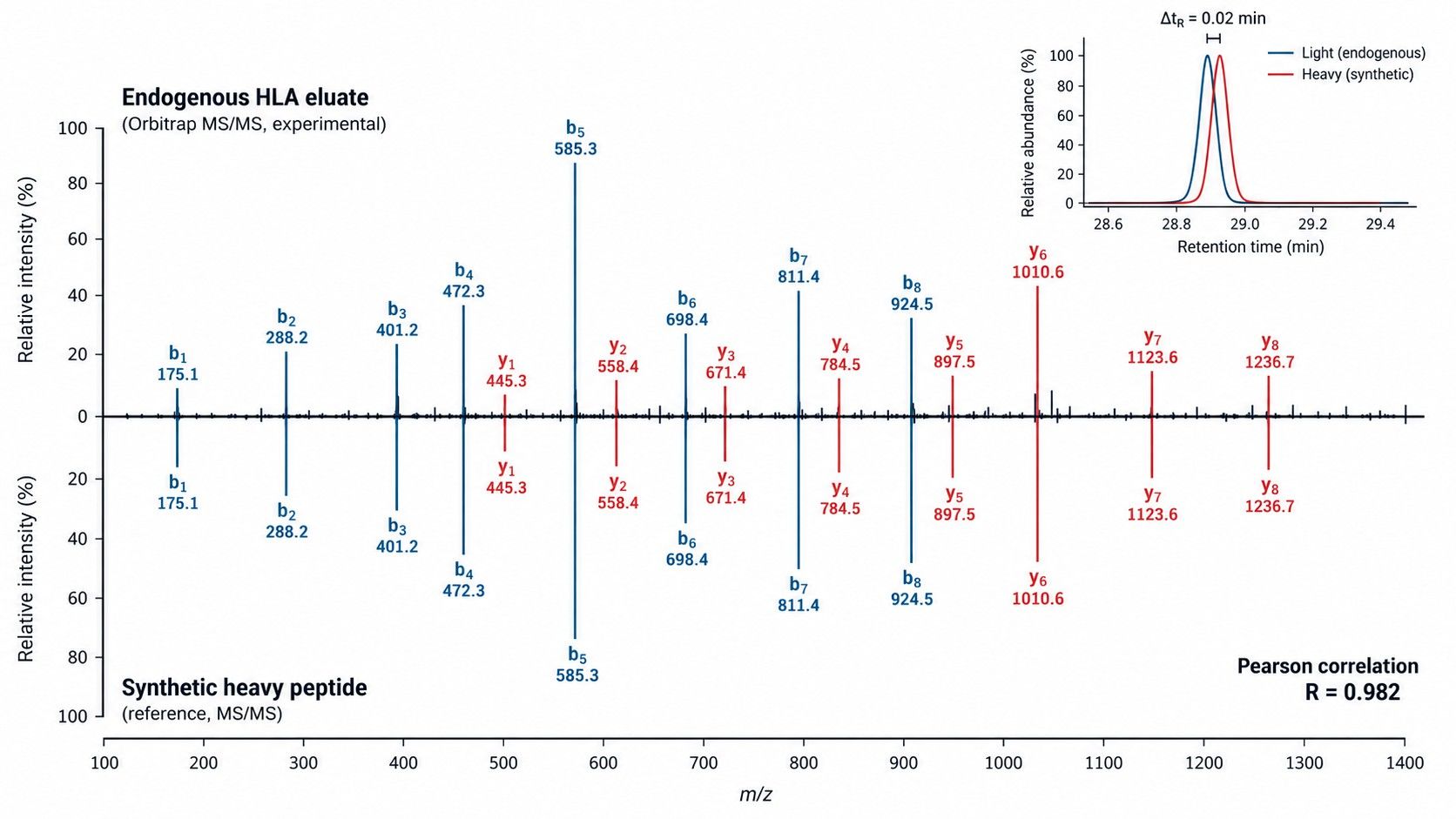
- Spectral Mirror Comparison: Generate a mirrored MS/MS spectrum plotting endogenous fragment intensities against the synthetic reference. Calculate the Pearson correlation coefficient (R) or spectral contrast angle (cos θ). Only candidates displaying Pearson R > 0.95 with matching relative fragment ratios across all major ions are accepted as verified chemical entities.
Biological Sources of Non-Canonical Antigens vs Proteogenomic Failure Modes
Non-canonical translation arises from diverse transcriptional and translational anomalies. The following table delineates the biological origins, presentation contexts, and specific analytical failure modes associated with each non-canonical category:
| Non-Canonical Genomic Source | Biological Translation Mechanism | Immunological Presentation Context | Proteogenomic Failure Mode & Artifact Risk | Mandatory Quality Control Filter |
|---|---|---|---|---|
| 5′ Untranslated Regions (5′ UTRs) | Non-AUG initiated translation (CUG, GUG) and upstream open reading frames (uORFs) | MHC Class I restricted; presentation elevated under cellular stress and viral hijacking | Search space inflation; low-intensity MS/MS spectra misassigned to canonical peptide isomers | Ribo-seq P-site triplet periodicity confirmation and synthetic peptide spectral matching (R > 0.95) |
| 3′ Untranslated Regions (3′ UTRs) | Ribosomal readthrough past canonical stop codons, alternative polyadenylation | High tumor-specificity; enriched in MMR-deficient and spliceosome-mutant malignancies | Overlapping peptide sequences from alternative splicing misattributed to novel 3′ translation | Strand-specific junction RNA-seq mapping and stop-codon readthrough quantification |
| Long Non-Coding RNAs (lncRNAs) | Pervasive non-canonical translation of short open reading frames (sORFs < 100 aa) | Shared across cancer lineages; potential source of universal "public" tumor antigens | Extremely low basal peptide copy number (<5 copies/cell); false-positive identification driven by noise matching | Entrapment database FDR filtering (≤1%) and targeted PRM verification with stable isotope internal standards |
| Retained Introns & Cryptic Junctions | Aberrant pre-mRNA splicing resulting from SF3B1, U2AF1 mutations or hypoxic stress | Generates novel frameshifted peptide sequences absent from normal human thymus tolerance | Homology with canonical pseudogenes; chimeric spectra from co-eluting high-abundance peptides | Split-read RNA-seq junction verification and HLA-A*02:01 / H-2Kb binding motif deconvolution |
| Endogenous Retroviruses (HERVs) | Epigenetic derepression (DNA hypomethylation) triggering translation of ancient retroviral Gag/Pol/Env fragments | Potent immunogenicity; recognized by high-avidity TCR repertoires | Multi-mapping genomic loci preventing unambiguous transcript origin assignment | Strict unique genomic locus mapping and orthogonal mass spectrometric de novo sequencing |
The Proteogenomic Evidence Matrix: Tiered Verification Guidelines
The table below summarizes the four sequential tiers of the Proteogenomic Evidence Ladder, detailing the inputs, acceptance thresholds, and explicit scientific capabilities and boundaries of each validation stage:
| Evidence Ladder Tier | Required Experimental / Computational Input | Specific Analytical Threshold & Metric | What This Tier Proves | What This Tier CANNOT Prove |
|---|---|---|---|---|
| Tier 1: Transcriptomic & Ribosomal Grounding | Matched deep RNA-seq (≥80M paired-end reads) and Ribo-seq profiling | RNA TPM ≥ 1.0; Ribo-seq sub-codon 3-nt translation periodicity (p < 0.01) | The non-canonical genomic region is actively transcribed and engaged by 80S ribosomes | Does NOT prove protein stability, proteasomal cleavage, TAP transport, or HLA presentation |
| Tier 2: Stratified Database Searching & FDR Control | Two-pass or class-specific database search against customized proteogenomic FASTA | Class-specific FDR ≤ 1.0%; entrapment database non-mammalian decoy FDR ≤ 1.0% | The MS/MS spectrum matches the non-canonical peptide better than the canonical proteome | Does NOT eliminate isobaric co-eluting chimeras, single-amino-acid variants, or modified peptides |
| Tier 3: Structural & Allele Binding Validation | NetMHCpan / NetMHCIIpan prediction and manual PSM fragmentation inspection | Predicted %Rank ≤ 2.0% (MHC-I); complete contiguous b/y-ion series (coverage ≥ 70%) | The peptide possesses biochemical affinity for the host HLA allele and high-confidence MS/MS | Does NOT definitively exclude isomeric or isobaric synthetic peptide differences |
| Tier 4: Synthetic Peptide Orthogonal Confirmation | Spiking heavy-labeled synthetic peptide or parallel mirror-spectrum acquisition | Co-elution ΔtR ≤ 0.1 min; spectral contrast angle cos(θ) ≥ 0.95 (Pearson R ≥ 0.95) | Definitive, unequivocal chemical confirmation of the exact non-canonical peptide sequence | Does NOT establish therapeutic efficacy, in vivo immunogenicity, or T-cell receptor activation |
Synthetic Peptide Mirror Matching: The Definitive Gold Standard
In regulatory audits, high-impact publications, and clinical translational dossiers, synthetic peptide validation serves as the ultimate arbiter of truth. Even a spectrum with a high database cross-correlation score (XCorr) and low PEP (posterior error probability) can represent an incorrect match if an uncharacterized modified canonical peptide shares similar mass-to-charge ratios.
Executing the Mirror Match Assay
The mirror match assay requires precise execution to eliminate experimental bias:
- Parallel vs Co-Injection Acquisition: In parallel mode, synthetic peptides are run under identical LC-MS/MS conditions within the same analytical queue. In co-injection mode (the most rigorous format), stable isotope-labeled heavy synthetic peptides are spiked directly into an aliquot of the biological immunopeptidome eluate. Co-elution of the endogenous (light) and synthetic (heavy) precursor peaks, accompanied by identical MS/MS fragmentation patterns shifted precisely by the mass of the labeled residue, provides irrefutable proof.
- Diagnostic Low-Mass Reporter Ions: Verify the presence of sequence-diagnostic internal cleavage ions and immonium ions in the low-mass region (m/z 50–200). Isomeric peptides containing leucine versus isoleucine can often be distinguished by unique w-ion side-chain losses generated under higher-energy collisional dissociation (HCD).
For research teams requiring end-to-end identification, validation, and functional screening, explore our comprehensive integrated antigen discovery and TCR-pMHC validation platform.
RUO Regulatory Boundaries and Immunotherapy Candidate Triage
A critical responsibility in proteogenomic immunopeptidomics is maintaining transparent scientific boundaries regarding what mass spectrometry can and cannot establish. Operating within strict Research Use Only (RUO) standards protects drug development programs from committing millions of dollars to unviable clinical candidates:
Presentation ≠ Immunogenicity
Physical presentation on surface MHC molecules is a necessary, but insufficient, condition for immune activation. A non-canonical peptide may bind HLA with high affinity yet fail to elicit a CD8+ or CD4+ T-cell response due to peripheral tolerance, low precursor frequency in the native TCR repertoire, or immunosuppressive checkpoint signaling.
Tissue Specificity vs "Dark" Normal Expression
Calling an antigen "tumor-specific" requires deep baseline profiling of normal tissues. Many non-canonical transcripts (e.g., uORFs in stress-response genes) are actively translated in healthy tissues (testis, brain, gut mucosa, or inflamed tissue). Immunopeptidomic profiling across human normal tissue atlases is mandatory to de-risk lethal off-tumor, on-target toxicities.
Copy Number per Cell Thresholds
Targeted T-cell therapies (TCR-T, bispecific T-cell engagers) typically require a minimum antigen density (10–50 copies per cell) to trigger cytotoxic lysis. Non-canonical peptides originating from low-abundance lncRNAs may be presented at sub-threshold levels (<1 copy/cell). Absolute quantification via targeted PRM/MRM is required to confirm that target copy numbers support therapeutic engagement.
HLA-Restriction and Allele Verification
In multi-allelic primary tumor specimens, deconvolution algorithms may assign a non-canonical peptide to multiple HLA alleles. To prevent clinical misdirection, allele restriction should be validated using monoallelic cell lines or soluble HLA (sHLA) recombinant expression systems before TCR engineering.
Frequently Asked Questions: Non-Canonical Antigen Validation
Why do non-canonical peptide searches require custom RNA-seq databases instead of six-frame genome translations?
A six-frame translation of the entire human genome generates a search database containing billions of theoretical peptide sequences. This massive search space inflates random decoy matches to such an extent that true peptide signals are completely overwhelmed, causing statistical power to collapse. By constructing a sample-specific database derived from matched deep RNA-seq, the search space is restricted strictly to transcribed genomic loci, reducing the database size by over 90% while preserving genuine biological candidates.
What is the difference between Ribo-seq and RNA-seq in non-canonical antigen discovery?
RNA-seq measures steady-state transcript abundance, demonstrating that a non-coding RNA or UTR is expressed. However, RNA presence does not guarantee translation. Ribo-seq (ribosome footprint profiling) isolates and sequences RNA fragments actively protected by translating 80S ribosomes. By tracking the sub-codon 3-nucleotide stepping periodicity of ribosomes along the transcript, Ribo-seq provides direct, codon-resolved proof that a specific non-canonical open reading frame is being actively translated into polypeptide chains.
Can synthetic peptide mirror spectra distinguish between leucine and isoleucine in a non-canonical peptide?
Under standard low-energy collision-induced dissociation (CID) or higher-energy collisional dissociation (HCD), leucine and isoleucine are completely isobaric (both having a mass of 113.084 Da) and cannot be distinguished by precursor or standard b/y fragment masses. However, they frequently display distinct chromatographic retention times on high-resolution reverse-phase C18 columns. Furthermore, specialized electron-transfer/higher-energy collision dissociation (EThcD) or high-energy HCD can induce side-chain cleavage, generating diagnostic w-ions (loss of 43 Da for Leu vs loss of 29 Da for Ile) that resolve isobaric ambiguity.
What is the minimum spectral similarity score required to claim synthetic peptide validation?
In leading immunopeptidomics literature and regulatory submissions, the widely accepted threshold is a Pearson correlation coefficient (R) ≥ 0.95 or a spectral contrast angle cos(θ) ≥ 0.95 across all assigned b- and y-ions, accompanied by a retention time shift ΔtR ≤ 0.1 minutes under identical chromatographic conditions. Visual inspection must also verify that relative fragment intensity hierarchies (e.g., dominant internal proline cleavages) are completely concordant.
How do class-specific FDR algorithms prevent false discoveries in proteogenomics?
Standard search engines group all target and decoy hits into a single pool to calculate false discovery rates. In proteogenomics, high-scoring canonical spectra artificially depress the overall decoy score cutoff, allowing low-scoring non-canonical false matches to pass. Class-specific FDR algorithms segregate canonical and non-canonical peptides into separate statistical buckets, calculating decoy distributions and score cutoffs independently for each class. This forces non-canonical peptides to satisfy rigorous statistical thresholds without borrowing credibility from abundant canonical proteins.
Are non-canonical antigens presented on MHC Class II molecules?
Yes. While initial research focused heavily on MHC Class I presentation, recent high-depth immunopeptidomic studies have revealed that non-canonical antigens are also presented on MHC Class II (HLA-DR, -DP, -DQ) molecules. Endogenous non-canonical proteins undergo autophagy-mediated lysosomal degradation and loading onto MHC-II complexes, stimulating CD4+ helper T cells. Validating MHC-II non-canonical antigens requires adjusting length boundaries (13–18 mers) and incorporating open-groove binding prediction tools (NetMHCIIpan).
References
- Laumont, C. M., et al. (2018). Noncoding regions are the main source of targetable tumor-specific antigens. Science Translational Medicine, 10(470), eaau5516. doi:10.1126/scitranslmed.aau5516.
- Chong, C., et al. (2020). Integrated proteogenomic deep sequencing and immunopeptidomics for personalized cancer vaccine discovery. Nature Communications, 11(1), 1293. doi:10.1038/s41467-020-14968-9.
- Ouspenskaia, T., et al. (2022). Unannotated proteins expand the MHC-I-restricted immunopeptidome in cancer. Nature Biotechnology, 40(2), 209–217. doi:10.1038/s41587-021-01021-1.
- Ruiz Cuevas, M. V., et al. (2021). Most non-canonical HLA-I presented peptides originate from transposable elements and untranslated regions. Cell Reports, 37(3), 109845. doi:10.1016/j.celrep.2021.109845.
- Kovalchik, S., et al. (2023). Quality control and error rate benchmarking in proteogenomic immunopeptidomics. Molecular & Cellular Proteomics, 22(8), 100602. doi:10.1016/j.mcpro.2023.100602.
- Ingolia, N. T., et al. (2019). Ribosome profiling of translation: new perspective on regulation and non-coding translation. Nature Reviews Genetics, 20(3), 192–207. doi:10.1038/s41576-018-0083-6.
- Purcell, A. W., et al. (2019). The road to high-confidence immunopeptidomics: a community consensus. Nature Immunology, 20(12), 1563–1568. doi:10.1038/s41590-019-0524-7.
Advance Your Non-Canonical Antigen Discovery Program
Whether you are mining cryptic neoantigens from deep RNA-seq, controlling proteogenomic FDR with entrapment algorithms, or validating target peptides with high-resolution synthetic mirror spectrometry, Creative Proteomics provides audit-ready immunopeptidomics solutions.
Request a Technical Consultation