Direct answer
Use a monoallelic cell system when the project requires peptides naturally presented at the cell surface in a controlled cellular background. Use secreted HLA when scalable media collection, temporal sampling, or an allele-resolved capture system in a less tractable host cell is the priority.
Study Overview
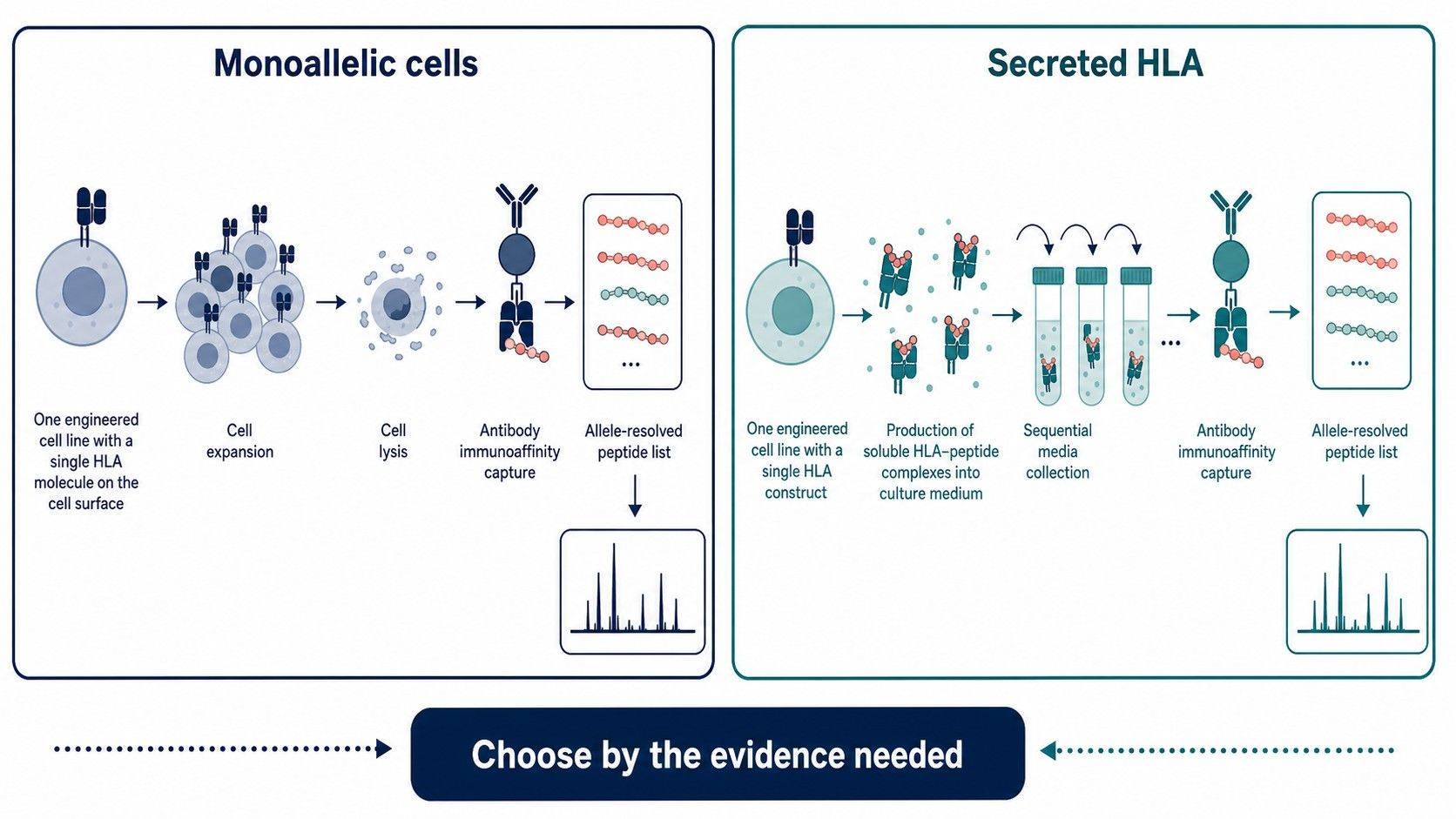
Single-allele HLA-I immunopeptidomics is best designed around the evidence a project needs. Use a monoallelic cell system when the goal is to measure peptides naturally presented at the cell surface in a controlled cellular background. Use a secreted HLA construct when the priority is scalable collection from culture media, temporal sampling, or allele-resolved peptide capture in a cellular context that cannot readily be made HLA-null. Neither approach should be treated as a universal replacement for the other. Both systems reduce the allele ambiguity inherent in multi-allelic HLA-I immunopeptidomics. Their differences are biological as well as practical: monoallelic cells simplify direct attribution of a ligand to one HLA allele, while secreted HLA designs shift recovery from cell-lysate capture to a defined recombinant HLA complex accumulated in media. The appropriate choice follows the biological model, not only apparent convenience.
Key Takeaways for Single-Allele HLA-I Immunopeptidomics
- Monoallelic cells provide direct, allele-resolved surface-presentation evidence in a standardized engineered cell background.
- Secreted HLA can make repeated media collection and scalable peptide recovery feasible, especially for temporal perturbation studies or systems with challenging lysate input.
- A secreted HLA repertoire can resemble the corresponding membrane-bound repertoire, but it should be validated in the specific construct and cellular context rather than presumed identical.
- HLA allele identity, surface or secreted expression, parental background, and sample collection scheme are essential project inputs—not administrative details.
- If a study needs evidence from a native multi-allelic tissue or primary culture, a model system can support reference-ligand generation but does not replace direct analysis of that native material.
Why Single-Allele HLA-I Immunopeptidomics Is Needed
Each HLA-I molecule has distinct peptide-binding preferences. In a conventional human cell line, multiple HLA-A, -B, and -C alleles can present peptides simultaneously. A peptide detected after pan-HLA enrichment may be assigned computationally to one or more plausible alleles, but the MS experiment alone may not establish which allele carried it.
Monoallelic and secreted-HLA systems are designed to remove or reduce that ambiguity. They can support allele-specific binding motif definition, generation of experimentally observed ligand libraries, source-protein analysis, and prioritization of candidates for later functional work. They are especially valuable when computational prediction needs direct experimental data from a defined allele rather than only a multi-allelic deconvolution.
The scientific output must still be described carefully. The result is evidence that a peptide is associated with the single HLA allele in the selected experimental system. It does not by itself prove that the peptide is presented in every cell type, perturbation state, or tissue that carries the same allele. Antigen processing, source-protein abundance, cellular compartment biology, and the engineered construct can all affect the observed ligandome.
For a project that needs a direct ligand list before downstream ranking, HLA peptidomics analysis can be planned to retain allele, sequence, MS/MS, and source-protein evidence as separate reportable fields.
Monoallelic Cell Immunopeptidomics: What It Measures Well
In a monoallelic cell workflow, an HLA-null or HLA-reduced parental cell line is engineered to express one HLA allele of interest. HLA complexes are then captured from cell lysate, associated peptides are eluted, and LC-MS/MS is used to identify the ligand repertoire. Because only the selected HLA allele is intended to contribute the class-I complexes, peptide–allele attribution is direct within that model.
Strengths of monoallelic cell systems
The main strength is experimental clarity. HLA-associated peptides are generated through cellular expression, intracellular protein turnover, antigen processing, peptide loading, and cell-surface HLA presentation in the engineered cell background. This makes the system well suited to questions about allele-specific motifs, comparative presentation across a panel of HLA alleles, and generation of reference data for an antigen-presentation model.
Abelin and colleagues used monoallelic cell lines to profile 16 HLA-I alleles and identified more than 24,000 HLA-bound peptides. Their approach showed how monoallelic MS data can reveal allele-specific and subdominant binding motifs that are difficult to resolve from mixed-allele samples (Abelin et al., 2017). A later large-scale monoallelic dataset expanded this logic across 95 HLA-A, -B, -C, and -G cell lines, demonstrating the value of direct allele-resolved data for presentation modeling (Sarkizova et al., 2020).
Monoallelic cells are a strong choice when the project needs to answer questions such as:
- Which native peptides are presented by this allele in a controlled reference background?
- What peptide lengths and terminal motifs are observed for this allele?
- How does one HLA allele alter the presentation of a shared engineered antigen cassette?
- Which experimentally observed ligands should enter a focused peptide panel or prediction-validation workflow?
Limits that must be acknowledged
The cellular background is part of the result. A monoallelic K562, B721.221, or other engineered line does not reproduce the proteome, processing machinery, expression state, or microenvironment of every biological system. This is not a defect; it is the reason the system is controlled. It becomes a limitation only if its evidence is overextended to a different cell type without appropriate confirmation.
Expression level also matters. An allele that is poorly expressed, unstable, or inconsistently maintained can change recovery and apparent ligand diversity. The project should therefore include an expression-verification strategy and a defined criterion for whether the engineered line is suitable for enrichment. Surface HLA assessment is not a substitute for the peptidomics experiment, but it is an important feasibility indicator.
Finally, monoallelic cell systems still require sufficient cell material for direct immunoaffinity capture. Published large-scale studies have used tens to hundreds of millions of cells per allele; those values provide context for discovery-scale ligandome generation but should not be represented as a fixed input requirement for every study (Sarkizova et al., 2020). The actual plan depends on expression, the desired depth, and whether the study needs broad discovery or a focused candidate readout.
Secreted HLA Immunopeptidomics: What Changes When Peptides Are Collected from Media
In a secreted HLA workflow, a construct is designed so that the selected HLA molecule is released into culture medium while retaining its peptide-binding function. The HLA–peptide complexes can then be enriched from the collected media and analyzed by LC-MS/MS. This shifts the material-collection strategy from harvesting and lysing a large cell mass to accumulating secreted complexes over a defined culture interval.
Advantages of a secreted HLA design
Secreted HLA can be advantageous when the project needs repeated collection from the same engineered culture, controlled sampling over time, or a single-allele model in a cellular setting that is difficult to convert into a fully monoallelic surface-presentation system. It can also avoid some of the practical constraints of repeated large-scale cell lysis.
Scull et al. compared HLA-A*02:01 peptide repertoires from secreted and membrane-bound forms and reported comparable consensus motifs, peptide lengths, predicted affinities, and source-antigen patterns in their model (Scull et al., 2012). More recently, Rettko et al. reported an HLA-Fc fusion strategy for single-allele ligand profiling across cell-line and perturbation contexts, emphasizing temporal control and allele-restricted identification (Rettko et al., 2023).
These studies make secreted HLA a credible research strategy. They do not justify the broader claim that every secreted construct will reproduce every cell-surface HLA immunopeptidome. The construct, HLA allele, cell type, culture interval, and perturbation can each shape what is recovered.
Limits that must be acknowledged
The secreted complex is an engineered reporting system. It captures peptides generated in the chosen cellular state, but its biosynthesis, transport, secretion, and collection are not identical to the membrane-bound HLA lifecycle. If the question specifically concerns surface presentation density or the exact membrane-associated ligand landscape of a primary material, direct cell-surface HLA analysis remains more relevant.
Media composition is also part of method design. Extraneous proteins, serum-derived components, media changes, cellular debris, and variable culture density can complicate recovery and interpretation. A planned collection schedule, matched controls, and a decision about whether media are pooled over time are necessary before the first harvest.
Secreted HLA is therefore a strong choice for allele-specific, engineered-model discovery or temporal profiling. It is not a shortcut for claiming native-tissue presentation without direct supporting data.
Monoallelic Cells vs Secreted HLA: Side-by-Side Comparison
| Decision criterion | Monoallelic cells | Secreted HLA | What it means for study design |
|---|---|---|---|
| Primary material | Cell-associated HLA complexes captured from lysate | Recombinant HLA–peptide complexes collected from culture medium | Select the model closest to the evidence needed. |
| Allele attribution | Direct within the engineered single-allele background | Direct for the encoded secreted allele | Both reduce multi-allelic deconvolution. |
| Biological context | Cellular processing and membrane presentation in the chosen engineered line | Cellular processing coupled to secretion by the engineered construct | Do not assume either system represents every native tissue. |
| Temporal sampling | Requires discrete cell harvests or separate cultures | Media can be collected over defined intervals | Secreted HLA is useful when time-resolved collections are central. |
| Material strategy | Requires cell expansion and lysate enrichment | Requires sufficient secreted complex accumulation and media handling | Choose based on expression and pilot recovery, not a generic cell count. |
| Best use case | Allele-motif definition, reference ligand libraries, surface-presentation model | Temporal perturbation, scalable media collection, allele-specific reporter strategy | Use the endpoint to choose the system. |
| Main caution | Engineered cell background may not mimic the target biological context | Construct and secretion can alter the recovered repertoire | Validate the model against the intended interpretation. |
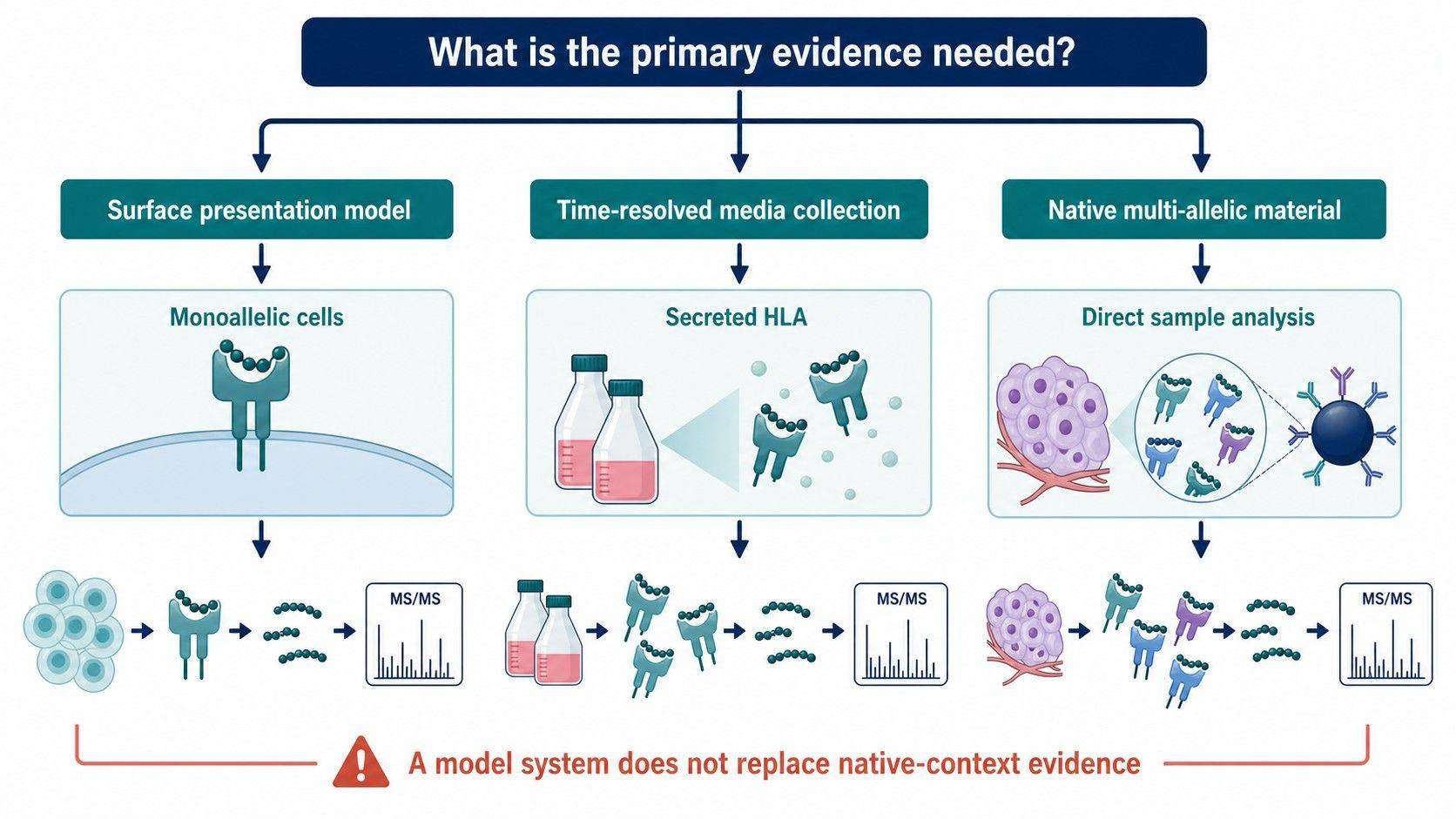
The comparison leads to a conditional conclusion. If the study needs controlled evidence of cell-surface peptide presentation by one allele, choose monoallelic cells. If the study needs repeated or scalable sampling of an engineered single allele in media, choose secreted HLA. If the question is whether a native multi-allelic primary sample presents a peptide, use either model as supporting evidence and retain direct analysis of the native material as the decisive experiment.
How to Select the Right Single-Allele HLA-I System
Start with the biological claim
Define the statement the project must ultimately support. “Generate a ligand library for HLA-A*02:01” can be answered with a well-characterized engineered system. “Show that a ligand is naturally presented by a particular primary cell state” requires direct analysis of that state or a carefully qualified comparison. These are different projects and should not share an automatic sample plan.
Define the allele and parental background
Provide the full HLA allele designation, the planned parental cell line, whether endogenous HLA-I expression remains, and how expression of the construct will be verified. A monoallelic design is only as interpretable as its allele control. For secreted HLA, the construct architecture and collection window should be part of the study record because they define the analyte source.
Decide whether perturbation or time is central
If the project compares a few endpoint states and direct surface presentation is important, monoallelic cells are usually the clearer choice. If the project needs multiple time windows after a controlled perturbation, secreted HLA can support a collection design that preserves temporal information. Do not pool multiple intervals unless the intended output is a cumulative ligand catalogue rather than a time-resolved comparison.
Plan the evidence hierarchy before data acquisition
The strongest projects specify which output will be used for discovery, which for computational ranking, and which for focused confirmation. A ligand identified in a monoallelic or secreted-HLA model can be prioritized for additional assessment in the biologically relevant multi-allelic model. This avoids forcing a single engineered system to answer every downstream question.
Creative Proteomics can support a study design that links single-allele ligand generation to peptidomics-based antigen discovery and prediction, keeping experimentally observed ligands distinct from in-silico predictions and candidate prioritization.
QC and Controls for Allele-Resolved HLA-I Peptidomics
Single-allele design reduces one major source of ambiguity, but it does not remove the need for peptide-level quality control. The QC plan should include the following considerations.
| QC domain | Monoallelic cells | Secreted HLA | Why it matters |
|---|---|---|---|
| Allele identity | Verify intended single HLA expression and minimal confounding endogenous class-I expression | Verify encoded allele and construct expression/secretion | Protects the allele-restricted interpretation. |
| Model suitability | Assess cell growth and surface HLA expression before scale-up | Assess secreted complex accumulation and media compatibility | Establishes whether material recovery is plausible. |
| Negative controls | Parental or empty-vector context where appropriate; preparation blank | Matched non-secreted/empty-vector context where appropriate; media blank | Identifies background introduced by cells, media, and processing. |
| Peptide evidence | Peptide-level identification control, length/motif review, MS/MS evidence | The same peptide-level controls plus collection-window metadata | Keeps source-protein annotation from replacing sequence evidence. |
| Interpretation | Relate results to the engineered cell background | Relate results to construct and culture context | Prevents overgeneralization to a native tissue state. |
Peptide motifs and predicted affinity are useful QC layers, but neither should be used as the sole criterion for calling a peptide–HLA pair. A discovery list should be reported with identification confidence, observed sequence, abundance or detectability pattern where applicable, HLA system, and source annotation.
For a short list of high-priority candidates, immune peptide mass spectrometry analysis can be used to plan a focused confirmation layer after broad ligand discovery.
Common Design Errors in Monoallelic and Secreted HLA Studies
Treating one system as an all-purpose native model
Monoallelic cells and secreted constructs are intentionally simplified systems. They are excellent for allele-resolved discovery, but their results need contextual interpretation when moved to a different cell type, tissue, or perturbation.
Ignoring residual or endogenous HLA expression
Single-allele attribution depends on controlling the HLA background. Document the parental state and expression verification rather than describing a line as monoallelic only because one allele was introduced.
Pooling media across time points by default
Pooling time windows increases total material but converts a time-resolved question into an integrated one. Pool only if the intended result is cumulative peptide coverage; otherwise, preserve biologically meaningful collection intervals.
Reporting source proteins as if they prove presentation biology
Source-protein expression helps explain a ligand list, but it does not replace peptide MS/MS evidence or allele context. A high-abundance source protein does not guarantee that every derived sequence is presented by the HLA allele of interest.
Using prediction as a substitute for experimental identity
Prediction can rank candidates and test motif coherence. It cannot substitute for experimental peptide identification when the aim is to build a validated allele-specific ligand dataset.
When Should You Use Monoallelic Cells or Secreted HLA?
Choose monoallelic cells when the project needs a controlled, cell-surface HLA-I presentation model for one allele, an allele-specific peptide library, or direct comparison across multiple engineered alleles.
Choose secreted HLA when the project needs a scalable allele-specific reporter that can be collected from media, especially across defined time intervals or in a cell system that is difficult to use for large-scale lysate capture.
Choose both as complementary layers when the project needs reference-ligand discovery plus a test of temporal or model-specific effects. Treat concordance as supporting evidence, and define in advance which system answers which question.
Choose direct multi-allelic sample immunopeptidomics when the essential claim concerns the native tissue or primary cell state. A single-allele model can help generate and rank hypotheses, but it should not replace the native presentation evidence.
Creative Proteomics can help match the HLA allele, parental background, construct strategy, sample collection plan, and intended evidence hierarchy to a practical single-allele HLA-I immunopeptidomics workflow. A useful project brief identifies the allele, system, perturbation, collection windows, expected number of samples, and whether direct native-material confirmation is needed.
FAQ: Monoallelic Cells vs Secreted HLA for HLA-I Peptidomics
Does a monoallelic cell line prove that a peptide is presented in primary cells?
No. It provides direct evidence that the peptide is associated with the specified HLA allele in the engineered cellular background. Primary cells can differ in protein expression, antigen processing, and cellular state, so direct primary-material analysis is needed for a native-context conclusion.
Can secreted HLA provide an allele-specific peptide repertoire?
Yes. A construct encoding one HLA allele can provide allele-restricted complexes for media-based collection and LC-MS/MS analysis. The construct and cellular context must be documented because they define the resulting repertoire.
Is secreted HLA always equivalent to membrane HLA?
No. Published models have shown substantial repertoire similarity, but equivalence should not be assumed across every allele, construct, and cell state. Use appropriate model validation when membrane presentation is central to the research question.
Which approach is better for a time-course experiment?
Secreted HLA is often useful when the key variable is a series of defined culture intervals, because media can be collected over time. The collection scheme must preserve the time resolution required for the final comparison rather than pooling all intervals by default.
What information is required to assess project feasibility?
Provide the HLA allele, parental cell line, whether endogenous HLA remains, engineered expression strategy, biological perturbation, intended collection windows, and the desired final output. These elements determine whether monoallelic lysate capture or a secreted-HLA design is more suitable.
Can predictions replace MS-based HLA ligand identification?
No. Prediction is valuable for prioritizing sequences and assessing motif consistency. MS-based peptide identification supplies the experimental ligand evidence needed to build or validate an allele-specific immunopeptidome.
References
- Abelin JG, Keskin DB, Sarkizova S, et al. Mass Spectrometry Profiling of HLA-Associated Peptidomes in Mono-allelic Cells Enables More Accurate Epitope Prediction. Immunity. 2017;46(2):315-326. doi: 10.1016/j.immuni.2017.02.007.
- Sarkizova S, Klaeger S, Le PM, et al. A large peptidome dataset improves HLA class I epitope prediction across most of the human population. Nature Biotechnology. 2020;38(2):199-209. doi: 10.1038/s41587-019-0324-5.
- Scull KE, Dudek NL, Corbett AJ, et al. Secreted HLA recapitulates the immunopeptidome and allows in-depth coverage of HLA A02:01 ligands. Molecular Immunology*. 2012;51(2):136-142. doi: 10.1016/j.molimm.2012.02.117.
- Rettko NJ, Kirkemo LL, Wells JA. Secreted HLA-Fc fusion profiles immunopeptidome in hypoxic PDAC and cellular senescence. PNAS Nexus. 2023;2(12):pgad400. doi: 10.1093/pnasnexus/pgad400.
- Bassani-Sternberg M, Chong C, Guillaume P, et al. Deciphering HLA-I peptidomes for cancer immunotherapy. Trends in Cancer. 2017;3(8):523-526. doi: 10.1016/j.trecan.2017.06.007.
- Caron E, Kowalewski DJ, Chiek Koh C, Sturm T, Schuster H, Aebersold R. Analysis of Major Histocompatibility Complex (MHC) Immunopeptidomes Using Mass Spectrometry. Molecular & Cellular Proteomics. 2015;14(12):3105-3117. doi: 10.1074/mcp.O115.052431.
Select a Single-Allele HLA-I Model That Supports the Evidence You Need
Share the HLA allele, parental cell background, intended perturbation, collection schedule, and whether direct cell-surface presentation or scalable temporal collection is central to the project.
Request a Quote