Direct answer
Reliable quantitative peptidomics begins before LC-MS acquisition. The study must define the peptide-level endpoint, the experimental unit, the biological comparison, the batch structure, and the missing-data strategy before samples are processed. Biological replication supports inference; technical replication characterizes analytical variance; pooled quality-control samples reveal drift and batch behavior. None of these elements can compensate for confounded sample allocation, uncontrolled peptide degradation, or a statistical model that treats non-detection as a measured zero.
Key Takeaways
- Design around the peptide-level claim. Endogenous peptide molecular forms are the primary quantitative units. Collapsing them to source proteins can erase biologically relevant processing differences.
- Biological replicates determine inferential scope. Repeat injections improve precision estimates but do not replace independent subjects, cultures, animals, or specimen collections.
- Do not select sample size from a universal rule. Use the target effect size, biological variance, missingness, group structure, and multiple-testing burden; a pilot study is often needed when variance estimates are unavailable.
- Use pooled QC to observe the measurement process. System suitability, internal standards, pooled study QC, and external reference samples answer different questions and should not be treated as interchangeable.
- Prevent batch-confounded biology. Cases and controls, time points, sexes, treatment arms, and other major covariates should be balanced across preparation and acquisition blocks.
- Missing values require diagnosis, not automatic imputation. Non-detection caused by low abundance is different from stochastic acquisition, interference, failed alignment, or sample failure. The analysis should preserve this distinction.
- Quantitative conclusions require an inspectable analysis trail. Sample exclusions, QC behavior, drift, batch correction, filtering, missingness, effect sizes, and false-discovery control should remain traceable at the peptide and sample levels.
Define the Quantitative Endpoint Before Estimating Sample Numbers
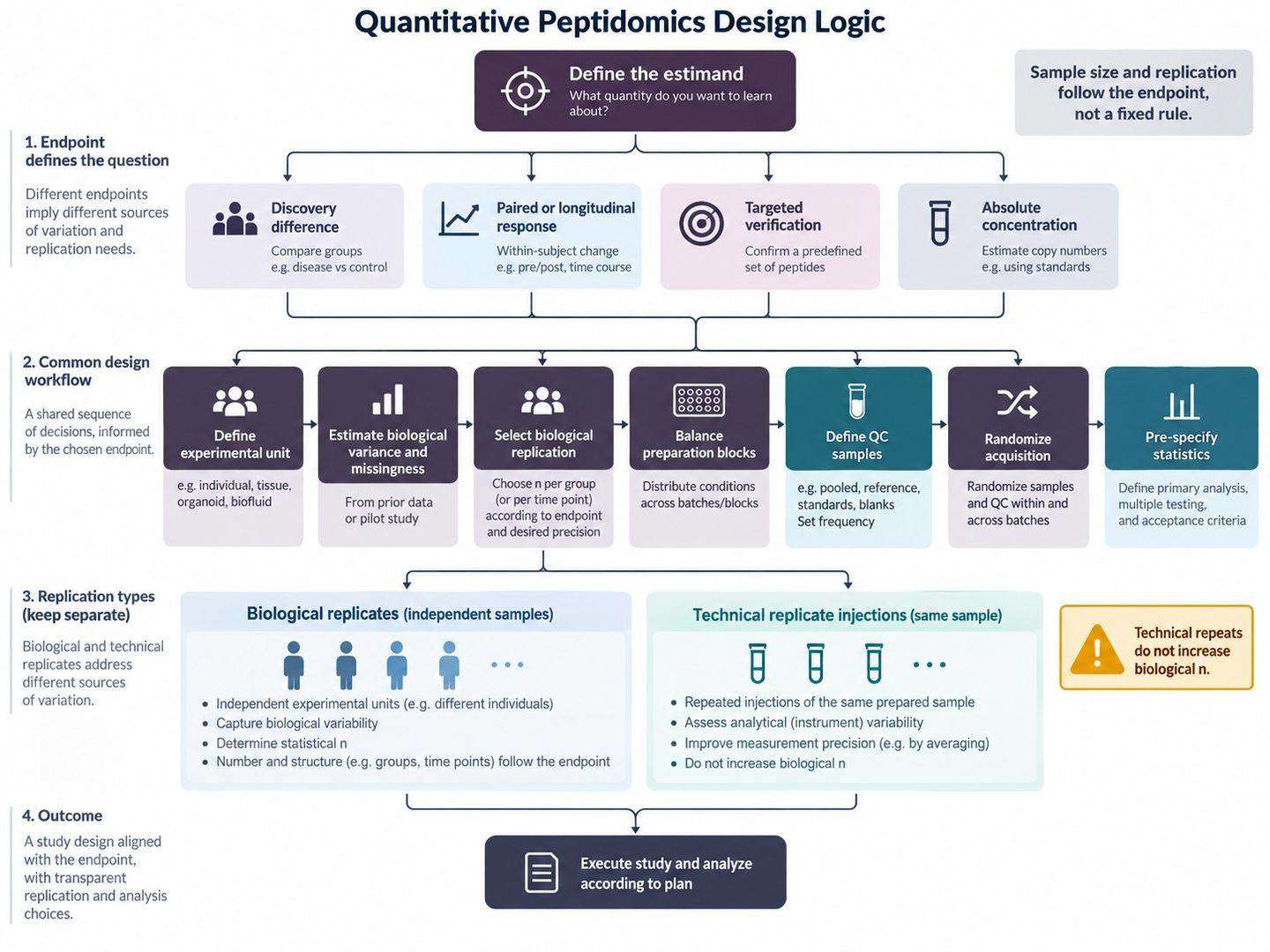
“Quantitative peptidomics” can describe several fundamentally different studies. An exploratory two-group screen, a longitudinal pharmacodynamic experiment, an absolute-quantification assay, and a multicenter biomarker cohort require different replication and QC structures. Sample number should not be calculated until the endpoint and experimental unit are explicit.
| Study objective | Primary quantitative endpoint | Experimental unit | Design implication |
|---|---|---|---|
| Discovery of differential endogenous peptides | Relative abundance of identified peptide molecular forms | Independent biological specimen | Requires biological replication, multiplicity control, and confirmation in an independent dataset |
| Mechanism study after genetic or pharmacological perturbation | Peptide-level response across defined conditions | Independent culture, animal, or subject | Blocking and paired designs can reduce variance when scientifically valid |
| Time-course or repeated-measures study | Within-unit trajectory of peptide abundance | Subject, animal, or culture followed over time | Mixed-effects or repeated-measures models must preserve within-unit correlation |
| Biomarker verification | Reproducible measurement of a predefined peptide panel | Independent specimen in a verification cohort | Discovery candidates should be locked before verification; targeted MS may be more appropriate |
| Absolute quantification | Concentration derived from calibrators and internal standards | Independent specimen | Requires calibration, recovery, selectivity, stability, and matrix-effect assessment |
| Process or stability characterization | Change attributable to handling, storage, or processing condition | Independently prepared sample aliquot or lot | Processing factors must be randomized and not confounded with acquisition order |
An endogenous peptidomics platform measures naturally occurring peptides rather than tryptic surrogates of proteins. Each truncated or modified form may have a distinct biological function. A peptide ending at residue 75 and a nested form ending at residue 73 should therefore not be merged merely because both originate from the same precursor protein.
Specify the Estimand
The estimand is the quantity the analysis intends to compare. Examples include the mean log2 abundance difference between treatment groups, a within-subject time-course slope, a dose-response relationship, or the concentration of a predefined peptide. Defining it clarifies which samples are independent, which covariates belong in the model, and whether missing observations are compatible with the intended comparison.
Separate Discovery from Confirmation
Discovery, verification, analytical validation, and clinical validation answer different questions and must not be represented as interchangeable stages. Discovery asks which peptide molecular forms are associated with a predefined contrast under a controlled analytical workflow. Because candidates are selected from the same data used to estimate their effects, reported fold changes and classification performance are vulnerable to winner's-curse inflation, model-selection bias, and cohort-specific confounding. Reusing the discovery specimens to claim confirmation does not remove those sources of optimism.
Candidate prioritization should therefore integrate several independent evidence dimensions: peptide-identification confidence; effect size with uncertainty; quantitative completeness; stability across defensible filtering, normalization, imputation, and batch-handling choices; consistency across relevant subgroups or blocks; biological plausibility; and feasibility of orthogonal measurement. A candidate that ranks highly only after one imputation method or disappears when one batch is excluded should not receive the same evidential weight as a directly identified peptide with stable direction and magnitude across sensitivity analyses.
Verification begins with a locked candidate list, predefined acceptance criteria, and specimens that were not used for feature selection. Where targeted PRM or MRM is introduced, the transition also requires confirmation that the selected precursor, fragment ions, retention behavior, and interference profile are suitable for reproducible measurement. Analytical validation is a separate fit-for-purpose exercise addressing properties such as selectivity, precision, sensitivity, linearity, recovery, stability, carryover, and matrix effects. Clinical validation applies only when the intended claim concerns performance in a defined clinical context of use.
| Stage | Primary question | Required design feature | Defensible output |
|---|---|---|---|
| Discovery | Which peptide forms are associated with the biological contrast? | Broad peptide measurement, controlled preprocessing, multiplicity correction, and sensitivity analysis | Ranked candidates with identification, effect, uncertainty, completeness, and robustness evidence |
| Verification | Are locked candidates reproducibly measured in independent specimens? | Independent sample set, predefined panel and analysis plan, appropriate bridge controls, and preferably targeted measurement | Replicated direction and magnitude with documented detection and interference behavior |
| Analytical validation | Does the assay measure the intended peptide with fit-for-purpose performance? | Characterization of precision, selectivity, response range, sensitivity, recovery, stability, matrix effects, and carryover | Defined analytical performance and acceptance criteria for the specified matrix and method |
| Clinical validation, where applicable | Does the biomarker perform for its stated clinical context of use? | Representative clinical population, prespecified endpoint and threshold, comparator strategy, and independent performance evaluation | Context-specific clinical performance rather than a discovery-derived claim |
Biological and Technical Replication
Biological Replicates
Biological replicates are independent experimental units to which the scientific conclusion should generalize. They may be different patients, animals, independently grown cultures, separately collected tissues, or independently prepared biological specimens. Repeated aliquots from one specimen do not increase biological sample size.
Biological replication estimates between-unit variability and supports inference about the target population. Its value depends on the sampling frame: five animals from one litter, multiple technical preparations from one tissue, or several wells from the same cell-culture batch may contain less independent information than their nominal count suggests.
Technical Replicates
Technical replicates repeat one or more analytical steps using the same biological material. They can diagnose extraction variability, injection precision, stochastic precursor sampling, peak-integration consistency, or low-abundance instability. They are useful during method development and pilot studies, but treating technical replicates as independent biological observations is pseudoreplication.
When technical replicate injections are used, the analysis plan should state whether they will be averaged, modeled as nested observations, used for QC only, or used to select a representative result. This decision should be made before viewing group differences.
Paired and Blocked Designs
Pairing is effective when measurements share a scientifically meaningful unit, such as pre- and post-treatment specimens from the same subject or matched tissues from the same animal. The analysis must preserve pair identifiers. Artificially pairing unrelated samples does not reduce variance legitimately.
Blocking groups samples by a known technical or biological factor—preparation day, instrument batch, plate, center, or subject—so that important comparisons occur within blocks. Each block should contain a balanced representation of the primary biological groups whenever feasible.
Determining Sample Size Without a Universal “n”
No single replicate count is defensible for all peptidomics studies. Sample-size planning depends on:
- the smallest effect size worth detecting;
- biological variance at the peptide level;
- expected technical variance and missingness;
- paired versus independent sampling;
- number of groups, time points, and covariates;
- allocation ratio and anticipated exclusions;
- number of peptides tested and the desired false-discovery control;
- whether the endpoint is discovery, estimation, classification, or targeted confirmation.
If project-specific variance estimates do not exist, a pilot study can estimate identification completeness, median and feature-specific coefficients of variation, the relation between abundance and missingness, and the effect of sample preparation. Pilot estimates are uncertain, so power calculations should examine several plausible variance and effect-size scenarios rather than return one falsely precise number.
For a continuous log-scale peptide endpoint, planning should distinguish the expected biological effect from the biological standard deviation at the experimental-unit level. In an independent-group design, the relevant signal-to-noise quantity is the group contrast relative to between-unit variability; injection variance should be incorporated only to the extent that it contributes to the final summarized measurement. In a paired or longitudinal design, power depends on the variance of within-unit differences and the correlation between repeated measurements, not on the marginal variance of each time point. These quantities cannot be recovered by counting technical injections as additional observations.
Discovery studies also require a multiplicity-aware planning strategy. Nominal power for one peptide does not determine how many true discoveries will survive false-discovery control across hundreds or thousands of tested molecular forms. The expected number of tested features, proportion of non-null effects, abundance-dependent missingness, and correlation among nested peptide families can materially change operating characteristics. When closed-form assumptions are not credible, simulation or resampling from representative pilot data is preferable to applying a single two-sample formula to every feature.
The sample-size output should therefore be a scenario grid rather than one unsupported integer. At minimum, it should show the required biological sample size across plausible effect sizes, biological variances, paired correlations where relevant, missing-sample rates, and feature-detection probabilities. The final allocation should then be inflated for prespecified exclusions and divided into preparation and acquisition blocks without separating the principal biological contrast from batch.
For large clinical cohorts, sample size should be driven by the clinical contrast and model, not the capacity of one acquisition batch. The batch plan is then designed around the required cohort, with bridge QC and balanced blocks. For small mechanistic studies, paired or factorial designs may yield more information than adding unstructured technical injections.
Fit-for-Purpose Quality-Control Architecture
Quality control is not one vial injected repeatedly. Different controls locate different failure modes.
| QC type | Composition | Primary purpose | What failure suggests |
|---|---|---|---|
| System-suitability standard | Stable defined peptide mixture or characterized digest | Verify LC-MS readiness, retention time, mass accuracy, sensitivity, and peak shape | Instrument or chromatographic issue before study samples are analyzed |
| Internal standard | Labeled or exogenous peptide added at a defined stage | Track recovery, injection, retention, or targeted quantification depending on addition point | Sample-specific preparation loss, matrix effect, or acquisition variation |
| Pooled study QC | Aliquots from representative study samples | Monitor study-relevant features, drift, alignment, and within/between-batch precision | Instability affecting the same molecular population as study samples |
| External reference QC | Stable matrix or reference material independent of the cohort | Track longitudinal laboratory performance and compare batches or studies | Laboratory-wide shift, lot effect, or platform change |
| Process blank | Reagents and consumables without biological sample | Detect contaminants, carryover, and background introduced by preparation | Non-biological signals or sequence contamination |
| Replicate preparation QC | Independent preparation from the same material | Estimate extraction and cleanup repeatability | Preparation variability not visible from repeat injection alone |
The peptidomic data quality assessment service should therefore evaluate controls at the stage where they enter the workflow. A heavy peptide added immediately before injection cannot measure extraction recovery; an internal standard added before extraction can track recovery but may not behave identically to every endogenous peptide.
Constructing a Pooled Study QC
A pooled QC should represent the study’s matrices and major biological groups. Equal-volume pooling is simple, but very dilute specimens or strongly different matrices can produce a pool that does not reflect every sample. If specimen volume is limited, a separate reference pool or matrix-matched surrogate may be required. The report should document how the pool was made, whether it spans all batches, and which peptide features are actually represented.
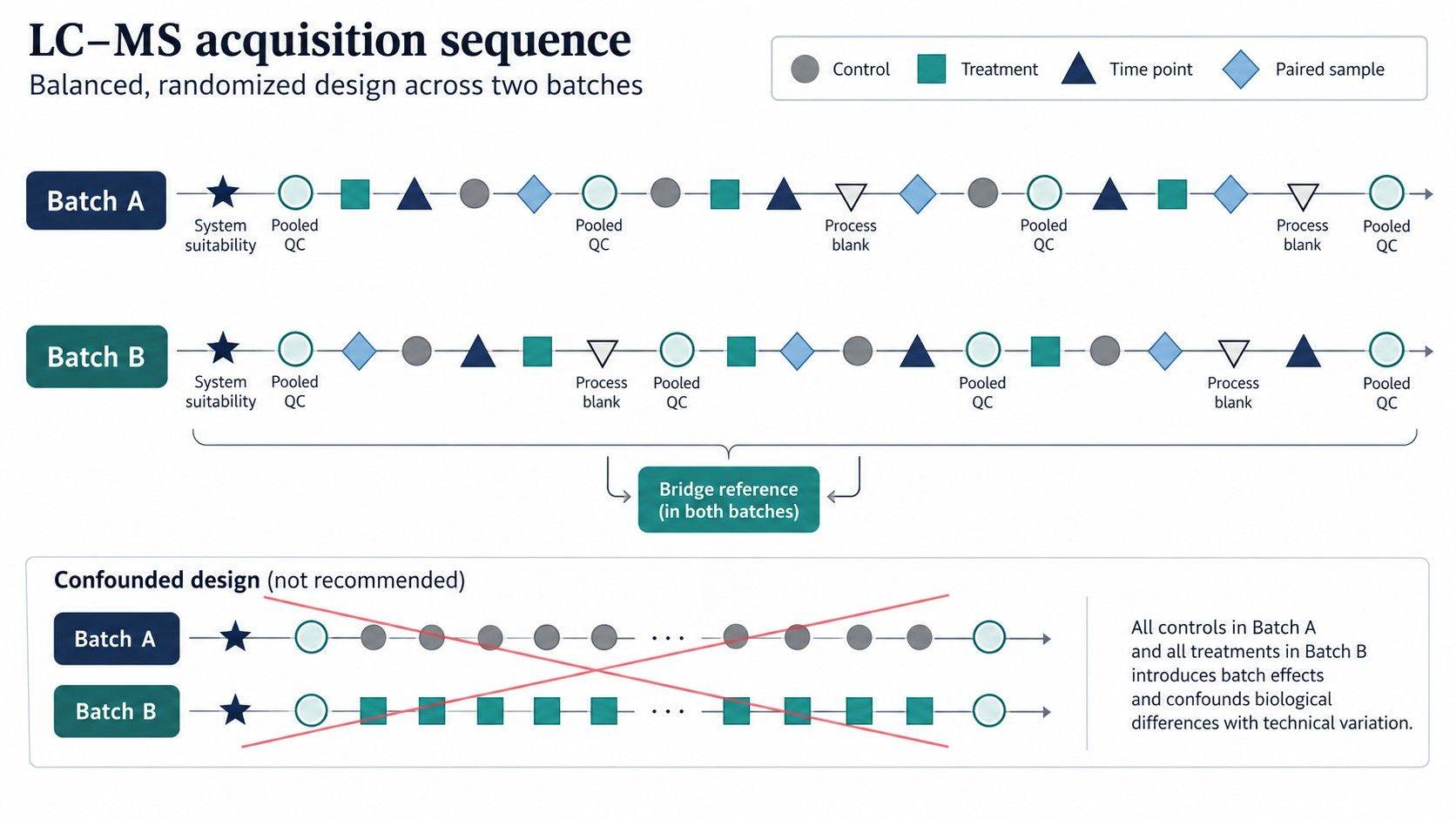
QC placement should be based on chromatographic stabilization, observed drift, run length, and correction strategy. Concentrating all pooled QCs at the beginning and end of a long sequence cannot characterize nonlinear drift within the batch. Conversely, an unnecessarily dense QC schedule can consume scarce material and instrument time. A pilot acquisition can establish a defensible interval.
QC Acceptance Metrics
Relevant metrics can include retention-time stability, precursor and fragment mass error, peak area precision, identification counts, peptide completeness, carryover, signal intensity, peak width, and internal-standard response. Acceptance limits should be method- and study-specific, established before unblinding, and linked to a predefined action: reinjection, repreparation, exclusion, maintenance, or qualification of a limitation.
Acceptance should be evaluated at more than one level. System-level metrics determine whether the LC-MS platform is ready to acquire study samples. Sample-level metrics identify failed extraction, abnormal total response, excessive missingness, or injection problems. Feature-level metrics determine whether a particular peptide is sufficiently stable and complete for the intended statistical comparison. Passing a global identification-count threshold does not establish that every reported peptide is quantitatively reliable.
The QC plan should also specify how evidence will be interpreted when indicators disagree. For example, stable total signal with deteriorating retention-time alignment can preserve identification counts while compromising feature matching; acceptable pooled-QC precision can coexist with matrix-specific suppression in one biological subgroup; and an internal standard added after extraction can monitor injection performance without reporting extraction recovery. A white-paper-grade report should therefore link each control to the process step it interrogates and avoid using one control as evidence for unmeasured stages.
Randomization, Blocking, and Blinding
Batch correction cannot rescue a design in which biology and batch are identical. If every control is prepared and acquired in Batch 1 and every treated sample in Batch 2, no statistical method can determine whether the observed difference is biological or technical.
Preparation Order
Randomize or balance extraction, enrichment, desalting, and reconstitution order. Use blocks when the number of samples exceeds one day, plate, kit lot, or operator shift. Include all major conditions within each block when possible.
Acquisition Order
Randomize injections while preventing problematic sequences such as repeated high-concentration samples followed by vulnerable low-input samples. In paired studies, keep pairs close enough to reduce drift exposure but vary pair order across the run. Insert blanks according to carryover risk and pooled QCs according to the drift-monitoring plan.
Blinding and Metadata
Operational identifiers can conceal biological group during sample preparation and data review. A separate key should preserve subject, pairing, center, collection date, processing interval, storage history, preparation batch, injection order, and rerun status. Unrecorded reruns or manually substituted files create hidden analytical decisions.
Peptide-Level Data Processing Requires Explicit Rules
Quantitative peptidomics should retain the identity of the measured molecular form. Data-processing rules should define how peptide-spectrum matches, charge states, isotope peaks, modifications, and nested sequences are consolidated.
Identification and Feature Alignment
Identification confidence and quantification confidence are related but distinct. A peptide may be confidently identified in pooled QC and quantified by aligned features in individual runs. The workflow should report when an abundance value is supported by direct MS/MS identification, match-between-runs or library transfer, or targeted extraction. Transfer criteria must control retention time, mass accuracy, ion mobility where available, and decoy behavior.
Modified and Truncated Forms
Oxidized, amidated, phosphorylated, pyroglutamylated, and truncated forms should not be summed automatically. Some are biologically distinct; others may be handling artifacts. The analysis plan should specify when forms are reported separately and when chemical equivalence justifies consolidation.
Nested Peptide Families
Endogenous peptidomics frequently detects overlapping peptides from the same precursor region. These “peptide ladders” may reflect ordered biological processing or ex vivo trimming. Statistical testing at the individual-peptide level can produce many correlated results. Region-level visualization is useful, but it should supplement—not replace—the molecular-form table.
Mechanism-Aware Treatment of Missing Peptide Intensities
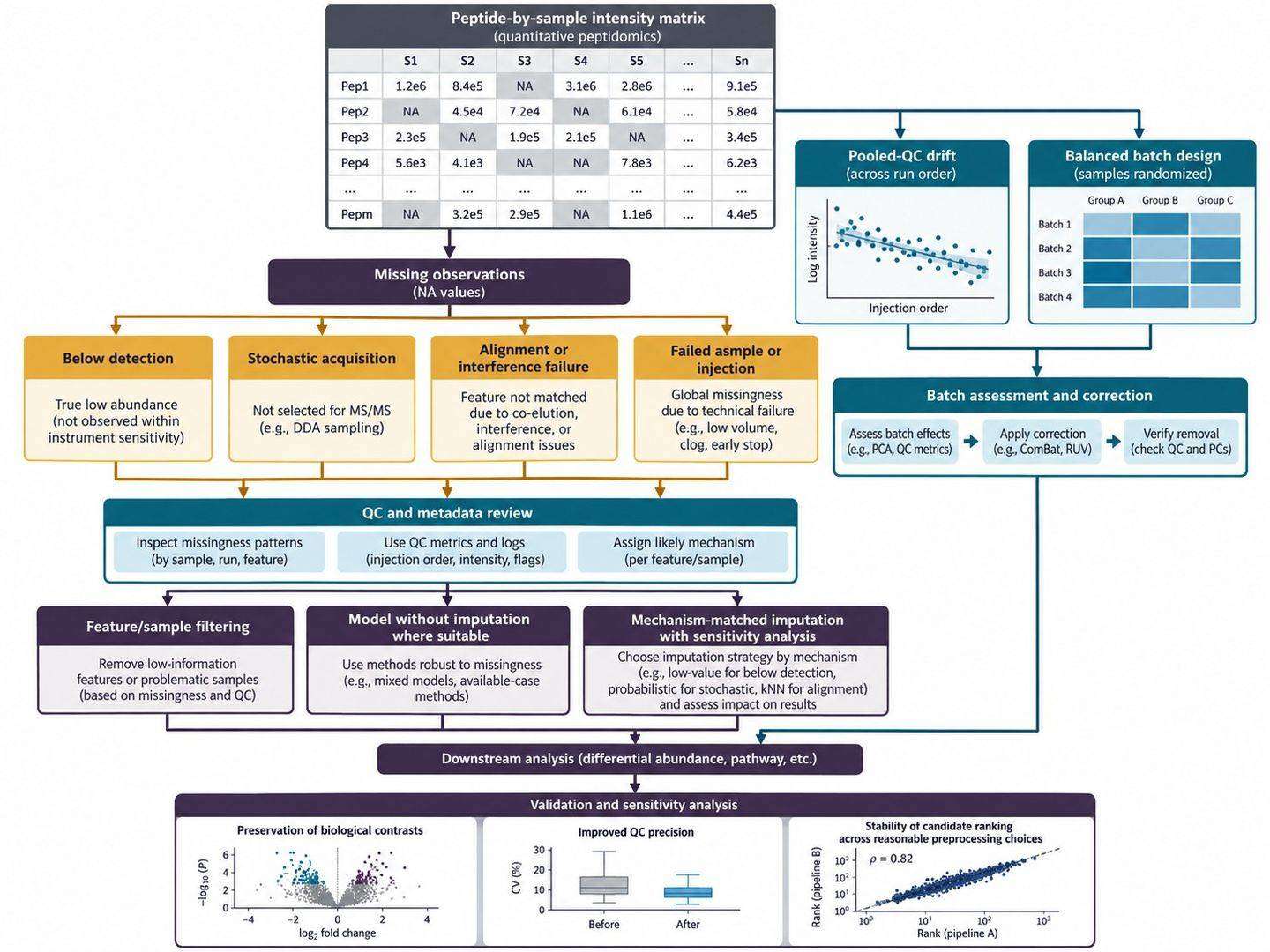
A missing value can arise at several stages:
- the peptide is biologically absent;
- abundance is below the limit of detection or quantification;
- the precursor was not selected for fragmentation;
- ion suppression or interference prevented reliable peak integration;
- retention-time or ion-mobility alignment failed;
- the sequence was excluded by identification filters;
- sample preparation or injection failed;
- the feature exists but was not transferred under conservative matching rules.
These mechanisms are not statistically equivalent. Missing completely at random (MCAR), missing at random conditional on observed variables (MAR), and missing not at random because abundance is below detection (MNAR) require different assumptions. Real datasets often contain a mixture.
Filtering Before Imputation
Remove contaminants, decoys, features outside the defined identification scope, and samples that fail prespecified QC before evaluating missingness. Peptides observed in too few experimental units may be unsuitable for group-level inference, but filtering should be independent of the direction of the biological effect. A peptide consistently detected in one group and absent in another can be biologically important; it requires a method that treats censored or detection-based data appropriately rather than deletion by a global completeness rule.
Consequences of Universal Minimum-Value Imputation
Replacing every missing value with the same small number creates artificial within-group precision and can exaggerate fold changes. Random draws from a low-intensity distribution also impose a specific MNAR model. K-nearest-neighbor and multivariate approaches assume that other measured features predict the missing value. Each method can alter candidate ranking and false positives.
The selected approach should match the expected mechanism and planned statistical model. Sensitivity analysis across defensible preprocessing choices is valuable for high-priority findings. Recent multi-batch peptidomics work demonstrates that imputation and batch correction interact; they should not be selected independently after inspecting which combination produces the most significant results.
Normalization, Drift Correction, and Batch Adjustment
Normalization removes systematic differences that are not part of the biological question. It is not automatically valid to force all samples to the same total or median peptide signal. A treatment that globally alters peptide secretion or proteolysis could produce a real distributional shift that median normalization would suppress.
Candidate strategies should be evaluated against sample composition, internal standards, pooled QC behavior, and known biology. Common approaches include total-signal scaling, median normalization, reference-feature normalization, internal-standard normalization, and QC-based drift correction. The choice and its assumptions should be reported.
Batch-effect assessment should begin with design metadata and QC samples. PCA or other ordination plots can reveal association with preparation day, plate, center, or injection order, but visual separation alone does not identify the cause. Feature-level drift plots, variance decomposition, QC CV distributions, and completeness by batch are more diagnostic.
Correction methods such as linear adjustment, empirical-Bayes models, nonlinear QC-based regression, or mixed-effects models require overlap between batches and preservation of biological groups. If one phenotype exists in only one batch, correction risks removing biology or manufacturing a group difference. A differential peptide expression analysis should therefore retain the design matrix, covariates, pairing, and batch structure rather than operating on a decontextualized intensity table.
Differential Analysis and Evidence Reporting
Peptide-level differential analysis should report effect size and uncertainty, not only a p-value. Depending on the design, suitable models may include linear models, moderated statistics, mixed-effects models, generalized models for detection/non-detection, or targeted calibration models.
Key analysis elements include:
- log transformation or other variance-stabilizing treatment when justified;
- explicit modeling of paired, longitudinal, factorial, or nested designs;
- biological covariates selected before outcome inspection;
- multiple-testing correction across the tested peptide set;
- effect sizes with confidence intervals;
- separate reporting of direct identifications and transferred features;
- sensitivity to filtering, normalization, imputation, and batch handling;
- independent verification of prioritized candidates.
Candidate Prioritization as a Multi-Evidence Decision
Differential significance alone is not a sufficient advancement criterion. Each candidate should be reviewed against an evidence matrix that preserves at least six dimensions: direct sequence evidence versus transferred identification; effect size and interval estimate; within-group completeness and censoring pattern; sensitivity to reasonable preprocessing choices; consistency across batches, blocks, and relevant subgroups; and biochemical or pathway context. These dimensions should remain visible rather than being collapsed into a single opaque ranking score.
Candidate disposition should be explicit. A peptide may be advanced for independent verification, retained as exploratory because identification or completeness is insufficient, redirected to a targeted feasibility study, or removed because the apparent effect tracks a technical factor. Recording the disposition rule prevents retrospective promotion of candidates based only on nominal significance or biological appeal.
Verification Design and Assay Transition
Verification should use a locked sequence and modification definition, a prespecified contrast, and an independent specimen set whenever the objective is reproducibility beyond the discovery cohort. If targeted MS is used, method development should address precursor uniqueness, fragment-ion specificity, coelution and interference, retention-time confirmation, internal-standard strategy, and the quantitative range required by the intended decision. A successful PRM or MRM transition confirms measurability under the targeted method; it does not by itself establish biological generalizability or clinical performance.
For projects transitioning from discovery to predefined measurement, quantitative peptidomics services can support relative profiling, while a label-free peptide quantification service may be suitable for multi-sample discovery. Targeted PRM or MRM should be considered when the candidate panel is fixed and analytical performance must be characterized explicitly.
Minimum Reporting Dataset for Reproducible Quantitative Peptidomics
Reproducibility requires more than a table of significant peptides. The reporting dataset should allow an independent reviewer to reconstruct the experimental units, identify where technical variation entered the workflow, reproduce the principal statistical contrasts, and determine which findings remain stable under defensible preprocessing alternatives. The following components should be treated as linked analytical records rather than disconnected supplementary files:
- Study design table: experimental units, groups, pairing, covariates, exclusions, preparation blocks, and acquisition batches.
- Sample and processing metadata: collection-to-freezer interval, storage, freeze-thaw history, stabilization, extraction date, operator, and reagent lot where relevant.
- System-suitability and QC results: retention time, mass accuracy, response, carryover, identification counts, pooled-QC completeness, and drift.
- Identification summary: search database, enzyme specificity, modifications, FDR levels, transfer rules, and peptide-form consolidation.
- Quantitative completeness: observed values by sample and peptide, missingness heatmap, abundance-missingness relationship, and exclusion reasons.
- Normalization and correction diagnostics: distributions and ordination before and after processing, with QC behavior and biological separation evaluated separately.
- Statistical model: design formula, contrasts, covariates, pairing or random effects, multiplicity adjustment, and software versions.
- Results table: peptide sequence, modifications, source-protein coordinates, abundance values, effect size, uncertainty, adjusted p-value, completeness, and evidence type.
- Sensitivity analysis: high-priority findings retained or lost under reasonable preprocessing alternatives.
- Candidate disposition: which peptide forms advance to independent verification, which remain exploratory, which require targeted feasibility assessment, and which are rejected because the apparent effect is analytically unstable or confounded.
The reporting package should preserve the relationship between these records. For example, every result-table entry should be traceable to its identification evidence, quantitative completeness, preprocessing history, statistical contrast, and candidate disposition. Static volcano plots or heat maps are useful summaries, but they cannot substitute for peptide-level provenance and analysis-ready data.
Where the study is intended to support candidate advancement, the final output should distinguish three classes: findings that are analytically robust within the discovery dataset; findings reproduced in independent specimens; and findings measured by a characterized targeted assay. Keeping these classes separate prevents discovery significance, cohort replication, and assay performance from being reported as though they were the same type of evidence.
Frequently Asked Questions
How many biological replicates are required for quantitative peptidomics?
There is no universal number. The required sample size depends on the smallest relevant effect, peptide-level biological variance, missingness, study design, and false-discovery objective. A pilot study can provide variance and completeness estimates. Technical injections should not be counted as additional biological replicates.
Should every study include pooled QC?
Pooled QC is highly useful in label-free multi-run studies because it contains study-relevant peptide features and can reveal drift, alignment, and batch behavior. It may be infeasible in extremely low-volume, longitudinal, or continuously enrolling studies. A stable bridge pool or matrix-matched reference can be used, but its coverage limitations should be documented.
How frequently should pooled QC be injected?
The interval should be selected from expected drift, chromatographic stability, batch length, available QC volume, and the correction method. A fixed interval copied from another platform is not automatically valid. Pilot runs and system-suitability history should justify the schedule.
Can batch correction fix an unbalanced design?
No. When biological group and batch are completely confounded, their effects are not statistically separable. Balanced allocation and bridge samples must be planned before acquisition. Correction is appropriate only when batches contain sufficient biological overlap.
Should missing peptide intensities be replaced with zero?
Generally, a missing value is not a measured zero. Zero replacement can distort log transformation, variance, and fold change. Missingness should be characterized, and the statistical approach should reflect whether values are censored by detection, sporadically absent, or missing because of technical failure.
Can peptide intensities be summarized to the source-protein level?
Not as the primary peptidomics result. Different endogenous peptides from one precursor can represent distinct mature products, cleavage intermediates, PTMs, or degradation fragments. Source-protein mapping is valuable for interpretation, but molecular forms should remain available in the quantitative table.
When should a discovery study transition to PRM or MRM?
Transition when the candidate panel and required analytical claim are defined. Targeted MS supports consistent acquisition, interference review, internal-standard use, and calibration. It should follow candidate prioritization and feasibility assessment rather than be used to rescue a poorly designed discovery comparison.
References
- Abid, M. S. R., Qiu, H., & Checco, J. W. (2024). Label-free quantitation of endogenous peptides. In Peptidomics: Methods and Strategies, Methods in Molecular Biology, vol. 2758, pp. 125-150. Springer. https://doi.org/10.1007/978-1-0716-3646-6_7
- Oberg, A. L., & Vitek, O. (2009). Statistical design of quantitative mass spectrometry-based proteomic experiments. Journal of Proteome Research, 8(5), 2144-2156. https://doi.org/10.1021/pr8010099
- Tsantilas, K. A., Merrihew, G. E., Robbins, J., et al. (2024). A framework for quality control in quantitative proteomics. Journal of Proteome Research, 23(10), 4392-4408. https://doi.org/10.1021/acs.jproteome.4c00363
- Čuklina, J., Lee, C. H., Williams, E. G., et al. (2021). Diagnostics and correction of batch effects in large-scale proteomic studies: a tutorial. Molecular Systems Biology, 17(8), e10240. https://doi.org/10.15252/msb.202110240
- Kong, W., Hui, H. W. H., Peng, H., & Goh, W. W. B. (2022). Dealing with missing values in proteomics data. Proteomics, 22(23-24), e2200092. https://doi.org/10.1002/pmic.202200092
- Lazar, C., Gatto, L., Ferro, M., Bruley, C., & Burger, T. (2016). Accounting for the multiple natures of missing values in label-free quantitative proteomics data sets to compare imputation strategies. Journal of Proteome Research, 15(4), 1116-1125. https://doi.org/10.1021/acs.jproteome.5b00981
- Gonidaki, C., Latosinska, A., & Vlahou, A. (2026). Practical impact of imputation and batch-effect correction for proteomics/peptidomics differential-abundance analysis. Proteomics, 26(5), 48-58. https://doi.org/10.1002/pmic.70111
- Cairns, D. A. (2011). Statistical issues in quality control of proteomic analyses: good experimental design and planning. Proteomics, 11(6), 1037-1048. https://doi.org/10.1002/pmic.201000579
- Geyer, P. E., Holdt, L. M., Teupser, D., & Mann, M. (2017). Revisiting biomarker discovery by plasma proteomics. Molecular Systems Biology, 13(9), 942. https://doi.org/10.15252/msb.20156297
Plan a Quantitative Peptidomics Study Before Samples Enter the Queue
Share the biological groups, sample matrix, cohort structure, expected effect, available volume, and quantitative endpoint. The study can then be scoped around appropriate replication, QC, batching, and statistical analysis.
Request a Technical ConsultationRelated Peptidomics Services
For research use only. Not for use in diagnostic procedures.