Direct answer
Endogenous peptidomics and degradomics both measure products of proteolysis, but they are not interchangeable. Endogenous peptidomics is designed to recover and characterize naturally occurring low-molecular-weight peptides as intact molecular species. Degradomics addresses proteolysis at the system level, while N- and C-terminomics enrich protein-terminal peptides to localize cleavage boundaries and support protease-substrate analysis. The correct workflow therefore depends on the analytical claim: a change in an endogenous peptide establishes a peptide-level observation; a neo-terminus localizes a cleavage event; attribution to a specific protease requires a perturbation or biochemical validation design.
Key Takeaways
- Use endogenous peptidomics when the analyte is the native peptide. Appropriate targets include mature peptide hormones, neuropeptides, antimicrobial peptides, secreted signaling peptides, and stable fragments that must be measured without routine proteolytic digestion.
- Use terminomics when the analytical endpoint is a protein boundary. N-terminomics or C-terminomics enriches terminal peptides so that native termini and protease-generated neo-termini can be mapped against the source protein sequence.
- Degradomics is the biological question; terminomics is one principal measurement strategy. Degradomics may integrate terminomics, conventional proteomics, intact-fragment analysis, activity assays, and targeted confirmation.
- A cleavage product does not identify its generating protease by itself. Motif compatibility and protease-prediction tools generate hypotheses. Direct substrate claims require controlled perturbation, inhibitor or genetic evidence, and preferably cleavage reconstruction with purified components.
- The methods are complementary. Peptidomics can reveal stable bioactive products, whereas terminomics can expose the corresponding cleavage boundaries and broader substrate network.
Define the Analytical Object Before Selecting the Workflow
Proteolysis produces several analytically distinct objects. A mature peptide hormone is an intact bioactive molecule. A short peptide found in plasma may be a stable product of physiological processing, a secondary degradation product, or an ex vivo artifact. A newly exposed protein terminus marks a cleavage boundary but may remain attached to a large protein fragment. These objects require different enrichment and data-analysis strategies.
The first planning question should therefore be: What molecular entity must be demonstrated?
| Intended claim | Primary analytical object | Preferred starting workflow | Critical limitation |
|---|---|---|---|
| Identify naturally occurring peptide species | Intact endogenous peptide | Endogenous peptidomics | Detection does not establish biological activity or the responsible protease |
| Compare native peptide abundance across conditions | Peptide-level ion signal or targeted concentration | Quantitative endogenous peptidomics | Pre-analytical proteolysis and missing values can mimic biological change |
| Locate a protein cleavage boundary | Native or neo-N/C-terminal peptide | N-terminomics or C-terminomics | A mapped terminus does not by itself assign the protease |
| Discover substrates of a protease of interest | Perturbation-responsive neo-termini and source proteins | Comparative degradomics with terminomic enrichment | Indirect network effects can resemble direct cleavage |
| Reconstruct a mature peptide-processing pathway | Precursor, intermediates, mature peptides, and boundary evidence | Combined peptidomics and terminomics | Requires time-resolved or perturbation evidence to order processing events |
| Confirm direct cleavage of a selected substrate | Defined substrate and cleavage product | Purified-protease assay plus targeted MS | In vitro cleavage may not establish physiological relevance |
This distinction prevents a common interpretation error: collapsing all non-tryptic peptides into a single category of “protease products.” A non-tryptic sequence identifies a boundary relative to the reference protein, but it does not reveal whether the peptide was generated in vivo, during collection, during extraction, or through downstream trimming after an earlier cleavage event.
What Endogenous Peptidomics Measures
Endogenous peptidomics analyzes naturally occurring peptides without the routine tryptic digestion used in bottom-up proteomics. The analyte is therefore the recovered peptide itself, including its native termini, sequence variants, and detectable post-translational modifications. Depending on the matrix and biological system, the measured population can contain:
- mature neuropeptides and peptide hormones;
- prohormone-processing intermediates;
- antimicrobial and host-defense peptides;
- secreted or extracellular signaling peptides;
- proteasome- or lysosome-derived fragments;
- extracellular-matrix and plasma-protein fragments;
- exogenous peptides, therapeutic peptides, or degradation products when included in the study scope.
An endogenous peptidomics platform typically combines rapid protease quenching, low-molecular-weight enrichment, LC-MS/MS, no-enzyme or unspecific database searches, peptide-level false-discovery control, PTM-aware annotation, and label-free or targeted quantification. The workflow is optimized around peptide recovery rather than protein digestion efficiency.
What the Result Can Establish
A high-confidence result can establish that a defined peptide sequence and molecular form was detected in the analyzed specimen. Comparative analysis can show that its measured abundance differs across the specified conditions. With suitable fragmentation and standards, the result can also distinguish selected truncated or modified forms.
What the Result Cannot Establish Alone
Peptidomics alone usually cannot determine whether the peptide is bioactive, which protease generated it, whether cleavage was direct, or whether a change reflects source-protein abundance rather than altered processing. Those conclusions require additional evidence. Even precursor mapping is an annotation step: it links a peptide to a possible source sequence but does not reconstruct the causal processing pathway.
What Degradomics and Terminomics Measure
Degradomics is the system-level analysis of proteases, their substrates, and proteolytic products. Its objective is not merely to catalog short peptides. It aims to resolve where proteins were cleaved, how cleavage changes between biological conditions, and which protease or protease network may be responsible.
Terminomic methods support this objective by enriching protein-terminal peptides. A protease cleavage creates two new molecular boundaries: a neo-C terminus on the upstream fragment and a neo-N terminus on the downstream fragment. In practice, N-terminomics is used more frequently because primary amines offer mature labeling and enrichment chemistries. C-terminomics can provide complementary boundary evidence but is analytically more difficult because carboxyl groups are less selectively reactive.
N-Terminomics
N-terminomics distinguishes internal tryptic peptides from peptides that represent original or protease-generated N termini. Major strategy classes include:
- negative enrichment, such as TAILS, in which internal peptides generated after protein digestion are depleted and the terminal peptide population remains for LC-MS/MS;
- diagonal chromatography, such as COFRADIC, which changes selected peptide properties and separates terminal peptides through chromatographic behavior;
- positive enrichment, including enzymatic or chemical labeling approaches that selectively capture accessible N termini;
- subtiligase-based labeling, which uses engineered ligase specificity to tag free N termini.
The analytical output includes the terminal peptide sequence, the mapped position within the source protein, terminal modification status when observable, quantitative behavior across conditions, and the local residues surrounding the putative cleavage site. These data support substrate nomination and cleavage-motif analysis.
C-Terminomics
C-terminomics targets native and protease-generated C-terminal peptides. It can provide the complementary side of a cleavage event and is useful when the downstream neo-N-terminal fragment is unstable, blocked, or analytically inaccessible. However, selective derivatization and enrichment of carboxyl groups must contend with side-chain carboxylates from aspartate and glutamate, contributing to greater method complexity.
A degradomics and protease profiling service may therefore use N-terminomics as the primary discovery strategy and add C-terminal, conventional proteomic, intact-fragment, or targeted evidence according to the substrate class and study objective.
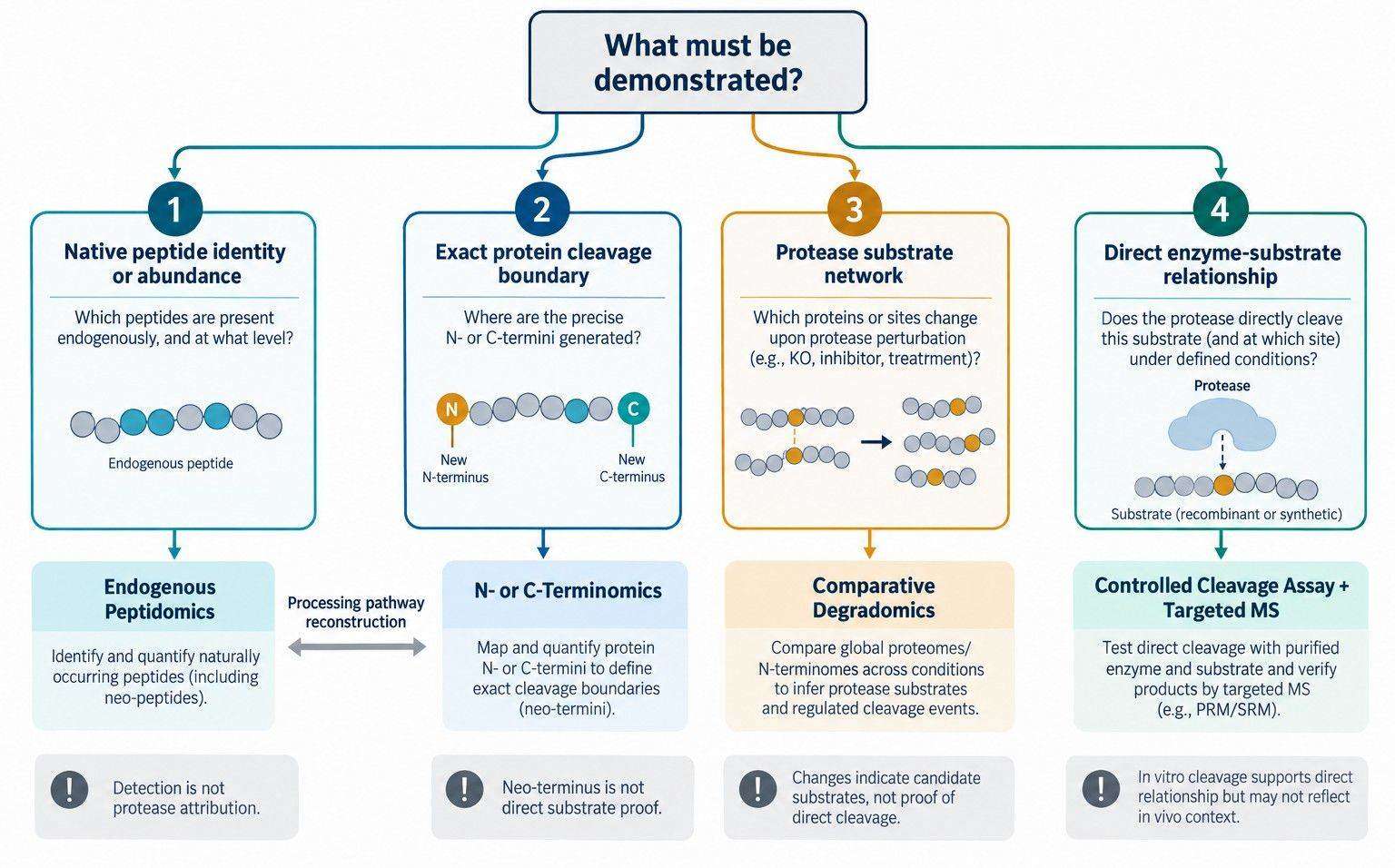
Selecting a Terminomics Strategy by Analytical Claim and Sample Constraint
Terminomics methods are not interchangeable implementations of the same enrichment principle. They differ in which termini are chemically accessible, whether enrichment is positive or negative, how samples can be multiplexed, which losses occur before LC-MS/MS, and what background remains after selection. Method choice should therefore begin with the required terminal population and comparative design rather than the familiarity of a particular protocol.
| Strategy | Selection principle | Strongest use case | Principal sources of bias or loss |
|---|---|---|---|
| TAILS | Protein-level blocking and quantitative labeling of primary amines, followed by digestion and polymer-based depletion of newly generated internal peptides | Comparative degradomics across biochemical, cellular, tissue, or biofluid conditions when broad recovery of blocked, mature, and neo-N-terminal peptides is required | Incomplete blocking, inefficient polymer capture, ultrafiltration loss, labeling-ratio compression, and under-representation of peptides with poor ionization or unsuitable length |
| N-terminal COFRADIC | Protein-level amine derivatization, digestion, charge-based prefractionation, and diagonal reversed-phase separation after selective modification of internal peptides | Deep N-terminome characterization when chromatographic fractionation capacity and material are sufficient and N-terminal processing or acetylation is central | Multi-step fractionation, recovery loss across chromatographic stages, reaction-specific selectivity, higher method complexity, and substantial instrument time |
| Subtiligase positive enrichment | Enzymatic ligation of an affinity-tagged peptide ester to accessible, unblocked protein N termini, followed by affinity capture and tag-specific release | Direct enrichment of free native or neo-N termini, including controlled protease reactions and spatially restricted cell-surface studies | Exclusion of naturally blocked termini, sequence preference of the ligase, dependence on N-terminal accessibility, and incomplete representation of the total terminome |
| ChaFRADIC or tip-based charge separation | Charge-state manipulation and repeated ion-exchange fractionation distinguish N-terminal peptides from internal digestion products | Low-input or throughput-constrained studies in which scalable tip-based processing is advantageous | Dependence on predictable peptide charge, altered behavior from histidine or missed cleavages, fraction overlap, and compatibility requirements for labeling chemistry |
| C-terminal COFRADIC or related C-terminomics | Selective manipulation and sorting of protein C-terminal peptides after digestion | Carboxypeptidase biology, confirmation of neo-C termini, and cases in which the corresponding neo-N-terminal product is blocked or unstable | Competition from aspartate and glutamate side-chain carboxyl groups, incomplete derivatization, C-terminal peptide composition, and greater chemical complexity |
TAILS for Comparative Protease-Perturbation Studies
TAILS is particularly useful when the primary objective is to quantify terminal peptides across conditions such as active versus inactive protease, inhibitor versus vehicle, or wild type versus knockout. Protein N termini and lysine side chains are blocked and can be differentially labeled before digestion; internal peptides formed during digestion acquire new free amines and are removed by reaction with a high-molecular-weight aldehyde polymer. The unbound fraction is enriched in mature and neo-N-terminal peptides, including naturally blocked termini that do not depend on positive capture.
Its broad recovery is also the main interpretive challenge. The enriched fraction can contain annotated protein starts, signal- or transit-peptide processing sites, constitutive maturation products, background proteolysis, and perturbation-responsive neo-termini. Quantitative comparison and hierarchical candidate filtering are therefore integral to the method rather than optional downstream additions. Blocking efficiency, labeling balance, polymer depletion, membrane cut-off, and recovery of the unbound fraction should be monitored because failure at any of these steps changes the observed terminal population.
COFRADIC When Fractionation Depth Is Justified
N-terminal COFRADIC uses sequential chromatographic separations separated by a chemical reaction that changes the behavior of non-terminal peptides. The method can provide deep characterization and supports analysis of N-terminal acetylation and protein processing, but it is operationally intensive. Multiple derivatization, strong-cation-exchange, pooling, and diagonal reversed-phase steps create more opportunities for incomplete reaction and fraction-specific loss than a single enrichment step. It is therefore most defensible when the expected gain in terminal depth or processing annotation justifies the material requirement, fraction count, and instrument burden.
Positive Enrichment for Accessible Free N Termini
Subtiligase-based workflows use an engineered peptide ligase to attach an affinity-tagged peptide ester selectively to accessible free N termini. After affinity enrichment and proteolytic release, the residual tag can provide direct evidence that the identified peptide passed through the N-terminal labeling reaction. This positive-selection logic can reduce background and has been adapted to controlled lysate assays and cell-surface proteolysis. However, N-terminal acetylation, pyroglutamate formation, steric occlusion, or unfavorable sequence context can prevent labeling. A negative result therefore means that a compatible accessible terminus was not recovered; it does not demonstrate absence of the cleavage event.
Low Input and C-Terminal Questions Require Separate Qualification
For limited material, charge-based workflows such as tip-format ChaFRADIC can reduce dependence on extensive HPLC fractionation, but low input does not remove the need to characterize recovery, labeling efficiency, and feature completeness. When the biological question concerns carboxypeptidase processing or the N-terminal counterpart is analytically inaccessible, C-terminomics may be necessary. Because terminal α-carboxyl groups must be distinguished from abundant side-chain carboxylates, C-terminal enrichment has different chemical constraints and should not be presented as a simple mirror image of N-terminal capture. Paired N- and C-terminal evidence is most valuable when both products can be linked to the same bond and perturbation; failure to observe one side may reflect fragment stability or method selection rather than asymmetric biology.
Workflow Differences That Affect Interpretation
The workflows may share high-resolution LC-MS/MS, but their upstream chemistry and downstream evidence models differ substantially.
| Workflow component | Endogenous peptidomics | N-terminomics within degradomics | Consequence for interpretation |
|---|---|---|---|
| Starting analyte | Naturally occurring low-molecular-weight peptides | Intact proteins and protein fragments | The two workflows sample different molecular populations |
| Routine protease digestion | Normally omitted | Usually introduced after terminal blocking or labeling | Digestion-generated peptides are expected in terminomics but would obscure native peptidomics |
| Enrichment target | Low-molecular-weight or physicochemically selected peptides | Native and neo-N-terminal peptides | Peptidomics favors stable free peptides; terminomics favors boundary evidence |
| Search specificity | No-enzyme or unspecific; peptide-focused | Enzyme-aware search with semi-specific terminal logic | Search spaces and false-discovery behavior differ |
| Quantitative unit | Intact peptide molecular form | Terminal peptide/cleavage event | Protein summarization can erase relevant peptide-level patterns |
| Primary biological conclusion | Native peptide identity and abundance | Protein processing boundary and substrate candidate | Neither alone proves the responsible protease |
Sample Stabilization Has Different Consequences
Rapid stabilization is essential for both workflows, but the failure mode differs. In endogenous peptidomics, ongoing ex vivo proteolysis can create abundant artificial peptides that appear biologically meaningful. In terminomics, uncontrolled cleavage can generate false neo-termini and inflate the apparent substrate network. Time-to-quench, temperature, tissue ischemia, clotting interval, tube chemistry, freeze-thaw history, and inhibitor compatibility should therefore be recorded as experimental variables rather than treated as routine metadata.
Protein Size and Fragment Stability Introduce Selection Bias
Low-molecular-weight enrichment favors stable peptides that remain soluble and survive cleanup. Large cleavage products remain outside the analyzed fraction even if they are biologically important. Terminomics can detect a terminal peptide derived from a large fragment after digestion, but terminal blocking, acetylation, cyclization, or poor ionization can still make a boundary invisible. Absence of a peptide or terminus is therefore not evidence that cleavage did not occur.
Database Search Settings Are Not Transferable
An unrestricted endogenous peptidomics search expands the candidate space because peptide termini are not constrained by a defined protease. Terminomics constrains interpretation through the experimental labeling scheme and terminal position, but labeling efficiency and digestion specificity become additional variables. Each workflow requires its own target-decoy strategy, peptide-length rules, modification scope, and review criteria. Applying a standard fully tryptic proteomics pipeline to either dataset can discard true endogenous products or misclassify digestion-derived peptides.
Evidence Levels for Protease-Substrate Claims
Protease attribution should be built as an evidence ladder rather than inferred from one peptide list.
Level 1: Peptide or Terminus Observation
The peptide or terminal sequence is detected with acceptable mass accuracy, fragmentation support, retention behavior, and project-defined false-discovery control. This establishes an analytical observation in the specimen.
Level 2: Cleavage-Boundary Assignment
The peptide is mapped to a source protein and its boundary is inconsistent with the experimental digestion rule. Terminal-labeling chemistry, native modification status, or complementary peptide evidence supports assignment as a native or neo-terminus. This establishes a candidate cleavage event.
Level 3: Protease Association
The cleavage event changes under a biologically relevant perturbation: protease inhibition, activation, knockdown, knockout, overexpression, disease state, or time course. The flanking sequence is compatible with known specificity, and source-protein abundance is evaluated. This supports association with the protease pathway but may include indirect effects.
Level 4: Direct Substrate Confirmation
The candidate substrate is cleaved by the protease in a controlled biochemical system, the same boundary is confirmed by targeted MS or an orthogonal method, and the reaction shows appropriate dependence on time, enzyme concentration, inhibitor, or catalytic competence. This supports direct cleavage under the tested conditions.
Level 5: Physiological Relevance
The cleavage event is reproduced in a relevant cellular, tissue, or in vivo context, and the resulting fragment or loss of the intact proteoform is linked to a functional phenotype. This level is needed before converting a biochemical substrate claim into a mechanism-of-action conclusion.
The evidence levels are cumulative only when the molecular entity remains traceable across experiments. A terminal peptide observed in tissue, an in vitro cleavage product, and a functional phenotype cannot be treated as one continuous evidence chain unless the same cleavage coordinate or molecular form is demonstrated with compatible analytical evidence. Differences in species, isoform, modification state, matrix, or sample-processing conditions should be recorded as qualifications rather than silently merged.
| Advancement decision | Minimum supporting evidence | Principal unresolved question | Appropriate next experiment |
|---|---|---|---|
| Retain as an analytical observation | Spectrum-level identification, project-defined FDR control, and reproducible detection | Is the boundary biological or handling-derived? | Stabilization controls, replicate preparation, and processing-delay assessment |
| Nominate a cleavage event | Source-protein mapping, terminal status, and incompatibility with the experimental digestion rule | Which pathway or protease produced the boundary? | Perturbation design with source-protein measurement |
| Associate with a protease pathway | Directionally consistent response to selective perturbation plus compatible cleavage context | Is the substrate relationship direct or network-mediated? | Catalytic controls, orthogonal perturbation, or purified cleavage assay |
| Confirm a direct substrate under defined conditions | Reconstructed cleavage at the same bond with enzyme-, time-, and inhibitor-dependent behavior | Does the event occur and matter in the relevant biological system? | Targeted measurement in cells or tissue with functional readout |
| Support physiological mechanism | Context-relevant cleavage, substrate/proteoform response, and linked phenotype | Is the finding generalizable across models or populations? | Independent biological replication and context-specific validation |
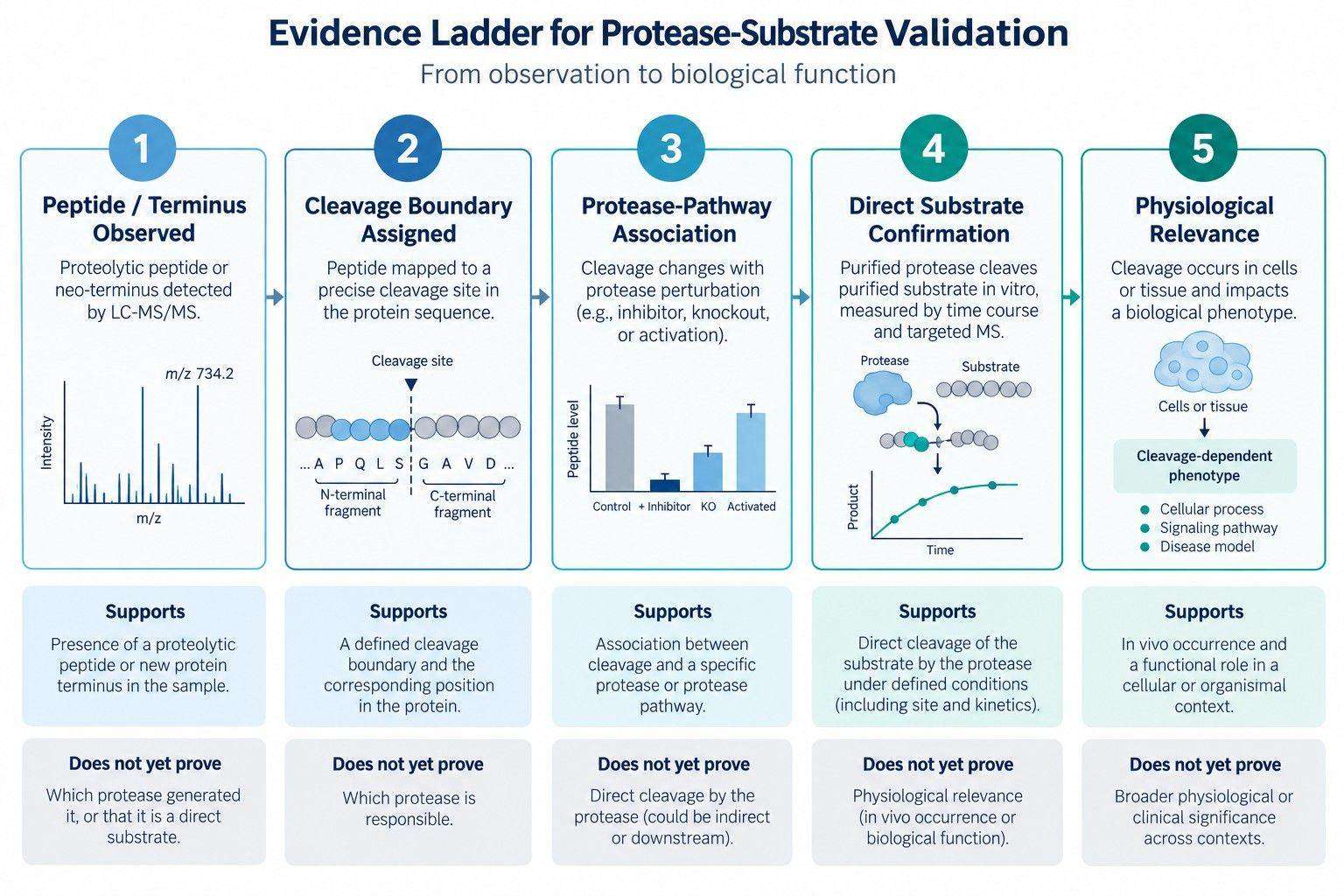
Common Failure Modes and Required Controls
Ex Vivo Proteolysis
Handling-derived fragments can be indistinguishable in sequence from genuine in vivo products. Stabilization-delay experiments, matched processing controls, rapid denaturation, cold-chain documentation, and compatible inhibitor conditions help determine whether a signal is processing-sensitive. A protease inhibitor is not automatically beneficial: incomplete coverage, inhibitor-derived MS interference, or altered extraction can introduce other biases.
Source-Protein Abundance Confounding
More substrate protein can yield more cleavage products without any increase in protease activity. Conversely, rapid destruction of a cleavage product can conceal increased proteolysis. Parallel protein-level quantification, intact-substrate measurement, or ratios between cleavage products and source protein can improve interpretation, but the appropriate normalization model depends on the biology.
Secondary Trimming
Exopeptidases can generate nested peptide ladders around an initial endoprotease cleavage. The most abundant peptide is not necessarily the primary product. Overlapping peptides should be aligned to the source protein, and termini should be examined as families rather than interpreted independently.
Motif Overinterpretation
Many proteases share partially overlapping sequence preferences, and accessibility is governed by protein structure, localization, binding partners, and inhibitor networks. A protease prediction service can prioritize hypotheses, but motif matching is not direct enzymatic evidence.
Protein Digestion Artifacts
Semi-specific peptides can arise from incomplete digestion, in-source fragmentation, or nonspecific sample processing. Terminomic labeling state and appropriate digestion controls must distinguish experimental neo-termini from preparation artifacts.
PTM and Terminal Blocking
N-terminal acetylation, pyroglutamate formation, amidation, phosphorylation, glycosylation, and disulfide connectivity can alter enrichment, fragmentation, and search behavior. Where the modification defines the mature peptide or affects capture chemistry, a PTM-aware workflow and orthogonal confirmation may be required. Dedicated peptide PTM identification can be integrated for prioritized molecular forms.
When a Combined Workflow Is Justified
A combined design is justified when the project must connect a stable peptide product to a protein-processing mechanism.
Bioactive Peptide Maturation
Endogenous peptidomics identifies precursor-derived intermediates and mature forms, while terminomics maps the source-protein boundaries that define the processing pathway. Targeted MS can then quantify selected molecular forms across a perturbation or time course.
Protease Inhibitor Mechanism Studies
Comparative terminomics can identify cleavage events suppressed by the inhibitor. Endogenous peptidomics can determine whether stable downstream peptides also decrease. Parallel proteomics is needed to distinguish cleavage changes from altered substrate expression.
Secretome and Extracellular-Matrix Remodeling
Terminomic enrichment reveals shedding and extracellular cleavage boundaries, whereas peptidomics captures stable soluble fragments that accumulate in conditioned medium or biofluids. Cell-viability controls and intracellular contamination markers are essential because lysis can release both proteases and substrate fragments.
Biomarker Development
Peptidomics may nominate stable circulating fragments whose abundance is associated with a phenotype, whereas degradomics can test whether those fragments are consistent with a reproducible processing pathway. Candidate advancement should consider sequence confidence, molecular-form specificity, pre-analytical stability, effect-size uncertainty, completeness across specimens, independence from source-protein abundance, and robustness to batch and preprocessing choices.
A discovery association does not establish biomarker performance. Verification requires a locked peptide definition and independent specimens; transition to a targeted assay requires confirmation of fragment-ion specificity, interference control, recovery, stability, matrix effects, quantitative range, and longitudinal precision. Clinical claims, where intended, additionally require validation in a representative population for a defined context of use. The value of degradomic evidence at this stage is mechanistic qualification: it can show whether a candidate fragment tracks a coherent proteolytic event rather than an unexplained abundance feature, but it does not replace analytical or clinical validation.
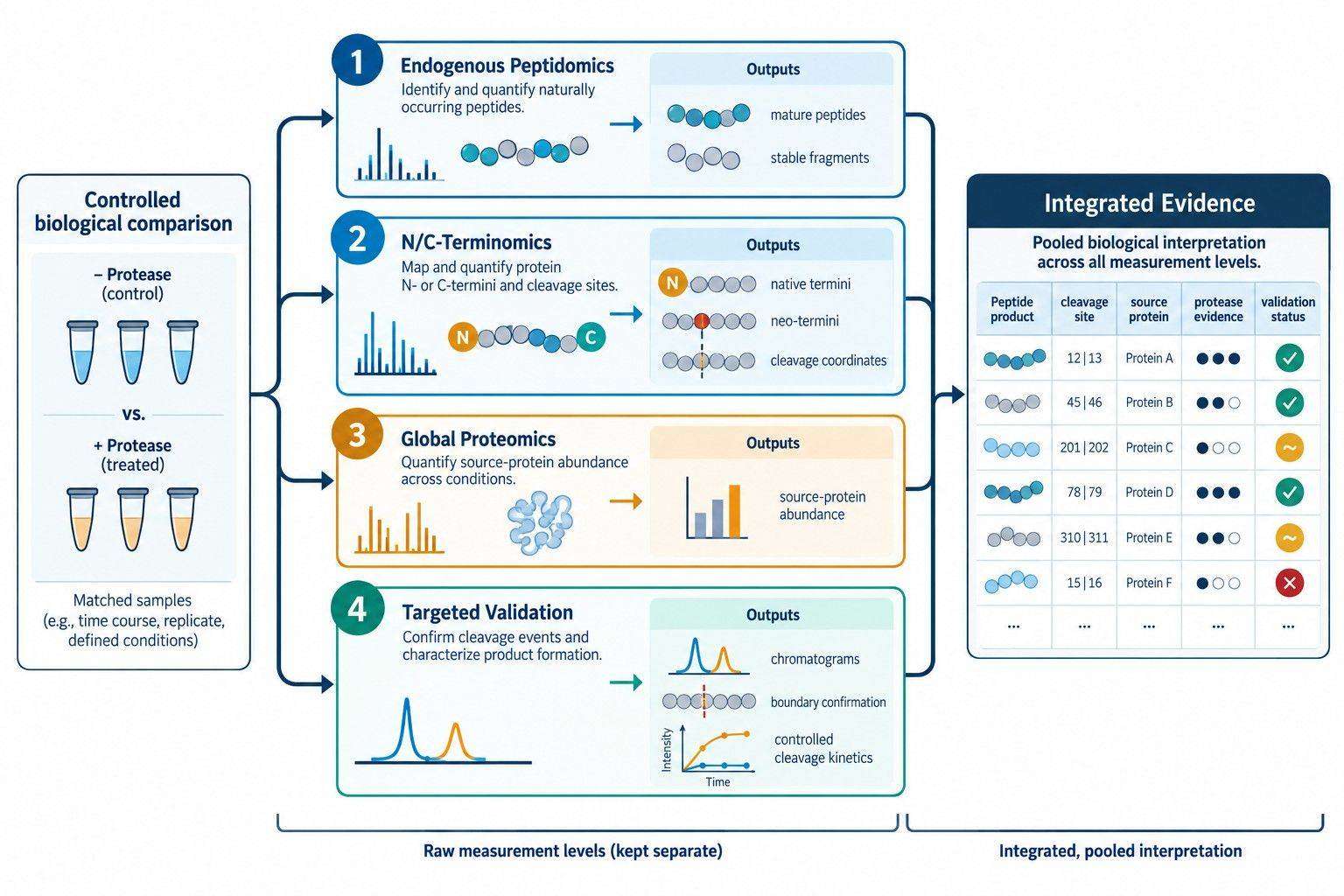
Building a Defensible Protease–Substrate Evidence Package
The final evidence package should allow a reviewer to reconstruct how an observed ion became a proposed cleavage event and, where applicable, a protease-substrate hypothesis. Spectrum-level observations, sequence and boundary annotations, perturbation evidence, protease predictions, and biochemical validation should remain distinguishable. Combining them into one undifferentiated confidence label conceals which part of the claim is measured and which part is inferred.
Candidate-level reporting is more informative than a single ranked substrate list. Each proposed event should retain the peptide or terminal sequence, source-protein coordinates, local cleavage window, terminal labeling or modification state, quantitative response, source-protein behavior, relevant processing metadata, and the experimental evidence supporting protease association. Motif or prediction results should be presented as supporting annotations rather than direct substrate evidence.
| Evidence domain | Information retained for each candidate | Interpretation enabled |
|---|---|---|
| Analytical observation | Precursor and fragment evidence, charge state, mass error, retention behavior, modification state, FDR category, and replicate detection | Whether the peptide or terminus was measured with sufficient analytical support |
| Boundary assignment | Source-protein accession and isoform, residue coordinates, native or neo-terminal classification, digestion compatibility, and local sequence window | Whether the observation supports a defined protein cleavage boundary |
| Quantitative response | Peptide- or event-level abundance, effect estimate, uncertainty, missingness, batch behavior, and perturbation response | Whether the boundary changes reproducibly under the tested biological comparison |
| Confounding assessment | Source-protein abundance, sample stabilization variables, nested peptide family, cell-lysis indicators, and relevant PTMs | Whether altered substrate availability or sample processing could explain the observation |
| Protease attribution | Specificity compatibility, localization, inhibitor or genetic evidence, catalytic controls, and direct cleavage status | Whether the result is a pathway association, a direct substrate relationship, or an unresolved hypothesis |
The conclusion should be assigned at the highest evidence level supported by the complete record, not by the strongest individual observation. A high-quality neo-terminal spectrum can establish a boundary but cannot compensate for the absence of perturbation evidence in a protease-attribution claim. Conversely, a strong phenotype following protease inhibition does not identify a specific substrate without molecular boundary evidence. This claim-by-claim structure is what makes the dataset auditable and suitable for targeted follow-up.
Frequently Asked Questions
Is every endogenous peptide a degradomics product?
Every endogenous peptide has a biosynthetic or proteolytic origin, but not every peptidomics observation is suitable for a degradomics claim. Mature peptide hormones and neuropeptides may be the functional endpoint of regulated processing, whereas many short fragments reflect secondary trimming or turnover. Degradomics focuses on the proteolytic system, substrates, and cleavage events rather than only the final peptide pool.
Can standard bottom-up proteomics replace N-terminomics?
Standard bottom-up proteomics can detect semi-specific peptides and suggest cleavage, but internal digestion peptides dominate the sample and many terminal peptides are not observed. N-terminomics adds terminal-selective chemistry and enrichment, increasing the ability to localize native and neo-N termini. Conventional proteomics remains valuable for measuring source-protein abundance and pathway context.
Does a neo-N terminus identify the responsible protease?
No. A neo-N terminus identifies a candidate cleavage boundary. Protease assignment requires additional evidence such as matched specificity, colocalization, perturbation response, inhibitor or genetic controls, and preferably reconstruction of the cleavage with purified components.
When is C-terminomics necessary?
C-terminomics is useful when the C-terminal side of the event is biologically important, when the corresponding neo-N-terminal peptide is blocked or unstable, or when complementary evidence is required for a high-priority cleavage site. Its additional chemistry and enrichment complexity should be justified by the analytical claim.
Should peptidomics and terminomics data be combined into one quantitative matrix?
Not without preserving their measurement levels. Intact endogenous peptides and terminal peptides generated after protein digestion are different analytes. They can be integrated by source protein, cleavage coordinate, pathway, or perturbation response, but raw intensities should not be treated as directly interchangeable.
What is the most convincing design for protease substrate discovery?
A comparative design that alters one protease axis while controlling source-protein abundance is the strongest discovery starting point. Examples include active versus catalytically inactive protease, wild type versus knockout, or vehicle versus selective inhibitor. High-priority candidates should then be confirmed through targeted boundary measurement and a controlled cleavage assay.
References
- Hellinger, R., Sigurdsson, A., Wu, W., et al. (2023). Peptidomics. Nature Reviews Methods Primers, 3, 25. https://doi.org/10.1038/s43586-023-00205-2
- Checco, J. W. (2023). Identifying and measuring endogenous peptides through peptidomics. ACS Chemical Neuroscience, 14(20), 3728-3731. https://doi.org/10.1021/acschemneuro.3c00546
- Mintoo, M., Chakravarty, A., & Tilvawala, R. (2021). N-Terminomics strategies for protease substrates profiling. Molecules, 26(15), 4699. https://doi.org/10.3390/molecules26154699
- Tanco, S., Gevaert, K., & Van Damme, P. (2015). C-terminomics: targeted analysis of natural and posttranslationally modified protein and peptide C-termini. Proteomics, 15(5-6), 903-914. https://doi.org/10.1002/pmic.201400362
- Niedermaier, S., & Huesgen, P. F. (2019). Positional proteomics for identification of secreted proteoforms released by site-specific processing of membrane proteins. Biochimica et Biophysica Acta - Proteins and Proteomics, 1867(12), 140138. https://doi.org/10.1016/j.bbapap.2019.06.009
- Prudova, A., auf dem Keller, U., Butler, G. S., & Overall, C. M. (2010). Multiplex N-terminome analysis of MMP-2 and MMP-9 substrate degradomes by iTRAQ-TAILS quantitative proteomics. Molecular & Cellular Proteomics, 9(5), 894-911. https://doi.org/10.1074/mcp.M000050-MCP201
- Kleifeld, O., Doucet, A., Prudova, A., et al. (2011). Identifying and quantifying proteolytic events and the natural N terminome by terminal amine isotopic labeling of substrates. Nature Protocols, 6, 1578-1611. https://doi.org/10.1038/nprot.2011.382
- Dix, M. M., Simon, G. M., & Cravatt, B. F. (2008). Global mapping of the topography and magnitude of proteolytic events in apoptosis. Cell, 134(4), 679-691. https://doi.org/10.1016/j.cell.2008.06.038
- Keller, M., & Schilling, O. (2024). Combinatorial degradomics: precision tools to unveil proteolytic processes in biological systems. Journal of Biological Chemistry, 300(7), 107347. https://doi.org/10.1016/j.jbc.2024.107347
- Staes, A., Impens, F., Van Damme, P., et al. (2011). Selecting protein N-terminal peptides by combined fractional diagonal chromatography. Nature Protocols, 6(8), 1130-1141. https://doi.org/10.1038/nprot.2011.355
- Mahrus, S., Trinidad, J. C., Barkan, D. T., et al. (2008). Global sequencing of proteolytic cleavage sites in apoptosis by specific labeling of protein N termini. Cell, 134(5), 866-876. https://doi.org/10.1016/j.cell.2008.08.012
- Shema, G., Nguyen, M. T. N., Solari, F. A., et al. (2018). Simple, scalable, and ultrasensitive tip-based identification of protease substrates. Molecular & Cellular Proteomics, 17(4), 826-834. https://doi.org/10.1074/mcp.TIR117.000302
- Tanco, S., Tort, O., Demol, H., et al. (2015). C-terminomics screen for natural substrates of cytosolic carboxypeptidase 1 reveals processing of acidic protein C termini. Molecular & Cellular Proteomics, 14(1), 177-190. https://doi.org/10.1074/mcp.M114.040360
Select a Proteolysis Workflow That Matches the Claim
Share the biological comparison, sample matrix, protease hypothesis, and required evidence level. The study can then be scoped around endogenous peptide profiling, terminomic enrichment, or an integrated validation design.
Request a Technical ConsultationRelated Peptidomics Services
For research use only. Not for use in diagnostic procedures.