Direct answer
Choose DDA when unknown peptide identities, processing patterns, and sequence evidence are the central risk. Choose DIA when a pilot has established a reliable peptide space and the main goal is comparable relative quantification across a standardized cohort. For many endogenous peptidomics projects, a DDA discovery pilot followed by DIA or targeted confirmation is the most defensible design.
Key Takeaways for DDA vs DIA Endogenous Peptidomics
- Discovery depth: DDA is the stronger first step for unknown endogenous peptides, non-canonical termini, and peptide modification hypotheses.
- Quantitative completeness: DIA can reduce stochastic precursor selection and support more consistent cohort-level measurement when peptide identification is already well controlled.
- Library strategy: A project-specific library should reflect the same species, matrix, and peptide chemistry as the main cohort; it is not interchangeable with a tryptic proteomics library.
- Low-input studies: A representative pilot is more valuable than committing the full sample set before peptide-level evidence and analytical behavior are established.
- Best practical route: DDA-to-DIA or DDA-to-PRM/MRM workflows separate discovery risk from cohort or confirmation risk.
Why DDA vs DIA Is a Study-Design Decision in Endogenous Peptidomics
Data-dependent acquisition (DDA) and data-independent acquisition (DIA) are often compared as instrument modes. In endogenous peptidomics, the choice is more consequential: it sets the balance between sequence certainty, biological coverage, quantitative completeness, sample consumption, and the type of conclusion a study can support.
Native peptides are not simply short versions of tryptic peptides. They can carry variable N- and C-termini, non-canonical cleavage products, amidation or other post-translational modifications, and wide abundance differences. Collection and preparation can also change the observed peptidome through ex vivo proteolysis. These characteristics make a generic proteomics method an unreliable default for endogenous peptide work.
The starting question should therefore be: Is the primary uncertainty peptide identity, or is it the relative behavior of a known and reproducibly measurable peptide set across samples? The answer directs acquisition, library construction, QC design, and the appropriate downstream service pathway.
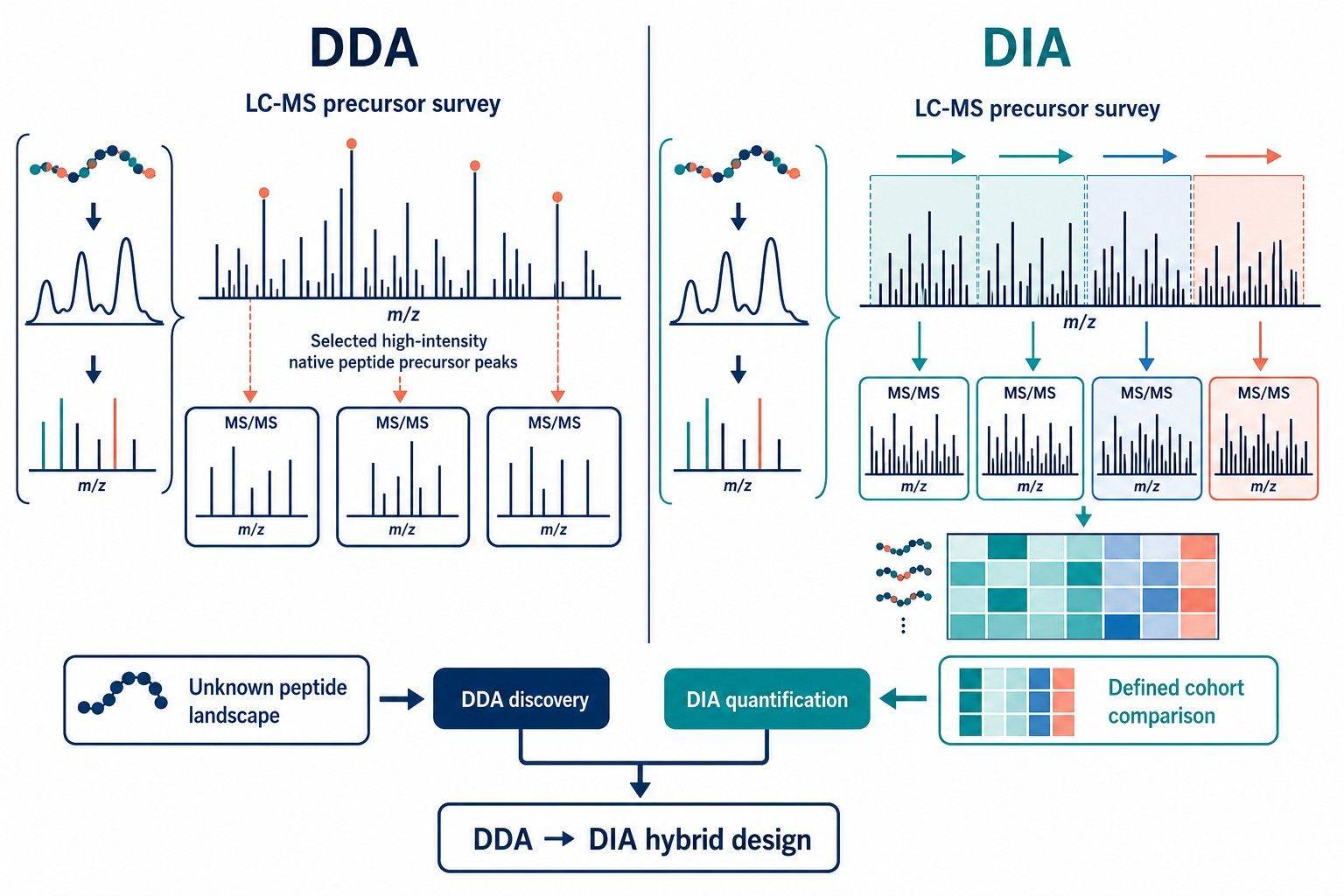
DDA for Endogenous Peptide Discovery and Sequence Characterization
DDA isolates selected precursor ions for fragmentation, typically favoring the strongest precursors in each acquisition cycle. Its primary value in endogenous peptidomics is relatively clean MS/MS evidence for peptide sequencing, termini, and modification hypotheses.
When DDA is the better first acquisition mode
- The peptide list is unknown or likely includes non-canonical processing products.
- The study needs cleavage patterns, terminal heterogeneity, or peptide PTM characterization.
- Representative material is limited and must establish feasibility before the main cohort is consumed.
- The expected next step is targeted PRM/MRM confirmation rather than a large discovery cohort.
- The essential output is a defensible peptide catalogue with MS/MS evidence, rather than only a feature-intensity matrix.
Search settings should depart from standard bottom-up proteomics defaults. Enzyme specificity may need to be relaxed; plausible peptide lengths, precursor charges, terminal forms, and modifications require an explicit plan. Peptide-level reporting is also essential because multiple mature peptides can originate from one precursor protein.
The DDA limitation: stochastic precursor selection
A low-abundance peptide can be missed in one injection because it co-elutes with stronger ions, even when an MS1 signal is present. This makes DDA-only absence difficult to interpret in a large cohort. Technical repeats can enrich a discovery catalogue, but they do not replace biological replication or convert an unselected spectrum into quantitative evidence.
The practical distinction is whether DDA is being used for catalogue building or for final comparative quantification. If the main objective is peptide identity and processing evidence, DDA is appropriate. If the objective is relative differences across many already characterized analytes, consider a DIA-compatible design or PRM-based peptide quantification.
DIA for Quantitative Completeness Across Peptidomics Cohorts
DIA samples predefined precursor windows throughout each run rather than choosing only the most intense precursors. This can provide a more consistent opportunity to measure peptides across injections, which is valuable for standardized tissue panels, time courses, perturbation studies, and other cohort-scale comparisons.
The benefit depends on whether complex fragment data can be assigned reliably for the actual native peptide population. Endogenous peptides vary in charge, termini, modifications, and co-elution behavior. A generic DIA preset should not be assumed to be fit for purpose without a matrix-matched pilot.
When DIA is the better primary comparative mode
- A defined peptide set or high-confidence project library is available from representative material.
- The study includes enough biological samples that missing-value control and cross-sample comparability are central.
- The same matrix, species, collection process, and extraction workflow can be standardized across samples.
- The expected deliverable is a relative abundance matrix across groups, time points, or perturbations.
- Pooled QC and blanks can be included to monitor retention, response stability, and feature completeness.
Do not select DIA solely because a cohort is large. If a pilot cannot provide reliable peptide assignments, a larger cohort multiplies ambiguous signals. Start with DDA discovery or a hybrid pilot when sequence space is poorly characterized; use DIA when reproducibly detectable peptide evidence already supports cohort-level comparison.
Library-Based vs Library-Free DIA for Native Peptides
The library decision can be as important as the acquisition decision. A library adds retention-time and fragment-ion expectations that can improve peptide scoring, particularly for modified and non-tryptic endogenous peptides. It also needs representative material and careful curation.
Library-based DIA
Library-based DIA is strongest when representative samples can capture the relevant peptide chemistry before the main cohort. Project-specific DDA data can record sequence form, charge, retention behavior, informative fragments, and modifications for later peptide-centric extraction. The library should match the same species, matrix, and peptide chemistry expected in the study.
Library-free DIA
Library-free DIA can be useful when material is scarce or the project must remain open to peptide forms outside an existing library. It is not an unvalidated shortcut: broad native peptide sequence space and terminal variability make appropriate databases, decoy strategy, and peptide-level validation essential. First test the m/z range, window scheme, chromatographic peak sampling, and scoring behavior in representative material.
DDA vs DIA for Endogenous Peptidomics: Side-by-Side Comparison
| Decision criterion | DDA | DIA | Planning implication |
|---|---|---|---|
| Primary strength | MS/MS-led discovery and sequence characterization | Consistent measurement opportunity across injections | Align acquisition with the dominant project endpoint. |
| Best starting point | Unknown peptide landscape, terminal forms, or modifications | Defined peptide space or a well-characterized pilot set | Use DDA before DIA when biological sequence space is uncertain. |
| Missing values in cohorts | Can rise from stochastic precursor selection | Often lower when identification and QC are well controlled | Evaluate feature completeness in a pilot, not only total IDs. |
| Spectral complexity | Selected precursor spectra are comparatively simpler | Co-isolation produces more complex fragment mixtures | DIA requires peptide-appropriate scoring and validation. |
| Library role | Can generate a project-specific library | Can use project-specific or library-free analysis | Match the library to the actual species, matrix, and peptide chemistry. |
| Low-input feasibility | Useful for targeted discovery from scarce material | Feasible only after sufficient signal and peak sampling are established | Do not commit the full cohort before a pilot confirms evidence quality. |
| Main deliverable | Peptide catalogue, sequence evidence, processing/PTM candidates | Quantitative peptide matrix with comparative statistics | Build the deliverable backward from the research question. |
The comparison is a decision aid, not an absolute ranking. DDA can produce useful relative quantitative data under the right conditions, and DIA can support discovery. The meaningful distinction is whether the project protects sequence certainty first or quantitative completeness first.
A Hybrid DDA-to-DIA Workflow for Cohort-Scale Peptidomics
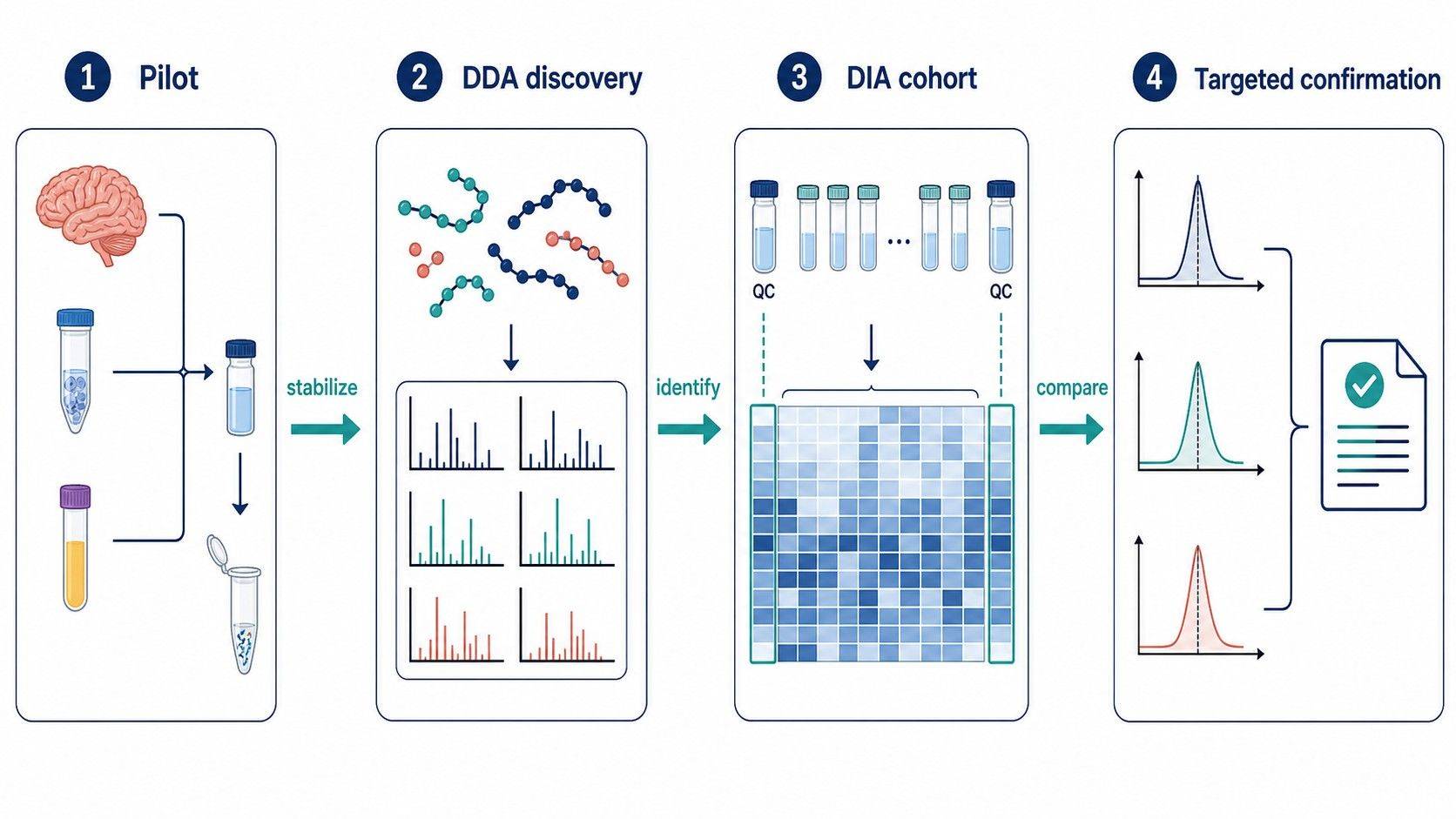
For many projects, the most useful design is not binary. A staged workflow separates discovery risk from cohort risk.
Define peptide space
Use representative samples to assess stabilization, extraction recovery, peptide chemistry, chromatographic behavior, and matrix background.
Curate DDA evidence
Build a high-confidence peptide list with false-discovery control, sequence and modification evidence, and an explicit policy for ambiguous assignments.
Scale with DIA or PRM/MRM
Use DIA for broad relative cohort quantification; use targeted methods when a short candidate list needs focused confirmation.
Report by evidence layer
Clearly distinguish discovery, relative quantification, and targeted confirmation in the final data package.
At the discovery stage, retain peptide-level outputs rather than reducing results to precursor proteins when processing is biologically important. A peptidomic data-quality assessment can help separate evidence-quality decisions from downstream interpretation before the main cohort is analyzed.
Common DDA and DIA Peptidomics Design Pitfalls
Treating endogenous peptides as standard tryptic peptides
Restrictive enzyme rules, limited modification settings, and protein-centric reporting can remove the processing information a peptidomics study is meant to capture. Design search and validation around intact endogenous sequences.
Using the full cohort to discover whether the workflow works
A large cohort cannot repair a weak pilot. Establish peptide-level evidence and quantitative suitability with representative material before consuming the main sample set.
Confusing feature counts with biological coverage
More features are not necessarily more credible peptides. Sequence confirmation, modification localization where relevant, QC consistency, and coherent cleavage patterns carry greater weight than an unfiltered feature count.
Ignoring the identification strategy
Search strategy affects overlap, missing values, and coefficients of variation in both DDA and DIA datasets. Compare acquisition modes under comparable processing principles whenever possible; otherwise, an apparent acquisition advantage may actually be a library or scoring advantage.
Adding technical replicates instead of biological replication
Technical repeats help describe analytical precision. They cannot estimate biological variability between experimental groups. Prioritize biological replication, then use pilot and QC injections to establish analytical confidence.
When Should You Choose DDA, DIA, or Targeted Peptide Quantification?
Choose DDA when the research goal is to discover and characterize unknown endogenous peptides, determine processing patterns, or build a defensible sequence-evidence layer from limited representative material.
Choose DIA when a pilot has established reliable peptide evidence and the main study needs broadly comparable relative quantification across a standardized cohort. Use a matrix- and species-relevant library when feasible, and validate a library-free strategy before scaling.
Choose targeted PRM/MRM when the candidate list is short, each peptide needs focused analytical attention, or the study needs confirmation after untargeted discovery. A dedicated endogenous peptidomics platform can support early feasibility and discovery planning before a targeted panel is finalized.
FAQ: DDA vs DIA for Endogenous Peptidomics
Can DIA identify unknown endogenous peptides?
Yes, provided each unknown peptide meets appropriate peptide-level identification criteria. DIA can support discovery through library-based or library-free analysis, but variable termini and modifications make pilot validation and search-space control essential.
Does DIA always give fewer missing values than DDA?
Not automatically. DIA reduces stochastic precursor selection, but missingness also depends on signal intensity, chromatography, acquisition windows, scoring, library quality, and QC. Evaluate it in a matrix-matched pilot rather than relying on the acquisition label.
Is a DDA spectral library necessary for DIA peptidomics?
No. Library-free DIA is possible, particularly when material is scarce. A representative project-specific library can nevertheless improve evidence and reproducibility, so the right choice depends on sample availability and the need for confident identification of native peptide forms.
Can DDA and DIA data be combined in one project?
Yes. A common design uses DDA for discovery and library generation, then DIA for broader comparative measurement. The two layers should have clearly defined roles and compatible peptide-level validation criteria.
What should be included in a peptidomics pilot study?
Include representative sample types, biological conditions where possible, procedural blanks, and pooled QC material. Test peptide stabilization, extraction, chromatographic behavior, identification quality, and quantitative completeness before the full cohort is consumed.
When is PRM or MRM better than DIA?
PRM or MRM is generally better when the study focuses on a small number of known peptide candidates and needs focused confirmation. DIA is more useful when many peptides must be compared across a cohort without reducing the study to a limited panel.
References
- Checco JW. Identifying and Measuring Endogenous Peptides through Peptidomics. ACS Chemical Neuroscience. 2023;14(20):3728-3731. doi: 10.1021/acschemneuro.3c00546.
- Phetsanthad A, Carr AV, Fields L, Li L. Definitive Screening Designs to Optimize Library-Free DIA-MS Identification and Quantification of Neuropeptides. Journal of Proteome Research. 2023;22(5):1510-1519. doi: 10.1021/acs.jproteome.3c00088.
- Fernandez-Costa C, Martinez-Bartolome S, McClatchy DB, et al. Impact of the Identification Strategy on the Reproducibility of the DDA and DIA Results. Journal of Proteome Research. 2020;19(8):3153-3161. doi: 10.1021/acs.jproteome.0c00153.
- Fan K-T, Hsu C-W, Chen Y-R. Mass spectrometry in the discovery of peptides involved in intercellular communication: From targeted to untargeted peptidomics approaches. Mass Spectrometry Reviews. 2023;42(6):2404-2425. doi: 10.1002/mas.21789.
- Fricker LD, Lim J, Pan H, Che FY. Peptidomics: Identification and Quantification of Peptides in Biological Samples. Mass Spectrometry Reviews. 2006;25(2):327-344. doi: 10.1002/mas.20078.
- Baggerman G, Verleyen P, Clynen E, et al. Peptidomics. Journal of Chromatography B. 2004;803(1):3-16. doi: 10.1016/j.jchromb.2003.10.036.
Turn Your Research Question into a Workable Peptidomics Plan
Tell us the matrix, species, group structure, available input, and the decision you need the data to support. We will help define a DDA, DIA, hybrid, or targeted workflow that fits the study.
Request a Quote