A de novo sequencing result is a scientific hypothesis supported to different degrees at different positions. The
output may contain high-confidence residue strings, mass-equivalent alternatives, inferred junctions, and regions for
which no decisive spectrum was obtained. Validation is therefore not a single score threshold. It is a structured
assessment that connects the proposed sequence back to precursor data, fragment ions, independent peptide reads,
assembly logic, and—when the intended use requires it—an orthogonal experiment.
This distinction matters because peptide-level correctness and residue-level correctness are not interchangeable. A
candidate peptide may receive a strong overall score while one internal residue is weakly localized. Conversely, a
locally ambiguous peptide can still contain a long, reliable sequence tag. At the protein level, several individually
credible peptides can remain incorrectly ordered or assigned to different proteoforms. A defensible result preserves
these evidence levels instead of compressing them into a single statement such as "high confidence" or "100%
coverage."
The validation strategy should be designed around the decision the sequence must support. Homology screening can
tolerate qualified sequence tags. Cloning, intellectual-property comparison, mutation confirmation, and therapeutic
antibody reconstruction require progressively stronger residue and assembly evidence. The objective is not to force
every position to a letter; it is to report exactly which positions are directly supported, independently
corroborated, inferred, or unresolved.
Analytical Summary
- A software confidence score is model-specific. It ranks predictions within the assumptions,
training distribution, and calibration of that tool; it is not automatically a universal probability that a residue
or peptide is correct.
- Validation begins with the raw precursor and MS/MS data. Charge, monoisotopic mass, isotope
selection, isolation purity, fragmentation continuity, mass error, and unexplained intense peaks can invalidate an
apparently plausible sequence.
- Residue confidence is local. Each residue should be evaluated from the fragment-ion boundaries on
both sides, complementary ion evidence, and compatible alternative interpretations.
- Independent overlap is stronger than repeated observation. Peptides with different enzymatic
boundaries or fragmentation behavior can confirm a junction; repeat scans of the same precursor mostly establish
reproducibility.
- Protein assembly requires another evidence layer. Peptide order, contig junctions, termini, chain
pairing, proteoform heterogeneity, and conflicts must be reviewed separately from peptide sequencing scores.
- Orthogonal evidence must answer the same claim. Intact mass, top-down data, Edman degradation,
nucleic-acid sequence, synthetic peptides, or functional assays validate different aspects and should not be treated
as interchangeable.
- A decision-ready report retains uncertainty. Ambiguous L/I assignments, PTM-versus-substitution
alternatives, unsupported gaps, and competing contigs should remain visible.
Define the Sequence Claim Before Selecting Validation Criteria
The phrase "validate the sequence" can describe several different analytical endpoints. The required evidence changes
with the claim.
| Sequence claim |
Minimum evidence question |
Typical additional evidence |
What must remain qualified |
| Sequence tag for identification |
Does a reliable residue string distinguish candidate proteins or homologs? |
Database or homology search, taxonomic consistency |
Unsequenced flanks and mass-equivalent alternatives |
| Peptide sequence assignment |
Does one precursor and its fragments support the complete proposed peptide? |
Replicate spectrum, retention behavior, complementary fragmentation |
Residues not bounded by diagnostic fragments |
| Protein sequence confirmation |
Do peptides confirm a supplied reference at the positions claimed? |
Multi-protease mapping, intact/subunit mass |
Reference-only residues without direct peptide evidence |
| Reference-free sequence assembly |
Are peptide reads ordered by unique, independent overlaps? |
Middle-down or top-down data, terminal sequencing |
Unsupported junctions, contig order, sequence gaps |
| Single-residue or variant confirmation |
Is the altered residue localized and are close alternatives excluded? |
Targeted reacquisition, synthetic standard, nucleic-acid evidence |
Isobaric or near-isobaric alternatives |
| Expression-ready full sequence |
Is every functionally or structurally critical position sufficiently resolved? |
Orthogonal terminal, intact-mass, genetic, or functional evidence |
Any unresolved position that changes the construct |
A pre-specified claim prevents two common errors. The first is using identification-grade evidence to make an
exact-sequence claim. The second is requiring exhaustive full-length reconstruction when the scientific question only
needs a discriminating sequence tag. For a truly unknown protein, unknown protein sequence analysis should define whether the
endpoint is identity, family assignment, partial sequence, or full reference-free assembly before the spectra are
interpreted.
Confirmation is not reconstruction
In sequence confirmation, a supplied reference determines residue order and fills regions not observed by LC-MS/MS.
Peptide evidence tests whether portions of that reference are compatible with the sample. In reconstruction, order
must arise from overlapping sequence reads and other experimental constraints. A high percentage of mapped residues
can support confirmation while remaining insufficient for de novo reconstruction.
Critical positions deserve stronger evidence
Not every residue carries the same decision risk. Active-site residues, complementarity-determining regions,
engineered substitutions, protease cleavage sites, terminal processing sites, disulfide-forming cysteines, and
positions that distinguish close homologs warrant targeted evidence. Validation effort should be concentrated where an
incorrect assignment would change the biological conclusion or downstream construct.
Separate Four Levels of Confidence
One number cannot adequately describe a de novo protein sequence. At minimum, four levels should be distinguished.
| Evidence level |
Unit being evaluated |
Representative measures |
Principal failure mode |
| Spectrum quality |
Precursor and MS/MS scan |
Isolation purity, signal-to-noise, fragment count, mass accuracy |
Chimeric, sparse, or misassigned spectrum |
| Peptide prediction confidence |
Complete proposed peptide |
Tool score, precursor mass agreement, explained intensity, competing candidates |
High score despite one incorrect internal segment |
| Residue or site confidence |
Individual position or junction |
Local score, bounding ions, complementary series, site-determining ions |
Local ambiguity hidden by a peptide-level score |
| Protein assembly confidence |
Ordered contig or full chain |
Independent overlaps, conflict graph, terminal support, global mass consistency |
Correct peptides joined into an incorrect sequence |
Modern algorithms may output peptide-level and amino-acid-level scores, but their numerical scales are not
interchangeable. Novor, for example, reports residue confidence on a 0–100 scale, whereas transformer-based methods
learn their own sequence probabilities. Benchmark precision depends on the test set, permitted modifications, peptide
length, charge distribution, fragmentation mode, and correctness definition. A score threshold established for one
software version or sample class should not be transferred without calibration.
Benchmark accuracy is not sample-specific certainty
Cross-species benchmarks estimate average performance against peptide-spectrum matches treated as ground truth. They
are valuable for method comparison but do not establish the correctness of a particular novel peptide. Casanovo's
2024 benchmark, for example, showed improved peptide- and amino-acid-level precision after training on a large
spectral collection, while also demonstrating that model behavior depends on the training distribution: a model
dominated by tryptic peptides produced a tryptic C-terminal bias in immunopeptidomics until it was fine-tuned on
non-enzymatic data.
The analytical implication is direct. A high model score should be reviewed more cautiously when the sample contains
unusual proteases, non-tryptic peptides, uncommon PTMs, long or highly charged precursors, atypical instruments, or
chemistry underrepresented in training data.
Local confidence must be anchored to observable evidence
A residue is most securely assigned when fragments define the cumulative mass immediately before and after that
residue. Support may come from one ion series or from complementary N- and C-terminal series. Confidence declines when
the sequence crosses a long fragmentation gap, when only low-intensity peaks support the boundary, or when multiple
residue combinations have the same cumulative mass.
Validate the Precursor Before Reading the Sequence
No interpretation of fragment ions can repair an incorrect precursor assignment. Validation should begin with the MS1
and isolation context.
Monoisotopic mass, charge, and isotope selection
The proposed peptide mass must agree with the observed neutral precursor mass after accounting for charge, isotope
selection, adducts, and specified modifications. Selecting the M+1 or M+2 isotope as monoisotopic can create a
systematic mass offset and favor an incorrect candidate. Charge-state errors change the neutral mass much more
substantially and can make an otherwise convincing fragment assignment internally inconsistent.
The tolerance should be appropriate to the instrument and calibration state, not copied from a publication. A
candidate outside the validated precursor tolerance should be rejected or explicitly investigated, even if its
predicted fragment pattern appears plausible.
Isolation purity and chimeric spectra
Co-isolated precursors can contribute product ions to the same spectrum. De novo algorithms may then construct a
hybrid sequence using peaks from different peptides. Warning signs include two incompatible ion ladders, intense
unexplained peaks, inconsistent charge-reduced products, and sequence tags that cannot coexist within the precursor
mass.
Narrower isolation, ion mobility, chromatographic separation, or targeted reacquisition can reduce the ambiguity.
Computational deconvolution may help, but a deconvolved answer should still be connected to precursor-specific
evidence. In heterogeneous samples, apparent conflict can also reflect two true proteoforms rather than one bad
spectrum.
Acquisition context is part of the evidence record
Collision energy, fragmentation mode, mass analyzer, scan resolution, dynamic exclusion, and peak processing
influence the observable ion series. Validation should retain raw files and processing parameters. A centroided peak
list alone may conceal isotope envelopes, saturation, co-isolation, or deconvolution errors needed to explain a
disputed assignment.
Evaluate Fragment-Ion Support at Residue Resolution
Fragment coverage is not the proportion of annotated peaks. It is the proportion and continuity of peptide-backbone
cleavage positions supported by assigned fragments. One cleavage may have several ions, while another has none.
Continuous ion ladders and bounding evidence
For a peptide of length n, there are n − 1 backbone cleavage positions. A residue in the interior
is bounded when fragmentation provides evidence on both sides. Consecutive b ions, y ions, c ions, or z-type ions
produce residue mass differences directly. Complementary series are particularly useful because they test the same
sequence from opposite termini.
A peptide with many annotated neutral losses but a long internal cleavage gap should not be described as uniformly
sequenced. The gap may permit alternative residue order, a modification shift, or a multi-residue substitution with
the same total mass. Residue-level maps should therefore display unsupported boundaries rather than only a global
fragment-coverage percentage.
Explained intensity and unexplained signal
Peak count treats a weak noise peak and the base peak equally. Explained intensity—the fraction of relevant spectral
intensity assigned to predicted fragments—provides another perspective, but it also requires care because dominant
internal fragments, neutral losses, immonium ions, and contaminants can distort the measure. The strongest practice
combines ion-series continuity, mass accuracy, intensity, and the absence of a credible competing sequence.
Research on Novor and DeepNovo across eight datasets found that fewer than 11% of correct predictions for either
algorithm came from spectra with more than one missing fragmentation cleavage, and that high-intensity noise degraded
performance. This does not create a universal acceptance rule; it demonstrates why missing boundaries and unexplained
intense peaks should be explicit validation variables.
Complementary fragmentation modes
HCD or CID commonly supplies b/y ladders, whereas ETD or EThcD can preserve labile modifications and produce c/z-type
evidence for multiply charged peptides. The two modes are not merely duplicate acquisitions. They may expose different
backbone cleavages, distinguish a PTM location, or provide side-chain fragments relevant to isomeric residues.
Mass spectrometry-based protein sequencing is most
informative when fragmentation is selected for the precursor and validation question. An ETD spectrum with inadequate
precursor charge does not constitute meaningful orthogonal support simply because it uses a different activation
method.
 Figure 1. De novo sequence validation proceeds from precursor integrity and fragment-ion continuity to residue confidence, independent peptide overlap, protein assembly, and fit-for-purpose orthogonal confirmation.
Test Plausible Alternative Sequences Explicitly
Manual validation is not complete when the proposed sequence can be annotated. The relevant question is whether the
spectrum discriminates that sequence from the strongest alternatives.
| Ambiguity class |
Why MS/MS can be non-discriminating |
Evidence that can resolve or constrain it |
| Leucine versus isoleucine |
Identical elemental composition and nominal/exact residue mass |
Diagnostic side-chain fragments under suitable methods, ion mobility or specialized chemistry, Edman or
genetic evidence |
| Lysine versus glutamine |
Small exact-mass difference; difficult at inadequate resolution or calibration |
High-resolution fragments bracketing the residue, enzymatic specificity, complementary spectra |
| Oxidized methionine versus phenylalanine |
Close masses and variable oxidation behavior |
Accurate fragment masses, oxidation-specific products, controlled preparation, alternative candidate scoring
|
| Asparagine versus glycine-glycine |
Similar cumulative mass |
Ions within the two-residue interval, independent overlapping peptide, complementary fragmentation |
| Glutamine versus alanine-glycine or glycine-alanine |
Similar cumulative mass |
Internal boundary ions, overlap with shifted peptide boundaries |
| PTM versus amino-acid substitution |
Same or near-identical net mass shift can localize to different sites |
Site-determining ions, open search, targeted fragmentation, orthogonal chemistry or genetics |
| Residue-block reversal |
Missing internal cleavage leaves order undetermined |
A spectrum that cleaves inside the block or an independently overlapping peptide |
Isobaric and near-isobaric assignments
I/L should ordinarily be reported as an unresolved isobaric site unless the method supplies diagnostic evidence. A
homolog or germline can suggest the more likely residue, but this remains reference-guided inference. K/Q and
oxidized-M/F are distinguishable in principle by sufficiently accurate mass measurements, yet the practical result
depends on fragment resolution, calibration, and whether diagnostic ions are observed.
Composite alternatives such as N versus GG are easily overlooked because the precursor masses can remain compatible.
The decisive evidence is often a fragment inside the alternative block. Without it, a single-letter display can
overstate what the spectrum establishes.
PTM, artifact, or sequence change
Deamidation, oxidation, carbamylation, alkylation side products, in-source loss, and sample-processing artifacts can
mimic biological sequence differences. Candidate generation should include chemically plausible modifications and
preparation-specific artifacts. At the same time, an unrestricted modification list increases the search space and can
manufacture explanations for noise. The final assignment should be supported by site-localizing ions and, when
relevant, by untreated controls or alternate preparation conditions.
Homology can guide, but it must not decide silently
Reference sequences are useful for identifying likely frameworks, prioritizing candidate residues, and locating
expected domains. They also introduce confirmation bias. A sequence should distinguish residues read from the spectrum
from residues copied or imputed from a homolog. If two candidates receive similar spectral support, homology may rank
them for follow-up but should not convert the position into direct experimental confirmation.
Use Independent Peptide Overlaps to Validate Sequence and Order
The most powerful bottom-up validation moves an uncertain position into a second peptide with different boundaries.
This can change the ion series, charge state, retention behavior, and susceptibility to co-isolation.
What counts as independent support
Strong overlap evidence may include:
- peptides produced by different proteases that span the same residue or contig junction;
- semi-specific peptides with experimentally credible cleavage boundaries;
- a missed-cleavage peptide spanning two shorter reads;
- the same region observed with complementary fragmentation and useful diagnostic ions;
- middle-down fragments connecting bottom-up contigs; or
- targeted reacquisition of a distinct precursor that contains the disputed position.
Repeat MS/MS scans of the same precursor establish technical reproducibility but do not create a new assembly
boundary. Different charge states can change fragmentation and add evidence, yet they may still originate from the
same peptide population and should not automatically be counted as independent sequence overlaps.
Overlap length alone does not establish uniqueness
An overlap is informative when its confident residue pattern places the reads uniquely. Low-complexity motifs,
repeated domains, conserved antibody frameworks, and short mass tags can join unrelated peptides. Assembly should
consider sequence uniqueness, orientation, residue confidence within the overlap, and whether the non-overlapping
flanks are mutually compatible.
A multi-protease design is valuable because it deliberately shifts peptide termini. Mirror-protease research
published in 2026 illustrates the analytical principle: complementary cleavage and fragment evidence can increase the
number of fully supported residues. The study's definition of a "high-confidence" peptide—100% ion coverage among
the peaks considered—is a method-specific criterion, not a universal substitute for protein-level assembly validation.
Conflicts are evidence, not noise to delete
Two overlapping peptides may disagree because of an incorrect de novo read, chimeric spectrum, modification
mislocalization, sample contamination, paralog, allelic variant, or proteoform mixture. The conflict should be
retained until its source is resolved. Selecting the higher score without examining spectrum quality and sample
heterogeneity can erase a real biological variant.
Validate the Protein Assembly Separately
After peptides are accepted, the sequence still requires protein-level validation. De novo protein sequencing and mutation analysis
should separate read generation from contig construction and final sequence adjudication.
Junctions, contigs, and termini
Every contig junction should be supported by at least one unique overlap, and critical junctions should ideally have
independent support. Terminal assignments require peptides that reach the mature terminus or an orthogonal terminal
method. A peptide mapped near the N- or C-terminus does not prove that no residues precede or follow it.
Long uncovered regions must remain sequence gaps unless another experiment supplies their order. A reference may
provide a proposed fill, but the report should label it as inferred. The same applies to signal-peptide removal,
initiator methionine processing, truncation, and proteolytic maturation.
Global mass consistency
Intact or subunit mass can test whether the assembled sequence plus specified modifications is globally compatible
with the sample. Agreement is valuable but non-unique: many sequence permutations share the same mass, and
compensating errors can cancel. A mass discrepancy signals missing residues, unexpected processing, adducts,
glycoforms, or incorrect modification accounting, but mass agreement alone does not prove residue order.
Protein full-length sequencing benefits from combining bottom-up
overlaps with middle-down, top-down, terminal, and intact-mass evidence. The combination should be described as
convergent evidence rather than a single composite confidence percentage unless the calculation has been explicitly
defined and validated.
Mixtures and chain pairing
In antibody or paralog mixtures, individually correct peptides may derive from different molecules. Co-fractionation,
non-reduced disulfide-linked peptides, middle-down fragments, and quantitative correlation across fractions can
constrain chain or domain pairing. A 2024 polyclonal antibody study combined overlapping peptides, middle-down data,
non-reducing experiments, native separation, B-cell repertoire information, recombinant expression, binding
measurements, and neutralization assays. The study illustrates why peptide overlap alone may not establish which
variable regions belong to the same antibody.
Select Orthogonal Evidence That Addresses the Residual Risk
Orthogonal validation is most efficient when it targets a defined unresolved claim rather than repeating a broad
measurement.
| Orthogonal approach |
Claim it can support |
Important limitation |
| Targeted LC-MS/MS with alternate fragmentation |
Residue order, PTM localization, disputed cleavage boundary |
Still mass-spectrometric and may repeat the same blind spot |
| Synthetic peptide comparison |
Fragmentation and retention agreement for a candidate peptide |
Co-elution and spectral similarity may not resolve all isomers; standard quality matters |
| Edman degradation |
Accessible N-terminal residue order |
Requires sufficient purity/amount and an unblocked terminus; limited read length |
| Top-down or middle-down MS |
Long-range connectivity, proteoform and terminal constraints |
Fragmentation gaps and spectral complexity can remain |
| Intact or subunit mass |
Global composition and processing consistency |
Does not establish sequence order or localize compensating differences |
| DNA, RNA, or construct sequencing |
Encoded amino-acid sequence |
Does not prove the mature protein molecule, PTMs, processing, or sample identity by itself |
| Recombinant expression and function |
Compatibility of the assembled construct with expected activity |
A functional product supports plausibility but cannot prove every residue is correct |
Targeted reacquisition and synthetic standards
Targeted acquisition can increase ion statistics, isolate the precursor more cleanly, and apply collision-energy or
fragmentation-mode optimization. A synthetic candidate peptide enables side-by-side comparison of precursor behavior,
retention time, and MS/MS. The comparison should specify chromatographic conditions, instrument method, similarity
metric, and whether the endogenous and synthetic materials were co-injected.
Retention time is supportive rather than definitive because positional and stereochemical isomers can behave
similarly. Published work has shown that retention-time information can improve de novo identification rates when
integrated with spectral scoring, but the study also emphasized that a simplified scoring model is not sufficient for
routine real-world validation.
Edman, genetic, and functional evidence
Edman degradation is valuable for an accessible N-terminus and can resolve residue order without relying on MS/MS
fragmentation. It cannot validate internal regions unless the protein is first cleaved and isolated. Genetic evidence
is powerful for encoded substitutions but should be reconciled with the actual protein sample, especially where
maturation, heterogeneity, or contamination is possible.
Functional testing is particularly useful when sequence assembly is intended to recover an antibody or enzyme. It
tests whether the proposed construct produces the expected phenotype. Function is nevertheless an indirect sequence
test: conservative errors may preserve activity, and loss of activity can arise from expression, folding,
glycosylation, or assay conditions rather than sequence error.
Evidence Grading for a Final Sequence
A practical validation scheme assigns each position or segment an evidence class. The labels should be defined in the
report and should not imply a universal regulatory standard.
| Evidence grade |
Recommended interpretation |
Example basis |
| Directly spectrum-supported |
Residue boundaries are supported within a reviewed peptide spectrum |
Continuous diagnostic ion ladder with acceptable mass error |
| Independently corroborated |
Position is supported in at least two analytically distinct peptide contexts |
Different protease boundaries or complementary long-range read |
| Assembly-supported |
Order is established by a unique, high-confidence overlap |
Two accepted reads with a junction-spanning peptide |
| Reference-guided |
Residue is proposed from a homolog, germline, or supplied construct |
No decisive sample-derived fragment at the position |
| Orthogonally confirmed |
A separate analytical principle addresses the same sequence claim |
Edman read, genetic confirmation, or matched synthetic standard |
| Unresolved or conflicting |
Evidence does not distinguish alternatives or accepted reads disagree |
L/I site, unsupported block order, competing proteoforms |
The classes can coexist. A residue may be directly supported by HCD and orthogonally confirmed by Edman. A contig
junction may be assembly-supported but contain an unresolved L/I position. The final sequence map should preserve both
dimensions.
Decision-Ready Reporting
A validation report should allow another scientist to trace the final sequence to the evidence without rerunning the
entire analysis. At minimum, include:
- the analytical objective and exact sequence claim;
- sample identity, purity considerations, preparation, proteases, and reduction/alkylation conditions;
- LC-MS/MS acquisition parameters relevant to mass accuracy, isolation, and fragmentation;
- software names, versions, model weights where applicable, search space, PTMs, enzyme rules, and thresholds;
- precursor-level QC and annotated spectra for all critical peptides;
- peptide- and residue-level confidence values with their operational definitions;
- a fragment-coverage map showing unsupported cleavage positions;
- an overlap map identifying digest origin and independent support;
- contig junctions, termini, conflicts, discarded alternatives, and the reason for adjudication;
- intact/subunit mass reconciliation and any unexplained mass difference;
- orthogonal validation results and the claim each experiment addresses; and
- a final FASTA or sequence table in which inferred and unresolved positions are machine-readable.
Avoid replacing this evidence package with a single "average local confidence" value. An average can conceal one
critical low-confidence residue. Report thresholds as analysis-specific acceptance rules and include the calibration
or benchmark used to select them.
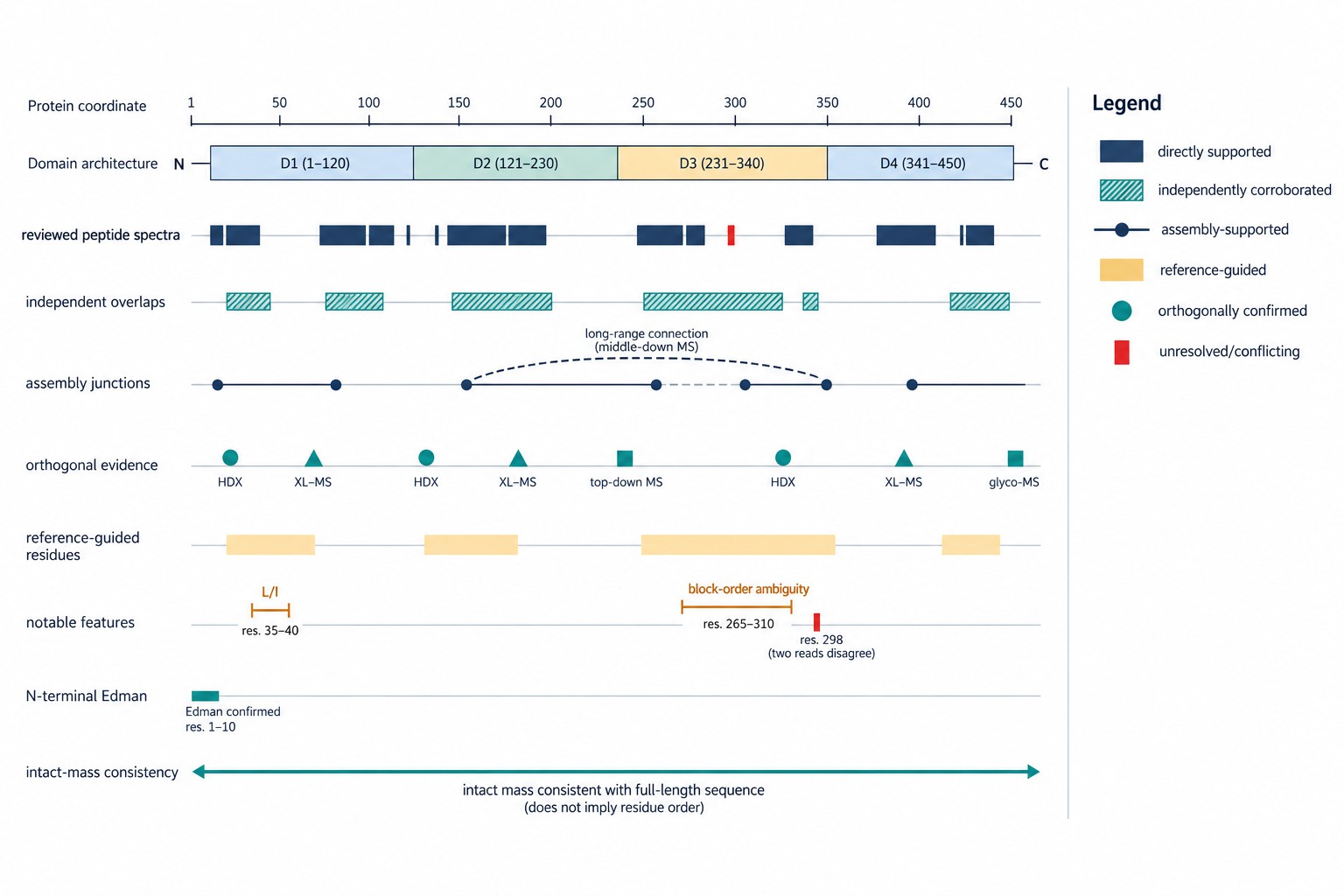 Figure 2. A decision-ready sequence map separates directly supported residues, independent overlaps, reference-guided segments, orthogonal confirmation, unresolved alternatives, and assembly conflicts.
Common Validation Failures
Treating a high de novo score as proof
The score ranks candidates according to a model; it does not replace precursor review, local fragment evidence, or
alternate-sequence testing. Calibration can shift between instruments, sample types, and software versions.
Counting coverage instead of evidence
Sequence coverage answers whether accepted peptides map to positions. It does not show whether every residue was
sequenced, whether adjacent peptides overlap, or whether a junction was reconstructed independently of a reference.
Using the same evidence twice
A database match created from a de novo sequence is not necessarily independent validation if the same spectrum
generated both. Likewise, repeated scans or charge states of the same peptide should not be presented as multiple
independent overlaps without qualification.
Hiding ambiguity in a single FASTA string
FASTA format encourages one letter per position, but the analytical result may be L/I, one of two residue blocks, or
a gap. Use explicit ambiguity codes, companion evidence tables, or multiple candidates. The delivery format must not
overrule the evidence.
Assuming orthogonal means conclusive
Intact mass can agree with an incorrect residue order. DNA can encode a sequence that is not the mature sampled
protein. Function can tolerate sequence errors. Each orthogonal method must be interpreted against the specific
residual risk.
Frequently Asked Questions
What de novo score is high enough to validate a peptide?
There is no universal cutoff. Use a threshold calibrated for the software version, instrument, fragmentation method,
peptide class, PTM space, and intended claim. Critical peptides should also pass precursor, spectrum, residue-level,
and alternative-candidate review.
Is 100% protein sequence coverage equivalent to a validated full sequence?
No. Mapped peptides may cover every reference position without independently establishing residue order, peptide
junctions, termini, isobaric assignments, or proteoform connectivity. Full-sequence validation requires an evidence
map, not only a coverage percentage.
How many overlapping peptides are required at each residue?
No fixed number applies universally. One high-quality peptide may be sufficient for a low-risk position, whereas a
critical mutation or contig junction may require a second peptide with different boundaries, complementary
fragmentation, or orthogonal evidence. Independence and diagnostic value matter more than raw count.
Can database searching validate a de novo sequence?
It can show consistency with a known or custom database and help identify homologs, contaminants, or alternative
peptides. It is not independent when the de novo sequence was inserted into the same database and evaluated with the
same spectra. Database agreement also cannot resolve residues absent from the reference.
How should L/I positions be reported?
Report them as unresolved L/I unless diagnostic side-chain fragmentation, specialized chemistry, Edman degradation,
genetic evidence, or another validated method distinguishes them. Homology alone should be labeled as reference-guided
inference.
When is a synthetic peptide needed?
It is most useful when one peptide controls a high-impact decision and spectral interpretation, retention time, or
PTM localization remains disputed. The endogenous and synthetic peptides should be analyzed under comparable
conditions, ideally with co-injection where appropriate.
Does nucleic-acid sequencing prove the protein sequence?
It confirms the encoded sequence of the sampled genetic material. It does not by itself establish which protein
molecule was present, its mature termini, PTMs, proteolytic processing, disulfide pairing, or whether a mixture was
correctly assigned.
What should be delivered when a residue cannot be resolved?
Deliver the competing candidates, their exact location, supporting and contradictory evidence, and the experiment
most likely to resolve the site. An unresolved position is a valid analytical conclusion and is preferable to an
unsupported single-letter assignment.
References
- Ma B. Novor: Real-Time
Peptide de Novo Sequencing Software. Journal of the American Society for Mass Spectrometry.
2015;26:1885–1894. doi:10.1007/s13361-015-1204-0.
- Yilmaz M, Fondrie WE, Bittremieux W, et al. Sequence-to-sequence translation from mass spectra to peptides with a transformer
model. Nature Communications. 2024;15:6427. doi:10.1038/s41467-024-49731-x.
- McDonnell K, Howley E, Abram F. The impact of noise and missing fragmentation cleavages on de novo peptide identification
algorithms. Computational and Structural Biotechnology Journal. 2022;20:1402–1412.
doi:10.1016/j.csbj.2022.03.008.
- Johnson RS, Searle BC, Nunn BL, et al. Assessing Protein Sequence Database Suitability Using De Novo Sequencing.
Molecular & Cellular Proteomics. 2020;19:198–208. doi:10.1074/mcp.TIR119.001752.
- Vyatkina K. Validation
of De Novo Peptide Sequences with Bottom-Up Tag Convolution. Proteomes. 2022;10:1.
doi:10.3390/proteomes10010001.
- Guthals A, Clauser KR, Frank AM, Bandeira N. Sequencing-grade de novo analysis of MS/MS triplets (CID/HCD/ETD) from overlapping peptides.
Journal of Proteome Research. 2013;12:2846–2857. doi:10.1021/pr400173d.
- Frank Y, Hruz T, Tschager T, Venzin V. Improved de novo peptide sequencing using LC retention time information.
Algorithms for Molecular Biology. 2018;13:14. doi:10.1186/s13015-018-0132-5.
- Le Bihan T, Nunez de Villavicencio Diaz T, Reitzel C, et al. De novo protein
sequencing of antibodies for identification of neutralizing antibodies in human plasma post SARS-CoV-2
vaccination. Nature Communications. 2024;15:8790. doi:10.1038/s41467-024-53105-8.
- Cao Z, Peng X, Zhang D, et al. DiNovo enables high-coverage and high-confidence de novo peptide sequencing via mirror proteases
and deep learning. Nature Communications. 2026;17:2203. doi:10.1038/s41467-026-70224-6.
For research use only, not intended for any clinical use.


