"Unknown protein" can describe several analytically different samples: an excised gel band with no assigned identity, a purified bioactive protein from a poorly annotated organism, a recombinant product whose reference sequence is uncertain, or a protein for which the complete amino-acid sequence must be reconstructed. These projects do not require the same LC-MS/MS strategy or produce the same type of result.
Database-dependent protein identification assigns observed peptide spectra to sequences already represented in a FASTA database. De novo peptide sequencing infers amino-acid order directly from product-ion spectra without requiring the correct peptide sequence to be present in the initial database. Complete protein sequence determination is a further task: de novo peptide sequences must be validated, overlapped, assembled, and supplemented where sequence gaps or isomeric ambiguities remain.
Method selection should therefore begin with the required analytical claim. A protein name or homolog assignment may be sufficient for an exploratory gel-band study, whereas recombinant asset recovery, mutation analysis, or characterization of a genuinely undocumented protein may require a hybrid workflow combining database search, de novo sequencing, sequence-similarity analysis, complementary proteolysis, and targeted confirmation.
Analytical Summary
- Protein identification and protein sequence determination are different deliverables. Identification can be supported by a limited set of sequence-unique peptides; complete sequence determination requires evidence across the entire polypeptide chain.
- Database search is reference-dependent. It is efficient when the correct protein, construct, or close homolog is represented in the search space, but it cannot identify a sequence that has been excluded from that space.
- De novo sequencing operates at the peptide-spectrum level. A predicted peptide sequence or sequence tag is not automatically a full-length protein sequence.
- No database match is not evidence of novelty by itself. Low abundance, contamination, inadequate digestion, incomplete fragmentation, inappropriate search settings, and unmodeled modifications can all produce unmatched spectra.
- Hybrid analysis is frequently the most informative strategy. High-confidence database matches establish known components, while de novo interpretation and homology searching focus effort on informative unmatched spectra.
Definition of the Analytical Objective
The phrase "identify my unknown protein" should be translated into a specific evidence requirement before sample preparation begins. The first distinction is whether the project needs an identity assignment against an existing reference or experimental determination of previously unavailable sequence.
| Analytical objective |
Primary question |
Typical result |
Principal limitation |
| Protein identification |
Which known protein or protein group best explains the observed peptides? |
Database accession, protein name, unique peptides, score, and sequence coverage |
Limited by database content and protein inference |
| Homolog identification |
Which known protein family or related-species sequence is most similar to the observed data? |
Candidate homolog supported by exact peptides and/or de novo sequence tags |
Does not establish identity at every differing residue |
| Reference-based sequence confirmation |
Does the sample support a supplied construct or expected protein sequence? |
Peptide coverage map with MS/MS evidence across required regions |
Cannot recover sequence absent from the supplied reference without an expanded analysis |
| De novo peptide sequencing |
What peptide sequence best explains an MS/MS spectrum without assuming a database sequence? |
Full or partial peptide sequence with residue-level confidence |
Incomplete fragmentation and isomeric residues can leave ambiguous positions |
| Full protein sequence determination |
What is the experimentally supported amino-acid sequence of the protein? |
Assembled overlapping peptides, coverage map, terminal evidence, and unresolved-position report |
Requires dense, complementary data and may remain incomplete at difficult regions |
"Unknown" does not necessarily mean absent from a database
An unlabelled band from a human, mouse, bacterial, or other well-annotated system may be unknown to the investigator but already well represented in UniProt, RefSeq, or a project-specific proteome. In this situation, routine bottom-up LC-MS/MS followed by an appropriately constrained database search is normally the logical first analysis.
A different problem arises when the organism has no reliable genome annotation, the expressed construct differs from the registered sequence, the sample contains an undocumented natural product, or the project requires residue-level reconstruction rather than a name. Here, de novo sequence tags and similarity searching may be necessary even if related proteins exist in public databases.
Identification does not establish the complete primary structure
Several unique tryptic peptides can identify a protein with high confidence while leaving most of its sequence experimentally unobserved. This may be sufficient to name a gel band, but it does not confirm termini, processing sites, sequence variants, or every residue in the mature protein. The report should state whether the result is a protein identification, a homolog assignment, partial sequence determination, or full primary-sequence characterization.
Database-Dependent Identification of an Unknown Protein
In a conventional bottom-up workflow, the protein is reduced, alkylated where appropriate, and digested with a protease such as trypsin. Peptides are separated by liquid chromatography, precursor ions are selected for fragmentation, and the resulting MS/MS spectra are compared with theoretical spectra derived from a sequence database.
The search engine does not read the protein name directly from the spectrum. It ranks peptide-spectrum matches within a defined candidate space. Protein-level results are then inferred from the accepted peptide assignments.
Database design is part of the analytical method
The database should reflect the sample origin and project hypothesis. Relevant elements can include:
- the expected organism or taxonomic group;
- a custom expression-construct sequence;
- common laboratory and sample-preparation contaminants;
- host-cell proteins where a recombinant product is analyzed;
- related-species sequences when the target organism is incompletely annotated;
- plausible signal-peptide, propeptide, tag, linker, or vector-derived regions; and
- known variants or translated transcriptomic/genomic sequences when available.
An excessively narrow database can exclude the correct answer. An unnecessarily broad database increases the candidate search space, complicates false-discovery control, and can produce indistinguishable protein groups. Database name, version, download date, taxonomy, and custom entries should therefore be reported.
Search parameters determine which explanations are considered
Enzyme specificity, allowed missed cleavages, precursor and product-ion mass tolerances, fixed and variable modifications, minimum peptide length, and charge-state handling all affect identification. A fully tryptic search may miss endogenous cleavage products or unexpected processing events. Conversely, an unrestricted nonspecific search with many variable modifications can create a very large search space and increase false assignments.
A staged approach is more interpretable: begin with justified parameters, evaluate high-confidence matches, then expand enzyme specificity or modification hypotheses when the unexplained spectra and experimental context support that decision. For a known or suspected reference sequence, peptide mapping provides a suitable framework for evaluating expected peptides, sequence coverage, and site-specific differences.
Peptide confidence and protein inference require separate review
Target-decoy false discovery rate, PSM score, mass error, fragment-ion agreement, and peptide uniqueness contribute different information. A peptide accepted at a global FDR threshold may still require direct spectrum review when it is the sole evidence for a protein, a critical sequence variant, or a distinction between close homologs.
Shared peptides cannot uniquely distinguish proteins that contain the same subsequence. The report should identify sequence-unique peptides, razor or shared peptides where applicable, the number of accepted spectra, and any protein-group ambiguity. A high protein score does not convert non-unique peptides into unique evidence.
Reference-Free De Novo Peptide Sequencing
De novo peptide sequencing infers amino-acid order from mass differences between product ions in an MS/MS spectrum. Depending on the fragmentation method, sequence information may be represented by b- and y-type ions, c- and z-type ions, or complementary ion series. Modern algorithms use graph-based, dynamic-programming, or machine-learning approaches to rank sequences that explain the precursor mass and observed product ions.
The term "reference-free" describes the initial sequence inference step. It does not mean that databases, homologs, known residue chemistry, or orthogonal evidence have no role in validation. De novo predictions are commonly converted into sequence tags and compared with homologous proteins, translated nucleotide data, or candidate constructs.
Spectrum quality controls the available sequence information
Before interpreting a de novo result, the following should be evaluated:
- correct precursor charge and monoisotopic mass assignment;
- isolation purity and evidence of co-fragmented precursors;
- number and continuity of sequence-informative product ions;
- precursor and fragment mass accuracy;
- unexplained high-intensity peaks and neutral losses;
- compatibility between predicted sequence mass and precursor mass;
- consistency with protease cleavage behavior; and
- residue-level confidence rather than only a peptide-level score.
Short or discontinuous product-ion series may yield only a partial sequence tag. Internal residues can remain ambiguous when neither ion series spans the relevant backbone cleavage. Chimeric spectra can combine fragments from more than one precursor and create an apparently plausible but chemically inconsistent sequence.
Isomeric and near-isobaric assignments require explicit qualification
Leucine and isoleucine have the same residue mass and are generally not distinguished by routine precursor mass or conventional collision-induced product-ion series. Other mass coincidences can occur between amino-acid combinations, chemical modifications, and substitutions. A de novo result should preserve unresolved positions—for example, Leu/Ile—unless specialized fragmentation, chemical derivatization, genetic information, homolog evidence, or another orthogonal method resolves them.
De novo peptide sequencing is not complete protein sequencing
One high-quality spectrum can establish a useful sequence tag or, in favorable cases, a complete peptide sequence. A full protein sequence requires multiple peptide sequences that overlap across the polypeptide chain. Complementary proteases redraw peptide boundaries and can place previously terminal or poorly fragmented residues inside a better-supported peptide.
Protein-level assembly should track which residues are supported by overlapping peptides, which are inferred from homology, which depend on a single spectrum, and which remain unresolved. N- and C-terminal regions, disulfide-linked peptides, glycosylated regions, hydrophobic segments, and low-abundance proteoforms may require dedicated methods. When the project requires extensive sequence reconstruction rather than a protein name, de novo protein and peptide sequencing should be designed as a multi-evidence workflow rather than a single software search.
Hybrid Database, De Novo, and Homology-Assisted Analysis
Database search and de novo sequencing are not mutually exclusive. A layered workflow uses each method where it provides the strongest evidence and limits expensive manual interpretation to spectra that can change the project conclusion.
- Define the biological and analytical context. Record sample origin, purification history, apparent molecular mass, expected modifications, known activity, candidate species, and available sequence information.
- Perform a constrained database search. Identify known proteins, expected constructs, contaminants, and exact homologs with suitable peptide- and protein-level controls.
- Review protein inference and coverage. Separate unique from shared evidence and identify regions or spectra that remain unexplained.
- Apply an expanded or error-tolerant search where justified. Test plausible processing events, modifications, substitutions, or database additions without opening an uncontrolled hypothesis space.
- Select high-quality unmatched spectra for de novo interpretation. Prioritize spectra with confident precursor assignment, informative product-ion series, and reproducibility.
- Use sequence tags for similarity searching. Compare multiple partially independent tags with homologous proteins or translated genomic/transcriptomic sequences.
- Design targeted confirmation. Acquire MS/MS for diagnostic peptides, introduce a complementary protease, or add intact, terminal, or other orthogonal evidence.
- Classify the final conclusion. Report known-protein identification, protein-family assignment, partial de novo sequence, or full sequence determination according to the achieved evidence.
This strategy reduces reference bias without treating every unmatched spectrum as a novel sequence. It also retains the statistical and interpretive advantages of database searching for the portions of the dataset that are adequately represented.
 Figure 1. Layered use of database search, de novo sequence inference, homology analysis, and targeted confirmation for unknown-protein projects.
Sample and Data Requirements
Sample composition determines whether the output can be interpreted at the protein level. An isolated gel band is simpler than an unfractionated lysate, but even a visually discrete band can contain co-migrating proteins, keratins, enzymes, or staining-related contaminants. A purified active fraction may still contain several components, so bioactivity alone cannot assign the detected sequence to the active molecule.
| Sample context |
Primary analytical concern |
Practical planning information |
| Excised gel band |
Co-migrating proteins, keratin contamination, fixation or staining effects |
Organism, stain, apparent molecular mass, gel image, band location, and biological context |
| Purified protein in solution |
Buffer incompatibility, carrier proteins, multiple molecular forms |
Concentration, buffer composition, purification method, intact mass or gel data, and expected oligomeric state |
| Bioactive chromatographic fraction |
Activity may not belong to the most abundant detected protein |
Fractionation history, activity assay, adjacent fractions, and negative controls |
| Poorly annotated organism |
Correct sequence may be absent from standard databases |
Taxonomy, related species, available genome/transcriptome data, and expected protein family |
| Recombinant product with uncertain sequence |
Construct mismatch, processing, tag retention, or host contaminants |
Vector/construct sequence, host, signal peptide, tags, cleavage sites, and expected mature form |
| Modified or glycosylated protein |
Heterogeneous peptides and modification-dependent fragmentation |
Known PTMs, treatment history, glycosylation expectations, and whether sequence or modification mapping is the priority |
| Endogenous peptide |
Unknown cleavage specificity and short sequence length |
Extraction method, molecular-mass range, biological matrix, and expected terminal modifications |
Increasing sample amount does not compensate for uncontrolled complexity. For unknown-protein sequence work, enrichment and orthogonal fraction evidence can be as important as instrument sensitivity because they establish which molecular species generated the spectra.
Workflow Selection by Project Scenario
| Project scenario |
Recommended first-line workflow |
Escalation criterion |
| Discrete gel band from a well-annotated species |
In-gel digestion, LC-MS/MS, and species-specific database search |
No credible unique-peptide identification or evidence of multiple co-migrating proteins |
| Purified protein with a trustworthy construct sequence |
Reference-based peptide mapping and intact-mass comparison |
Unmatched peptides, unexplained mass, or absent critical regions |
| Protein from an organism with incomplete annotation |
Related-species database search plus de novo sequence tags and homology analysis |
Tags do not support a coherent homolog or critical differences remain unlocalized |
| Unknown natural protein isolated by bioactivity |
Layered identification with controls across purification fractions |
Candidate identity does not track activity or full sequence is required |
| Recombinant protein with possible mutation or processing error |
Custom FASTA search, error-tolerant review, and targeted MS/MS |
Candidate substitution or terminal event lacks diagnostic ions |
| Complete sequence required without a reliable reference |
Multiple complementary digests, de novo peptide sequencing, overlap assembly, and terminal evidence |
Coverage gaps, Leu/Ile positions, PTM-rich regions, or conflicting peptide assemblies remain |
An unknown protein sequence analysis project should therefore be scoped around the required conclusion and available reference information, not only around the fact that the sample lacks a current label.
Common Failure Modes and Misinterpretations
No database hit does not establish a novel protein
An absent match can result from low precursor abundance, incomplete digestion, an inappropriate species database, unexpected cleavage, unmodeled PTMs, sequence variation, poor fragmentation, or exclusion by acquisition settings. Novelty should be considered only after technical and search-space explanations have been evaluated.
A top-ranked hit is not necessarily a unique identification
Closely related proteins can share most detected peptides. If the discriminating region is not observed, the defensible result may be a protein group or family assignment. The identity should not be reported at species, isoform, or variant resolution beyond the sequence-unique evidence.
A single de novo tag is a hypothesis, not a complete sequence
A sufficiently specific tag can identify a promising database candidate, but the candidate must be tested with additional peptides or targeted spectra. Sequence similarity can direct the investigation while still leaving substitutions, insertions, deletions, termini, and modifications unresolved.
The most abundant protein may not be the target protein
Gel bands and active fractions can contain multiple proteins. An abundant structural protein or contaminant may dominate the spectral count while a lower-abundance component produces the relevant activity. Comparison with controls, adjacent fractions, enrichment behavior, and orthogonal biochemical evidence helps connect identity to function.
Broad searches can convert uncertainty into false specificity
Allowing many modifications, nonspecific cleavage, and a very large database in one search increases the number of candidate explanations. A plausible high score may reflect the flexibility of the search rather than strong sequence evidence. Staged analysis and manual review of conclusion-defining spectra are preferable.
Data-Backed Examples
Sequence-similarity identification in an organism with an unsequenced genome
Waridel and colleagues analyzed membrane proteins from Dunaliella salina using a layered workflow. A stringent database search first removed spectra matching known sequences and contaminants; remaining spectra underwent automated de novo interpretation and MS-BLAST similarity searching. The study identified 55 proteins from 32 gel spots, including six proteins detected only through sequence-tag homology searching. The result demonstrates that partial, redundant de novo tags can support protein-family identification even when an exact organism-specific sequence is unavailable.
Identification of a 31 kDa venom protein
König, Obermann, and Eble described an unknown approximately 31 kDa protein from Bothrops moojeni venom as a practical de novo identification case. Purification based on measurable biological activity was followed by chemical analysis and manual interpretation of peptide spectra. Sequence tags were used to generate a database hypothesis, which then required targeted validation. The case shows why purification, biological context, and confirmatory analysis remain necessary even when one informative tag points to a candidate protein.
Multi-digest evidence for de novo antibody sequence determination
Suckau and colleagues analyzed nivolumab with separate trypsin, chymotrypsin, and elastase digests. The individual digests produced 94%, 94%, and 90% sequence coverage and 86%, 84%, and 85% fragment coverage, respectively. Combining the three peptide maps yielded approximately 550 peptides and supported full-sequence confirmation and de novo determination. These values are study-specific, but the design principle is broadly applicable: dense overlapping evidence from complementary cleavage specificities is substantially different from identifying a protein through a few signature peptides.
Reporting Requirements for Unknown-Protein Projects
A decision-ready report should expose the evidence chain between the sample, spectra, candidate sequence, and final conclusion.
- sample description, preparation method, and relevant controls;
- LC-MS/MS acquisition and fragmentation conditions;
- database name, version, taxonomy, contaminants, and custom sequences;
- enzyme specificity, missed-cleavage allowance, mass tolerances, and modification settings;
- peptide- and protein-level confidence procedures;
- unique, shared, and single-peptide evidence;
- protein-group ambiguity and alternative candidates;
- peptide coverage map for reference-based conclusions;
- de novo peptide sequences or tags with residue-level confidence;
- homolog-search method and matched regions;
- annotated spectra for conclusion-defining peptides;
- unresolved termini, sequence gaps, isomeric residues, and PTM ambiguities; and
- recommended targeted or orthogonal confirmation.
| Final classification |
Minimum report language |
| Known-protein identification |
Candidate accession and name supported by specified sequence-unique peptides under the stated database and confidence controls |
| Protein-family or homolog assignment |
Closest supported homologs, shared and distinguishing regions, taxonomic limitation, and unresolved sequence differences |
| Partial de novo sequence |
Experimentally supported tags, residue-confidence notation, ambiguous positions, and unassembled gaps |
| Full sequence determination |
Assembled sequence, overlap evidence, terminal status, coverage and fragment support, and explicit unresolved residues if any |
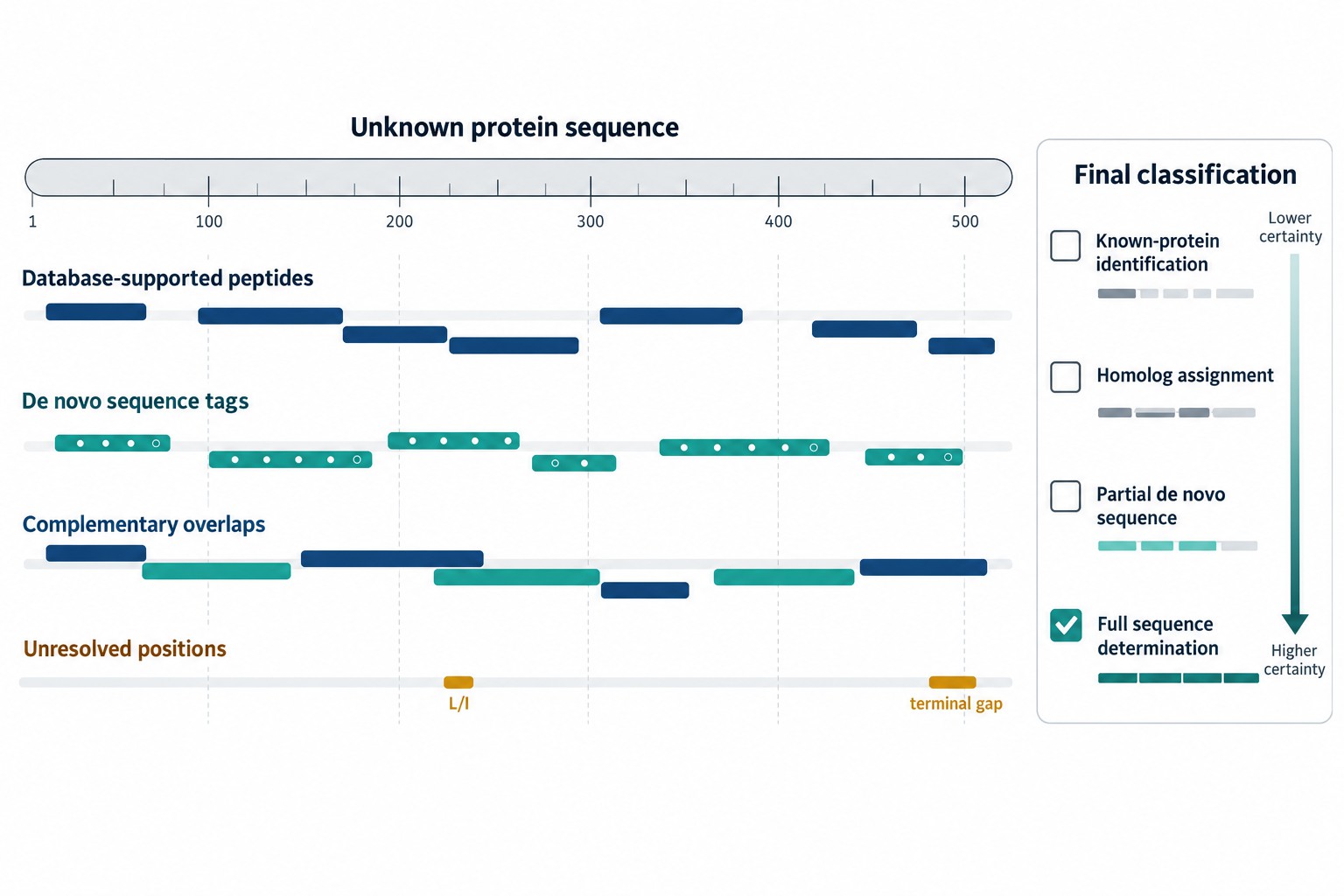 Figure 2. Example evidence hierarchy from database-supported peptides and de novo sequence tags to overlapping peptide assembly and explicitly unresolved positions.
Technical FAQ
Can LC-MS/MS identify an unknown protein from a gel band?
Yes, when the band contains sufficient protein and informative peptides can be matched to an appropriate database. Co-migrating proteins are common, so the result may contain several candidates. Sequence-unique peptides, apparent molecular mass, biological context, and controls are used to determine which assignment is relevant.
Does a failed database search mean the protein is novel?
No. A failed search can reflect incorrect taxonomy, insufficient abundance, contamination, poor digestion, weak fragmentation, unexpected modifications, sequence variation, or inappropriate parameters. These possibilities should be evaluated before biological novelty is inferred.
What is the difference between de novo peptide sequencing and de novo protein sequencing?
De novo peptide sequencing interprets an individual MS/MS spectrum to infer a peptide sequence or sequence tag. De novo protein sequencing requires many validated peptide sequences, complementary overlaps, assembly, gap closure, and appropriate terminal or orthogonal evidence.
Is database searching more accurate than de novo sequencing?
Database searching usually provides more constrained and statistically tractable peptide assignments when the correct sequence is represented. De novo sequencing is valuable when the reference is absent or unreliable, but its accuracy depends strongly on spectrum quality, fragmentation completeness, training domain, and residue ambiguity. The methods answer different reference conditions rather than forming a universal accuracy ranking.
How many unique peptides are required to identify a protein?
There is no universal number independent of database size, peptide specificity, spectrum quality, protein homology, and project risk. Multiple sequence-unique peptides are preferable. A single-peptide identification requires stringent spectrum review and should be reported with appropriate qualification.
Why are leucine and isoleucine difficult to distinguish by LC-MS/MS?
Leucine and isoleucine have identical residue masses. Routine collision-based spectra generally cannot distinguish them solely through standard backbone product ions. Specialized fragmentation, chemical strategies, genetic information, or homolog evidence may be required.
When should a homology-assisted workflow be used?
Homology searching is appropriate when an exact sequence is unavailable but related organisms or protein families are represented in databases. Multiple de novo sequence tags can tolerate limited substitutions and support a family-level hypothesis that is subsequently tested by targeted analysis.
Can bottom-up LC-MS/MS determine the N- and C-termini of an unknown protein?
It can identify terminal peptides when they are generated, recovered, and fragmented adequately, but standard digestion may leave one or both termini unobserved. Dedicated terminal analysis, alternative cleavage, intact mass, or other orthogonal strategies may be required for full-length reconstruction. Full-length protein sequencing should explicitly address these gap-closing requirements.
Creative Proteomics supports research-use unknown-protein identification and sequence analysis using reference-dependent, de novo, and hybrid LC-MS/MS strategies. Project design begins with the required conclusion, sample composition, available sequence information, and the level of residue-specific evidence needed for the next research decision.
References
- Nesvizhskii AI, Vitek O, Aebersold R. Analysis and Validation of Proteomic Data Generated by Tandem Mass Spectrometry. Nature Methods. 2007;4(10):787–797. doi:10.1038/nmeth1088.
- Ma B, Johnson R. De Novo Sequencing and Homology Searching. Molecular & Cellular Proteomics. 2012;11(2):O111.014902. doi:10.1074/mcp.O111.014902.
- Wang P, Wilson SR. Mass Spectrometry-Based Protein Identification by Integrating De Novo Sequencing with Database Searching. BMC Bioinformatics. 2013;14(Suppl 2):S24. doi:10.1186/1471-2105-14-S2-S24.
- Muth T, Renard BY. Flying Blind, or Just Flying Under the Radar? The Underappreciated Power of De Novo Methods of Mass Spectrometric Peptide Identification. Proteomics. 2020;20(9):e1900335. doi:10.1002/pmic.201900335.
- Waridel P, Frank A, Thomas H, et al. Sequence Similarity-Driven Proteomics in Organisms with Unknown Genomes by LC-MS/MS and Automated De Novo Sequencing. Proteomics. 2007;7(14):2318–2329. doi:10.1002/pmic.200700003.
- König S, Obermann WMJ, Eble JA. The Current State-of-the-Art Identification of Unknown Proteins Using Mass Spectrometry Exemplified on De Novo Sequencing of a Venom Protease from Bothrops moojeni. Molecules. 2022;27(15):4976. doi:10.3390/molecules27154976.
- Suckau D, Evers W, Belau E, et al. Use of PASEF for Accelerated Protein Sequence Confirmation and De Novo Sequencing with High Data Quality. In: Therapeutic Antibodies: Methods and Protocols. Methods in Molecular Biology. 2022;2313:207–217. doi:10.1007/978-1-0716-1450-1_12.
- Yilmaz M, Fondrie WE, Bittremieux W, et al. Sequence-to-Sequence Translation from Mass Spectra to Peptides with a Transformer Model. Nature Communications. 2024;15:6427. doi:10.1038/s41467-024-49731-x.
Author: CAIMEI LI, Senior Scientist
For research use only, not intended for any clinical use.


