Mass-spectrometric protein sequencing is not completed by collecting a set of identified peptides and placing them on a reference sequence. For a protein whose sequence is unknown or incompletely documented, peptide reads must be connected into an ordered assembly, disagreements must be resolved, and every claimed residue must be traceable to spectrum-level evidence. A multi-protease workflow supports this task by generating different peptide boundaries across the same protein, thereby creating overlaps that can join short peptide sequences into longer contigs.
The analytical value of multiple proteases is therefore different from simple redundancy. Repeated detection of the same tryptic peptide improves confidence in that peptide but does not extend the sequence. A complementary protease can move the same residue into another peptide, produce a longer sequence read, bridge a cleavage boundary, or separate two ambiguous positions. The most useful digest panel is the one that contributes independent, assembly-informative overlaps rather than the largest raw peptide count.
Sequence coverage, fragment coverage, overlap depth, contig length, and assembly completeness describe different properties. A protein can have nominally complete residue coverage but still contain unresolved order, isomeric residues, unsupported junctions, or incompatible peptide reads. A defensible LC-MS/MS assembly must distinguish directly sequenced residues from homology-guided placements and preserve gaps or conflicts that the data do not resolve.
Analytical Summary
- Multiple proteases create complementary peptide boundaries. Their principal sequencing value is generation of independent overlaps that connect peptide reads across cleavage sites and difficult regions.
- Sequence coverage is not sequence assembly. Coverage records whether residues are represented by accepted peptides; assembly requires their order, junctions, and conflicts to be supported.
- Separate digests are usually more interpretable than an uncontrolled enzyme mixture. Digest-specific cleavage rules, artifact tracking, and quantitative comparisons are preserved.
- Overlap quality matters more than overlap count. A useful overlap contains enough confidently sequenced residues or mass-constrained positions to establish orientation and placement uniquely.
- Conflicting reads require biological and analytical investigation. They can indicate sequencing error, modification misassignment, co-isolated precursors, sample heterogeneity, paralogs, sequence variants, or multiple proteoforms.
- Protein-level confidence cannot be summarized by one peptide score. Residue confidence, peptide confidence, overlap support, contig topology, and global mass consistency must be evaluated separately.
- Unresolved sequence should remain unresolved. L/I sites, unsupported junctions, terminal gaps, and incompatible alternatives should be carried into the final report rather than silently resolved by a reference sequence.
Coverage, Overlap, Contigs, and Assembly Completeness
Four related terms should be defined before interpreting a multi-digest result.
| Term |
Operational meaning |
Evidence required |
Common overstatement |
| Sequence coverage |
Fraction of protein residues represented by accepted peptides |
Peptides mapped to a supplied or assembled sequence |
Treating covered residues as independently sequenced |
| Fragment coverage |
Fraction of possible peptide backbone cleavages supported by assigned product ions |
Annotated MS/MS spectra |
Assuming one peptide score describes every residue equally |
| Overlap depth |
Number and independence of peptide reads spanning a residue or junction |
Different peptide boundaries, digests, charge states, or fragmentation modes |
Counting repeat spectra from the same precursor as independent assembly evidence |
| Contig |
Ordered sequence assembled from mutually compatible overlapping reads |
Unique overlap plus consistent orientation and mass |
Extending through an unsupported or isobaric junction |
| Assembly completeness |
Fraction of the target chain assigned with explicit residue-level evidence and resolved junctions |
Contigs, termini, gap analysis, conflict resolution, and global consistency |
Equating 100% mapped coverage with an unambiguous full-length sequence |
A peptide-spectrum match can identify one peptide. A peptide read can contribute a residue string or sequence tag with local confidence. A contig joins several reads. A protein assembly orders contigs, establishes termini where possible, and accounts for gaps. These evidence levels should not be collapsed into the single phrase "full sequence coverage."
Reference-based mapping versus reference-free assembly
In reference-based mapping, peptide sequences are placed onto a supplied FASTA entry or construct. The reference supplies order and intervening residues, even where direct peptide evidence is absent. This is appropriate for sequence confirmation but should not be presented as de novo reconstruction.
Reference-free assembly begins with peptide reads and their overlaps. Homologs may later orient contigs or suggest gap candidates, but residues copied from a homolog remain inferred until confirmed. Unknown protein sequence analysis should therefore state whether the outcome is an exact identification, homolog assignment, partial de novo assembly, or experimentally supported full sequence.
Why One Protease Commonly Leaves Assembly Gaps
Trypsin cleaves mainly after lysine and arginine. It is highly effective for routine proteomics because many tryptic peptides have favorable length and charge, but protein sequences are not distributed to guarantee ideal tryptic products. A region may yield a peptide that is too short, too long, excessively hydrophobic, heavily modified, disulfide-constrained, or poorly fragmented.
Cleavage at the end of every observed peptide also creates a structural limitation: two adjacent tryptic peptides do not overlap. Their order is supplied by the reference, not demonstrated by the digest. In de novo work, a second protease that cuts at different residues can generate a peptide spanning the tryptic boundary and establish the junction.
Complementary cleavage changes the evidence topology
Lys-C retains lysine-directed boundaries but may produce longer peptides than trypsin. Glu-C and Asp-N reposition acidic residues. Chymotrypsin targets aromatic and other hydrophobic residues with condition-dependent specificity. Elastase, pepsin, papain, Nepenthes digestive fluid, or broader-specificity proteases can produce dense overlapping ladders. Chemical cleavage can add another independent boundary system.
Protease choice should be based on predicted contribution to unresolved regions, not only convention. An in silico digest can estimate peptide length, uniqueness, hydrophobicity, charge, modification sites, and whether candidate peptides bridge existing contig ends. Experimental behavior will differ from prediction because cleavage efficiency and secondary specificity depend on sequence context and conditions.
Designing a Multi-Protease Digest Panel
Preserve digest identity
Parallel digestion in separate aliquots normally provides the clearest evidence. Each dataset retains a defined enzyme, cleavage rule, reaction condition, and artifact history. This helps distinguish a true semi-specific terminus from nonspecific proteolysis and allows the contribution of each protease to be measured.
Simultaneous or sequential enzyme mixtures can reduce sample consumption and generate additional products, but attribution becomes less certain. One enzyme may destroy peptides produced by another, and the final peptide population may be dominated by the broadest specificity. Gradient or timed digestions can intentionally create nested peptides, but collection time and enzyme conditions must become part of the analytical record.
Protease selection criteria
A rational panel considers:
- predicted cleavage distribution across the unknown or homolog-guided sequence;
- complementary rather than redundant specificity;
- peptide lengths compatible with LC-MS/MS and de novo interpretation;
- probability of spanning current contig ends or difficult domains;
- charge-state generation for HCD, ETD, EThcD, or other fragmentation modes;
- PTM stability and preservation of glycosylated, phosphorylated, or terminal regions;
- disulfide connectivity and whether reduced and non-reduced conditions are needed;
- sample amount, digestion efficiency, and cleanup losses; and
- computational support for nonspecific or enzyme-specific peptide assembly.
The optimal panel is protein-dependent. Three well-chosen digests may outperform six digests that repeatedly sample the same accessible regions. Conversely, antibody complementarity-determining regions or an undocumented natural protein may require broader sequence diversity.
Replication and controls
At least one independent preparation helps distinguish stable peptide evidence from stochastic MS/MS selection or digestion artifacts. A known protein control can verify protease activity and cleavage behavior. Blank and carryover controls are important because one contaminating peptide can create a false bridge in an assembly.
For de novo protein and peptide sequencing, sample purity has a direct effect on assembly complexity. Closely related proteins, polyclonal antibodies, isoforms, or proteoforms can yield individually correct peptides that do not belong to the same chain.
LC-MS/MS Acquisition for Assembly-Informative Reads
The longest peptide is not necessarily the most useful read. An assembly-informative spectrum balances sequence span with sufficient fragmentation, precursor purity, and mass accuracy.
Peptide length and charge state
Short peptides may map non-uniquely or provide too little overlap. Long peptides span more residues but distribute signal across many fragments and often contain internal gaps. Multiply charged precursors may benefit from ETD or EThcD, while HCD provides strong b/y evidence for many conventional peptides. Complementary fragmentation can resolve regions left incomplete by one ion series.
Acquisition should avoid repeatedly selecting the highest-abundance peptides at the expense of rare bridge peptides. Inclusion lists, exclusion lists, gas-phase fractionation, ion mobility, targeted reacquisition, or longer accumulation can prioritize contig ends and unresolved regions.
Precursor and spectrum quality
Before assembly, each read should be reviewed for correct monoisotopic mass, charge state, isotope pattern, isolation purity, and retention-time coherence. Chimeric spectra can combine fragments from two precursors and create an apparently valid hybrid sequence. Missing cleavage ions can reverse short residue blocks or make several sequences mass-equivalent.
Residue-level confidence is more useful than one peptide-level score. A high-scoring read may contain a low-confidence central segment. Assembly algorithms should not use that segment as a decisive bridge without corroboration.
Fragmentation complementarity
CID and HCD often emphasize b/y ions; ETD and ECD generate c/z ions and can retain labile PTMs. Paired or triplet spectra can distinguish true sequence ladders from noise. A study combining CID/HCD/ETD spectra from overlapping peptides reported consensus reads averaging approximately 70 residues and extending to 200 residues in its tested systems, illustrating the value of complementary ion chemistry without establishing a universal performance expectation.
 Figure 1. Complementary protease digests create overlapping peptide reads that bridge enzyme-specific boundaries and assemble into evidence-graded sequence contigs.
From Peptide Reads to Sequence Contigs
Normalize peptide evidence before assembly
Peptide reads from all digests should use a common residue notation, modification representation, mass convention, and confidence scale. Leucine/isoleucine ambiguity must remain explicit. Fixed and variable modifications should not be converted into sequence letters. N- and C-terminal mass gaps require separate representation from internal residues.
Reads that differ only in oxidation, deamidation, alkylation, missed cleavage, charge, or fragmentation mode may represent the same underlying sequence. They can corroborate one peptide but should not be counted as separate sequence variants.
Establish orientation and unique placement
An overlap must be long or distinctive enough to place reads uniquely. A short motif such as GG, AS, or a repeated framework sequence may occur in several locations. Exact prefix and suffix masses, protease termini, complementary fragment ions, and homolog context can help orient the read, but any dependency on a reference should be disclosed.
Assembly can be represented as a graph: peptide reads are nodes, compatible overlaps are edges, and alternative paths represent unresolved sequence hypotheses. A single linear output hides conflicts; preserving the graph or candidate alternatives makes uncertainty auditable.
Build contigs before a full-chain sequence
High-confidence reads form local contigs first. Contigs should be extended only when the overlap is compatible in sequence, precursor mass, modification state, and sample context. Terminal peptides, intact mass, disulfide evidence, and top-down fragments can then order or join contigs that lack direct bottom-up overlap.
In protein full-length sequencing, a continuous displayed sequence should differentiate four residue states: directly supported, overlap-supported, reference-inferred, and unresolved. A visually complete string is not sufficient documentation.
Conflict Detection and Resolution
Conflicts are informative. They can reveal a genuine mixture that a single consensus sequence would obscure.
Spectrum interpretation error
Missing fragments, noise peaks, incorrect charge assignment, and b/y-series switching can produce wrong residue order. Reinspect the raw spectrum, compare alternative sequences, acquire complementary fragmentation, and seek a peptide with different boundaries. A second software prediction is not independent evidence if it interprets the same incomplete spectrum.
Isobaric and near-isobaric alternatives
Leu and Ile have identical residue mass. Other ambiguities include an Asn residue versus a Gly-Gly combination, Gln versus Ala-Gly or Gly-Ala, and near-isobaric Lys/Gln when mass accuracy or calibration is insufficient. Modification and substitution mass shifts may also coincide. Overlapping reads help only if they contain diagnostic fragments that cross the ambiguous position.
PTM and sample-preparation artifacts
Oxidation, deamidation, carbamylation, alkylation, disulfide scrambling, and nonspecific cleavage can produce peptide forms that appear to disagree. Track modification state separately from base sequence and compare independent preparations. A peptide that emerges only after prolonged digestion or high-pH handling may reflect preparation chemistry.
Biological heterogeneity
Two high-quality reads with incompatible residues may represent allelic variants, somatic mutations, isoforms, mixed clones, proteoforms, homologous contaminants, or polyclonal chains. The correct outcome may be two assemblies rather than one corrected consensus. Relative chromatographic abundance and co-fractionation can support but not always prove chain membership.
Protease-specific bias
A sequence change can create or remove a cleavage site, making one form more readily detected in one digest. Digestion efficiency and missed-cleavage behavior should be considered before comparing peptide counts as abundance. A conflicting residue observed only in a cleavage-dependent peptide warrants an alternative protease or targeted intact/subunit measurement.
Gap Closure Strategies
An unresolved region should first be classified by cause: no peptide generated, peptide generated but not retained, precursor detected but not selected, spectrum acquired but uninterpretable, or sequence intrinsically ambiguous.
| Gap mechanism |
Diagnostic observation |
Targeted response |
| Unfavorable cleavage |
Predicted peptide too short/long or cleavage boundary at contig end |
Add a protease with a different specificity or controlled limited digestion |
| Hydrophobic sequence |
Poor recovery or late broad LC feature |
Alternative chromatography, organic-compatible preparation, or top-/middle-down evidence |
| PTM-rich/glycosylated region |
Heterogeneous masses and weak unmodified peptide |
Enrichment, deglycosylation with mass-tag awareness, ETD/EThcD, or glycopeptide analysis |
| Disulfide-constrained region |
Weak backbone release under non-reduced conditions |
Paired reduced/non-reduced mapping and disulfide-directed fragmentation |
| Low-abundance bridge peptide |
MS1 feature present but inconsistent MS/MS selection |
Targeted PRM/inclusion list, narrower isolation, or fractionation |
| Ambiguous residue block |
Several sequences share precursor and partial fragment masses |
Complementary fragmentation, synthetic comparator, Edman, genetic evidence, or explicit ambiguity |
| Terminal gap |
No peptide uniquely defines mature N- or C-terminus |
Terminal enrichment, specific derivatization, Edman, carboxypeptidase, or top-down MS |
Adding more data is useful only when it changes the missing evidence. Repeating the same digest and acquisition settings may improve sampling but cannot resolve a systematic absence of informative peptide boundaries.
Assembly Confidence and Evidence Grading
Confidence should be assigned at several levels.
| Evidence level |
Minimum basis |
Appropriate conclusion |
| Residue-supported |
Product ions bracket the residue in one high-quality peptide |
Residue is supported within that peptide context |
| Independently overlapped |
A second peptide with a different boundary crosses the residue or junction |
Local sequence and order have independent support |
| Contig-supported |
Multiple mutually compatible overlaps create one unique path |
Continuous local sequence contig is supported |
| Globally constrained |
Contig order agrees with intact/subunit mass, termini, and orthogonal data |
Protein assembly is consistent with all measured evidence |
| Reference-guided |
Placement or residues depend on a homolog, germline, or supplied construct |
Sequence is inferred at specified positions |
| Unresolved |
Competing paths, gaps, or isomeric positions remain |
Alternatives or ambiguity must be reported |
Overlap depth should distinguish technical repeats from independent boundaries. Three spectra of one peptide do not equal three protease-spanning reads. Likewise, a peptide found by two search engines is one experimental observation.
Data-Backed Literature Examples
Spectrum assembly from overlapping peptides
Shotgun protein sequencing studies assembled MS/MS spectra from peptides created by multiple proteases. Subsequent work combining CID, HCD, and ETD triplets reported long consensus sequences and showed that overlaps can suppress noise and extend beyond individual peptide reads. The reported accuracies and read lengths depended on purified test systems, spectrum quality, and the assembly algorithm.
Three-digest PASEF sequence analysis
One PASEF workflow analyzed separate trypsin, chymotrypsin, and elastase digests of nivolumab and dulaglutide. Individual sequence coverages were approximately 90–100% in the reported examples, and the merged nivolumab map contained about 550 peptides. The study demonstrates how a compact complementary panel can generate extensive evidence, while the large peptide count should still be interpreted through overlap and fragment support rather than as 550 independent full-sequence confirmations.
Antibody light-chain sequencing with bottom-up and top-down evidence
A workflow for patient-derived antibody light chains combined trypsin and Nepenthes digestive fluid to produce overlapping peptides assembled with ALPS. Top-down mass spectrometry was required to obtain the reported final coverage and characterize samples containing several light-chain proteoforms. This illustrates the role of intact data in constraining assemblies that bottom-up overlaps alone cannot uniquely resolve.
Direct protein sequencing with broader protease panels
The 2026 InstaNexus study evaluated a multi-protease workflow in which different enzymes contributed distinct reads and overlaps to sequence scaffolds. A separate archaeal-protease study showed that a broad-specificity single enzyme could generate dense overlapping reads in its test system. Together, these studies indicate that assembly performance depends on peptide diversity and evidence topology rather than the number of enzyme labels alone.
Decision-Ready Reporting
A sequence-assembly report should include:
- sample identity, purity assessment, chain composition, and evidence of heterogeneity;
- protease, lot, enzyme-to-substrate ratio, buffer, pH, temperature, time, reduction/alkylation, and cleanup for each digest;
- LC-MS/MS acquisition mode, isolation window, fragmentation settings, replicate structure, and targeted reacquisitions;
- peptide-read table with sequence, modifications, protease, boundaries, precursor, charge, mass error, score, local confidence, and spectrum link;
- residue-level map distinguishing direct support, independent overlap, single-read coverage, inference, and gaps;
- contig list with the reads and unique overlap supporting every junction;
- conflict table showing competing sequences, likely causes, follow-up evidence, and final status;
- L/I and other isobaric positions retained explicitly unless resolved by diagnostic evidence;
- N- and C-terminal evidence and any mature-chain versus precursor numbering;
- intact/subunit/top-down mass consistency and unexplained mass differences;
- reference or homolog use identified separately from reference-free evidence; and
- final classification as peptide set, partial contigs, reference-guided assembly, near-complete assembly with stated gaps, or fully supported sequence.
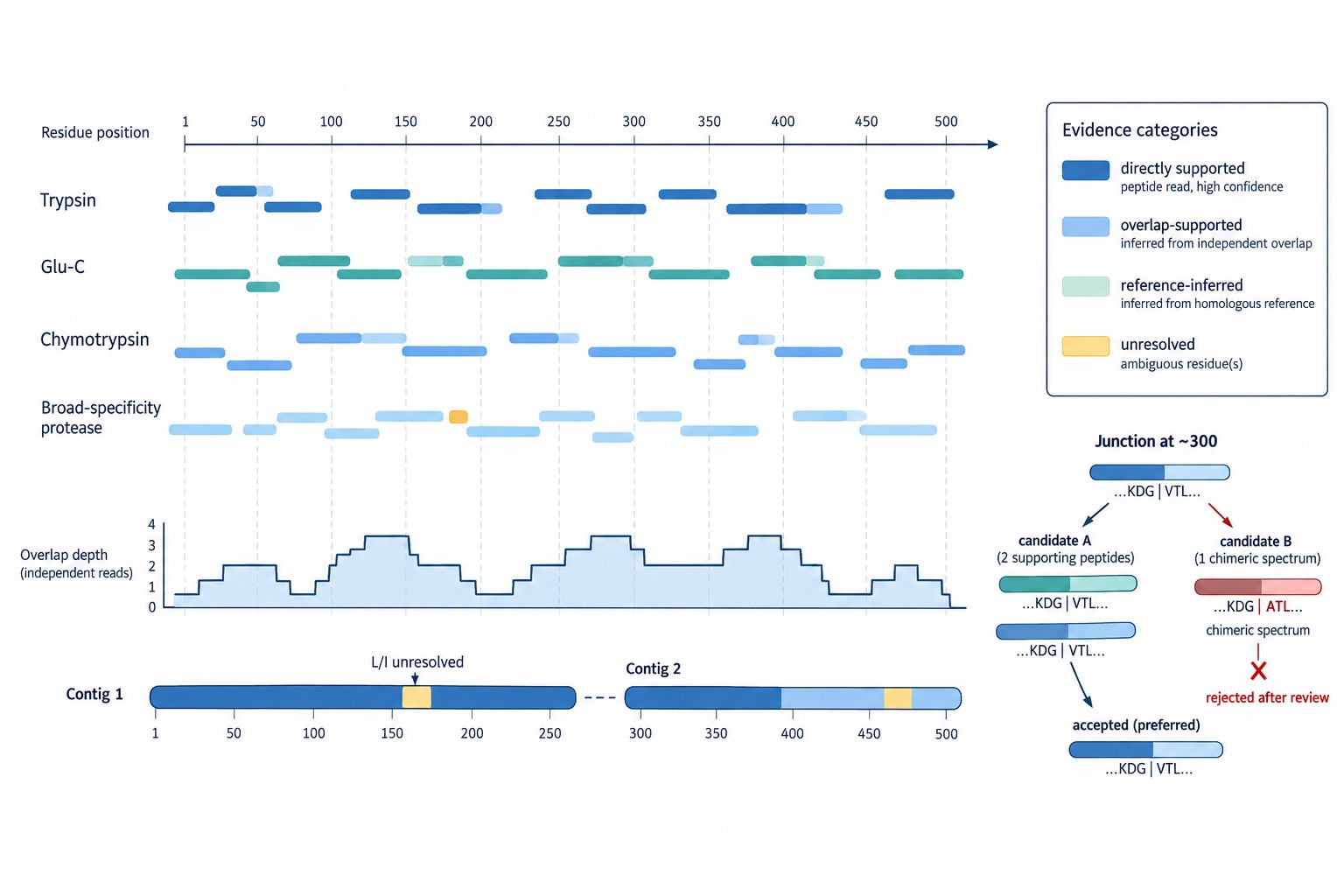 Figure 2. A decision-ready assembly report displays digest-specific reads, overlap depth, contig junctions, competing paths, terminal evidence, and unresolved positions.
Technical FAQ
Why are multiple proteases used for de novo protein sequencing?
Different proteases create different peptide boundaries. This produces overlaps that bridge cleavage sites, moves difficult residues into alternative sequence contexts, and increases the chance that each region yields an interpretable peptide.
Do multiple proteases need to be mixed in one tube?
No. Separate parallel digests are often preferable because cleavage specificity and artifacts remain traceable. Simultaneous or sequential digestion can be useful when intentionally optimized, but the resulting peptide origins are less straightforward.
How many proteases are required for a complete sequence?
There is no universal number. The requirement depends on protein sequence, size, modifications, sample purity, protease behavior, fragmentation, and the needed confidence. The goal is sufficient independent overlap and gap closure, not a fixed enzyme count.
Is 100% sequence coverage equivalent to a complete de novo assembly?
No. Coverage can be calculated by mapping peptides to a reference and may not prove peptide order, junctions, termini, L/I identity, or that all reads belong to one molecular form. Assembly completeness requires explicit evidence across these relationships.
What is a useful peptide overlap?
A useful overlap is long or distinctive enough to establish unique placement and orientation and contains sufficiently confident residues. Short common motifs or low-confidence mass blocks should not be used as the sole bridge between contigs.
How are conflicting peptide sequences resolved?
Review raw spectra and precursor purity, acquire different fragmentation, generate a peptide with new boundaries, test PTM and artifact explanations, and investigate sample heterogeneity. When alternatives remain supported, report separate assemblies or an unresolved branch.
Can a homologous protein sequence be used during assembly?
Yes, as a scaffold or hypothesis, particularly for poorly covered regions. However, residues placed only from the homolog must be labeled as inferred. Exact agreement with a homolog is not direct evidence that the analyzed protein contains every residue.
How are L/I positions handled?
Routine precursor mass and b/y fragments do not distinguish leucine from isoleucine. The assembly should retain L/I or Xle unless specialized side-chain fragmentation, Edman sequencing, genetic evidence, or another valid orthogonal method resolves the site.
When should top-down data be added?
Top-down or intact/subunit data are useful when bottom-up contigs cannot be ordered uniquely, when several proteoforms are present, when terminal processing matters, or when the assembled sequence must agree with the measured molecular mass.
References
- Bandeira N, Clauser KR, Pevzner PA. Shotgun Protein Sequencing: Assembly of Peptide Tandem Mass Spectra from Mixtures of Modified Proteins. Mol Cell Proteomics. 2007;6(7):1123-1134. doi:10.1074/mcp.M700001-MCP200.
- Guthals A, Clauser KR, Frank AM, Bandeira N. Sequencing-Grade De Novo Analysis of MS/MS Triplets from Overlapping Peptides. J Proteome Res. 2013;12(6):2846-2857. doi:10.1021/pr400222d.
- Liu X, Han Y, Yuen D, Ma B. Automated Protein (Re)Sequencing with MS/MS and a Homologous Database Yields Almost Full Coverage and Accuracy. Bioinformatics. 2009;25(17):2174-2180. doi:10.1093/bioinformatics/btp366.
- Liu X, Dekker LJM, Wu S, et al. De Novo Protein Sequencing by Combining Top-Down and Bottom-Up Tandem Mass Spectra. J Proteome Res. 2014;13(7):3241-3248. doi:10.1021/pr401300m.
- Suckau D, Resemann A, Schuerenberg M. Use of PASEF for Accelerated Protein Sequence Confirmation and De Novo Sequencing with High Data Quality. Methods Mol Biol. 2022;2313:207-217. doi:10.1007/978-1-0716-1450-1_12.
- Tran NH, Rahman MZ, He L, et al. Complete De Novo Assembly of Monoclonal Antibody Sequences. Sci Rep. 2016;6:31730. doi:10.1038/srep31730.
- Dupré M, Duchateau M, Sternke-Hoffmann R, et al. De Novo Sequencing of Antibody Light Chain Proteoforms from Patients with Multiple Myeloma. Anal Chem. 2021;93(31):10627-10634. doi:10.1021/acs.analchem.1c01250.
- Yang Y, Liu X, Shen C, et al. Mass Spectrometry-Based De Novo Sequencing of Monoclonal Antibodies Using Multiple Proteases and a Dual Fragmentation Scheme. J Proteome Res. 2021;20(7):3555-3567. doi:10.1021/acs.jproteome.1c00181.
- Le Bihan T, Nunez de Villavicencio Diaz T, Reitzel C, et al. De Novo Protein Sequencing of Antibodies for Identification of Neutralizing Antibodies in Human Plasma Post SARS-CoV-2 Vaccination. Nat Commun. 2024;15:8790. doi:10.1038/s41467-024-53105-8.
- Muth T, Hartkopf F, Vaudel M, Renard BY. Flying Blind, or Just Flying under the Radar? The Underappreciated Power of De Novo Methods of Mass Spectrometric Peptide Identification. Proteomics. 2018;18(18):e1700150. doi:10.1002/pmic.201700150.
- Reverenna M, Nielsen MW, Wolff DS, et al. Generalizable Direct Protein Sequencing with InstaNexus. Mol Cell Proteomics. 2026;25(4):101547. doi:10.1016/j.mcpro.2026.101547.
- Pérez Pañeda L, Kadavá T, Shamorkina TM, et al. Deep Coverage and Extended Sequence Reads Obtained with a Single Archaeal Protease Expedite De Novo Protein Sequencing by Mass Spectrometry. Cell Syst. 2026;17(4):101536. doi:10.1016/j.cels.2026.101536.
For research use only, not intended for any clinical use.


